Silvio Rodríguez: ‘The world is run by an authoritarian, warmongering and thieving regime — and it's not Cuba’
Published in Spanish at Segunda Cita. Translation by LINKS International Journal of Socialist Renewal.
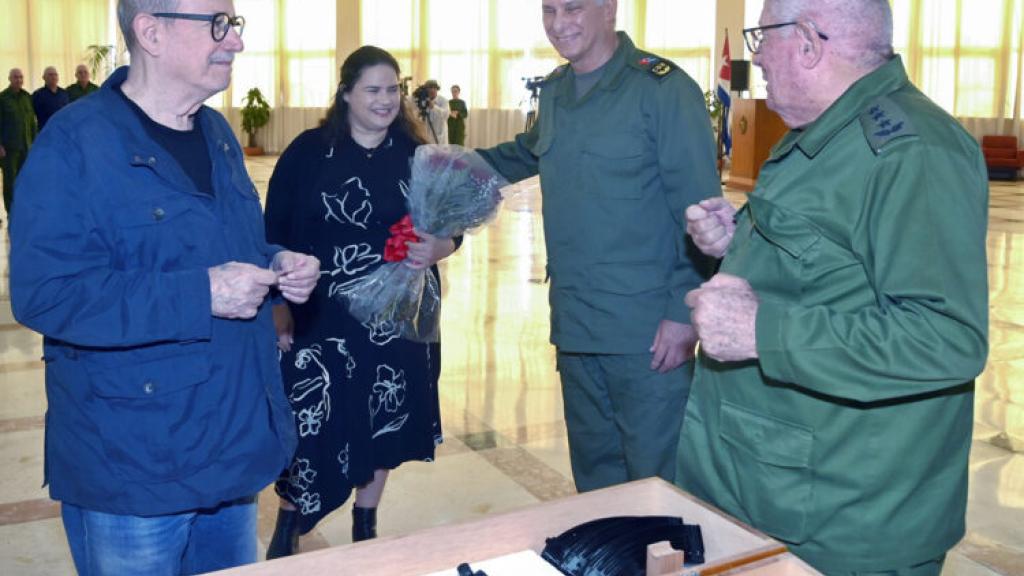
The Cuban singer-songwriter welcomed El País (Spain) to his studio in Havana, days after receiving a replica of the Kalashnikov rifle he had requested to fend off a potential United States attack.
Seeing an image of a singer-songwriter with a rifle in their hands is strange, but not when the person wielding it is Silvio Rodríguez.
The Cuban singer-songwriter has spent his entire life singing, directly or indirectly, about the Cuban revolution, its leaders and ideals, and the martyrs and guerrillas. “My songs have politics, but not propaganda,” says the musician, who welcomed El País at his Ojalá studios in Havana.
Rodríguez discussed the government's “orthodox and closed-minded” economic vision and his commitment to a less “rigid” socialism. “Textbook socialism is very idealistic,” he concludes.
His opinion of the US government has not shifted one iota: “The world is run by an authoritarian, warmongering and thieving regime — and it's not Cuba.”
Adored by the international left and reviled by the Cuban opposition — who refer to him as the “regime’s troubadour” — Rodríguez speaks against a backdrop of guitars and a painting by Cuban prisoners for whom he sang two decades ago, just a week after asking the Armed Forces for an AKM Kalashnikov rifle in case US president Donald Trump invades the island. “But it is a replica, a very well-made imitation,” he points out.
His intention to use a real one remains unchanged. “I am not going to tell you what I think of those who want their own country to be bombed and invaded,” he says, alluding to the Cuban-Americans who support Trump’s foreign policy. “I do not wish the opposition ill, but I do not want them to win either. Not for my sake, but for what it would mean for this country.”
In Rodríguez's legendary studio, which has hosted Chucho Valdés, Omara Portuondo and Pablo Milanés, among others, one of his soon-to-be-released songs plays. It is one of dozens spread across more than 20 albums that have been sold around the world, establishing him among Latin America’s most prestigious voices. “Fake Cuban and genuine Cuban; rebellious Cuban and official Cuban,” the lyrics go.
He smiles, imagining a Cuba where dissenting voices also have a place. “The positive thing is that people have the opportunity to express what they think and that truths emerge from discussion and dialogue,” he says.
Despite his country’s critical situation, the author of anthems such as “Ojalá,” “La Maza,” and “Unicornio” insists he has not succumbed to despair. “I refuse to believe that the future will be one devoid of human compassion. If that were the case, life would have been a failure. I do not believe that is the case.”
Why did you ask to be issued with an AKM rifle?
It is a replica, a very well-made imitation. But they gave me a document so that, in the event of an armed attack on our country, I can go to a military unit and request a real weapon.
To some extent, I come from the Armed Forces; I started playing guitar in the military. When someone from there [US Secretary of State Marco Rubio] said that the talks between the Cuban and US governments were not enough, and immediately afterward, their president said he was going to “take over the country,” it seemed to me that something was imminent. They had already done what they did in Venezuela and are still bogged down with Iran.
So I said, “They are coming here,” and wrote a short post on my blog. I did not think it would have that much impact, to be honest. But it did. And they gave me the replica.
Do you see a scenario in which Trump takes over Cuba as likely?
I see it as possible. Hopefully it is not imminent and I wish it was impossible, but it is possible. Especially given the long history of US interventions, sabotage, invasions…
Are there more Cubans willing to arm themselves if Trump invades the island?
I cannot guarantee it. There is a very long history of interventions and attempts to take over Cuba. The Cubans who know that history, who have lived through some of what I have lived through, I am sure would be willing to defend our country with weapons. But not everyone.
There are other Cubans who are crossing their fingers for an intervention to happen.
Yes. Today I read there was a demonstration in Miami by Cubans calling for the government to be overthrown by force — in other words, practically calling for an invasion. I am not going to tell you what I think of those who want their own country to be bombed and invaded.
What do you think?
Just imagine…
The Mexican government has supported Cuba, but other countries in the region have not. Costa Rica and Ecuador have withdrawn their embassies from Cuba, and Jamaica and Honduras have closed their doors to Cuba’s medical brigade. Is Latin America turning a blind eye?
When it comes to those dominated by right-wing governments, then obviously yes. But that has always been the case. Now, given the current climate of overt aggression in the world, many countries think it is better to avoid provocation. It is disappointing that we have fought so hard for Latin American unity and that suddenly there are countries selling out.
In an interview with Rolling Stone you said you had never been disillusioned with the government or the revolution. Do you still maintain that position?
Disillusioned? No, but I have my own views. The problem is that governments are made up of people, and each person, within their own sphere, does what they think is best or what they believe benefits them personally. Opportunism and extremism exist in all ideologies. I do believe that there are economic issues which, for the last 30 years, we should have approached differently.
In what sense?
The economic model dictated by “textbook socialism" is very idealistic. Practice has shown that people produce better and more when they directly benefit from what they do. And having so many bureaucratic obstacles is not helpful.
Do you see the government's recent economic measures as beneficial then?
Yes. A little late, because there are economists who have been at odds with the government for many years for that very reason.
Some of these measures are aimed at the diaspora, especially in Florida, where the main opponents of the government live.
That bothers me a little, because it may seem as though these measures are the result of talks with the US, but they have been discussed in Cuba for a long time.
But the announcement came days after acknowledging that negotiations were underway...
But, as I said, these issues have been raised in Cuba for many years. I have published countless articles on my blog by people criticising the orthodox and closed-minded approach to economic issues.
You were particularly critical of the government for the crackdown during the July 11, 2021, protests, when between 1000–1500 protesters were imprisoned.
I have always said so. Security forces should guarantee the safety of protesters.
Do you feel the same way about the current protests and pot-banging demonstrations against the government?
Yes. This is normal, people are having a very hard time. There is rampant inflation; older people like me, with a lifetime of savings, sometimes cannot even buy a carton of eggs. That is very serious. The situation in hospitals is dire. Schools are closing, universities are sending their scholarship recipients to the provinces… All because of the tightening of the blockade.
Leaving aside the blockade, what is the government’s share of the blame in all this?
We would have more food if these economic measures [to open up the economy] had been taken decades ago. People in the countryside would be more resilient and have more resources to withstand the crisis.
The opposition labelled the Nuestra América convoy as “ideological tourism.” What do you think?
It is logical that those who want to destroy Cuba would denigrate such acts of solidarity. It is part of the smear campaign we have been subjected to for many years. They talk about a regime and other similar words they like to use, but we all have regimes. Right now, the world is run by an authoritarian, warmongering, thieving, murderous regime — and it is not Cuba.
You talk about a media strategy, but there are dozens of journalists in exile who cannot return to the island.
It is sad that the deepest truth is drowned out by so much slander. Cuba is also at a disadvantage in the face of that [media strategy]. Many act in the interests of those who lack humanity.
Cuba has simply sought to be a country where everyone has rights, can go to university, and receive any kind of medical treatment. We enjoyed a period of prosperity for many years, but because we were Communist, that label stuck with us. They call you a Communist and say “aahhh.”
Has Cuba made mistakes? We would have to see what we would have been like without the blockade. That's another utopian ideal. They did not allow us to find out.
You were 12 years old when the revolution triumphed. You witnessed a functioning system and how it collapsed…
It was sad and alarming. Undoubtedly, this reluctance and suspicion to opening up has always existed and has continued with this government, which defined itself as “continuity.”
You do not believe that to be the case?
I have no way of judging what happens up there because I do not know what goes on there, but I do know that within the superstructure there are different ways of seeing things. There has always been a very quiet, unspoken conflict, one that never becomes public, between those who are more orthodox, more closed-minded, and others who are more open, with a more realistic approach.
Who is going to win this arm wrestling match?
This has been going on for many years, but I like to see ideas being exchanged. The positive thing is that people have the opportunity to express what they think and that truths emerge from discussion and dialogue.
Are you afraid of a complete opening up?
The only thing missing is for them [the US] to add us as another star on their flag. I do not want that to happen with Cuba, not at all. The US is a complex country, but one that must be taken into account because of its power and its “capacity for persuasion.”
You are a figure who evokes feelings of love and hate. To some you are a symbol of the left, to others the “regime’s troubadour”...
They hate me [laughs]. There is a song that goes: “They say they will drag me over rocks when the revolution falls, that they will crush my hands…” That was because they once smashed my guitar, and I heard that is what they would like to do to us the day the revolution falls.
I have never hated anyone enough to wish something so terrible on them. I do not wish the opposition ill , but I do not want them to win either. Not for my sake, but for what it would mean for this country.
What do you think of artists who seek to separate their work from politics?
That has always existed. Cuba is a controversial topic even within the left; there are people who behave as if they are leftists but keep their positions on Cuba to themselves.
Are you a radical?
In some respects. I am aware of what is going on. I have many political songs, but I do not set out to campaign with them. No, no. I was never interested in being a politician; I prefer beauty.
There are things that bring beauty and politics together. A few days ago, you admitted that you liked Bad Bunny’s song “Lo Que Le Pasó a Hawaii”...
Yes, because what he did at the Super Bowl was very brave. I think he is a brave guy for using his platform to promote that idea.
Do you think Cuban youth have stopped being left wing?
Young people born in an impoverished country such as ours may not find reasons to believe in their country. We have to understand that; circumstances have led them to think that way.
But I refuse to believe that the future will be one devoid of human compassion. If that were the case, life would have been a failure. I do not believe that is the case.