Anticolonial fraud: The Kremlin in Africa
First published at Rosa-Luxemburg-Stiftung.
Among the many concepts coined by the Cold War, campism remains strikingly relevant in today’s increasingly polarized world. It frames global politics as a division between two camps: the imperialist West, seen as the primary source of global exploitation and instability, and its supposed anti-imperialist opponents. The term describes a tendency to support any force opposing Western imperialism and its allies — regardless of how reactionary, exploitative, or even imperialist those forces may be.
In the case of Russia, the resurgence of this mindset became especially visible after the full-scale invasion of Ukraine in 2022. As Moscow launched its assault on an independent country and proceeded to systematically commit colonial crimes both on the front lines and in occupied territories, some observers have chosen to overlook these atrocities, arguing instead that NATO’s expansion left the Kremlin with no alternative.
Amid the Kremlin’s growing suppression of indigenous peoples’ rights within Russia and the intensifying persecution of opposition voices — including those on the left — campist logic separates geopolitics from internal social relations. In contemporary Russia, however, this divide is even more pronounced. Despite its claims to speak on behalf of the Global South, Moscow extends its imperial ambitions far beyond its borders, reaching not only into neighbouring independent states such as Ukraine and Georgia but further afield.
In its quest for an anti-imperialist image, Russia increasingly targets African countries, which continue to be shaped by competition among global and regional powers. An alliance with an anti-Western Moscow is often framed as a path toward resisting the expansionist ambitions of former colonial powers, as well as securing stability and economic growth. Yet the reality of Russian involvement in Africa indicates something else: anticolonial rhetoric alone is insufficient to justify campism — or to deliver genuine liberation.
Cold War histories
During the Cold War, the Soviet Union, driven by its rivalry with the capitalist bloc, played a notable role in decolonization movements across many African countries. It provided key resources for liberation struggles: weapons, economic support, and ideology. At the same time, tens of thousands of students from across Africa received education in the USSR and other Eastern Bloc countries, further strengthening the appeal and influence of the Soviet project.
After the collapse of the USSR, Moscow’s presence in Africa declined sharply as the new Russian state faced internal crises. From the mid-2000s into the 2010s, the Kremlin gradually began to rebuild ties with previous partners on the continent. Its return to Africa, however, became a prominent part of public discourse in 2019, when Russia hosted its first Russia–Africa Forum in Sochi. There, President Vladimir Putin declared the opening of a “new page” in Russian–African relations. Western media captured the moment with headlines such as “Putin just took a victory lap in the Middle East. Now he’s turning to Africa” and “The Russia-Africa summit, Moscow’s show of ambition in the region”. Amid growing isolation in the Global North and a desire to be perceived as a real superpower, the Kremlin began actively promoting its influence in the Global South, particularly in Africa.
Conventional hard-power tools
Since 2019, the scope of Russia's cooperation with African countries has noticeably expanded: Moscow has deepened its relations with historical partners and expanded its network among the new regimes facing regional and international isolation, as well as non-aligned regimes seeking to diversify their partnerships.
Economically speaking, Moscow’s presence in Africa remains limited — Russia simply does not have the capital to compete with other regional actors. While Russian media praised the historical maximum of the total trade value between Moscow and African countries which constituted almost $28 billion in 2025, for China and the EU this index exceeds $300 billion, while that of the U.S., UAE and India were over $100 billion each. But Russia has managed to carve out an economic niche for itself by exporting nuclear energy projects. As the demand for energy is growing along with the region’s population, Moscow is offering its own expertise, education for future personnel, and the nuclear fuel to run these long-term projects.
Another dimension of Russia’s strategic economic influence in the region concerns food security. In 2025, Agroexport, the Russian agency for agricultural exports, claimed that Moscow had become Africa’s largest grain supplier, accounting for a third of the continent’s wheat market. In total, Russia exports grain to around 40 African countries, with demand from Algeria, Libya, Kenya, Morocco, Tunisia, and Tanzania increasing significantly in recent years. Against the backdrop of disrupted supply chains and rising prices — driven in part by Russia’s war in Ukraine, as well as climate shocks and the lingering effects of the pandemic — some African governments have accused the Kremlin of exploiting this dependency for political leverage.
However, the backbone of Russia’s presence in the region is arms exports. In January Rosoboronexport — Russia’s agency for military sales — claimed that its exports to African countries reached the scale of the Cold War times, when the Soviet Union was responsible for 40% of supplies to the continent. One cannot be certain if this reflects the reality or rather wishful thinking by the Kremlin, given the limitations in Russia’s military exports capacities amid its war in Ukraine. Nevertheless, Moscow remains the critical actor on the continent’s arms market. According to SIPRI, in 2020–2024, Russia accounted for 21% of African imports of major arms, putting it ahead of China (18%) and the U.S. (16%).
‘Military presence with a human face’
In addition to conventional arms exports, for years, Russia has supplied its African partners with the services of the private military company (PMC) Wagner. The so-called ‘Wagner Group’ has now been formally absorbed by the Russian Defense Ministry and rebranded as Africa Corps (perhaps a reference to the German “Afrikakorps” in World War 2), following the PMC’s founder’s, Evgeny Prigozhin, death in 2023.
A package deal from the Russian “military instructors” — the vague mercenary job description — includes not only the security services, but also political consulting on topics such as disinformation campaigns and staged protests, as well as the management of lucrative and extractivist contracts in an array of industries from gold and other minerals to lumber.
Case in point is the Central African Republic (CAR): its president Faustin-Archange Touadéra was the first African leader to openly welcome the Russian PMC as far back as 2018. Formally, the CAR leader invited “Russian instructors” to support the national army in its fight against local rebels. In reality, they became the guarantor of Touadéra’s own hold on power. For instance, they supported the 2023 constitutional referendum, the results of which allowed the president to remain in office without term limitations. Currently the “political advisors” in CAR are promoting a foreign agent law — the Kremlin’s signature repressive mechanism it has employed against its own opponents for 15 years and has exported to the friendly authoritarian regimes in decline. The Russian-backed organizations also conduct aggressive social media campaigns in the CAR, intimidating critics of the regime, with AFP sources suggesting the Russian forces even track the president’s opponents with drones.
In reports from other countries that have experienced Russian military instructors’ presence, civilians have accused them of killings, torture and sexualized violence. Former Wagner Telegram channels are full of evidence of routine executions and desecration of corpses, especially in Mali. This is what Russian propaganda calls “military presence with a human face”.
On top of that, recent reports indicate that young African men who travel to Russia for education or what they believe to be well-paid civilian jobs are instead sent to the front lines in Ukraine. Moscow views them as a source of cheap labour, essential for sustaining its war effort. Often forced to sign contracts in a language they do not understand, thousands of men from at least 36 African countries are used as cannon fodder at the frontline. INPACT investigation identified over 1,400 Africans recruited by Russia, however, additional reports suggest higher numbers. Within months of arrival, over 300 are said to have been killed. Those who survive frequently receive no financial compensation, face racism from their commanders, and struggle to leave. With limited international scrutiny, the Kremlin has effectively built a transnational human trafficking network, a system of exploitation, capitalizing on the economic vulnerabilities of the very people it claims to support in their anti-colonial struggle.
Anticolonialism-washing
Such hybrid operations appear to be the perfect fit for the struggling autocracies among Moscow’s historical partners as well as the young regimes that find themselves limited in their choice of partners. For instance, the Sahelian juntas — the regimes in Mali, Burkina Faso and Niger — heavily rely on anticolonial sentiments. Needless to say, those sentiments originate from the real grievances of the people against the centuries-long exploitation, with France still conducting years-long military operations in the region until recently. The young regimes appeal to this inequality and unfairness, refuse cooperation with the former metropoles. They commonly end up turning towards Russia.
The Kremlin first takes the opportunity to promote a fitting image. According to the Kremlin-disseminated conspiracy theories, the U.S. runs biological laboratories across the continent and Western companies produce deadly vaccines. The Kremlin appeals to the Global South by promoting BRICS as a project battling the American hegemony. Putin openly condemns the “shameful” history of western colonialism and consistently calls for creation of the Palestinian state.
Various propaganda outlets assist the Kremlin in spreading these narratives: Sputnik Africa, RT, TASS, as well as the recently established news agency African Initiative. Its content is translated into all the major languages spoken on the continent. The staff includes members from the former Wagner PMC network. African Initiative is headed by Artem Kureev. Reports suggest he is an operative of the Fifth Directorate dealing with the foreign affairs of the Russian internal intelligence agency (FSB).
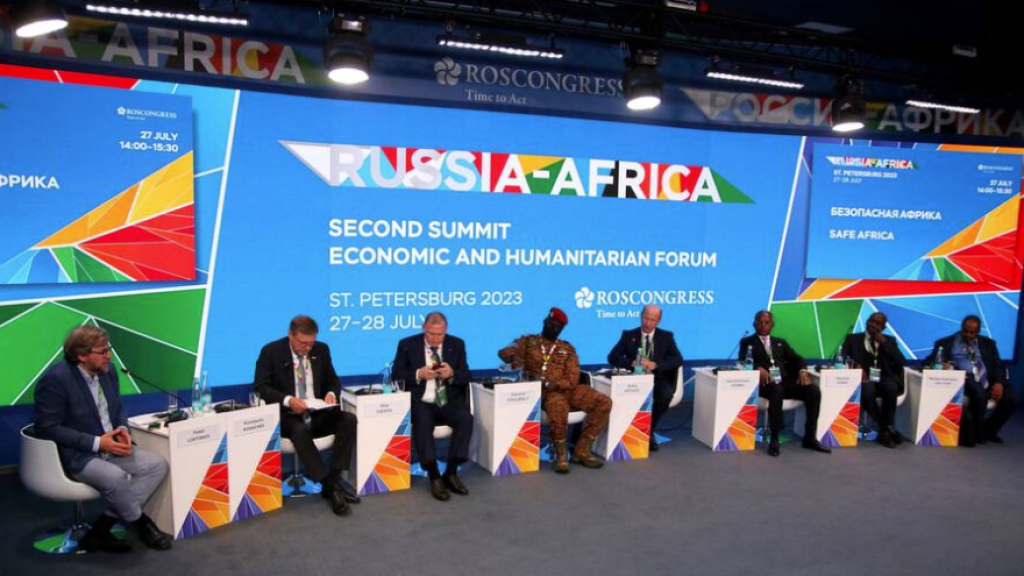
In the countries where Russian influence is already quite strong, propaganda campaigns to shape the public opinion on the ground have been handed over to local organizations and opinion leaders. At the second Russia-Africa forum, the president of Burkina Faso, Ibrahim Traoré, praised Moscow’s support of African sovereignty and even compared the modern history of Russia with African countries by calling both “the forgotten peoples of the world”. On a lower-tier, a Russia-affiliated Ivorian NGO called Total Support for Vladimir Putin in Africa (SOTOVPOA) even launched an international prize in his name, honouring what the founder of the NGO called Putin’s “liberating act for Africa.” Furthermore, the African Initiative organizes press tours of the occupied Ukrainian territories, during which bloggers from Sahelian regimes discuss the “reconstructions of new regions” and receive training in conducting information campaigns.
Against campism
As outlined above, Russia’s presence in Africa has little to do with the liberation of local populations and is instead focused on sustaining partner regimes. War crimes, extractivism, and the reinforcement of autocratic rule point to the underlying motives behind the Kremlin’s return to the continent — motives that are not so different from those of other neocolonial powers.
Many questions remain: Is the pretend-anticolonialism, supported by propaganda efforts and disinformation campaigns, convincing anyone? Are the protests depicting crowds with the Russian and Wagner flags staged or is there genuine support for Russia in Africa? Do a majority of people recognize the influence Russia has on their own governments, elections, economies? The generalized sociological data provides limited information: the latest edition of the Afrobarometer study shows significant cross-country variation. In Mali, one of Moscow’s essential newer partners, the positive public perception of Russia’s economic and political influence increased from 56% in 2019–2021 to 88% in 2023–2025. Meanwhile, in Guinea — no stranger to Russia’s business activities — the positive opinion of Russian influence dropped from 63% to 49% in respective years. Simultaneously, an average positive perception of Russia in Africa (36%) is lower than that of China (62%), the U.S. (52%), EU (50%) or India (39%).
The results of the Kremlin’s fight to win hearts and minds on the ground remain inconsistent, although it is clear that some groups are benefiting from its presence. At the same time, Moscow appears to be taking competition of great-powers in the region seriously. This is evident in the growing number of the Kremlin’s soft power institutions (such as Russian Houses), its expanding security presence, and investments in long-term infrastructure projects.
In the global context, the Kremlin’s cynical instrumentalization of anti-colonial narratives — including its claimed efforts to “liberate” African societies — appears to have achieved limited but notable traction among segments of the left. Beyond Kremlin-affiliated propagandists, this position is echoed by anti-intellectualist commentators and online influencers, as well as whole political parties (such as the German DKP), who denounce Western imperialism while overlooking the anti-democratic and reactionary nature of its geopolitical rivals. In this framing, Russia’s activities in Africa are often invoked as evidence to support such views.
This logic is not only deeply Western-centric — within a campist framework, only the West is seen as possessing the agency to commit significant crimes — but also quite dangerous. It undermines progressive struggles against regimes that present themselves as opponents of the West, whether in Russia, Iran or Venezuela. Meanwhile, despite ostensibly belonging to opposing camps, conservative elites in both Russia and the United States alike continue to pursue overlapping interests, by scheming over their own fascist International and shaking hands in Alaska. In the current global system shaped by capital and enforced by states, only genuinely internationalist and anti-colonial movements grounded in solidarity with people across both “camps” offer a viable path toward the liberation of the exploited class.
Sasha Fokina is a journalist and analyst focusing on anti-colonial struggles, wars, and autocracies across the Global South, as well as on feminist and migration issues.