Why is Spain in Africa?
First published at Canadian Dimension.
“No one leaves home unless home is the mouth of a shark.” This passage from Warsan Shire’s Home has become one of the defining passages of the 21st century, quoted beneath photographs of overcrowded boats, following wrecks and rescues in the Mediterranean, whenever another image forces the world to confront displacement, movement, and migration. The images that emerged from Ceuta — a Spanish enclave on the northern coast of Morocco, where tens of thousands of people crossed from Morocco last week — felt hauntingly familiar. People of all ages in the water, a sea of plastic sandals, clothes soaked through, phones and babies held above the waves, families waiting for word that someone had made it across. A boy wrapped in a wet shirt, phone pressed to his ear before he’d even dried off, calling his mother. Aerial photographs reduced thousands of individual lives into what looked, from above, like movement itself. The geography had changed, but the visual grammar had not. A decade ago, the photograph of three-year-old Alan Kurdi gave the Syrian crossings a name and a face, briefly breaking through the language of crisis and provoking immense public empathy. Yet the crossings in Ceuta — or Sebta, as it is known in Arabic — were met, in many left-wing circles, not with empathy but with debates about geopolitics.
The resemblance between the images does not mean northern Morocco is Syria; the histories are different, as are the legal and political realities that shape the movement of human beings. Their familiarity reveals something worth sitting with: we have become remarkably fluent in reading images of migration while remaining surprisingly illiterate in reading images of empire. The camera arrives at the shoreline, but history is not captured in the frame. Images move us quickly; they provoke outrage, sympathy, and fear almost instantly. What they rarely do is explain themselves, and what we rarely do is think beyond the politics and geography we already know.
Canadian audiences, like those elsewhere, have encountered this visual archive before. The Mediterranean crossing became one of the defining images of the last decade, with photographs of overcrowded dinghies and exhausted families becoming synonymous with displacement itself. Canada responded with a humanitarian narrative that celebrated refugee resettlement, one that rightly transformed many lives while also drawing a quiet line between the carefully selected refugee and the person who simply arrives. Much of that welcome was, in practice, offloaded onto the public: private sponsorship groups fundraised, housed, and resettled families in numbers the government’s own systems could not have processed alone, letting Ottawa claim credit for generosity that citizens were doing the work of. That generosity was also politically useful. Canada resettles refugees every year, but the Syrian initiative allowed the government to expand that image of generosity without bearing the full cost itself. Months after the resettlement push began, Trudeau announced Canada’s bid for a seat on the United Nations Security Council, and Canada’s ambassador to the UN later cited the country’s welcome of Syrian refugees as part of the case for why it deserved one. The bid failed in 2020, but the instinct behind it is worth naming: even a humanitarian welcome can double as statecraft. The images from Ceuta belong to that same visual archive. They expose a different blind spot, wherein we have learned to recognize migration but have not learned to recognize the colonial geography that produces it.
Most reports described what unfolded in Ceuta as a migration crisis. Politicians debated border security, while some on the left interpreted the crossings primarily through the lens of Palestinian liberation and competing state interests. Instagram activists advanced arguments about Moroccan diplomacy, European policy, and imperial power. Almost none of this commentary paused to ask the question that should have preceded all the others: Why is Spain in Africa?
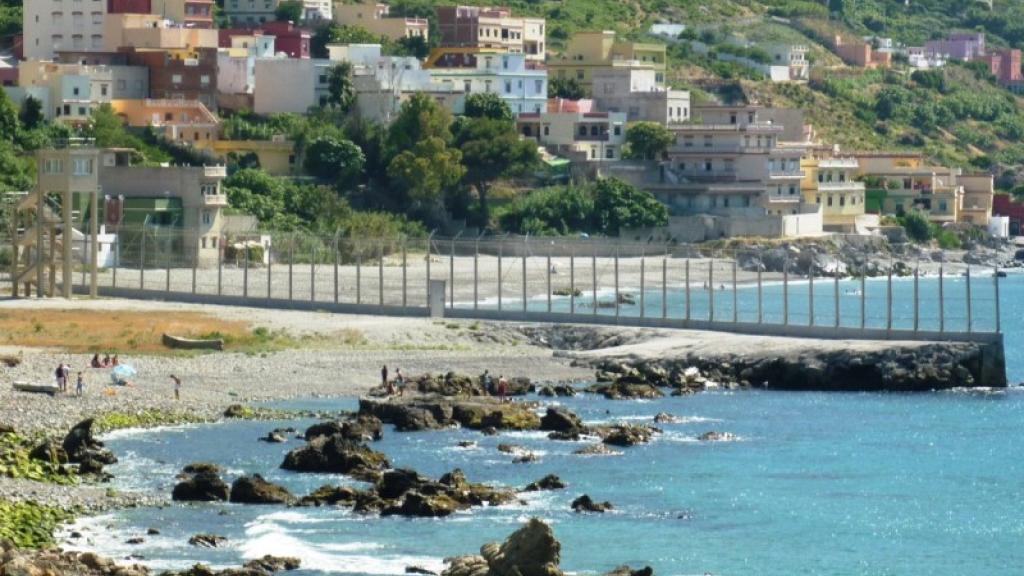
If it is mentioned at all, Ceuta’s history is often compressed into a footnote. Leftists point to Western Sahara as the last colony in Africa — revealing an ignorance of, or amnesia about, Ceuta and Melilla. Ceuta was captured by Portugal in 1415 and transferred to Spain in the 17th century; the city has remained under Spanish administration since Morocco gained independence in 1956. Morocco continues to claim Ceuta and Melilla as occupied territories, while Spain regards them as integral parts of the Spanish state. Today, the enclaves are among the European Union’s most heavily fortified external borders, regulating movement across a disparate colonial geography. Time has a remarkable ability to convert colonial occupation into unquestioned geography. The longer a colonial border survives, the less colonial it appears. Maps acquire the authority of being normal and natural renderings of the world order. Spain in North Africa becomes a geographical fact rather than a political question.
A day after the crossings, I found myself writing that colonial geography becomes invisible when it is European. Looking again at the photographs, I think that is precisely what unsettled me. Many people immediately recognized the images as migration, while far fewer recognized them as images of a European colonial border on the African continent. In the absence of that history, the people in the water were easily reduced to an act of Moroccan retaliation against Spain. But people risking, and in some cases losing, their lives in pursuit of another future cannot be reduced to instruments of retaliation by one state against another. If this was a “failure” of Moroccan border enforcement, was it not equally a “failure” of Spanish border enforcement? Anyone who has crossed that border knows the level of scrutiny involved. A border — especially an externalized European border — is enforced from both sides.
Looking carefully at the videos and photographs, what struck me was not only desperation but ordinariness: plastic sandals, cheap jeans darkened by seawater, a plastic bag with a phone held above the waves because it was the most valuable thing someone had, a woman holding a baby, a man carrying a woman on his back. Yet almost everyone rushed to explain the people in the water as instruments of retaliation against Spain. Proof that European borders had failed. Proof of Moroccan government retaliation. The categories arrived almost immediately, and the people disappeared inside them. As people commit to imagining a more just world, we need to be wary of the language we use and the world that will inherit it. Our political vocabularies are rich in categories and often poor in curiosity. The more useful question isn’t which label best fits the geopolitics of this situation but what conditions made that crossing imaginable, and what histories produced those conditions.
One of the more striking reactions to the Ceuta crossings was how quickly some pro-Palestine accounts folded the images into a broader geopolitical theory. They suggested that Morocco had deliberately facilitated the crossings with the backing of Israel and the United States in order to “punish” Spain for its position on Palestine. One Instagram video advancing the narrative received more than 3.2 million views while prominent figures and commentators, including George Galloway, Javier Bardem, and Hasan Piker helped circulate versions of the same claim. Yet little hard evidence was offered for this claim, and the theory transformed thousands of people into instruments of state strategy. It also reproduced a premise long associated with the European far-right: that irregular migration is not human movement but an organized invasion directed at Europe. Changing the alleged architects of the invasion does not make that premise any less dangerous. Whatever role Moroccan border enforcement or diplomatic tensions played in the timing of the crossing, the people in the water were not reducible to anyone’s geopolitical manoeuvre. Before making Ceuta evidence in an argument about Palestine, NATO, or regional diplomacy, we should first ask the more immediate question: Why is there a European colonial border in Africa, and why do so many people overlook its colonial character only when doing so supports an argument they already want to make?
If we are committed to liberation, we should demand more of ourselves than choosing which migrants deserve solidarity based on whether they fit neatly into narratives we already hold. Freedom of movement cannot be a principle we defend only when it embarrasses an empire we already dislike. If we oppose walls, checkpoints, and colonial borders in one place, we have to be willing to interrogate them everywhere, including in moments that don’t hand us a tidy geopolitical win. People have long crossed at Ceuta, and they will continue to. Empire has to reckon with its past — and in this case, its present — with a physical presence in Africa, in Morocco. The colony and the metropole were, and are, never truly separate.
Notably, Ceuta is not a crossing point only in moments dramatic enough to make international news. For decades, people from across the African continent have travelled through northern Morocco seeking an opportunity to enter Europe. Some spend months or years in transit, repeatedly displaced by police raids and border enforcement while waiting for a possible route across. People have attempted to reach Ceuta by swimming around the breakwater, climbing its fortified fences, or hiding in vehicles passing through official checkpoints. The sudden visibility of thousands of people should not be mistaken for the sudden appearance of their desire to move. The border did not create that desire; it concentrated it, forcing ordinary hopes into increasingly dangerous routes.
Writer and organizer Harsha Walia, who has written about border imperialism for over a decade, made a post on Instagram that held onto nuance amid the invasion theories circulating on the left, warning that entertaining claims of a US-Israeli military manoeuvre only reinforces the far-right’s premise that irregular migration is an invasion to be repelled. Her point cuts through what gets lost when human movement is reduced to geopolitical strategy: people will keep crossing. Borders and pushbacks do not hold against material conditions, and the attempt to explain every mass movement as someone else’s strategy erases the much older and simpler fact that people go where survival and possibility take them.
The ease with which some commentators slipped into the language of invasion should concern all of us. So should the temptation to celebrate movement only when it seems to punish the right villain. Both responses flatten people into pawns and symbols, stripped of the agency they had just exercised in its fullest form. Few acts in life require more courage than entering open water and swimming toward a shore that offers no guarantee. A politics of liberation demands more of us. It requires us to remain attentive to the ordinary aspirations that rarely make headlines: the right to study, to work, to care for family, to play, to move, to imagine a future larger than the present, without reducing every migrant to fit someone else’s geopolitics.
Over almost three years, Palestine has taught many of us to recognize walls and checkpoints as political structures rather than unfortunate facts of life, to ask how a border came to exist and whose interests it serves. Those moments of recognition shouldn’t stop at Palestine’s contours. An anti-colonial politics can’t just be an attachment to particular places we’ve already decided matter; it has to become a way of seeing borders more broadly.
If the images and videos from Ceuta teach us anything, it is that anti-colonial politics cannot end with recognizing only certain occupations. Image after image has shown African migrants stranded, thirsty and hungry, denied refuge, and pursued by guards after surviving a dangerous crossing. To reduce their movement to an attempt to “punish” Spain is to erase both their humanity and the conditions that brought them to the border. Anti-colonialism must become a way of seeing the world: one that asks how borders came to exist, whose movement they regulate, and whose histories they conceal. It must resist the xenophobic narratives that invariably accompany moments of mass movement while refusing to turn migrants into symbols in someone else’s geopolitical argument.
We often quote Warsan Shire to explain why people leave home. The images from Ceuta suggest another question. What happens when home itself has been divided by empire, when Europe is visible from your shoreline and demarcated on your land? When colonialism has become so ordinary that the border itself disappears for non-Moroccans? The headlines called it migration. I couldn’t stop seeing a colony.
Nashwa Lina Khan is a Moroccan-Pakistani Canadian writer, researcher, artist, and community educator based in Montreal. Her work explores migration, colonialism, public health, and the politics of narrative. She hosts and curates the podcast project Habibti Please and her writing has appeared in The New York Times, Vice, Briarpatch, and other publications.