Sweden’s 2026 election on a knife-edge
First published at Rosa-Luxemburg-Stiftung.
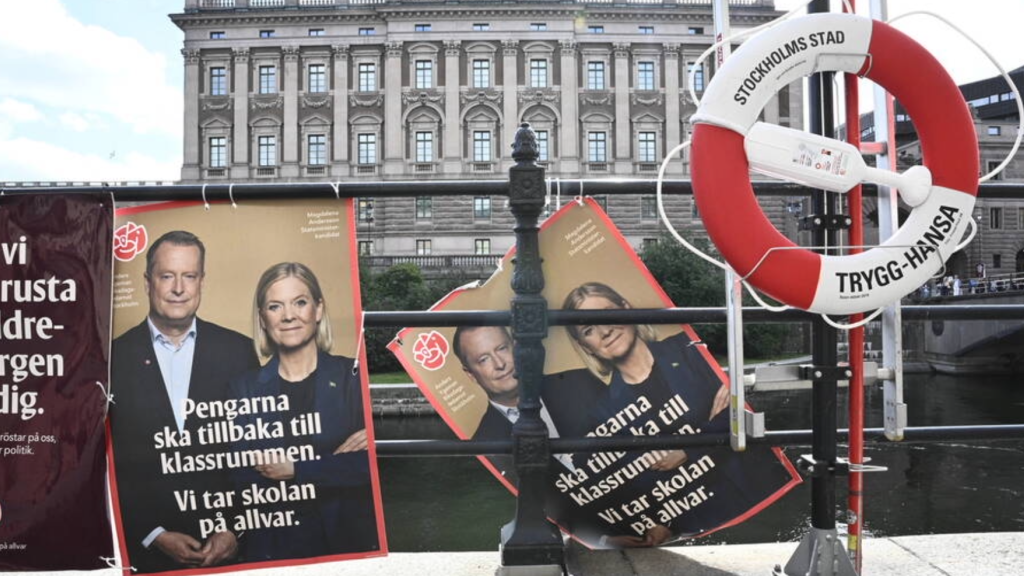
If opinion polls are to be believed, Sweden’s September 13 parliamentary election will return former Social Democratic prime minister Magdalena Andersson to power after four years on the sidelines. But the centre-left opposition’s once-substantial lead has narrowed sharply, with Social Democratic support falling to an historic low. Discord among potential coalition partners could further complicate a left victory, making it difficult for a new government to undo four years of right-wing government under the sway of the far-right Sweden Democrats.
The past four years of far-right influence have transformed the political landscape of the Nordic country, making their xenophobic rhetoric increasingly mainstream. The Social Democrats have themselves adopted much of the right’s politics on migration and law and order, narrowing the political spectrum. While Andersson’s potential government allies remain divided, the question is therefore not simply whether the left can return to government, but what kind of politics it can offer after four years of far-right influence. Sunday’s vote is also a triple election, with Sweden’s regional and municipal councils facing re-election, making the results consequential for Swedish society for years to come.
Support for Social Democrats falling
The Riksdag, Sweden’s parliament currently hosts eight parties, broadly divided into two blocs. For most of the summer, the centre-left opposition — the Social Democrats (S), the Greens (MP), the Left Party (V) and the Centre Party (C) — held a substantial lead over the right-wing “Tidö” bloc: the Moderates, Christian Democrats (KD), Liberals (L) and Sweden Democrats (SD). At its peak, the centre-left led by around 10 points, 54 to 44 percent while the Social Democrats were polling just above 30 percent — already a poor result for Sweden’s oldest party — with the Moderates on 17 percent and the Sweden Democrats sitting just below 20.
Since then, support for the Social Democrats has fallen further to an historic low of 27 percent, while the Left, the Greens and the Centre Party have all risen to around 8 percent, well above their 2022 results. On the right, the Sweden Democrats sit around 20 percent, and the Liberals appear to have finally moved back above the 4 percent parliamentary threshold. A centre-left victory remains the most likely outcome, but the narrowing margin means it is no longer assured.
Support has bled from the Social Democrats to their potential coalition partners to such an extent that a left-bloc government would require the involvement of all three minor parties. This alignment is further complicated the Left Party’s decision at its last congress to insist on full government participation as a condition of its support. The Social Democrats have shown little enthusiasm for such a deal, while the Centre Party — traditionally a party of the centre-right — has rejected it outright.
The Centre Party’s hope, shared by some in the Social Democrats, of persuading the Christian Democrats to support — or even join — a minority S-MP-C government were quickly ruled out by Christian Democrat leader Ebba Busch. Ironically, such attempts by the Social Democrats to look for allies to the right have only further encouraged left wing voters uneasy with its right turn on migration, crime, and citizenship to shift towards the Left or the Greens, raising the stakes on government formation even further.
The Sweden Democrats’ influence
The right is not without its own tensions, largely over how to relate to the Sweden Democrats. Formed in 1988 out of the racist, far-right organisation Keep Sweden Swedish (itself founded by Nazis and neo-Nazis), the Sweden Democrats spent their first 30 years behind a political “cordon sanitaire”. In 2022, it became Sweden’s second-largest party with 20.5 percent of the vote, but its failure to enter government was less a continuation of this firewall than a decision by the Moderates, Christian Democrats and Liberals to form a minority government dependent on the Sweden Democrats for external support, through the Tidö Agreement (named for the castle where it was negotiated).
The Tidö agreement granted the Sweden Democrats most of their major policy demands, including tougher criminal penalties, expanded deportation powers (including on the grounds of “dubious morals”), tighter asylum, residence and citizenship rules, and a shift from renewables to nuclear power. It also gave the Sweden Democrats an unprecedented coordinating office inside the Government Offices, allowing the far-right to work alongside and influence governing parties on legislation and budgets, veto core domestic policies, and access information and briefings normally available to ministers. The Sweden Democrats thus became a governing force without ministerial posts. Much of the Tidö Agreement’s reactionary programme, particularly on migration and law and order, has since been implemented.
Jimmie Åkesson, far-right violence and the Örebro Party
Rather than moderating through proximity to government, the Sweden Democrats have continued to intensify their provocative rhetoric. Their campaign slogan, “Make Sweden like Sweden again” — itself a reference to its radical far-right origins — has accompanied inflammatory attacks on migrants and welfare recipients. This includes plastering buses in western Sweden with the message: “Do you miss Mogadishu? The repatriation grant helps you home”, and spending over a million kronor to blanket Stockholm Central Station in similarly inflammatory posters.
Yet the political question on the right is now no longer whether the Sweden Democrats should join a right-wing government, but how much direct power they should receive, with their leader Jimmie Åkesson demanding at least twelve ministerial posts. Both the Moderates and Christian Democrats have accepted full Sweden Democrat participation, while the Liberals remained opposed until March this year, when the party’s new leadership abandoned that position. That backflip triggered massive internal upheaval, and cost vital public support, with the party polling well below the 4 percent threshold until only days before the vote.
The rise of the Sweden Democrats has also created space and comfort for other forms of radical-right politics. Incidents of Islamophobia and far-right violence, including activity associated with the global Active Clubs phenomenon, have increased. In Örebro, where a gunman killed 10 people in 2025 — most of them of immigrant backgrounds — the obscure far-right Örebro Party has surged in regional polls, backed financially by tech millionaire Daniel Berntsson, co-founder of Mullvad VPN.
The Örebro Party was formed in 2014 by expelled Left Party member Markus Allard, yet its policies — mass “remigration”, welfare chauvinism, aggressive assimilation, forced labour for criminals, and a DNA database to monitor residents’ ethnicity — place tit to the right even of the Sweden Democrats. Some polls have put it at up to 15 percent support in the Örebro region, enough to win a seat. Sweden’s electoral system allows parties winning over 12 percent in local constituencies to qualify for a limited number of “top-up” seats, bypassing the national 4 percent threshold.
The Left Party’s plan to reverse inequality
While the right has sought once again to make crime and immigration central election issues, concerns over public services and the cost of living have asserted themselves as Sweden’s welfare model comes under strain. This focus is due, in part, to the fact that Sunday’s vote is in fact a triple election: Sweden’s 21 regional councils, responsible for health, public transport, and regional development, and 290 municipalities, overseeing schools, social services, care, and recreational facilities, all up for re-election. Sweden faces shortages of nurses (made worse by recent immigration reforms) and aged-care workers, ballooning emergency-room waiting times, and stubbornly high food, housing, and energy costs. It has the third highest unemployment rate in the European Union, and a youth unemployment rate of 23.3 percent.
The Social Democrats have presented a raft of proposals, including free dental care for under-23s, and cheaper treatment for other adults, higher child and student allowances, higher taxes on banks and high earners, and paid sick leave from the first day. The right-wing government, trumpeting the health of Sweden’s economy, has nonetheless cut fuel tax and temporarily halved VAT on food, while promising free kindergarten places. The Sweden Democrats, too, have promised subsidised dental care, and the Christian Democrats are calling for a doubling of child benefits.
The Left Party has taken a more radical approach, presenting the election as a chance to reverse decades of inequality and the erosion of public services. Its demands include universal dental care (an issue later picked up by the Social Democrats), a “billionaire tax” to raise SEK 50 billion (approx. EUR 4.5 billion), stronger price controls, cheaper food, and expanded public investment, alongside more healthcare staff, stronger primary care and an end to profit-driven welfare and marketised education.
On climate and infrastructure, the Left argues for a much larger role for public investment in the transition — expanding rail and public transport, renovating and building climate-friendly housing, and supporting the transformation of industry. The Greens and Social Democrats are also promising additional resources for schools, healthcare, climate, regions and municipalities, but are less willing to challenge the privatisation and market mechanisms that have undermined Sweden’s welfare state, including under Social Democrat-led governments. The key difference is not simply how much to spend, but whether public investment should be accompanied by greater public ownership, democratic control, and a redistribution of wealth and power.
Currently enjoying around 8 percent support, the Left is polling better than in 2022 and has spent the intervening years preparing for government, including moderating its positions on NATO and the EU. While heavily debated within the party, its demand for ministerial representation is therefore far from symbolic. External support for previous Social Democrat-led governments gave the Left only limited influence, allowing the Social Democrats to compromise repeatedly with parties further to the right. Government participation would give the Left Party greater leverage over welfare, taxation, housing, and climate policy.
For the Centre Party, however, the prospect of an influential left in government is a red line. Although it has moved away from its former right-wing allies over their cooperation with the Sweden Democrats, the Centre Party remains committed to lower taxes, a “flexible” labour market, and the for-profit schools and welfare provision. It has indicated it would rather trigger a snap election than allow a government containing Left Party ministers. The Centre Party also opposes the Social Democrats’ proposals on higher corporate taxes, workers’ rights, and sick leave, and its preferred outcome remains an S-MP-C-KD government across the centre, making the path to a left government difficult to chart.
Teen deportations and inaction on climate change
The consequences of the Tidö government’s restrictive migration policies point to the limits of change under a government led by the Social Democrats. Most controversial is the “teen deportations” issue, where tightened migration laws mean the children of long-term migrants, many of whom have grown up in Sweden, can face deportation when they reach adulthood, while their parents and younger siblings remain. Recent reporting identified at least 127 such deportation cases in 2025, many involving “well-integrated” children of people with work, study or business permits, with little or no connection to the countries to which they were being sent (such as Egypt and Iran).
Facing public outcry, the government temporarily paused removals, and — facing further pressure — the parliament finally lifted the dependency age from 18 to 21. Yet the move came too late for the hundreds already affected, and the issue has exposed a deeper political challenge. Having itself moved right on migration and integration, and terrified of appearing “soft on borders”, the Social Democrats also initially refused to back legislative moves by the Left, Greens and Centre Party to stop the deportations. In the face of immense backlash, and the prospect of losing votes on both sides, the Social Democrats eventually came out against the deportations. Yet the Social Democrats continue to support a restrictive migration framework, including backing government proposals to make it easier to revoke the Swedish citizenship of dual citizen holders. The episode therefore raises doubts about how far the Social Democrats in government would depart from the Tidö consensus on migration.
Climate policy is another dividing line, with 37 percent of respondents to a recent poll identifying climate change as a main election priority. Sweden has long presented itself as a climate leader, but the Tidö government has weakened previous ambitions, put new main railway lines on hold, suspended night-train plans, and prioritised nuclear power and cheaper fossil fuels over renewables. On August 23, around 50,000 climate activists marched in Stockholm, five times the expected turnout, demanding more urgent climate action.
The Social Democrats’ climate strategy centres heavily on industrialisation, including fossil-free steel, mining, and electrification. But setbacks including the bankruptcy of battery developer Northvolt have exposed the risks of large-scale private investment supported by public resources. The strategy is also criticised by environmentalists and the left for a lack of urgency, reliance on “green capitalism”, and limited attention to biodiversity, forests, and conservation.
The Left Party instead advocates broader public investment: rebuilding railways, expanding public transport and night trains, renovating and constructing climate-friendly housing, supporting industrial transformation, and making electric vehicles and household energy investments more affordable. The Left’s proposals also include a nationwide public-transport card costing SEK 450 (approx. EUR 40) a month, and “Sweden prices” to decouple domestic electricity from European energy markets. It insists that increased public investment should come with greater public ownership and democratic control.
NATO and Swedish neutrality
Sweden joined NATO in March 2024 after Russia’s full-scale invasion of Ukraine ended decades of military non-alignment, but the issue has featured little in the campaign. Most major parties now agree on membership, the Russian threat, and increased defence spending. Sweden is rapidly integrating into NATO and increasing military expenditure, while providing substantial support to Ukraine, leaving a potential left government to reconcile those commitments with investment in healthcare, education, housing, and climate.
The Left Party remains opposed to NATO, but it accepts that Swedish membership is a reality. It instead focuses on security policy within the alliance, calling for a ban on nuclear weapons, opposing foreign military bases, and seeking to preserve Sweden’s diplomatic independence. Its pragmatic acceptance of NATO membership removes a formal obstacle to joining government, but this may not be enough to resolve tensions with its potential partners.
What comes after the four year Tidö government?
Early voting has reached a record 29.7 percent, particularly in areas with greater inequality and social exclusion and high rates of migrant backgrounds. Much of this appears driven an opposition to Sweden Democrats that has become a central theme of the campaign’s final days, but it also challenges assumptions that these communities are politically apathetic. The Left is also running its largest grassroots door-knocking campaign to date, targeting voters most affected by Sweden’s growing inequality.
The centre-left may well win, but such an Andersson-led government — if it can be formed — would inherit a political landscape transformed by the centre-right and far-right and years of increasingly restrictive migration, tougher criminal justice, increased military expenditure, and market-oriented economic policy, all of which the Social Democrats have themselves helped to shape. Simply restoring the Social Democrats to government will not reverse that trajectory.
With national, regional and municipal elections being held simultaneously, Sunday’s vote is a test not only of who governs Sweden, but of whether the electorate can respond in defence of the public services, democracy, and egalitarianism that Sweden once claimed to represent. The Left believes its stronger position — building on its excellent European Parliament election results in 2024 — gives it an opportunity to push the next government towards wealth redistribution, stronger welfare, public investment and a more ambitious climate transition.
But the Left Party will have to demonstrate that it can operate close to power without becoming a left appendage of the Social Democrats, while developing and promoting a convincing response to the politics of insecurity. The Sweden Democrats spent decades moving from the political margins into the centre of Swedish politics, bringing their politics with them. The task for the left is not simply to remove them from government, but to change the material and political conditions that allowed them to get there in the first place.
Duroyan Fertl is a former political advisor for Sinn Féin and the European United Left/Nordic Green Left (GUE/NGL) in the European Parliament. Since 2021, he has been coordinating the work of the Rosa Luxemburg Foundation’s Brussels Office in the Nordic countries.