The radical ecology of Rosa Luxemburg
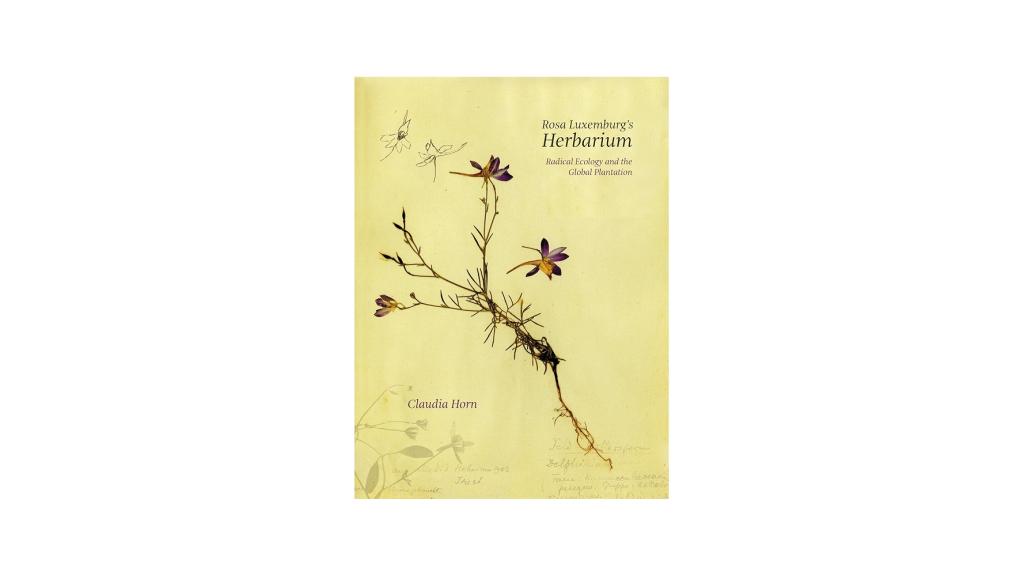
The following is a review by Paul Le Blanc of Rosa Luxemburg’s Herbarium: Radical Ecology and the Global Plantation, edited by Claudia Horn. New York: OR Books, 2026. 256 pages. $30 US/ £23 UK. This review is simultaneously published on LINKS and Communis.
Rosa Luxemburg’s Herbarium: Radical Ecology and the Global Plantation is a handsomely crafted and inspiring volume to be savored and shared, thanks to the uniquely exquisite sensibilities of Rosa Luxemburg and the splendid labors of the book’s editor, Claudia Horn. Richly illustrated by Luxemburg herself — with beautiful reproductions from among the many hundreds of samples in the 17 notebooks that contain Luxemburg’s drawings of vegetation and the pressed plants themselves, enhanced with numerous marginal notes by her in German — the book also provides well-chosen slices from correspondence with some of her closest friends, along with insightful and informative commentary from the editor. Revealed to us are little known dimensions of Luxemburg the outstanding thinker and revolutionary, but also the generously gifted human being.
Qualities of thought and revolutionary practice
Luxemburg wanted to replace the established order with a genuinely democratic and socialist future. The old order in Germany had taken the form of voracious capitalism integrated with a reactionary elite of land-based aristocrats. Much has changed in the world since, and yet Luxemburg’s perspectives have never stopped resonating in countries throughout the world to the present moment.
For her revolutionary commitments, she was denounced as “bloody Rosa”. Many (including moderate socialists) agreed with the highly esteemed centrist-liberal/conservative sociologist Max Weber. He was fiercely critical of the Spartacus League, which Luxemburg led with her comrade Karl Liebknecht in 1919. Several days before they were brutally killed in the so-called “Spartacist uprising,” Weber said that “Liebknecht belongs in a lunatic asylum, and Rosa Luxemburg in a zoo.” While he had not advocated their murder, it seems not to have shocked him. “Liebknecht was undoubtedly an honest man,” Weber commented, once the deed was done. “He called on the street to fight — the street killed him.” Much the same could have been said of Luxemburg. Of course, they were not killed by “the street,” but by a right-wing paramilitary, the Freikorps, commanded by officers from Germany’s reactionary elite, with tacit support from more moderate “law and order” elements.1
The personal qualities of “bloody Rosa” — who spent years in prison for her beliefs — do not correspond, though, to Weber’s anti-revolutionary caricature. Horn cites the testimony of one of the many prison staff members who befriended her (in this case a non-commissioned officer, Arthur Gertel, who was tasked with accompanying her on walks that she was permitted to take):
She was an intellectual genius yet full of kindness and compassion for all beings, human or animal… And yet the newspapers called her “Bloody Rosa.” The sharpness and refusal to make fundamental compromises that characterized Rosa Luxemburg’s political speeches and writings undoubtedly stemmed from her outrage at all injustice.2
It is the crescendo of injustice and horrific violence — inherent in capitalism, imperialism and global war — that would finally bring an end to Luxemburg’s life in 1919. That is not the focus of this volume. What Horn presents to us, however, transcends the violence in a way that refuses to push aside Luxemburg’s determined struggle to replace it with something better. As she emphasizes, “Luxemburg’s expansive sensitivity to human and non-human suffering drove her unswerving, unfailing, and uncompromising commitment to the cause of world revolution.”3
Enlightenment, Romanticism and the natural world
The great intellectual-cultural streams of the Enlightenment and Romanticism blend in this remarkable woman, with — at the very same time — rock-hard yet supple Marxist convictions that had become inseparable from a passionate yet very conscious connection to the natural world. Her strong bond with blue-feathered titmice is especially evident. She would feed them between the bars of her prison window and copy their bird song. In a letter to Mathilde Jacob, Luxemburg boasted that she could imitate them so well “that they all immediately come running,” adding: “In spite of the snow and frost and loneliness, we believe — the titmice and I — in the coming of spring!” In another letter to Sophie Liebknecht, she confessed that “sometimes, it seems to me that I am not really a human being at all, but rather a bird or a beast in human form.” In yet another letter, she proudly confided to Luise Kautsky:
The great titmice are in loyal attendance in front of my window; they already know my voice exactly; and it seems they like it when I sing. Recently I sang the Countess’s aria from Figaro, about six of them were perched there on a bush in front of the window and listened without moving all the way to the end; it was a very funny sight to see.4
Little wonder that she fantasized: “on my grave, as in my life, there will be no pompous phrases. Only two syllables will be allowed to appear on my gravestone: ‘Tsvee-tsvee’” (her transliteration of the titmouse call that she had mastered). While expressing the fervent hope that her death would come in the struggle for the socialist cause, she confessed “my innermost self belongs more to my titmice than to the ‘comrades’.”5
In fact, her expansive temperament embraced the whole of the natural world. “Inwardly,” she wrote, “I feel so much more at home in a plot of garden … and still more in the meadows when the grass is humming with bees, than at one of our party congresses.” As this little volume reveals, Luxemburg shared the passionate engagement of the bees and other creatures with the flourishing and sometimes struggling plants of all kinds — which delighted and fascinated her. Yet she insisted that nature was not, for her, “a restful refuge,” noting that “in nature too, at every step, I find so much that is cruel that I suffer very much.”6 The point was to be vibrantly aware, conscious of, and in tune with the wondrous reality of life — deeply in touch with herself and the vast and complex world around her.
In more than one way, this informed her political understanding and orientation. Luxemburg tirelessly analyzed the causes and impacts of the catastrophic horrors of World War I, with the conviction that “by its nature, socialism cannot be imposed” — that the key to reaching it could only be found through “uninhibited, effervescing life,” which meant that “experience alone is capable of making corrections and opening up new paths.” While the failure of the international socialist movement to stay true to its principles in resisting the global imperialist war brought a devastating “misfortune for humanity,” she insisted, “socialism will be lost only if the international proletariat refuses to learn from it.”7 Revolutionary consciousness and insurgency cannot be manufactured from the top-down. It must flow from actual experience as a collective process.
Capitalism and metabolic rift
Even more than was the case with the cataclysms of global war in 1914-18 and 1939-45, all human and non-human life on our planet is threatened by unfolding and intensifying ecological disasters. Just as imperialism and the global wars it generated were not simply the fruit of mistaken policy decisions — according to Luxemburg’s penetrating analyses — so is the environmental crisis not the outcome of policies that can simply be reversed. Both flow inexorably from the accumulation process at the heart of the capitalist economic order in which we live. Horn notes the same point when she writes, “profit seeking capitalist behavior causes various kinds of economic imbalance.”8
This imparts a special urgency to aspects of Luxemburg’s application of ecological sensibilities to her development of Marxist analysis. It is related to the notion of “metabolic rift,” recently highlighted in significant studies by such “eco-Marxists” as John Bellamy Foster and Ian Angus.9 Foster and Angus, following Marx — as Horn puts it — use the metaphor of “metabolism” to describe “the complex, interdependent process linking human society to nature.” According to Horn, “all economies transform — metabolize — physical materials such as wood, water, and soil into goods for use or exchange.” But “if producers do not exploit those natural resources in a sustainable way, both the resources and the economic system they support may be exhausted.”
Drawing from Luxemburg’s classic The Accumulation of Capital (1913), Horn presents the view that “capitalism was not a closed system but rather operated within and depended upon a wider, non-capitalist ‘milieu’.” In fact, “capital accumulation had required the continuous absorption and transformation of resources — both human labor power and natural materials like wood or minerals — that originated outside capitalist societies.” Capitalism existed “not as a stable equilibrium but as a ceaseless, violent churn.” This was stressed in Luxemburg’s theory of imperialism as a perpetual invasion and exploitation of non-capitalist portions of our planet.
In Luxemburg’s words, “capitalism feeds on the ruins of such organizations, and, although this non-capitalist milieu is indispensable for accumulation, the latter proceeds, at the cost of this medium, by eating it up.” Horn draws out this point: “Eating up the conditions for its survival, ‘capitalism prepares its own downfall under ever more violent contortions and convulsions.’” Nonetheless, as Horn observes later, “the capitalist system continues to displace the real costs of production, such as environmental destruction, outside the realm of capital accumulation, to be borne off-books by exploited people, non-human animals, and future generations.”10
Horn strongly suggests that Luxemburg’s particular analysis of imperialism suffered from its own flaws, to which she gives serious attention, but insists on the relevance of much of what she had to say about the capital accumulation process:
If history has not borne out Luxemburg’s argument that capitalism depends upon both exploiting and incorporating the non-capitalist world, such that it must inevitably exhaust itself, still, the enduring relevance of her analysis lies in its global scope; its sensitivity to the physical predicates of economic growth; its focus on the boundaries that capital constantly transgresses, polices, and redraws; and its attentiveness to the broad coalitions these trespasses and depredations could bring together in resistance.
The qualities of this remarkable book certainly do justice to the multifaceted person who was Luxemburg, but they also speak to us on a variety of levels about the meaning of life and about what must be done in the present moment.
- 1
Alexander Behrens, review of The Young Max Weber and German Social Democracy by Victor Strazzeri (Brill 2022/Haymarket, 2023) in The Progressive Post, July 16, 2024, https://feps-europe.eu/inspiration/the-young-max-weber-and-german-social-democracy/.
- 2
Claudia Horn, ed., Rosa Luxemburg’s Herbarium, 14.
- 3
Ibid., 19.
- 4
Ibid., 15-16, 48, 136-137. Blue tufted titmice: https://www.youtube.com/watch?v=zcQOEMxYUMU; Mozart aria: https://www.youtube.com/watch?v=HaZTuRBFtDk.
- 5
Rosa Luxemburg’s Herbarium, 15-16.
- 6
Ibid., 16.
- 7
Ibid., 16, 13.
- 8
Ibid., 52.
- 9
See, for example, John Bellamy Foster, Marx’s Ecology: Materialism and Nature (New York: Monthly Review Press, 2000) and Ian Angus, Metabolic Rifts: Capitalism's Assault on the Earth System (New York: Monthly Review Press, 2026).
- 10
Rosa Luxemburg’s Herbarium, 51, 52, 55-7, 58, 211.