Reform or revolution? Why the distinction still matters
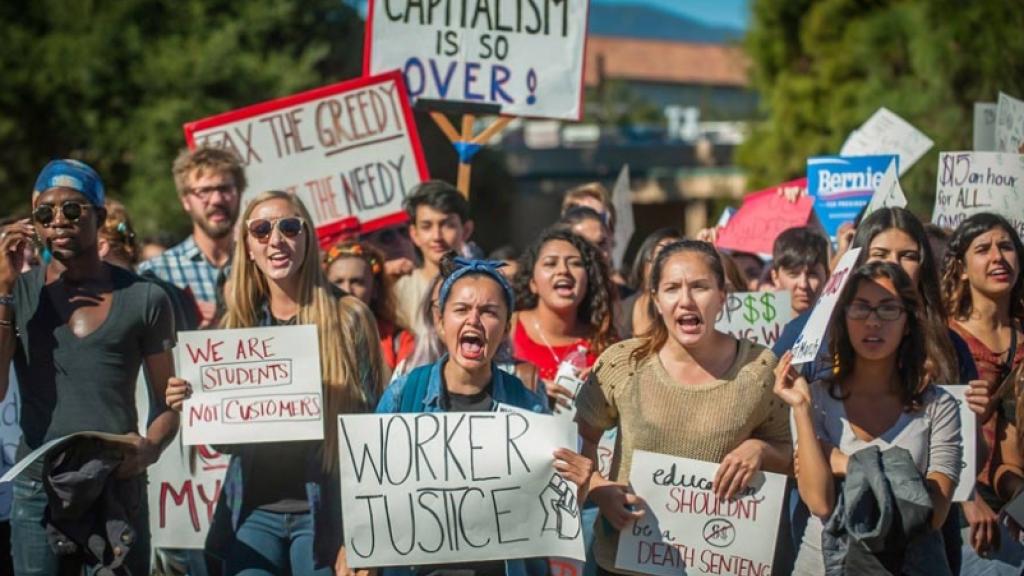
The contemporary struggle against capitalism is marked by two major contradictions. First, capitalism continues to inflict immense social and ecological suffering, while the ruling class is increasingly incapable of implementing reforms to meet the masses’ needs. Despite this, many influential academic Marxists consider revolutionary struggle against capitalism implausible, even as dissatisfaction with capitalism becomes increasingly widespread.
Second, while popular receptivity to socialism is growing, and confidence in capitalism and its institutions declines, organised revolutionary socialist politics remains remarkably weak. Moreover, much of the Communist movement remains committed to a two-stage revolutionary strategy, according to which a democratic revolution must precede socialist revolution as a separate historical stage. In practice, this strategy means postponing socialist revolution indefinitely. Yet, as I shall argue later, democratic, agrarian, national and anti-imperialist tasks must be integrated into the struggle for socialist revolution under proletarian leadership.
These two contradictions raise fundamental questions. Why do so many Marxist scholars downplay or reject revolutionary politics at a time when capitalism’s contradictions are increasingly evident? Why does growing dissatisfaction with capitalism not translate into organised revolutionary struggle? And how can struggles for immediate improvements in people’s lives become part of a movement for the revolutionary transformation of society?
This article addresses these questions from the standpoint of revolutionary Marxism.1 Its central argument is that the necessity of socialist revolution arises from the structural contradictions of capitalism, while its possibility depends on the development of the objective and subjective conditions for revolutionary struggle. Neither capitalist crisis nor popular dissatisfaction automatically produces revolutionary consciousness or organisation. The decisive political task is to transform the potential for revolutionary struggle into an organised movement capable of challenging capitalist class power, nationally and internationally.
The marginalisation of revolutionary politics in academic Marxism
Academic Marxism is the Marxism that emerges primarily from educational institutions rather than the terrains of class struggle (socialist parties and non-party organisations). It has contributed to our understanding of society, even while its practitioners work under difficult conditions not of their own choosing.2 For many revolutionaries, academic Marxism has also served as a starting point in their intellectual and political development.
Yet a hallmark of academic Marxism is the separation of intellectual analysis of society from political practice: academic Marxist ideas generally focus on analysing the world in isolation from the question of what is to be done to transcend capitalism and establish socialism. To the extent that academic Marxists discuss political practice, they generally refrain from advocating revolutionary practice.
Let me provide some examples.3 John Holloway argues that “[t]he idea of changing society through the conquest of power … ends up achieving the opposite of what it sets out to achieve.”4 According to Erik Olin Wright, “a revolutionary rupture with capitalism to create a democratic egalitarian socialism isn’t plausible” and “system-wide ruptural strategies have no possibilities of success for the foreseeable future.”5 Vivek Chibber argues: “Our strategic perspective has to downplay the centrality of a revolutionary rupture and navigate a more gradualist approach.”6
Leo Panitch and Sam Gindin write: “The worn-out concepts of the smashing of the state and the withering away of the state do not begin to capture this.”7 Similarly, David Harvey says: “A revolutionary overthrow of this capitalist economic system is not anything that's conceivable at the present time. It will not happen, and it cannot happen, and we have to make sure that it does not happen.”8
The anti-revolutionary positions of academic Marxists discussed here are rooted in several related theoretical limitations, although these vary among them: a relative underemphasis on capitalist production relations and value theory; an underestimation of the class character of the capitalist state and the revolutionary agency of the working class; and insufficient recognition of the structural limits of reform. These limitations contribute to excessive confidence in reformist strategies and scepticism about the need or possibility of revolutionary rupture.
Their positions are difficult to reconcile with Vladimir Lenin’s criterion for Marxism:
Those who recognize only the class struggle are not yet Marxists… Only he is a Marxist who extends the recognition of the class struggle to the recognition of the dictatorship of the proletariat.9
Rising mass radicalisation
Many Marxist scholars downplay the need for socialist revolution precisely when significant sections of the population are becoming increasingly radicalised. Instead of helping people further radicalise their views, academic Marxists merely promote a reform-oriented view of anti-capitalism.
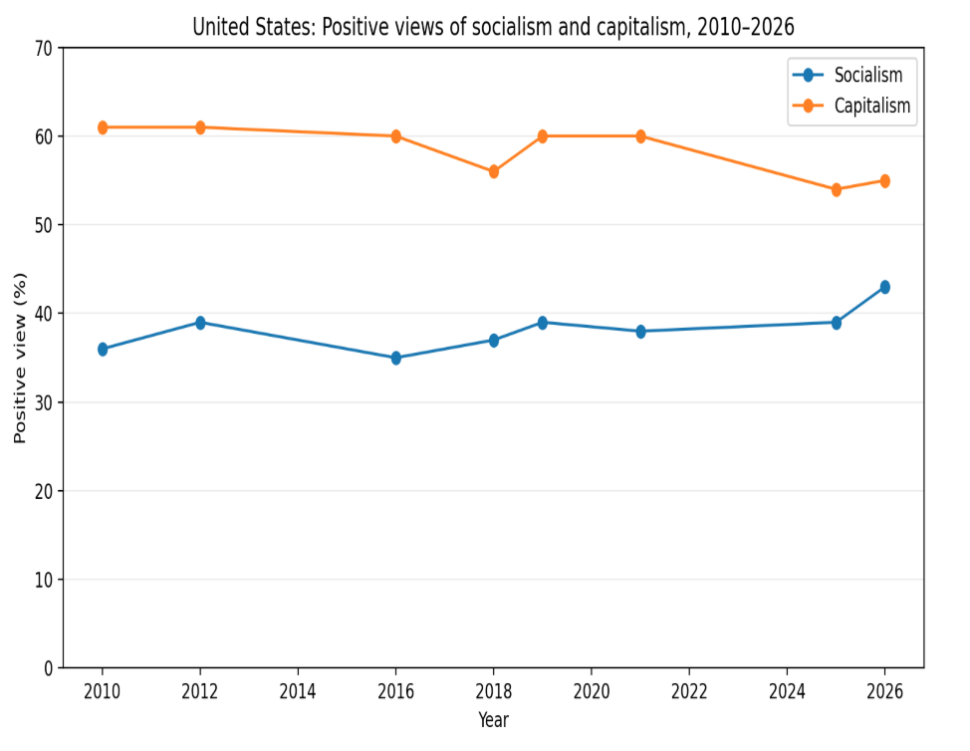
Support for socialism is high today and, in some cases, rising. In the United States, 43% of adults have a positive view of socialism, including 57% of those aged 18–34.10
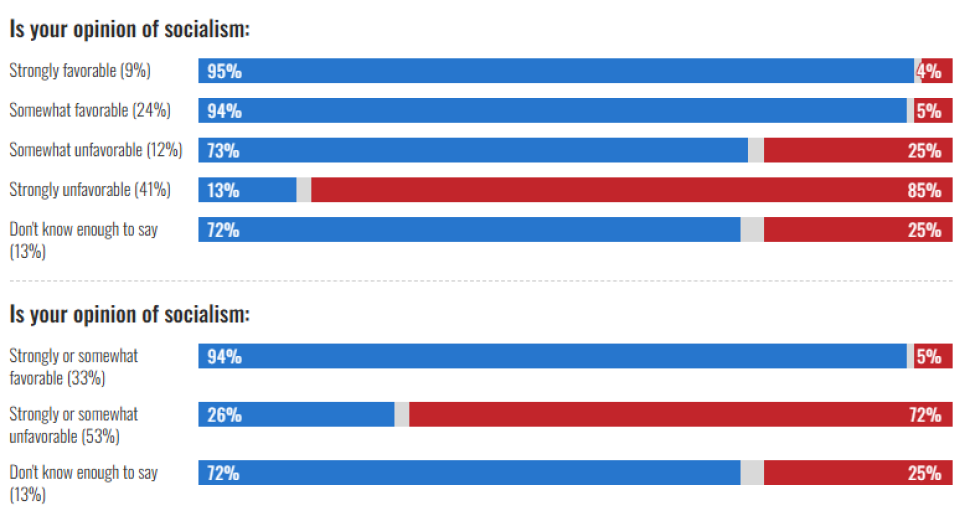
This is further supported by November 2026 US midterm election exit polls, which revealed a significant degree of sympathy for socialism. According to the NBC News exit poll, 33% of voters expressed a favourable opinion of socialism, including 9% who viewed it strongly favourably, while 54% expressed an unfavourable opinion (Figure 2). Among those favourable towards socialism, 93% voted Democratic. In the absence of a viable mass socialist party, these numbers indicate that socialist ideas have a substantial potential audience within the electorate.11 Together with the Gallup evidence, they also suggest a significant potential for the development of left-wing political consciousness.
Capitalism is dominated by big business. In the US, public confidence in big business is remarkably low: in June 2025, only 15% expressed a great deal or quite a lot of confidence in it; among adults aged 18–34 the figure was 10% (Figure 3). This is consistent with the NBC exit poll results, which reveal that a large majority of US voters (69%) believe the economic system in the US favours the wealthy (Figure 4).12


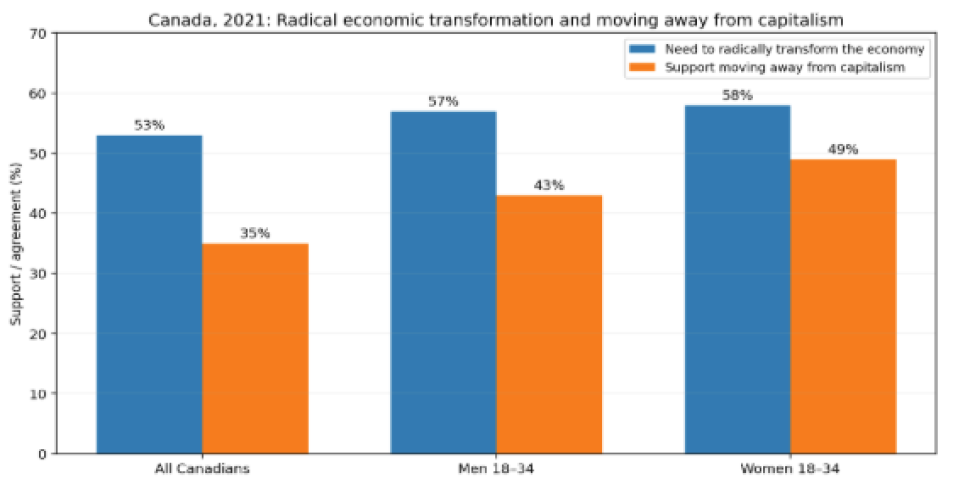
In Canada, anti-capitalist sentiments appear to be widely prevalent too. In an Innovative Research Group poll, 53% agreed that the COVID-19 pandemic showed a need to radically transform the economy and 35% supported government action to move away from capitalism (49% of women aged 18–34 supported this) (Figure 5).
Of course, survey evidence by itself tells us little about whether such attitudes reflect revolutionary Marxist class consciousness. The question, then, is: why does revolution remain necessary and possible?
Five reasons
The following five reasons all stem from one aspect of capitalism: the fundamental interests of capital and labour are ultimately incompatible.
First, because capitalism rests on private control over the means of production and the exploitation of labour, meaning there are structural limits to the concessions capital can grant. A rise in wages, whether resulting from increased investment, class struggle or both, can occur, but as Marx argues it “only means at best a quantitative diminution of the unpaid labour that the worker has to supply”, and “[t]his diminution can never reach the point at which it would threaten the system itself.”13 Consequently, struggles for concessions must ultimately be connected with a revolutionary political struggle for state power.
Second, to the extent that the struggles for significant and durable reforms matter, they become successful when they are integrated into a revolutionary upsurge. As Lenin said: “Reforms are a by-product of the revolutionary class struggle.”14
Third, the state protects the class relations that generate this suffering. The state possesses enormous coercive powers, yet it does not use them to expropriate the capitalist class and reorganise production in the interests of the majority. It does not do so because it is inherently the state of the capitalist class. Revolution is necessary because, as Marx says, “the ruling class cannot be overthrown in any other way.”15
Fourth, existing state institutions cannot simply be used by people to build a new post-capitalist society. Revolution is needed to transform the materiality of the state itself, including through the establishment of recallable representatives receiving workers’ wages. The existing capitalist state apparatus must be replaced by new institutions of democratic working-class power.
Finally, revolution is necessary for a subjective reason. Capitalism inculcates cultural habits that encourage people to accept capitalist relations as natural and inevitable. Marx explained: “The advance of capitalist production develops a working class, which by education, tradition, habit, looks upon the conditions of that mode of production as self-evident laws of Nature.”16
To create a society under their own control, people themselves must change. Revolutionary struggle is needed to produce new forms of consciousness, collective capacity and self-confidence. Marx and Frederick Engels argue in The German Ideology that “the revolution is necessary … because the class overthrowing [the ruling class] can only in a revolution succeed in ridding itself of all the muck of ages and become fitted to found society anew.”17
Why and when is revolution possible?
An important objective condition for revolution is a crisis of capitalist accumulation. Driven by “the restless never-ending process of profit-making”18 on an increasingly global scale, capitalist accumulation develops the productive forces while simultaneously creating class relations that increasingly fetter their further development. This contradiction manifests itself in economic crises, stagnation, unemployment, declining living standards and other forms of deprivation.19 An economic crisis combined with a political or governmental crisis in which representatives of the ruling class are unable to manage capitalism creates conditions for revolution.
Revolution requires revolutionary agency. The proletariat is the leading agent of revolution. Because workers collectively produce value and surplus value, they possess the capacity to interrupt capitalist production. Numbers matter only when workers are united, organised and armed with scientific knowledge and class consciousness and engage in organised anti-capitalist action. Class consciousness does not automatically arise from poverty or suffering, nor does it arise spontaneously from economic-ecological struggles.
Trade unions and mass organisations are important. Socialists must work within them despite the fact that they are often reformist. The masses must fight for transitional demands. Such demands — for example, jobs for all, housing and healthcare for all, urgent and significant action to reduce global warming, and control over key industries by common people — provide a bridge between immediate needs and the struggle for power. They begin with present conditions and consciousness but increasingly challenge the basis of capitalist rule.
Above all, there is a need for a revolutionary socialist party, independent of all fractions of the ruling class and capable of coordinating struggles over immediate and transitional demands, transforming the proletariat’s structural potential into organised political power.20
Within capitalism, women and racialised people experience specific forms of oppression and exploitation. Fearful of the rising proletariat, the capitalist class in the Global South is unable to consistently fight against undemocratic political institutions and oppressive pre- or non-capitalist social relations. Consequently, the task falls on the proletariat, allied with the peasants and other oppressed groups. This is one reason why revolution must have a permanent or uninterrupted character, in the sense articulated by Marx and Engels:
it is our interest and our task to make the revolution permanent until all the more or less propertied classes have been driven from their ruling positions, until the proletariat has conquered state power and until … at least the decisive forces of production are concentrated in the hands of the workers.21
There is another reason why revolution must have an uninterrupted character: imperialism. Imperialist businesses, supported by militarily powerful states, appropriate surplus from workers and peasants in relatively less developed nations, including transitional societies such as China. In the Global South, workers and petty producers suffer because of the actions of imperialist institutions, such as the World Bank and IMF, which are major forces behind neoliberal austerity and other forms of economic devastation that impoverish the masses and facilitate their exploitation by imperialist capital.
Workers within imperialist countries also suffer from imperialism. Militarism diverts enormous resources from social and ecological improvements. Imperialism places workers in different countries in competition with one another. Wars kill ordinary people, contribute to ecological destruction and fuel attacks on democratic rights. Workers in imperialist countries do not just have a moral obligation to support people in the Global South but a material and political interest in opposing imperialism.
The struggle against imperialism and predatory wars is integral to the fight against capitalism and for socialism: “Imperialist war is the continuation and sharpening of the predatory politics of the bourgeoisie... The fundamental content of the politics of the international proletariat will consequently be a struggle against imperialism and its war.”22 The global character of capitalism provides an objective basis for an international alliance of workers and other exploited people in the North and South.
Democratic, agrarian and national tasks must therefore be integrated into the struggle for socialist revolution, rather than assigned to a separate historical stage to be completed before socialist transformation can begin. Revolution must be permanent, both geographically and socially. Without revolution extending into the imperialist heartland, socialist reconstruction cannot be completed in the Global South.
The possibility of beginning socialist transformation within national boundaries is one thing; the possibility of completing socialist reconstruction within those boundaries is another. The former does not imply the latter. As Marx and Engels said, the revolution needs to be permanent
until the association of the proletarians has progressed sufficiently far — not only in one country but in all the leading countries of the world — that competition between the proletarians of these countries ceases.23
Although the revolutionary proletariat is the key agent of revolution, it cannot succeed alone. It needs three kinds of alliance: an alliance with non-Communist scientists to fight obscurantism and post-truth practices spread by a decaying capitalism; an alliance with reformist workers to fight fascist forces; and, a revolutionary alliance with non-exploiting petty producers, especially peasants, based on “an irreconcilable struggle against the influence of the national-liberal bourgeoisie.” The last alliance is particularly important in the Global South.24
Revolution requires a class movement, not a collection of self-isolating sects.25 Political and theoretical differences among revolutionary Marxists are real, and polemical struggle is needed, but ideological demarcation must not become a substitute for intervention in mass struggles. Revolutionary organisations must engage in united action against capitalism and social oppression, and work towards the development of a mass proletarian party.
Conclusion
Academic Marxism’s retreat from this revolutionary perspective does not diminish its necessity. Marx argued that the working masses “require not only a change of distribution, but a new organization of production,… and their harmonious national and international co-ordination.”26 Michael Roberts writes that this requires “the ending of imperialism and its replacement by an association of nations based on democratic planning and common ownership.”27 Anti-capitalism must be anti-imperialism, and vice versa.
Class struggle can result in socialism or the common ruin of the contending classes, expressed as social-ecological barbarism. These outcomes are not inevitable or equally desirable. People have compelling reasons to seek better social-ecological conditions than those capitalism can provide, but their desire for such conditions does not by itself guarantee barbarism will be avoided. Revolutionary reconstruction is necessary and possible, but its realisation depends on revolutionary consciousness informed by Marxist theory, organisation, leadership and political action.
To conclude, here are four clear propositions:
- Socialism is the only solution to capitalism’s social-ecological problems;
- Revolution is the only means of replacing capitalism;
- The proletariat is the only class capable of leading the socialist revolution; and
- Marxism is the only theory capable of guiding the socialist revolution.
Raju J Das is a professor at York University, Toronto, Canada. His teaching and research interests include political economy, class theory, the capitalist state, climate change and workers’ health, and international development. His recent books include Marxist Class Theory for a Skeptical World; Marx’s Capital, Capitalism, and Limits to the State; Contradictions of Capitalist Society and Culture; The Challenges of the New Social Democracy; Theories for Radical Change; and Marx, the State, and Primitive Accumulation. He serves on the editorial board and manuscript review committee of Science & Society, and co-edits the Theory and Class Struggle section of Race, Class and Corporate Power. Further information about his work is available at https://rajudas.info.yorku.ca/
- 1
This article is based on the script of a talk prepared for the Anti-Imperialist Symposium in Toronto on November 8, 2026. It draws on an 8,000-word article.
- 2
Raju J Das. The marginalization of Marxism in academia, LINKS International Journal of Socialist Renewal. https://links.org.au/marginalization-marxism-academia (2020). Raju J Das. The Relevance of Marxist Academics. Class, Race and Corporate Power, 1(1). (2013)
- 3
I discuss academic Marxist work in greater detail in: Raju J. Das, ‘Against the Retreat from Class: Marxist Class Theory in the Age of Capitalist Crises, Part I’ (2026, forthcoming); Raju J. Das, ‘Marxism and Revisionism in the World Today’, Capital & Class 47, no. 3 (2023): 383–406. https://doi.org/10.1177/03098168221139287; Raju J. Das, Marxist Class Theory for a Skeptical World (Brill, 2017), pp. 22–174.
- 4
John Holloway, Change the World Without Taking Power: The Meaning of Revolution Today (Pluto Press, 2002), https://www.thetedkarchive.com/library/john-holloway-change-the-world-without-taking-power
- 5
Erik Olin Wright, ‘Interview with Erik Olin Wright for New Left Project’ (2010), https://www.sscc.wisc.edu/soc/faculty/pages/wright/Published%20writing/New%20Left%20Project%20interview.pdf. See also Erik Olin Wright, Envisioning Real Utopias (Verso, 2010), chap. 8
- 6
Vivek Chibber, ‘Our Road to Power,’ Jacobin (2017), https://jacobin.com/2017/12/our-road-to-power
- 7
Leo Panitch and Sam Gindin, ‘Marxist Theory and Strategy: Getting Somewhere Better,’ Historical Materialism 23, no. 2 (2015): 3–22, at 19.
- 8
David Harvey, ‘Anti-Capitalist Chronicles: Global Unrest,’ Democracy at Work (2019), https://www.democracyatwork.info/acc_global_unrest
- 9
Lenin, V. The State and Revolution (1917), https://www.marxists.org/ebooks/lenin/state-and-revolution.pdf
- 10
Lydia Saad, ‘Socialism’s Positive Rating Tops 40% for First Time,’ Gallup, September 23, 2026, https://news.gallup.com/poll/714653/socialism-positive-rating-tops-first-time.aspx
- 11
However, a favourable opinion of socialism does not necessarily imply support for socialist revolution, or even an understanding of socialism as a system based on collective ownership and control of the means of production. Nor should voting Democratic be confused with support for socialism.
- 12
Note that the NBC figures describe voters, whereas the Gallup figures describe US adults. Note also that the Gallup survey measures confidence in big business, while the NBC exit poll measures perceptions of the economic system's fairness. They are related but not identical.
- 13
Karl Marx. Capital vol. 1. (1887:435). https://www.marxists.org/archive/marx/works/download/pdf/Capital-Volume-I.pdf
- 14
V. Lenin. Fourth Anniversary of the October Revolution (1921). https://www.marxists.org/archive/lenin/works/1921/oct/14.htm
- 15
Marx, K. and F. Engels. The German Ideology. https://www.marxists.org/archive/marx/works/download/Marx_The_German_Ideology.pdf
- 16
Karl Marx. Capital vol. 1. https://www.marxists.org/archive/marx/works/download/pdf/Capital-Volume-I.pdf (p. 520).
- 17
Karl Marx and Frederick Engels, The German Ideology (written 1845–46; Foreign Languages Press, 2022), 60. https://foreignlanguages.press/wp-content/uploads/2025/08/C37-The-German-Ideology-Marx-1st-Printing-FINAL_compressed.pdf
- 18
Karl Marx. Capital vol. 1. https://www.marxists.org/archive/marx/works/download/pdf/Capital-Volume-I.pdf, (1887), p. 107.
- 19
Michael Roberts, The Long Depression (Haymarket, 2016).
- 20
Leon Trotsky, The Transitional Programme (1938), https://www.marxists.org/archive/trotsky/1938/tp/
- 21
Karl Marx and Frederick Engels. https://www.marxists.org/archive/marx/works/1847/communist-league/1850-ad1.htm (1850).
- 22
Leon Trotsky (1938), ‘The Death Agony of Capitalism and the Tasks of the Fourth International’, https://www.marxists.org/archive/trotsky/1938/tp/transprogram.pdf, p. 25
- 23
As Trotsky argues: “One of the basic reasons for the crisis in bourgeois society is the fact that the productive forces created by it can no longer be reconciled with the framework of the national state. … The socialist revolution begins on the national arena, it unfolds on the international arena, and is completed on the world arena.” Leon Trotsky. ‘What Is Permanent Revolution?’ https://www.marxists.org/archive/trotsky/1931/tpr/pr10.htm (1931).
- 24
Leon Trotsky, ‘What Is Permanent Revolution?’ https://www.marxists.org/archive/trotsky/1931/tpr/pr10.htm (1931)
- 25
Raju J Das. ‘The weapon of criticism cannot replace the criticism of the weapon’, International Journal of Socialist Renewal, 2021. https://links.org.au/weapon-criticism-cannot-replace-criticism-weapon-what-knowledge-do-we-need-revolution-against
- 26
Quoted in Roberts, Michael. “China as a Transitional Economy to Socialism?” Journal of Global Faultlines 9, no. 2 (2022): 180–97. https://www.jstor.org/stable/48713461, p. 181
- 27
Roberts, Michael. “China as a Transitional Economy to Socialism?” Journal of Global Faultlines 9, no. 2 (2022): 180–97. https://www.jstor.org/stable/48713461