Asia
Sri Lanka: Genocide of the Tamil minority

By Brian Senewiratne
January 23, 2009 -- There is a humanitarian crisis in Sri Lanka, where the Tamil minority in the island’s north and east are facing annihilation at the hands of the Sinhalese-dominated government.
This article will deal with the current crisis, with the more fundamental problem of the legacy left by colonial British rule (1796-1948) dealt with in later articles. These colonial administrative structures will need to be reversed of there is ever to be peace or prosperity in Sri Lanka.
I am a Sinhalese, from the majority community, not from the brutalised Tamil minority. I quit Sri Lanka in 1976.
Who runs that country is of no concern to me, as long as it is run without serious violations of human rights. Sri Lanka was tossed out of the UN Human Rights Council in May last year due to its human rights record, and the drift of a democracy to a fascist politico-military dictatorship, none of which have been publicised internationally.
Current problem
Sri Lanka: Behind the genocidal war against the Tamils
By Tony Iltis
January 17, 2009 -- The January 14 announcement by the Sri Lankan government that its forces had completed the capture of the Jaffna Peninsular, effectively bringing all of the historic Tamil nation in Sri Lanka’s north-east under military occupation, was a grim reminder that the Israeli assault on the Gaza ghetto is not the only holocaust at the start of the new year.
The Tamil people have been fighting for independence from Sri Lanka since 1983 when an island-wide pogrom (the most violent of several that had regularly occurred since 1956) convinced Tamils that they would not attain equality or security under the Sinhala-chauvinist state that has ruled Sri Lanka since independence in 1948.
Sinhala is the first language of 74% of Sri Lankans. Most of the remainder are Tamil-speaking. Tamils form the majority in the north and east of the island (Tamil Eelam).
While the government has declared that the group leading the armed resistance, the Liberation Tigers of Tamil Eelam (LTTE), is finished as a military force, this is not the first time their demise has been announced. However, it has undoubtedly suffered a serious setback as a result of the sustained military offensive by the Sri Lankan army.
Thailand: Activist Giles Ji Ungpakorn charged with `insulting' monarchy
[Please sign the petition HERE against the attack on freedom of speech in Thailand, which the use of lese majeste represents.]
By Giles Ji Ungpakorn
January 20, 2009 -- Today, the police informed me that I have been charged with lese majeste because of eight paragraphs in Chapter 1 of my book A Coup for the Rich. The paragraphs are listed below.
According to the police charge sheet, the charges arise from the fact that the director of Chulalongkorn University bookshop decided to inform the police Special Branch that my book "insulted the Monarchy". The bookshop is managed by the academic management of the university. So much for academic freedom!
Paragraphs from A Coup for the Rich that are deemed to have "insulted the Monarchy":
Please sign the petition (below the videos) and ask others to sign.

Giles Ji Ungpakorn
Readers of Links International Journal of Socialist Renewal are urged to send letters of protest and calling for all charges against Giles Ji Ungpakorn to be dropped. Send them to the Thailand's Prime Minister Abhisit Vejjajiva at Government House, Bangkok, Thailand, fax number +66 (0) 29727751. Please also write letters of protest to the ambassador of the Royal Thai embassy in your own country.
By John Berthelsen
Asia Sentinel -- January 12, 2009 -- Giles Ji Ungpakorn, a political science professor at Thailand's Chulalongkorn University and a well-known socialist activist, has been ordered to appear at a Bangkok police station to be charged under the country's stiff lèse majesté laws for insulting the country's monarchy.
Malaysian police detain anti-war protesters; PSM slams minister’s ‘double standards’
Malaysiakini -- January 10, 2009 -- The police have arrested 21 people, including member of parliament for Klang MP Charles Santiago and several top leaders of the Socialist Party of Malaysia (Parti Sosialis Malaysia -- PSM, at an anti-war vigil at Dataran Merdeka, Kuala Lumpur. The vigil was organised by Anti-War Coalition to show support to the victims of war and aggression in Palestine and Sri Lanka.
About 200 people had gathered at about 8pm for the vigil, which was declared illegal by the police who were also present at the venue. About 100 light strike force personnel were on hand to control and disperse the crowd.
The crowd was ordered to disperse and the 21 were arrested for their failure to leave the area. They were then taken to the Dang Wangi district police headquarters. They are still being held at the police station.
Among those held were Parti Sosialis Malaysia leaders Dr Nasir Hashim and S. Arutchelvan, PKR’s Kuala Langat MP Abdullah Sani and several activists from Suaram and Jerit. Nasir is also the Kota Damansara state assemblyperson.
Ferment in Nepal: A dynamic vortex of revolutionary change

By Bill Templer
World economic crisis: No room for band-aid solutions in the Third World
By Reihana Mohideen
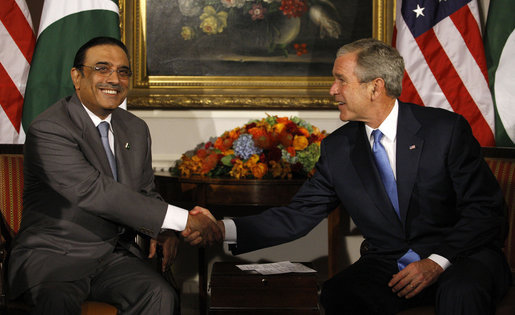
A government in pandemonium: The first nine month of Pakistan Peoples Party rule
By Farooq Tariq
December 22, 2008 -- Instability, price hikes, growing unemployment and rising debts are the hallmarks of the first nine months of the Pakistan Peoples Party (PPP) government. There are daily demonstrations across Pakistan around one or another of these issues.
There is a real danger of a war between Pakistan and India after the Mumbai terrorist attack on November 26. The statement by Pakistan's President Asif Ali Zardari about the doubtful Pakistani identity of Ajmal Qasab, the only terrorist captured alive, did not go down very well within the Indian establishment. The joint war-room meeting of all the Indian government's important officials is a very serious matter.
Spend the trillions on climate!

Sydney, October 2, 2008.
Indonesia: Protest napalm bomb attack on farmers' settlement!
By Papernas (National Liberation Party of Unity, Indonesia)
December 18, 2008 -- About 1000 thugs sent by PT Arara Abadi and directly led by 500 police, under Riau regional police commander Alex Mandalika, unsparingly attacked, destroyed and burned houses using napalm bombs in Suluk Bongkal village, Riau Province, Indonesia. A two-year-old girl died in the attack.
The attackers said the villagers were newcomers who must be evicted. They were also falsely accused of having ilegally cleared state-owned forest. According to our information, Suluk Bongkal village has been legally acknowledged in the state map made after the Dutch cooperated with the Siak kingdom (around 1940), and in 1959 (after independence) the area was designated as customary rights forest (for Sakal tribe); Suluk Bongkal was included in it. Suluk Bongkal villagers have lived peacefully with the other citizens and surrounding tribes.