trade unions
How the Communist Party of Australia exposes the Democratic Socialist Party's 'Trotskyism'
By Doug Lorimer
[This article first appeared in the Democratic Socialist Party's internal discussion bulletin, The Activist, volume 10, number 7, August 2000.]
The Communist Party of Australia has recently published a pamphlet by David Matters entitled Putting Lenin's Clothes on Trotskyism which claims that the DSP's rejection of Trotsky's theory of permanent revolution is really a cover for its support for Trotskyism. However, the real purpose of the pamphlet is to criticise the DSP's position on the 1998 waterfront dispute.
This is made clear in the introduction to Matters' pamphlet by CPA general secretary Peter Symon:
In writing Putting Lenin's clothes on Trotskyism, David Matters has contributed to the task of clarifying ideas and maintaining the validity and truth of Marxism...
The attack on Marxism in the name of Marx, or on Lenin in the name of Lenin, is a particularly pernicious form which can easily mislead those who are not familiar with what Marx, Engels and Lenin actually said and wrote.
The pretension that Trotsky was a great Leninist is one of these misrepresentations and was refuted time and again by Lenin.
China: Workers' strikes -- what did they win?
By Boy Lüthje
South Korea: `Just the first round' by `irregular workers' at Hyundai Motors
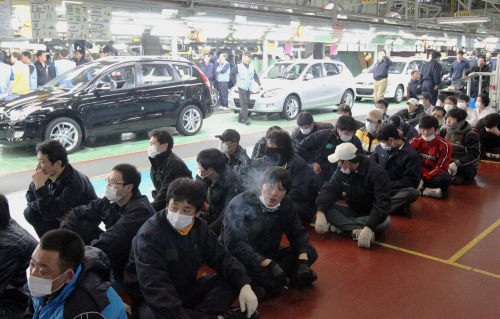
Hyundai Motors workers' sit-in at Hyundai's plant in Ulsan.
reports on strikes and factory occupations at Hyundai Motor Company in South Korea, which is building solidarity among regular and irregular workers, and among workers internationally.
December 16, 2010 -- Socialist Worker (US) -- "Even a worm will squirm when it is being stepped on" is an old Korean idiom that basically means that even the most powerless creature reacts against an aggressor. However, when such a worm is transformed into a fearful dragon, it will do a lot more than just squirm, to the point that you had better think twice about stepping on it.
That's what happened at one of South Korea's most profitable companies, Hyundai Motors, when the company's irregular workers mobilised with strikes and factory occupations during the middle of November, after decades of being "stepped on". Before we start with that fateful day of November 15, we need to take a look at how it progressed.
South Africa: `COSATU has waged titanic battles' -- COSATU marks its 25th anniversary

Workers celebrate COSATU’s 25th anniversary. Picture: Gallo Images.
The following speeches, by COSATU's president and general secretary, were delivered at a ceremony in Johannesburg on December 3, 2010, to celebrate the Congress of South African Trade Unions' 25th anniversary.
* * *
By Sidumo Dlamini, COSATU president
December 3, 2010 -- Cyril Ramaphosa was prophetic when he declared that “a giant has arisen!” That giant has grown from 130,000 members when it was launched to well over 2 million paid up members today.
While still barely walking, the young giant launched itself into titanic battles against employers and the apartheid regime. In his speech at the launch, founding COSATU president Elijah Barayi gave apartheid ruler P.W. Botha a six-month deadline to do away with passes. Indeed Botha succumbed and the hated pass laws that had humiliated millions for decades were scrapped. Today we carry proper identity documents.
France: Not victorious, but not defeated

By Murray Smith
New Zealand: Matt McCarten on Unite and the prospects for a new left party

Matt McCarten (right) campaigning for better pay.
December 7, 2010 -- Links International Journal of Socialist Renewal -- Matt McCarten is secretary of the New Zealand's fastest growing union, Unite. The union organises fast-food workers, cleaners, hotel and casino workers, security and part-time staff. It has a financial membership of 8000 members. The transient nature of the industries the union organises means it has an annual membership turnover of 66 per cent and recruits about 600 new members every month. The union operates on an income of just over 1 million dollars per annum.
McCarten is a veteran of many left campaigns, including playing a key role in the foundation of the New Labour Party following the split from the New Zealand Labour Party in 1989. It was his leadership in the historic 1985 occupation of the Sheraton Hotel with the Hotel and Hospital Workers Union that put McCarten in the national spotlight. He writes a weekly column for the Herald on Sunday.
France: Movement debates next steps in resistance to government attacks
By Chris Latham
November 14, 2010 -- Green Left Weekly -- President Nicolas Sarkozy enacted a new law on November 10 that increases the retirement age of French workers. The move came just days after more than a million workers and students mobilised across France against the law.
The November 6 protests were the eighth national strike and protests since September 7 against the bill — although it was the easily the smallest of the mobilisations.
The protest highlighted the depth of ongoing popular anger over the changes, which were pushed through parliament on October 27. However, the decline in the size of the protests reflects growing divisions in the movement over its direction now the law has been passed.
Sarkozy enacted the law just hours after it had been approved by the Constitutional Council. There had been hopes among some union leaders and left groups that the council would reject the bill.
Indonesia: FNPBI fifth congress -- `Time to awaken the sleeping lion'

Compiled by Ulfa Ilyas, translated by Risma
November 4, 2010 -- Berdikari -- The National Front of Indonesian Workers’ Struggle (FNPBI) held its fifth congress on October 24-26 in Denpasar Bali. About 300 FNPBI organisers from nine provinces of Indonesia attended the opening ceremony. It was also attended by Agus Jabo Priyono, the chairperson of People's Democratic Party (PRD), and Agung Winarte from the Labor Department of Bali Province.
Agus Jabo, in his solidarity message, highlighted the importance of workers organising themselves and being at the forefront of the national liberation struggle. He disagreed with the idea that labour movement should not be political. He asserted that to alienate the workers from the political arena is the same as to deny the workers a better future.
Swaziland: Historic unity and merger of trade union federations
October 2010 -- COSATU has welcomed the great leap forward and giant step taken by workers of Swaziland in resolving to unite by merging the two federations; Swaziland Federation of Trade Unions (SFTU) and Swaziland Federation of Labour (SFL), together with the independent Swaziland National Association of Teachers (SNAT) to form a new giant federation. It marks the deepening and strengthening of the most progressive, militant and revolutionary traditions constantly being evolved by the working class movement the world over.
This breakthrough comes after years of hard work, dedication and sacrifice behind the scenes to diagnose, confront and clear all obstacles in the way of unity. Frank and brutally honest engagements, painful and demanding persuasions, as well as engaging feedbacks to members are all the hallmarks of a transparent, democratic and accountable process characterised by traditions of worker control. Once this part of the journey has been travelled with success, the nearing horizons only serve to inspire the march on.
Turning the tide of oil in US and world politics
By Dan La Botz
