women
The Communist Women’s International (1921-26)

"Emancipated woman -- build up socialism." Poster by Strakhov-Braslavskij A. I., 1926.
By John Riddell
June 12, 2011 -- The following working paper was presented to the Toronto conference of Historical Materialism on May 16, 2010. It first appeared on John Riddell's blog and is posted at Links International Journal of Socialist Renewal with the author's permission.
* * *
When we celebrate International Women’s Day, we often refer to its origins in US labour struggles early last century. Less often mentioned, however, how it was relaunched and popularised in the 1920s by the Communist Women’s International. Moreover, this movement itself has been almost forgotten, as have most of its central leaders.
The Communist Women’s International was founded by a world gathering of communist women in 1921, which elected a leadership, the International Women’s Secretariat, reporting to the executive of the Communist International, or Comintern. It also initiated the formation of women’s commissions in national parties, which coordinated work by women’s bodies on a branch level, and called periodic international conferences of Communist women.
Venezuela: Discussing the workers' control movement: An interview with 'Cayapa' radio show

The workers at Grafitos del Orinico are proud of their collectively run factory. Photo by Ewan Robertson.
Raj Patel: Can the world feed 10 billion people? Yes, but social change needed

Maize farmers in Malawi.
Global microfinance industry totters as Grameen Bank founder’s career ends in disgrace

Grameen Bank's Muhammad Yunus (right) with Bangladeshi women. The promised empowerment and poverty reduction failed to eventuate.
By Patrick Bond
April 27, 2011 -- Links International Journal of Socialist Renewal -- Bangladesh’s once-legendary banking environment is now fatally polluted. The rot is spreading so fast and far that the entire global microfinance industry is threatened. Controversy ranges far beyond poisonous local politics, the factor most often cited by those despondent about Grameen Bank’s worsening crisis.
Sexual self-determination in socialist Cuba: An interview with CENESEX director Mariela Castro Espín
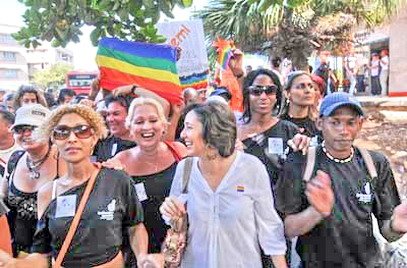
CENESEX director Mariela Castro Espín (centre).
March 23, 2011 – Links International Journal of Socialist Renewal -- In Cuba, there is a LGBTT [lesbian, gay, bisexual, transvestite, transsexual] movement whose gestation is found at the intersection of the state and organised civil society. This movement seeks to tackle the main themes of LGBTT reality from the perspective of human rights, health and social integration, while inserting itself into the national project of a just society. Historically, the space for its existence was provided by the country’s women’s movement, which was largely responsible for making Cuba, in 2008, the first country in the Americas to have sex-change operations included in the universal health-care system.
Egypt: Much more than a `Facebook revolution'

February 18, 2011 – There has been much written in the main
Women and revolutionary transformation in Venezuela
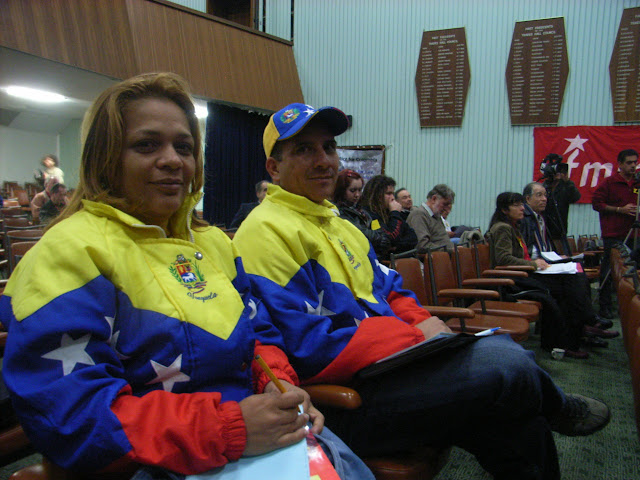
Yoly Fernandez (left) during her 2009 Australian tour, organised by the Australia-Venezuela Solidarity Network.
By Coral Wynter
Yoly Fernandez lives in a barrio in the city of Valencia in Venezuela. She has been involved in community politics all her life and is a member of the United Socialist Party of Venezuela (PSUV), headed by Venezuela's President Hugo Chavez. Fernandez works in Mission MERCAL, the government agency that sells subsidised food to the population. I interviewed her in May 2010.
* * *
How has the life of women improved over the last 10 years of the Chavez government?
Our lives have improved enormously, mainly in the area of humane values; not so much at the level of work or even at the political level. I say humane because now the role of women is valued, not as an object but as a subject, as mother, wife, daughter and sister.
Why calls for a ban on the wearing of the burqa help the racists
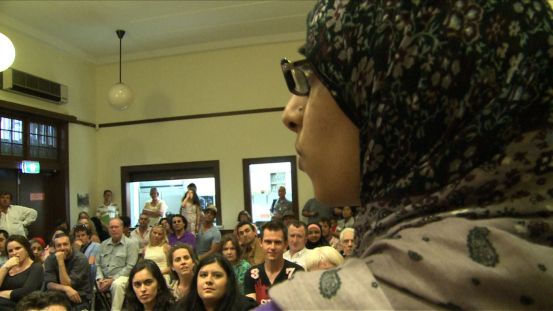
Pip Hinman addresses the meeting on November 24, 2010.
By Pip Hinman
Australia: A community says no to racist burqa bans
By Peter Boyle, Sydney
November 26, 2010 -- All around the Western world, far-right groups (some with neo-Nazi orgins and links) are gaining political ground through an orchestrated campaign against Muslim communities. By spreading fear and hatred against recent immigrant communities from Muslim countries these groups have tapped into well-resourced post-9/11 war propaganda campaigns initiated by rulers of the world’s richest and most powerful states.
One of the favourite tactics of these anti-Muslim hate campaigners is to push laws banning the burqa, the fully veiled dress style used by a tiny minority of Muslim women. In Australia, the ultra-conservative Reverend Fred Nile, leader of the Christian Democratic Party and a member of the NSW Legislative Council, and Liberal senator Cori Bernardi from South Australia, have unsuccessfully tried to move private member's bills to ban the burqa.
Australia -- burqa ban debate: If I can't wear a burqa it's not my revolution?

Kiraz Janicke's "Burqa Revolution".
Green Left Weekly -- On September 23, the Daily Telegraph reported on a wall mural in the Sydney inner-west suburb of Newtown by artist Sergio Redegalli with the slogan “Say no to burqas”. Redegalli’s mural has sparked protests by local residents who have condemned it as racist. Sydney Socialist Alliance activist Kiraz Janicke says Redegalli’s piece “has no other value than to promote racism”. She has responded with an artwork of her own — a submission to the Live Red Art Awards, titled “Burqa revolution”.
Below, Janicke argues that banning the burqa (a veil covering the entire body, with a mesh over the eyes), or other forms of Islamic dress worn by some Muslim women that cover the face, will hinder true women’s liberation.
* * *