[Updated] Kurdish left statements: Defend Rojava!
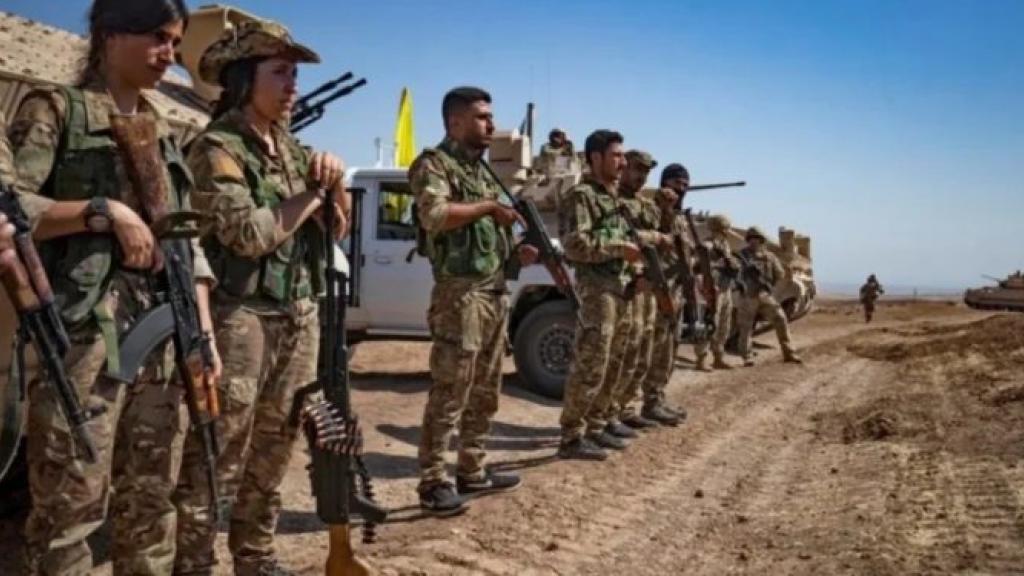
Statements by Kurdistan Democratic Communities Union, Democratic Union Party and Kongra Star Coordination denouncing the Damascus transitional administration’s attacks on Rojava and North and East Syria.
Women’s Protection Units (YPJ): To democratic public opinion and women of the world striving for freedom
Since 6 January 2026, armed groups affiliated with Hay’at Tahrir al-Sham and the Turkish occupying state have been launching attacks against the Women’s Revolution in North and East Syria. Following the massacres committed in the Sheikh Maqsoud and Ashrafieh neighborhoods of Aleppo, these factions have carried out further massacres in cities such as Raqqa, Tabqa, al-Shaddadi, Ain Issa, and the countryside of Kobani. These attacks have targeted women—especially the women of North and East Syria who have struggled for decades for a democratic and communal life. The most horrific crimes have been committed against women fighters within the ranks of the struggle.
In their attempt to revive ISIS in the region, they have sought to distort the image of women — particularly women fighters — and to sow division among peoples. They even cut the braid of a Kurdish woman fighter, claiming that this braid would spread fear and anxiety within the struggle for women’s freedom. But they failed to understand that women across Kurdistan are stronger than ever in the face of such atrocities. They are fighting these merciless gangs on the front lines in defense of human dignity and honor, just as they once fought against the brutal gangs of ISIS for the sake of freedom.
Our anger and deep loathing toward the mentality that denies the very existence of women continue to grow. Therefore, as the Women’s Protection Units, we are taking our place on all fronts of resistance. We are fighting to protect our existence and responding forcefully to these barbaric gangs.
The Women’s Revolution in Rojava Kurdistan embodies the foundation of a democratic life for all peoples. It has been built with the blood of 15,000 women martyrs, and thousands of fallen women have led this struggle. Today, with the same determination to protect their honor and dignity, women under the banner of the Women’s Protection Units are leading the way in defending the values of communal life that are being destroyed around women, by joining the movement of women from across the entire region.
We renew our commitment to struggle and resistance, and we say it clearly: let friend and foe alike know that this revolution — led by women and strengthened by the heroism of young people struggling for women’s freedom — will raise the call of freedom on this land with greater determination, will, and struggle than ever before. Just as it defeated the genocidal ideology of Daesh (ISIS) in Kobani, it will plant the seeds of communal life in this land once again.
Therefore, we say that our braided hair has become a source of fear in the hearts of our enemies, because victory will inevitably belong to women and freedom-loving peoples. From this standpoint, we call on Kurdish women, all women of the Middle East, and women around the world striving for freedom to participate more strongly in the mobilization inspired by the philosophy of Leader Abdullah Öcalan: “Woman, Life, Freedom.”
Every woman whose heart beats for freedom must know that the Rojava Revolution is a guarantee for the freedom of all women. Today, not only Rojava Kurdistan and all its components, but also the peoples of all four parts of Kurdistan, are facing a horrific genocide. We call on all women to join the mobilization in the spirit of Kobani and to defend their dignity based on the principle of the existence of women and peoples.
Let our people know that we will never bow to the jihadist ISIS mentality and will never surrender. For us as women fighters of this people, nothing is more important than protecting the existence of the Kurdish people and all its components. Our hopes are as strong as the number of our braids. No one can erase us by cutting a braid, and our hopes will not vanish under the attacks of colonialists and genocidal forces. For this reason, none of the inhumane acts committed against our women fighters will go unpunished.
Ilham Ehmed (Democratic Autonomous Administration of North-East Syria): Diplomatic pressure needs to be applied most forcefully upon the aggressor
Ilham Ehmed, Head of the Office of External Relations, Democratic Autonomous Administration of North-East Syria (DAANES), sent an urgent letter to the 15 members of the U.N. Security Council and the Secretary-General of the United Nations which is meeting today to discuss Syria.
Ehmed urges immediate U.N. intervention to enforce the cease-fire that Syrian president al-Sharaa himself called, and is now violating. As of this morning, the town of Kobani is completely under siege without water and electricity, and thousands are suffering as government troops and their extremist allies intensify attacks across the region.
It is urgent that the Security Council take action to condemn this violation of the ceasefire and that international partners from around the world intervene to forge a plan that would allow for the resumption of negotiations between the government and the Kurds, leading to a democratic, peaceful, and stable Syria.
Addressed to António Guterres, Secretary-General of the United Nations, and Ambassador Abukar Dahir Osman, Permanent Representative of Somalia to the United Nations, President of the UN Security Council, the letter by Ilham Ehmed includes the following:
Current security situation
The immediate situation – on 21 January, today - is that the military forces of the Syrian Transitional Government (STG) of President Ahmed Al-Sharaa continue to attack towns and villages in the North East region despite the announcement of a ‘ceasefire’ by the transitional president on 20 January. For our part, the SDF has announced its acceptance of the ceasefire. We want a cessation of all violence immediately, but if the government’s attacks continue, we are forced to engage militarily in order to defend and protect civilians.
Urgent need for ceasefire
The need for a ceasefire is urgent, and we hope that the Council will call for one immediately. At the same time, it’s important for Council members to note that only the government is currently engaged in aggressive hostilities. We are not. It is easy in these circumstances to place blame equally on ‘both parties’ or call for general ‘de-escalation’ by both sides. However, in this case, this would be inaccurate. Diplomatic pressure needs to be applied most forcefully upon the aggressor.
The origin of the current violence
The government attacks began with assaults on civilian Kurdish neighbourhoods in Aleppo on 6th January. This assault, which involved tanks and artillery in civilian areas, was totally unprovoked and came without warning. In addition to the deployment of heavy weapons, drones conducted air strikes on civilian areas. These attacks resulted in 107 civilian deaths and 322 injured civilians. 35 thousand household civilians were displaced and are now refugees in eastern Syria.
In order to prevent further bloodshed, and upon the advice of the US, we agreed to withdraw SDF forces from Aleppo and from other areas west of the Euphrates River. After further negotiation with the government, we then agreed to withdraw from Deir ez Zor and Raqqa governorates. These concessions, however, did not end the government’s aggression. STG forces attacked SDF soldiers across eastern Syria and pushed towards the major towns of Hasakeh and Kobani. At the time of writing, both towns remain under siege. All water and electricity has been cut off to Kobani, causing significant civilian suffering. The president’s announcement of a ‘ceasefire’ also contained, it must be noted, an explicit threat to attack towns and villages of the North East if the government’s terms were not accepted.
STG forces have been accompanied by other armed groups, including remnants of the Hayat Tahrir al-Sham (HTS), the Syrian National Army (SNA), and assorted jihadists, including former members of Al-Qaeda and ISIS – known members of both terrorist groups have been identified alongside government forces. Both STG forces and these extremist groups have committed atrocities both against civilians and SDF soldiers, both men and women. SDF soldiers have been tortured and summarily executed, their corpses desecrated or thrown off buildings. Videos of these criminal acts are then gleefully shared online by the jihadists, accompanied by religious chanting celebrating the murder of non-believers (i.e. Kurds), acts which are reminiscent of ISIS terrorism in years past. The religious and ethnic character of the STG campaign was underlined by the government’s denoting of its aggression as ‘Anfal’, a Koranic verse cited by Saddam Hussein for his genocidal campaign in northern Iraq in 1988 which killed 100,000 Kurds.
Background to the current situation
There is a broader history which must be understood. We, like other Syrians, welcomed the fall of the dictator Assad, who was responsible for systematic repression of Kurds in Syria, including the denial of citizenship and other human rights. When power was seized by President al-Sharaa in December 2024, we repeatedly pledged our willingness to partner with him to build a new, unified Syria. For example, the commander of the SDF signed an agreement with President al-Sharaa on 10 March 2025 committing the SDF to become an integral part of the Syrian army. There were several meetings to take this agreement forward, including with the transitional president himself. We made multiple proposals for military integration, including handing over a list of SDF personnel, an act of significant good faith and trust, and proposing that the SDF join the army as three distinct divisions, in order to preserve their regional character. President al-Sharaa accepted this proposal, and his agreement was witnessed by several officials from the government, SDF and the US. However, since that meeting, there has been no response to our proposals. At a meeting in Damascus on 4 January, the government delegation abruptly terminated the meeting without explanation.
Despite the clarity of this history, today we face accusations of ourselves blocking the process of integration. This could not be further from the truth.
On the political future of Syria, it should be emphatically noted that President Al-Sharaa has never been elected as president. He took power by force. At the parliamentary ‘elections’ that took place in November, the president appointed a third of the ‘elected’ representatives and the other two-thirds were appointed by committees appointed by him. Most notably, there were no elections in the North East or coastal regions. Therefore, there is no democratic mandate to claim the rule of Syria. We have been, however, and remain, prepared to work with the STG to establish a stable long-term constitutional settlement for Syria.
Instead, the president made a ‘constitutional declaration’ in March 2025 which granted extensive and unaccountable powers to the president, including the power to suspend the representative assembly, i.e. democracy itself, in wholly undefined circumstances and without restraint by any other institution, such as the assembly, or courts. Power was concentrated in Damascus, i.e. the presidency, with no devolution of power to the regions. Islamic law was named as the only source of national laws. Democratic elections were postponed for five years, an inexplicably long period. In short, therefore, Syria now has an unelected president governing by decree and announcement. In our opinion, this is not dictatorship – yet – but it is not democracy either.
Meanwhile, there have been bouts of ethnically driven violence against the Alawite and Druze minorities in western and southern Syria, and now against Kurdish communities in the North East. Hundreds have been killed in this violence, which has involved massacres, torture and summary executions. The involvement of government forces and the extremist groups which operate alongside them in these killings has been well documented, including by international human rights organizations. After these events, it is unsurprising that there is little confidence among Syria’s minorities that they will be protected by this government.
The way forward
It is unconscionable in these circumstances for the international community to permit the violent and militarized imposition of central government rule in the North East. Our region has been self-governed with stability and peace since 2012. It is a direct democracy, where the people themselves make decisions. It is a unique women-led and multi-ethnic government, and should not be essentialized as ‘the Kurds’, which is a lazy (and, frankly, ‘Orientalist’) way to reduce a multi-ethnic dispensation built over many years, involving Arabs, Yazidis, Syriac communities as well as Kurds. This depiction and resulting policy are the typical habit of arranging the affairs of the Middle East without consulting the people themselves, and without taking account of the complexities and history on the ground.
To reflect the needs and protect the rights of the many ethnic and religious groups present in today’s Syria, we have proposed a decentralized government structure, with significant powers devolved to the regional governorates. We have never proposed that the North East be governed separately or that it should secede from Syria, as some have claimed, along the lines, for instance, of the German Basic Law or Swiss constitution, is the best, in fact the only, way to guarantee the rights and safety of Syria’s minorities and thus provide peace and stability for the country as a whole.
Council members should be aware that the current state that the transitional government is building in Syria is not a rights-respecting ‘democracy’. It is a highly centralized and Islamist government which prioritises the rights of the majority ethnic group and Islam itself over other religions and ethnic groups, which are instead to be dominated by force and coercion, usually outside the gaze of the international press. This manner of governing is a recipe for instability. Note, for instance, the naming of the Syrian army as the ‘Syrian Arab Army’ – an overt choice to exclude Syria’s Druze, Yazidi and Kurdish communities. At the same time, legitimizing the fight against the SDF by falsely depicting the SDF as ‘terrorist’, a description that flies in the face of the SDF’s long history – and huge sacrifices – in combating ISIS terrorism for the last 12 years, at a cost of no less than forty thousand casualties, and our long-standing commitment to joint operations against ISIS under the international auspices of Operation Inherent Resolve (OIR).
The necessary role of the United Nations
In the circumstances we have described, there is a clear need for impartial international engagement to ensure peace and security – and democracy - in Syria. We would welcome the establishment of a formal negotiation process, convened by the UN Special Envoy, attended by other states with an interest, to discuss both military and political integration in Syria. This process would be the most constructive and, we trust, peaceful way to arrange the integration of the SDF with Syria’s existing army and to agree the fundamental elements of a new constitutional settlement, one that with substantive measures (and not mere declarations) protects all minorities, and women as well as men. Negotiations to date have been sporadic and sometimes chaotic, with no accountability for decisions made – such as President Al-Sharaa’s explicit agreement in October to our proposals for SDF integration.
Syria should not be governed and dominated by a single individual or group. This is a recipe for civil war and repression. Syria’s future should be for all the regions and minorities of Syria, its women and men, to decide. We call on the UN to enable and lead such a process of discussion and decision. A statement to this effect from the Council’s deliberations on 22 January would be a good start.
Kurdistan Democratic Communities Union: The spirit of resistance of Kobanê must rise!
Following the attack on Kurdish neighborhoods in Aleppo, attacks have also been launched on Rojava and North and East Syria. These attacks are being carried out by HTS, gangs and mercenaries affiliated with Turkey, and with the direct support of the Turkish state. This attack is a conspiracy against all Kurds and the people of the region, embodied in Rojava and North and East Syria. The international forces with their military and political presence in the region have also become partners in this conspiracy through their policies and attitudes.
Kurdish people’s leader, Abdullah Öcalan, had conveyed a statement, underlining that confidence-building measures should be taken by the Autonomous Administration of North and East Syria to reduce the tensions in Syria. He has also called on the Damascus transitional administration to avoid further conflict. The Turkish state is aware of these calls. While the Autonomous Administration of North and East Syria and the SDF were preparing to take important steps, attacks were carried out on Kurdish neighborhoods in Aleppo. Autonomous Administration officials stated that while a positive outcome had been achieved in the meetings held on January 4 under the supervision of US officials, Shaibani, who is under Turkish influence, intervened in this meeting and prevented a joint statement from being given. Thus, reconciliation and agreement were sabotaged, and the Kurdish neighborhoods of Aleppo were attacked. It shows that these attacks were planned in advance and that the talks were used as a stalling tactic.
The Turkish state has been actively involved in planning and executing this war. From the outset, HTS leader Jolani has constantly threatened the Kurds with a reactionary and monist mindset, refusing to respond to the reconciliation efforts of the Autonomous Administration of North and East Syria and demanding submission to his oppressive rule. These attacks aim to dismantle the Autonomous Administration established by the Kurds, Arabs, Syriacs, and other peoples based on the concept of the ‘Democratic Nation.’ The goal is to create a fascist system in Syria based on one single nation and on one single faith. This mentality marks an attack on the co-existence of peoples and faiths in the Middle East, including Syria. Thus, the concept of the Democratic Nation that would bring peace and stability to the Middle East is being undermined.
These attacks have once again demonstrated that the monist, capitalist international powers are willing to trample on any value for their own interests. The Kurds and the people of North and East Syria have given more than 10,000 martyrs and tens of thousands of wounded in the fight against ISIS. ISIS launched a war against all of humanity; the Kurds and the peoples of North and East Syria fought at the forefront against ISIS to protect humanity. International powers have taken a stance of standing with the Kurds who resisted ISIS during this process. They saw their own interests in this, but after ISIS was defeated, they did not provide the necessary support for the struggle for a free and democratic life of the Kurds and the people of North and East Syria. After making Jolani the ruler of Damascus, they became supporters of the ISIS-minded HTS and turned down the peoples of Rojava and North and East Syria, who have given over 10,000 martyrs and tens of thousands of wounded in the fight against ISIS. In doing so, they hypocritically trampled on all moral, ethical, and moral values. They are sacrificing the people once again for their own interests.
While the Kurds, with their mentality of the Democratic Nation, have created an exemplary model for the Middle East together with Arabs, Syriacs, and other peoples, the HTS administration is trying to destroy this oasis of democracy in the Middle East by attacking Alawites, Druze, and Kurds. The international powers have revealed what kind of Middle East they want through their support for HTS. Thus, democracy and women’s rights are merely a mask on their faces.
These attacks are not only against Rojava and North and East Syria but also a conspiracy against all Kurds. It is not desired for Kurds to have any will or power anywhere. Kurdish-hostile and genocidal forces, in particular, are targeting the existence of the Kurds by attacking their organization and gains everywhere. What is being done to the Kurds in Syria is a continuation of this general understanding and policy. From this perspective, all Kurds should see these attacks as directed against themselves, and national unity and stance should be demonstrated, especially today. Our people in Rojava, in the north and the south of Kurdistan, and abroad have risen up against these attacks. This uprising must be further intensified. Kurds must view this war as a war of survival and honor and engage in this struggle with all their might. In this regard, our people in all parts of Kurdistan must respond to the call to arms by the Autonomous Administration of North and East Syria.
HTS’s attacks are a conspiracy against Syria’s future. HTS is pursuing a policy that will lead to the fragmentation of Syria, not its unity. While the Autonomous Administration has created Kurdish-Arab unity, HTS wants to create Kurdish-Arab hostility. This is proof that HTS is waging a war under the influence of certain external powers. It is clear that HTS cannot achieve Syria’s democratic unity with these policies, and therefore this regime has no future.
The Arab people and all democratic forces must also resist any attack aimed at preventing Kurds and Arabs from creating a new Syria as siblings. The most valuable achievement, Kurdish-Arab siblinghood, must be protected. Our Arab people must take a stance against provocations. HTS also shows hostility to the Arab people with these attacks. While the Arab people are living freely and democratically in peace in North and East Syria, HTS and its supporters now want to subject them to a repressive, authoritarian regime. In this regard, the Arab people must also stand against these attacks and protect the free and democratic life they have created.
The peoples of North and East Syria have so far resisted all kinds of attacks together. To protect their free and democratic life, repelling this attack is also essential. In this regard, the Autonomous Administration of North and East Syria has called for mobilization, urging all people, especially young people, to fight alongside the SDF. Just as people of all ages took up arms against ISIS, such an attitude must be demonstrated now. Cities and villages can only be protected against the ISIS mentality if the entire population becomes a force of self-defense. This is how existence and freedom can be protected. This is the only way to repay the debt owed to ten thousand martyrs.
The attacks that began in Aleppo and spread throughout North and East Syria have shown that the people can only fight for their existence and freedom by relying on their own strength. Indeed, the Kurds have waged a historic struggle for existence and freedom for decades, relying on their own strength. All Kurds in Syria have also fought to this day, relying on their own strength, and have secured all their gains in this way. In this sense, the Kurds and all the peoples of North and East Syria must trust in their own strength in the face of these attacks. If they trust their own strength and show the will to resist, they will demonstrate an exemplary resistance to the world, as they have done throughout their history, and they will win.
These attacks also form an attack and sabotage against the ‘Peace and Democratic Society’ process that is underway in Turkey under the initiative of Kurdish people’s leader, Abdullah Öcalan. Those who do not want Kurdish-Turkish siblinghood, siblinghood among peoples, forces that want to keep Turkey in a state of war, as in the last century, have brought HTS into this attack. While the Kurds in Turkey are called our siblings, a hostile attitude has been adopted towards the Kurds in Syria. The statements of some government officials and the way the press reports on the war in Syria are expressions of this. While Kurdish people’s leader, Abdullah Öcalan, works with patience and great effort for peace and stability in Turkey and the Middle East, this attack on the Kurds and the Autonomous Administration of North and East Syria is an attack on peace and stability in the Middle East. It is clear that this will cause great damage to Turkey and negatively affect Turkey’s future stance in this war. From this perspective, we call on all democratic circles and Turkish patriots who want to see this process develop and Turkey achieve peace and a democratic society to fight against approaches that seek to sabotage this process. Recognizing that Turkey’s common future can only be secured through democratic unity, we must oppose the war in Syria and take part in the struggle for a Turkey and Middle East based on the siblinghood of peoples.
The Kurdish people and their international friends who have risen up against this conspiracy against the Kurds must stand firm, and they must stand with the forces resisting in Rojava and North and East Syria. The spirit of resistance that emerged against ISIS in Şengal [Sinjar] and Kobanê must rise up today and repel this new ISIS attack together with all peoples and international friends in the Middle East and around the world. As the Kurdish Freedom Movement, we emphasize that we stand with those fighting for freedom and democracy, and we salute our resisting people.
A widespread special war is being waged against the Autonomous Administration and the resistance fighters in Syria. Half of the war has been turned into a special war. The press and social media are being used for this purpose in particular. Our people and our international friends should only obtain information from free and democratic media. The stance and resistance against the attack should also be demonstrated in this way.
Democratic Union Party (Syria): An open letter to Western governments
While Western governments — foremost among them the United States — raise the banners of defending human rights and combating terrorism, the Kurdish people in northern and eastern Syria face a perilous political and security reality that threatens to undo all the gains achieved in the global war against ISIS.
The Syrian Democratic Forces (SDF) formed the backbone of the war against the ISIS terrorist organization, fighting fierce and valiant battles on behalf of the entire international community, sacrificing more than 20,000 martyrs in the fight to eliminate the most dangerous terrorist organization the modern world has known.
In this context, and with the direct coordination and support of the international coalition, prisons and detention centers were established in the areas under the Autonomous Administration, designated to hold thousands of ISIS leaders and members, in a move aimed at protecting regional and international security and preventing the resurgence of terrorism.
However, recent developments in the Syrian landscape are causing grave concern among political and human rights circles. The Islamic State of Iraq and Syria (ISIS), officially known as the Islamic State of Iraq and Syria (ISIS), was not a single, isolated entity. Rather, it stemmed from al-Qaeda and comprised several terrorist factions, including the former al-Nusra Front, which later changed its name to Hayat Tahrir al-Sham (HTS).
Ironically, due to the convergence of regional and international interests, HTS leader Abu Muhammad al-Julani (Ahmed al-Sharaa) became a key player in the Syrian conflict, even reaching the position of president of Syria, at a time when Western countries considered the Syrian Democratic Forces (SDF) a crucial ally in the war on terror.
Today, northern and eastern Syria are witnessing direct attacks on the SDF, the takeover of prisons holding ISIS members, the release of hundreds of extremists, and widespread assaults on Kurdish civilians. These attacks include summary killings and grave violations against women, civilians, and fighters, reminiscent of the most horrific chapters of terrorism that the world claimed to have overcome.
The silence of Western governments, or their mere issuance of general statements, falls short of political and moral responsibility and is inconsistent with their legal obligations to combat terrorism and protect partners who have sacrificed their lives in defense of global security.
Ignoring these developments poses a threat not only to the Kurds but also opens the door to the resurgence of ISIS and its networks, undermining years of international military and intelligence efforts.
What is happening today is a true test of the credibility of Western governments: either they stand with their allies who have fought terrorism, or they allow extremism to be recycled under new names, at the expense of a people who have given their most precious possessions in defense of the world.
Kongra Star Coordination: Stand with Kobanî: Stop the attacks on Rojava
Under the leadership of the Turkish state and with the involvement of international actors, a coordinated attack is being carried out against the fundamental values of our society. What is unfolding has the characteristics of a systematic and targeted campaign, which can be understood as an international genocide conspiracy. Armed extremist groups, including the so-called Islamic State, are effectively being reactivated, creating the conditions for new mass atrocities.
At this moment, a large-scale assault targets the population of Kobanî, a city that has become an international symbol of resistance against ISIS. Forces emerging from Daesh, under the name HTS, are conducting severe attacks on Kobanî. The liberation and defense of this city were achieved through the unity of the Kurdish population and international solidarity. Today, these values of unity and shared responsibility must be defended once again.
These attacks are not only directed against the Kurdish population but also constitute an attempt at ethnic and religious cleansing against Alawite, Druze, and Christian communities. The democratic system of Rojava represents hope for all Syrian communities. If this model is destroyed, all communities in the country face the threat of large-scale violence and atrocities.
Wherever these forces advance, they leave behind grave human rights violations, including looting, targeted killings, forced displacement, beheadings, the drowning of children, abduction of women, and systematic enslavement. Today, the same patterns from the early years of the Syrian conflict are being repeated under different pretexts, apparently to prevent international scrutiny. Yet this reality can no longer be hidden. The role of international actors in enabling extremist violence is becoming increasingly visible, while civilians pay the highest price.
Despite the scale of the attacks, the people’s will remains strong. Communities trust in their collective strength and resilience. To prevent a repetition of the crimes committed by ISIS in 2013–2014, urgent and united action by women, youth, and all segments of society is required.
This is a moment that demands unity, responsibility, and collective mobilization. The defense of the values for which so many have sacrificed their lives cannot be postponed. We are convinced that these brutal and illegitimate attacks can be repelled through coordinated and principled resistance.
We call on all peoples, Kurdish women, and women worldwide to transcend borders and stand in solidarity with the people of Rojava. In this historic moment, defending Rojava is defending humanity itself.