Working class stratification, education and politics in Australia

In the past two decades, new mass left-wing formations have arisen in varied parts of the world that have challenged bourgeois politics’ status quo. Notwithstanding their considerable differences, examples of this include Syriza in Greece, Podemos in Spain, the upsurges around Bernie Sanders’ presidential bids and Jeremy Corbyn’s 2015-19 leadership, and left turns by some Green parties, including the Australian Greens and now the England and Wales Greens.
Some of these formations, not least Syriza in its dramatic collapse into neoliberalism, have been coopted into mainstream politics. Nonetheless, in general they have posed complex questions for Marxists. They radically challenge official social democracy while clearly not representing the mass revolutionary politics we want to build.
One arguably undertheorised aspect of these formations is their attraction to young people. Younger people today have higher levels of education than any previous generation. They also have poor prospects for employment and life generally. Their condition is sometimes summarised using the concept of a “precariat”.
This article examines the social and political bases of such formations, using the example of the Australian Greens. It explores the political effects of the changing nature of education under late capitalism.
First, we present a theoretical framework. This is based on an adapted theory of a labour aristocracy, which explains how the working class is stratified and the political effects such stratification has. Our framework also considers the nature of education as a key way that capitalists improve workers’ labour power. We then present data showing the increasing importance of post-school education in Australia. Finally, we analyse survey data from the 2025 Australian Election Study to show relationships between class, education, ideological positions and voting.
Working class stratification, the labour aristocracy and politics
According to historical materialism, class emerges from a dynamic field of relationships within a system of social production. Under capitalism that consists of a working class constrained to sell its labour power, a ruling class owning and controlling the means of production, and a variegated middle class, with intermediate levels of ownership and control in the socio-economic field (Fieldes, 2005, Kuhn, 2005, 2006). Moreover, classes are formed through the historical and political agency of their members (Thompson, 1963).
Workers’ class agency, however, has proved to be problematic. Workers’ organisations, such as national industrial federations and parties, formed readily after the emergence of a working class in what are now the advanced capitalist countries (Kelly, 1988: 72-73). But these have not proceeded to dig the grave of capitalism.
Divisions within the working class might be an explanation for the persistence of non-revolutionary forms of working-class action. Many Marxists seem to have been wary in their considerations of the effects of social stratification among workers, in part because other analyses of occupational, educational, income, and/or status differences are often explicitly opposed to Marxist class analysis (Sørensen, 2005, Breen, 2005).
In this paper we argue that stratification within the working class is important, but we do not exaggerate this point. We understand the political effects of the relations among the strata of the class are just that, not a signifier of class differences. The latter is a misconstruction that has become especially prominent since the emergence of a strata of highly educated, non-managerial workers. Those workers, and the parties mainly supported by them, have been categorised by some commentators as “middle class”. Meanwhile parties mainly supported by other workers are considered some sort of “workers’ party”, whether the latter parties attempt a revolutionary politics or set out to manage capitalism even in its moments of crisis (Hillier 2010).
Our analytical framework is a theory of the labour aristocracy, as this originated in the writings of Karl Marx and, especially, Friedrich Engels, Karl Kautsky (when he was a revolutionary), Vladimir Lenin, and the early Comintern leaders, such as Antonio Gramsci (1924: 199-200). As Lenin explained the theory, it associates:
- the super-profits of monopolising capitals;
- a “bribe”: concessions to sections of workers that, having been made where necessary due to the course of the class struggle, can be sustained by monopolising capitals from their super-profits;
- a gradation among workers in their conditions of class struggle, as constituted by those concessions;
- the specific complex of interests of the “upper stratum” of workers, or “labour aristocracy”, which arises from the material basis of their relatively privileged conditions of class struggle;
- tendencies among the labour aristocrats, who are already experienced in and organised for the class struggle, towards both political class consciousness and opportunism, a specific class-collaborationist reformism, these being political outlooks that express the variety of interests in the labour aristocracy;
- the opportunism of a part of the labour aristocracy “naturally” asserts itself in the workers’ movement and the politics of workers generally because of the labour aristocracy’s more formed organisation and thinking, so that, in interaction with the influences of bourgeois ideology and the labour bureaucracy, a “bourgeois labour party” is inevitably created as a political organisation or trend; and
- the development of a socialist labour movement can only begin in struggle against the opportunist trend (see, for example: Lenin, 1916: 115-20).
This Marxist tradition of a theory of the labour aristocracy is fundamentally a guide to political action — that is, the theory is concerned especially with points v–vii. In particular, it directs revolutionaries not to accept reconciliation with the workers’ “mass organisations” that collaborate with capital. Instead, they must recognise the interests of the mass of the working class are most fully represented in the struggle against capitalism. This is, even though most workers will only enter that struggle in revolutionary periods, through means such as mass strikes, which are characterised precisely by the involvement of the previously unorganised.
Criticism of theorisation of labour aristocracy, however, tends to focus on its elements of political economy and sociology, claiming that it exaggerates working class stratification — that is, the criticism is primarily concerned with points i–iv (see Post, 2010; Bramble, 2012). It is beyond the scope of this article to thoroughly review these debates (see Strauss, 2007a, 2005, 2007b, 2004a, 2004b). But we will note that the original proponents of the theory had not usually considered its sociological underpinnings issues for debate.
The contradictory political roles in the latter half of 19th century of the “respectable worker” in Britain and skilled workers towards the German social democratic movement were generally acknowledged: the relatively privileged workers had shown themselves to be the most capable of industrial organisation and political action, but could also be elitist and a brake on radicalism (see Kautsky writing in 1892 on “skilled and unskilled proletarians” in the worker movement, “the part of the proletariat that fights for the common interests of its class”, compared with “worker ‘aristocrats’ sunk in their egoism”, cited in Lih, 2008, p. 76; and 1901).
The labour aristocrat has traditionally been considered to be a skilled manual worker. To them, society had granted a higher social status and they pursued a collective monopoly of their particular type of labour-power to secure more reliable employment and higher wages. More recent decades have altered this picture of working class stratification. In part, change has stemmed from capitalism’s non-recovery from its structural crisis through three or more decades of the ruling class’ neoliberal response, which has changed in type and scope the form of the concessions that constitute the bribe. But here we focus on how stratification within the working class has changed with the changing level of formal education among workers.
We demonstrate below that formal education has increased in importance under late capitalism. This trend has developed alongside the constitution of more formally educated employees as workers. We argue labour aristocracy theory poses these trends as a recasting of long-standing divisions in the working class, in contrast to the view that a “new middle class” has arisen. Thus, we are concerned with a group of workers who we posit are potentially, on the basis of their fundamental working class nature, part of a revolutionary workers movement, but whose current political involvement is more contradictory. These workers are often better organised, but often influenced by opportunism, materially based on being part of the labour aristocratic stratum.
Capitalism, labour power and education
A strand of Marxism has developed an analysis of education as the production of labour-power without discounting the ideological role of education. The latter role, on the other hand, has been disputed within Marxist theorisation of education. One view focuses on the role of education in the reproduction of the social relations of capitalist production through firstly, training members of the ruling class in the ruling ideology and its “practice” and, secondly, through training members of the working class to be subject to that ideology (Althusser, 1972: 89-126, Bowles and Gintis, 1976).
But there is also a cogent critique of that “dominant ideology” view, which argues that workers are subordinated by economic relations and are relatively free of bourgeois ideology (Abercrombie, Hill and Turner, 1984). If an over-emphasis on education as ideology is to be avoided then further development of the conception of education as labour-power production may contribute to an explanation of the reproduction of the conditions of capitalist production, and to an explanation of the role of education and related forms of class stratification in politics.
Marxism treats labour power as the human capacity to labour. Under capitalism, labour-power is a commodity that is sold by a worker to a capitalist in return for a wage related to its value — the socially necessary labour-time for its production.
Analysis of capitalist production in Marxist political economy usually proceeds from the point of view that the qualities of labour-power available to capital are given. That aids in the explanation of the creation of surplus value, including the variables involved. Such a simplification also expresses the distinction between commodity production and the de-commodified reproduction of labour-power within a family system, including the social position of apprentices when they were dependants within their master’s household.
The qualities of labour-power, however, are developed in varied ways within individuals and do matter to the capitalist. Labour-power of a higher quality — in, for example, workers’ capacities to interact with other workers, to use machinery and raw materials effectively, to apply scientific findings, and to exercise initiative within an overall understanding of operations — increases relative surplus value if it reproduces its own value more quickly (Rikowski, 2002: 196).
Distinct forms of education and training, if sometimes undertaken concurrently with mutually reinforcing effects, develop labour-power’s qualities. In on-the-job training, a worker learns while they are employed by a capitalist. In education a worker, as a student, is not employed, but is involved, along with her or his teachers, in the production of labour power. Workers whose qualities of labour-power are developed by education or training are then employed, or continue to be employed, by capitalists because the latter want to get higher profits — that is, to secure for themselves more surplus value relative to the increased value of the capital they might expend on wages (variable capital) and, perhaps, non-salary costs (constant capital).
A tendency seems to exist for the significance of formal education to increase relative to on-the-job training in improving the quality of labour-power. This would follow, first, from capitalism’s increasingly socialised production, which favours abstracted systems-level thinking over what might be learnt experientially, although the role of the latter in producing goods and services for use is not eliminated. A second reason for this development, particularly in the context of intense competition, is that capitalists want to benefit from the more developed qualities of a worker’s labour-power, but not to bear the growing costs of that worker’s learning. With education, each employer might be able to have other employers, through the state, or workers as students and graduates, at least initially meet some or all of the cost of extra years of labour-power improvement.
That is, the dynamic behind the post-World War II expansion of education is that capital and capitalist states have sought to arrest declining profit rates by increasing the quality of labour power. This process led to a broadening and deepening of the engagement in education among workers. In the post-war boom decades, secondary education for the working class expanded dramatically, in addition to the more generally acknowledged growth of post-school education.
In recent decades this tendency has continued, intensifying into a qualitative change. In Australia, governments, starting with the Australian Labor Party under Bob Hawke and Paul Keating, have striven to universalise upper secondary school study and increase participation in post-school education. The impact of the latter development in the changing composition of the labour force in terms of the increased numbers of post-school qualifications, is evident from the Survey of Education and Training, which unfortunately only ran from 2001–09 (see Figure 1).
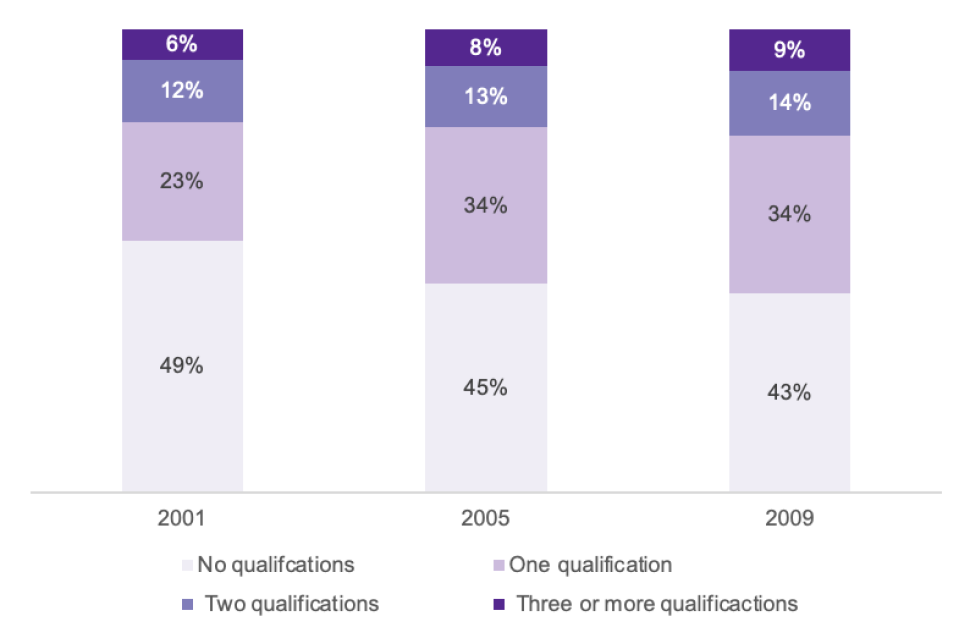
The proportion of those with at least one qualification has risen from 51% in 2001 to 57% in 2009; in the same period, the proportion of those in the workforce with three or more qualifications has increased from 6% to 9%. There is a clear trend towards a more highly qualified workforce including the holding of multiple qualifications.
The breakdown of the type of qualifications held by members of the workforce, according to their highest qualification (as shown by Census data in Figure 2) reinforces this picture. People are holding higher qualifications than before in professional, trades and other occupations.
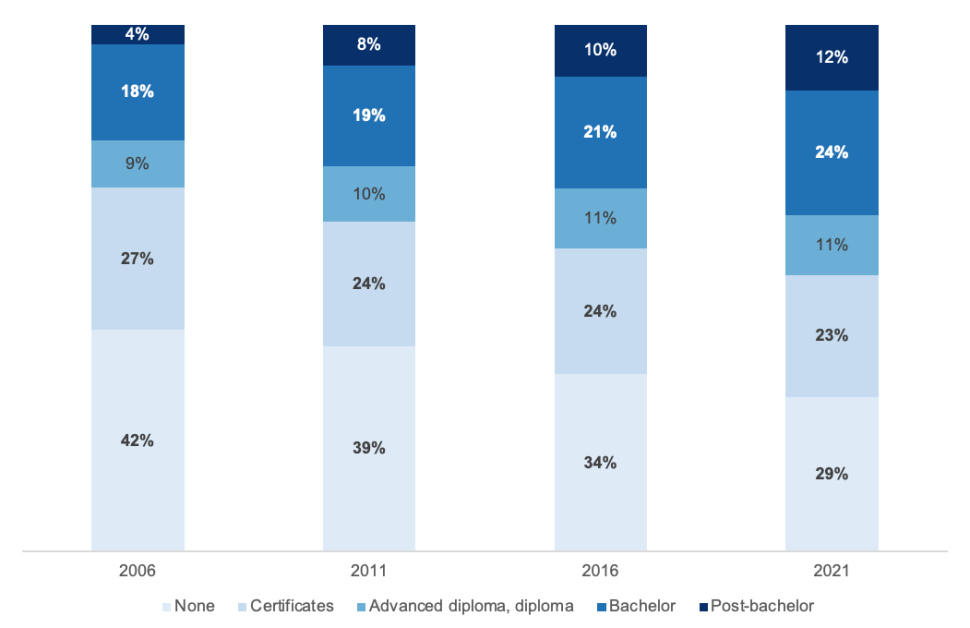
Diplomas as a highest qualification are stagnant, while bachelor and postgraduate degrees and certificates are increasing, because as Tom Karmel (2010) shows, the bachelor degree is tending to supplant the diploma as the entry level qualification in many occupations (for example, in teaching and nursing from the 1980s). Additionally, occupations such as childcare increasingly need formal qualifications, initially in certificates, rather than informal or on-the-job training.
These developments — accompanied by workers needing the capacities and skills developed through formal education to get many more jobs than before, and a growing proletarianisation of these jobs through workers’ employment (rather than self-employment as professionals) and their increasing real subordination within capitalist or state employment because they are now less likely than were many white collar workers in the past to be petty authorities and managers in the factory, in the classroom and so on — have had effects on the working class and its stratification.
First, where the general level of workers’ education has risen to match that of occupations that were previously held by more educated workers, many workers in those occupations have lost much of the strategic strength in the class struggle that they had and have sunk into the mass of the working class: this has been the fate of most clerical work, for example (Braverman, 1974: ch. 15).
Second, the strategic position of the now more educated workers was in the first instance strengthened. However, since the onset of capitalism’s structural crisis and a long wave of relative stagnation, their educational advantage has become less certain to result in a better-off position of these workers. This is because the effects of that advantage had to be refracted through the processes of gaining and sustaining concessions in the class struggle, yet capital had begun to impose neoliberalism.
If Marxists consider the development of white-collar labour, and, specifically, the political involvements of more educated workers, as “middle class”, “new class” or “post-materialist” phenomena, that underestimates the extent of both the restructuring of the working class and the social variation within the class. Raewyn Connell and Terry Irving show an understanding of both the unity of and the specific, historically deeply-rooted, divisions within the contemporary working class when they discussed the growth of white-collar unionism from the 1950s:
In some ways, what was happening here was a revision to a very old pattern, the use of industrial action by privileged groups in the workforce to maintain their distance and extend their privileges over other employees. The “labour aristocracy” of the nineteenth century was reincarnated on a basis, not of traditional manual skill, but of professional knowledge certified by specialised higher education. (1992: 203)
Yet Connell and Irving’s analysis errs in seeing the industrial action of relatively privileged workers as one-sidedly negative. On the one hand, the better-off workers continue to often be the best organised, and to dominate the class’ political life. On the other, the elements of capitalism’s inability to respond to its contradictions are multiplying: workers should oppose this through their industrial and political power.
As well, extended post-school education increases training in critical and systemic thinking. So, the advance of further education had contradictory effects for capitalism. Extended education is intended to make labour-power more productive and profitable for capital, but it also enables some developments of workers’ political consciousness in directions that can extend into radical, objectively anti-capitalist thinking and action. Bruce Tranter (1996), for example, argued that higher education is associated with higher ecological consciousness. This is explored in the following section with an analysis of the changing relationships between class, political identification, political consciousness and education.
Workers and the Greens
Therefore, we argue the multiple crises of capitalism and the expansion of post-secondary education in the working class is the basis for new and particular expressions of workers’ politics in parties that these workers understand to be of the left. Furthermore, the political context for new workers’ parties is the old social-democratic parties’ support for attempts to resolve capitalism’s crises through neoliberalism, workers’ rejection of that and attempts to find alternatives, and thus, many workers’ experience of political change and uncertainty for large numbers of workers.
In recent decades, some new workers’ parties have been formed, or dramatically developed, with a more avowed class orientation. This is most clear, perhaps, in the case of the Belgian Workers Party, although the formation of others partly in opposition to Greens parties that have supported neoliberalism (such as Die Linke in Germany, which has now also rejected a leader’s proposal for a populist nationalism) could also be considered in this framework.
But the new parties we are considering here instead combine social movement politics and class politics, with the latter “traditional” but not in contrast to “post-materialism”, because these new parties are anti-neoliberal, but not anti-capitalist. The Australian Greens, with which we are, in the first instance, concerned, is an example: it has depended for its success on a pursuit of “social justice” and thus opposed neoliberalism (Hawker, 2009: 12, 16, Hoffman and Costar, 2010: 702, Hutton and Connors, 2004: 36, Lohrey, 2002: 64, 66-68, Manning and Rootes, 2005: 403-08, Miragliotti, 2006, Vromen and Turnbull, 2006, Williams, 2006: 325-30, 337).
Three propositions will be explored here with regard to the Australian Greens:
- This party is primarily supported by workers. In that sense, we do not consider the party “middle class”, unlike a range of authors (see, for example: Allsop, 2011; Bramble and Kuhn, 2011: 189; Hillier, 2010).
- This party’s support from workers has historically been rooted in the more formally educated part of the working class, although a broadening of support may be evident more recently.
- This party’s worker support is from the left (Tietze, 2010). In 2009, David Charnock showed the associations among voters between supposed “post-materialist” values and traditional leftist concerns, the strongly leftist self-identification of Greens candidates and the strong perception of the Greens as leftist by voters.
In this paper we seek to extend and broaden Charnick’s contribution with more analysis of the interaction of political attitudes and social structures that drives support for the Greens, and by more explicitly showing the connections between the Australian Greens and social democracy, which were also discussed by former party leader Adam Bandt before 2025, when he lost his parliamentary seat and could not continue in the leadership role.
Data and method
To explore how voting patterns, particularly in relation to the Greens, were structured by class, education and political attitudes, we mainly used data from the Australian Electoral Study/Survey series (AES), up to and including the most recent 2025 survey (McAllister et al., 2025). This random sample survey series collects data after each federal election across a broad range of items covering demographics, voting and political participation behaviour, and political attitudes.
We relate class, education, attitudinal factors and voting behaviour in 2025 using the following methods.
- First, we restructured collected data on labour force participation to categorise respondents into class groups in several of the election surveys, including 2025. We put respondents who stated what their employment relationship is or had been into one of three categories: “capitalists” (self-employed and employers); “employed upper managers”; and “workers” (non-upper managerial employees). This means we included not only those who were currently working but also the unemployed and retired, before identifying those who were or had been employers or self-employed and also those who described themselves as an upper manager.1
- We then descriptively show how lower house voting in 2025 varied by class, and also by union membership as an indicator of class consciousness, and by highest post-school education levels. These results are compared to relevant findings from some earlier AES and other political attitude surveys (Bean et al., 2004, Jones et al., 1996, McAllister and Mughan, 1987, Aitkin, 1979).2
- We then constructed five attitudinal scales by several methods, depending on the number of survey items measuring aspects of key attitudes. We present average values of these attitudes by lower house vote, class and education level. The attitude scores are:
- A “union power” attitude score, derived from responses to the item, “Do you strongly agree, agree, disagree or strongly disagree with the following statement? The trade unions in this country have too much power.”
- A “women’s rights” score, derived from the item, “Do you think the following change that has been happening in Australia over the years has gone too far, not gone far enough, or is it about right? Equal opportunities for women.”
- A “Pro-Palestine” score, derived from the item, “Which side in the Israeli-Palestinian conflict, if any, do you sympathise with more?”
- An “Aboriginal rights” score, derived from the numeric mean of responses to the two items, “Do you think the following change that has been happening in Australia over the years has gone too far, not gone far enough, or is it about right? Aboriginal land rights”, and “Do you think the following change that has been happening in Australia over the years has gone too far, not gone far enough, or is it about right? Government help for Indigenous Australians.”
An “immigration” score, derived from six items relating to immigration using factor analysis, the method that most validly estimates scores from more than two survey items.3
To account for differing measures among variables, these scores are standardised, that is converted to a scale with a mean of 0 and a standard deviation of 1 (which means about two-thirds of scores are between -1 and 1)
- Finally, we test models of voting behaviour using regression analysis. There is some complexity in the results due to the categorical nature of class, education and voting data. To include this type of variable in statistical models, the effects of inputs (class and education) and the effects on outcomes (vote) need to be in the form of comparisons between each category and a reference category. Reference categories can be chosen to be the category of most interest: for example, we look at the effect of being a worker as compared to being a business owner, and the effects on voting Greens as compared to voting Labor.4
Results
In results reported in the following charts, we show relevant proportions of categories and mean scores by party group, with “confidence intervals”. Confidence intervals are an indication of how reliable a result from a sample survey is. By giving the range, we are 95% confident that the value lies in the population from which the survey is sampled — in this case the population of Australian voters. If confidence intervals for two results do not overlap, we can say that there is a statistically significant difference in these results at a 95% level — that is, we can be 95% confident that the difference found in the sample derives from an actual difference in the whole population — but also where there is some overlap there is still the possibility of a significant difference, which can then be calculated (Cumming 2009).
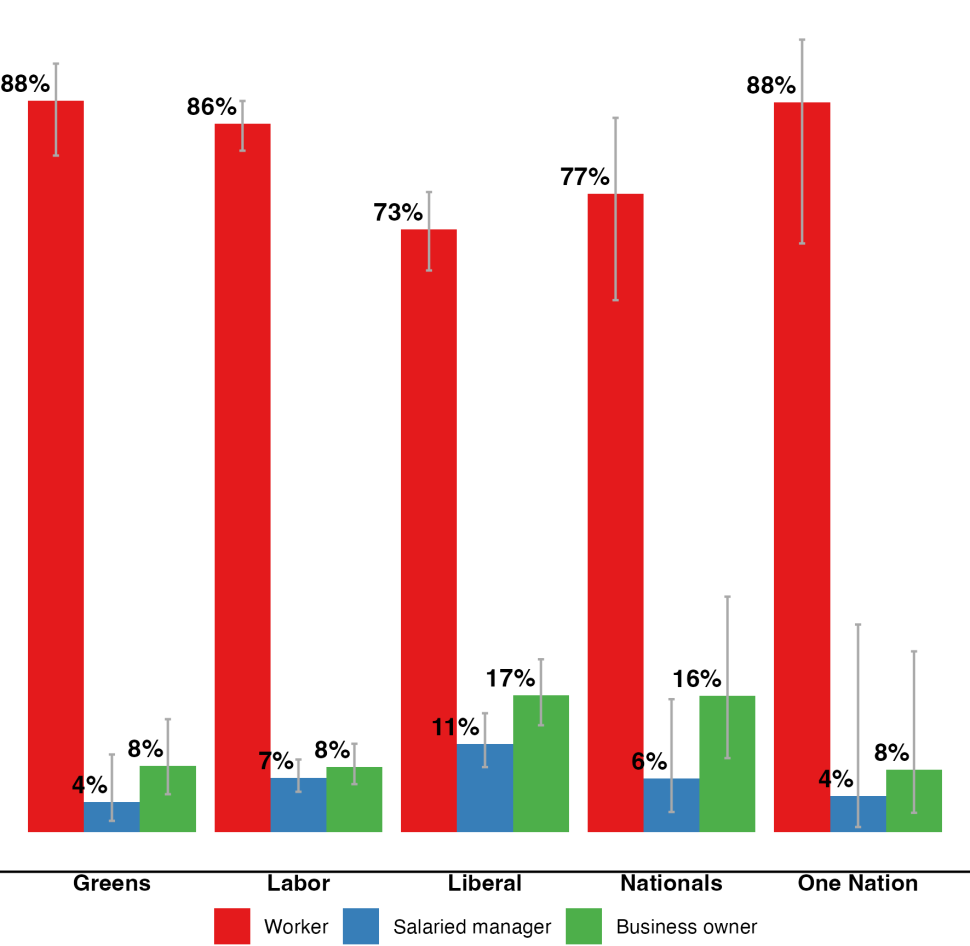
First we examine the class composition of the party voter groups in the 2025 AES. As we can see from Figure 3, the vote for each party group varied somewhat by class. The proportion of the Liberal’s (73%) and National’s (77%) vote that came from workers was significantly smaller than the proportion of the ALP’s (86%) or Greens’ (83%) vote; and the proportion of capitalists among the Liberal (17%) and National (15%) was much higher than among the ALP or Greens (both 8%). None of the differences between the proportions of the ALP’s and Greens’ vote from different classes were significant. This repeats, though less emphatically, the 2007 pattern of the proportion of these parties’ votes from workers we have previously examined (Fredman, 2013) and the 2010 pattern (Fredman and Strauss 2012).
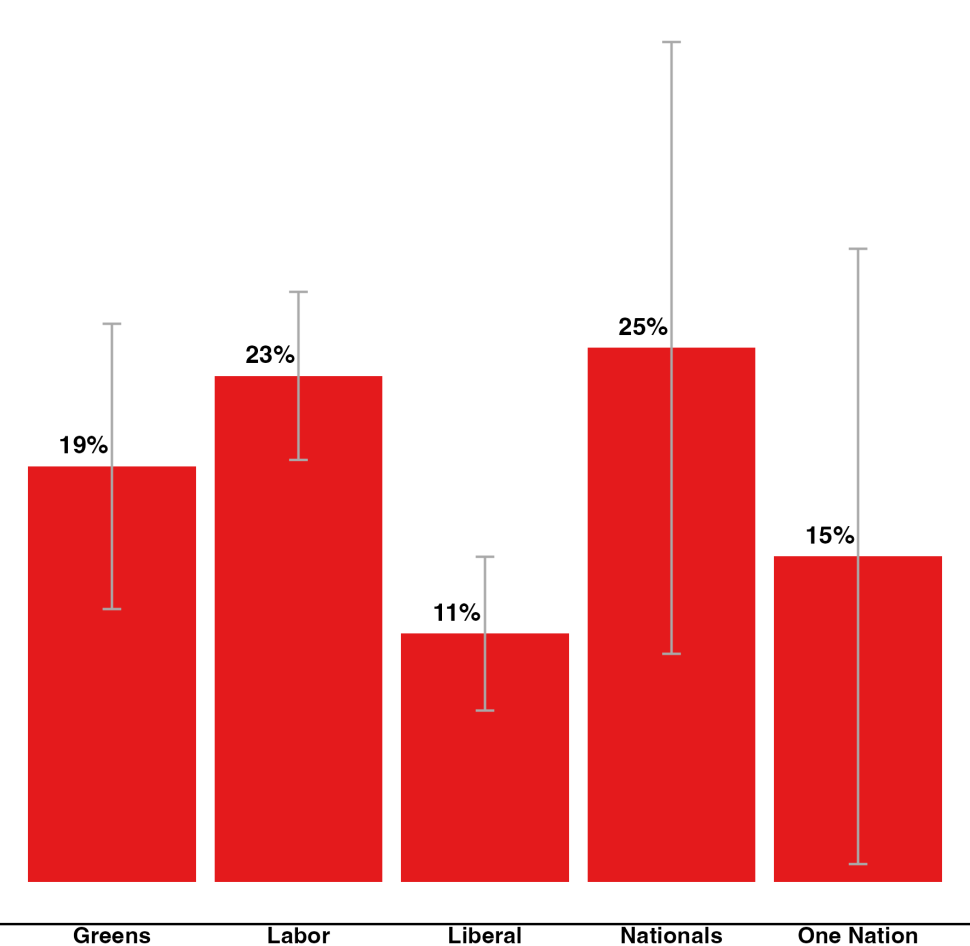
Evidence of the working-class nature of the bulk of the ALP and Greens’ electoral support is reinforced by consideration of the proportion of all party groups of unionists, taking union membership to signify an element of working-class consciousness. Again, as can be seen from Figure 4, there is no significant difference in this proportion between the ALP (23%) and the Greens (19%), with the figures for both parties being significantly different to that for the Liberals (11%) but not the very unreliable figures from Nationals (25%) and One Nation (15%) voters.
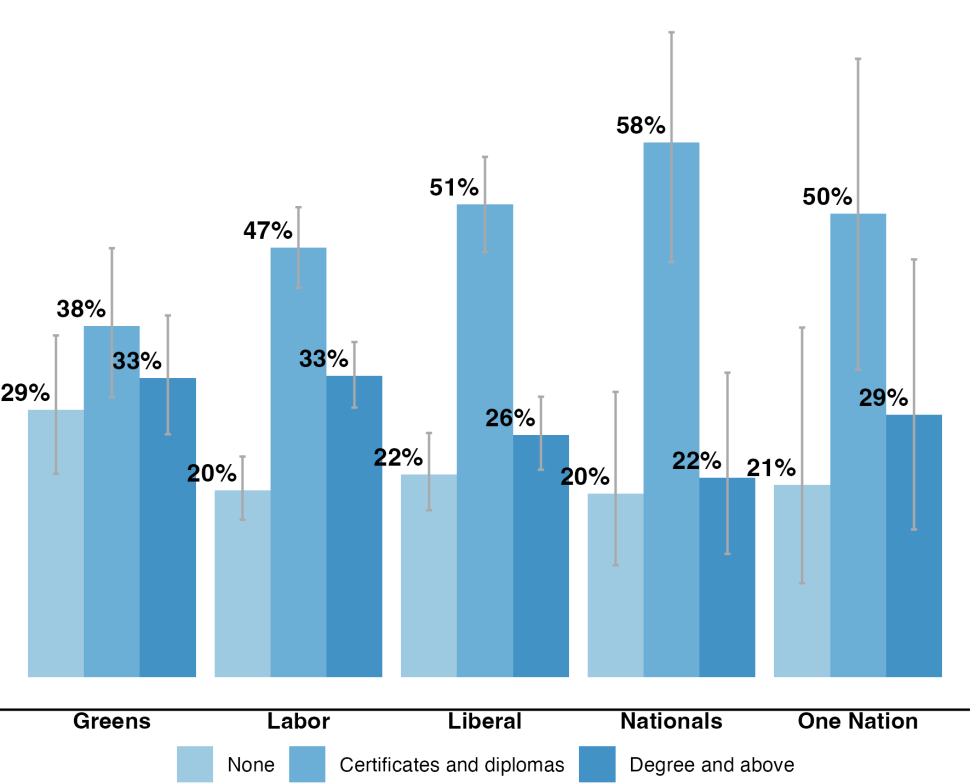
Our previous work showed that Greens voters could be demographically distinguished from Labor voters, most notably by their typical level of education: at the 2007 election, 50% of Greens voters had a bachelor degree or higher compared with 28% of Labor voters (Fredman 2013). However, in 2025 (see Figure 5), the proportion for both parties’ voters is 33%, in turn significantly higher than for other parties apart from the unreliable figure of 29% for One Nation voters. Meanwhile, more Greens voters than Labor voters have no higher education qualification, and there is a significantly larger proportion of Labor voters with a certificate or diploma as their highest qualification (46%) than Greens voters (35%).
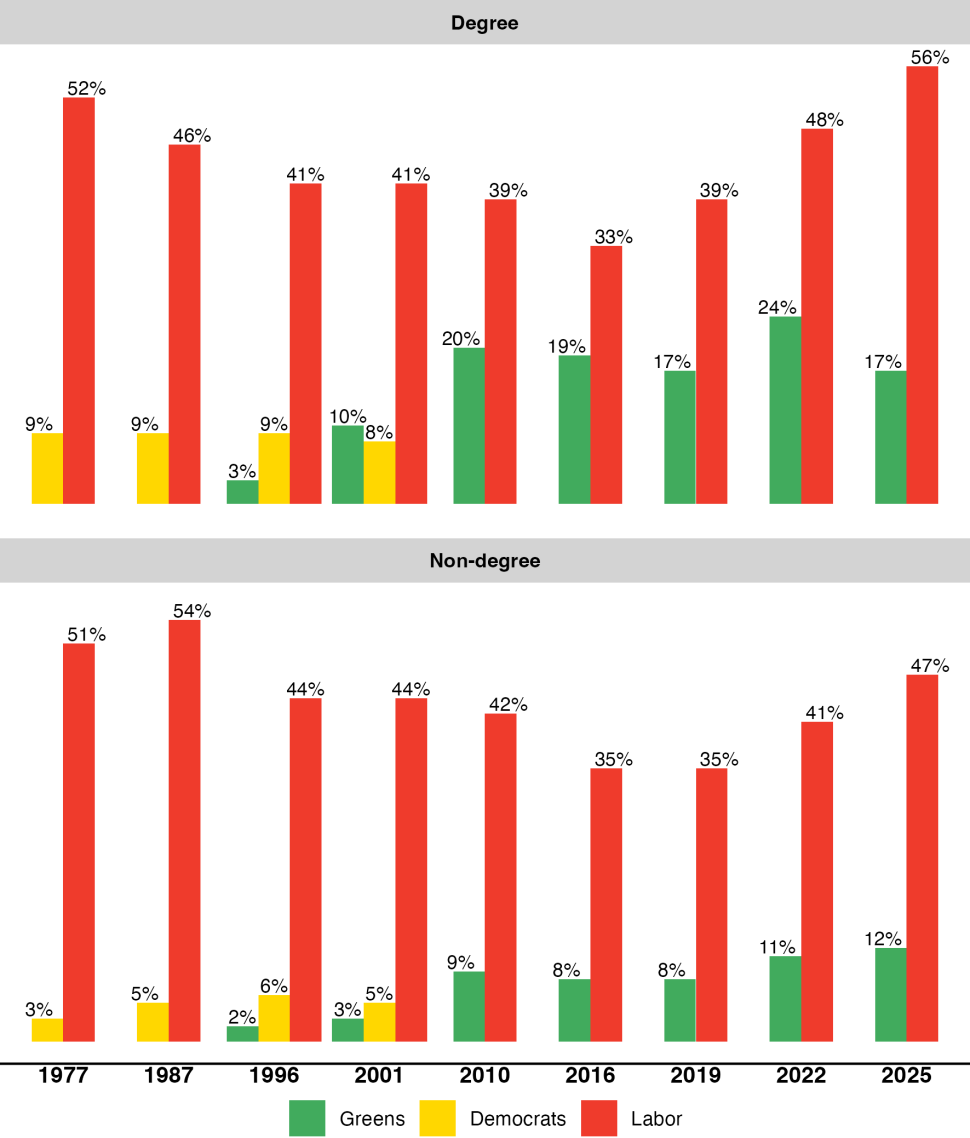
The changing voting pattern of more highly educated workers suggests that the past election saw them swing back towards voting for Labor after a period of consolidation of Greens votes from these workers. Figure 6 examines this pattern, in this case only showing working class voters. It shows that during the 1980s, the ALP first lost the support of many highly educated workers, initially to the fragmented progressive alternatives of the 1980s, with the Greens beginning to win them after the party’s formation in 1990 before thoroughly bringing them together in the 2000s. The ALP’s vote among workers with a bachelor degree fell between 1977–87, even though the party’s electoral fortunes overall had improved, from a second harsh defeat following Gough Whitlam’s dismissal to a third election victory under Hawke. By 1996 many highly educated workers who would have supported the ALP in the past were no longer doing so, and up until 2022 the Greens won the support of a generally increasing proportion of them. This advance was reversed in 2025, perhaps due to the threat of a hard right Coalition.
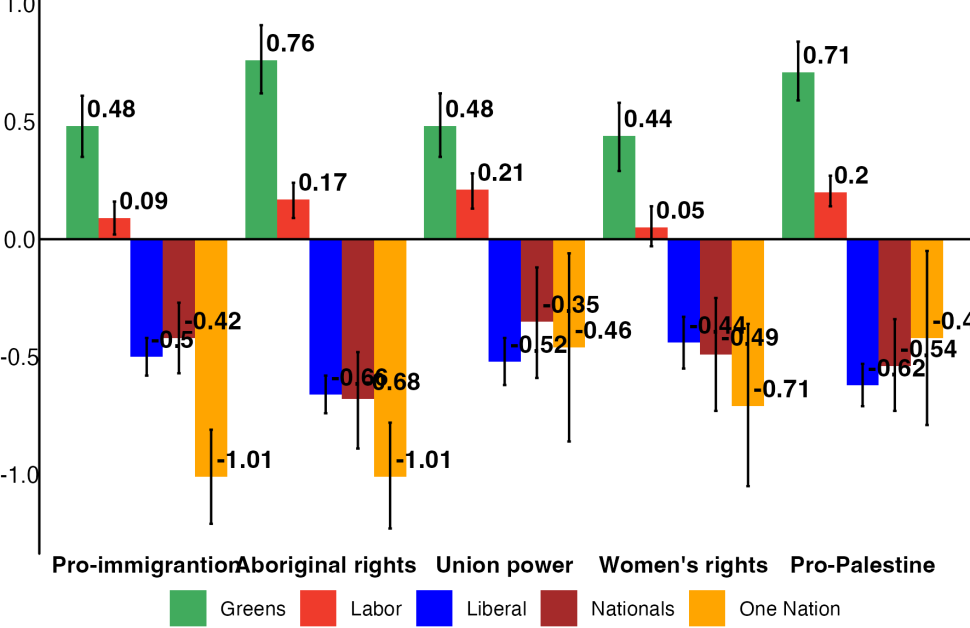
Those who vote for the Greens, however, continue to be distinguished from those who vote for Labor by some of their political attitudes, as discussed in the data and methods section.
Figure 7 shows the means of the score by party group for each of the attitudinal scales. Labor supporters are on average more pro-union, more pro-women’s rights, more pro-immigration and more pro-Palestine than Liberal, National or One Nation supporters. Greens supporters are on average more pro-union, more pro-women’s rights, more pro-immigration and more pro-Palestine than ALP supporters.
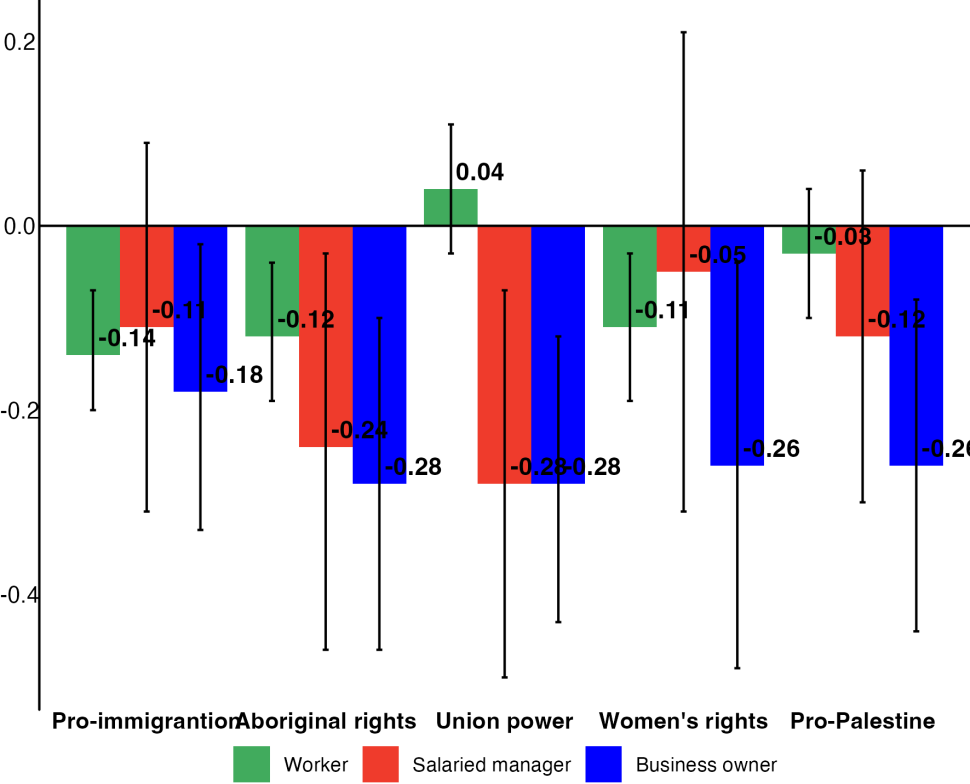
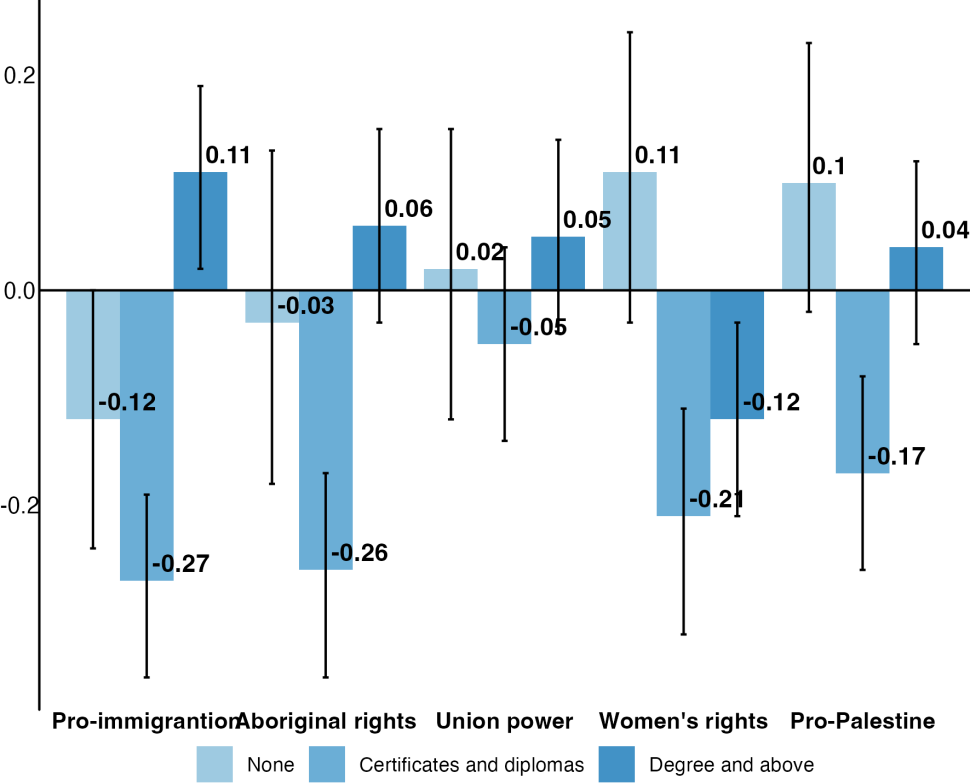
We have then a number of factors clearly related to party vote. However, it should be noted that these variables are themselves related to some extent, as can be seen from Figures 8 and 9. From Figure 8 we can see that attitudes vary with class: in particular, workers are on average more pro-union than the other classes. From Figure 9 we can see that attitude scale scores vary with highest qualification: in particular, those with a bachelor degree or higher are on average more pro-immigration than those with other levels of highest educational attainment.
A model of voting
The discussion above outlining our descriptive statistical results suggests that Greens electoral support, compared with the Coalition and One Nation, varies with class, education and attitudinal scales. But compared with the ALP, it varies with some attitudinal scales. Meanwhile attitudes also vary somewhat with class and education.
To further investigate the interrelationship between different explanatory factors, and their relative weight in explaining voting behaviour, we have tested a statistical model. Logistic regression is a technique for modelling the probability of one event occurring with respect to another, and gives the relative weight of explanatory factors associated with such an occurrence. “Multinomial” logistic regression can model a dependent categorical variable with several categories (such as a voting choice between several parties) as a series of binary logistic regressions with the possibilities being one category compared to another. That is, in the results shown in Table 5, the column marked “Greens vs Labor” gives the probability of voting for the Greens in the lower house versus the probability of voting for a Labor candidate in the lower house.
The results are expressed in terms of “odds ratios”. Each odds ratio result indicates the extent by which the odds of voting for one party group with respect to another (for example, voting for the Greens rather than Labor) are increased if the independent variable is increased by one unit, in the case of numerical independent variables (such as our attitude scales), or is “true”, in the case of dichotomous variables, controlling for other independent variables in the model. Independent variables which are categorical variables with several categories (in this case highest educational level and class position) are treated in the regression procedure as a series of dichotomous variables.
To illustrate, consider the first column of Table 5, which models the probability of voting for the Greens rather than Labor. The result indicated in the last row, marked “Aboriginal rights score”, for this column, is 1.68 (with a double asterisk indicating that we can be 99% certain this is a statistically significant result). This means that, in this model, the odds of voting for the Greens versus voting for the Labor increased by 1.68 times for every additional unit of the Aboriginal rights score, controlling for other independent variables (comparing cases within the same categories of categorical variables, and keeping numerical variables at their average level).
Now consider the fourth row in the first column of Table 5, marked “degree and above vs none”, with an odds ratio result of 0.62. This means that those with a degree or above compared to those without a post-school qualification were 0.62 times as likely to vote for Green compared to Labor, or equivalently 38% less likely, controlling for other independent variables. Statistically significant results are indicated with single (95% significance) or double (99% significance) asterisks.
Table 1 shows that from statistically significant results, what most distinguishes Greens voters on average from:
• Labor voters are, in order of relative weight, higher Pro-Palestine and Aboriginal rights scores, and, unexpectedly, a lower likelihood of holding a degree or higher qualification compared to no post-school qualification;
• Liberal voters are, in order of relative weight, higher Pro-Palestine, Aboriginal rights, pro-immigration and union power scores, and a lower likelihood of being a salaried manager compared to a worker;
• Nationals voters are, in order of relative weight, higher Aboriginal rights and Pro-Palestine scores;
• One Nation voters are, in order of relative weight, higher Aboriginal rights and Pro-Palestine scores, and, unexpectedly, a lower likelihood of holding a degree or higher qualification compared to no post-school qualification, and higher women’s rights scores.
In testing the validity of the model a “pseudo-r squared” score of 0.45 was found, which indicates that 45% of the variation in the outcome is explained by the dependent variables, a quite high score for a model in the social sciences.
Table 1: Odds ratio results and their statistical significance from our voting model
| Factor | Greens vs Labor | Greens vs Liberal | Greens vs Nationals | Greens vs One Nation |
| (Intercept) | 0.33** | 0.61* | 3.85** | 7.56** |
| Certificates and diplomas vs none | 0.66 | 0.79 | 0.59 | 0.62 |
| Degree and above vs none | 0.62* | 0.84 | 1.00 | 0.38** |
| Salaried manager vs worker | 0.59 | 0.32* | 0.63 | 1.18 |
| Business owner vs worker | 0.90 | 0.50 | 0.50 | 1.36 |
| Immigration score | 1.13 | 1.68** | 1.46 | 4.93 |
| Women's rights score | 1.11 | 1.24 | 1.39 | 1.37* |
| Union power score | 0.98 | 1.52** | 1.33 | 1.35 |
| Pro-Palestine score | 1.65** | 3.49** | 2.90** | 2.16** |
| Aboriginal rights | 1.68** | 2.91** | 3.48** | 4.37** |
Pseudo r2=0.45 * significance at p≤0.05 ** significance at p≤0.01
By way of a conclusion: The Greens, social democracy and the question of a way forward
We have shown that, in the 2025 federal election, Greens voting support among workers demographically widened and there was a return to Labor voting by sections of the highly educated workers. This reversed a key trend from our, and others, earlier findings (Fredman and Strauss 2012, Fredman 2013) on Greens voters’ differences in demographic characteristics, from Labor voters in particular. Previously the Greens had tended to win voting support from much of the highly-educated working class, whereas in 2025, the only educationally differentiated group of voters the Greens particularly won support from was those without higher educational qualifications.
What remains constant is the leftist position of Greens’ voters on average. Developing Charnock’s study, we have shown that voter support for the Greens is most related to leftist positions on economic and, particularly, social questions. Thus, contrary to Geoff Hawker (2009), Greens’ electoral difficulties do not stem from relatively narrow support for protest “against the political system in general”, which he considered to be the party’s stance (11-14). That is not the basis of the Greens’ electoral support. If the numbers of people holding the political attitudes that drive support for the Greens grew, so would that support (in addition to what might be won from people already holding those attitudes who have continued to identify with the ALP).
A key limitation on the Greens lies elsewhere. Tom Bramble and Rick Kuhn (2011) have pointed out the party neither includes class as an organising concept politically nor orients to trade unions, unlike the ALP (184). But, by the same token, the ALP has not deployed those political concepts and orientations to pursue a radical politics. Indeed, in the 1980s, in response to capitalism’s crises, it offered its own version of the neoliberal solution to that crisis (Humphrys, 2019). At a time of “the death of social democracy” and left electoral challenges, Ashley Lavelle has noted that the Greens’ policies have been perceived as more social democratic than those of the ALP (2008: 42, 171).
The Greens, like its sister parties that have arisen across the world since the 1980s, proclaim four “core beliefs”: peace and non-violence, grassroots democracy, social and economic justice, and environmental sustainability (Australian Greens, 2011). These principles suggest both traditional leftist and new social movement antecedents. However, contrary to the predominant commentary on the Greens, which argues that these parties represent either a fundamentally new form of politics or a contemporary expression of the socialist or far left, the Australian Greens can be understood, to a considerable extent, as a contemporary expression of social democracy.
This understanding is proposed not just because Greens parties have not moved beyond social democracy politically, exemplified in different ways by the archetypal German Greens participation in coalition government and the Australian Greens leadership avowed commitment to replacing the ALP as the reforming party of an Australian capitalism (Brown and Singer, 1996). We have shown, first, that the Greens support is similar sociologically to that of traditional social democracy, or, more precisely, the Greens support comes from what has been a part of the active and dominant element of workers’ support for social democracy.
But a second element has emerged. The Greens are to the left of the ALP, in particular in their voters’ respective attitudes. In the face of the now decades-long neoliberal policy trend of traditional social democracy, many workers who come into struggle around ecological, social or industrial issues are seeking alternative political expressions. But as yet the Greens’ worker supporters do not stand out from those of traditional social democracy in their attitudes to capitalism. We might suggest that the overall reformism of the Greens’ worker supporters wins out in the absence of revolutionary influences: their consciousness of the relations between classes is conflictual, but not antagonistic (Kelly, 1988: 87-88).
Some Greens’ leaders appear to be aware of a need to relate to working people suffering economic stress. At time of writing, the far-right One Nation party is experiencing a surge in support evident in a range of polls, in the 2026 South Australian election, and by winning their first federal lower house seat in the 2026 Farrer by-election. One Nation’s new support seems generally to have been won due to discontent with the political system and the economic stress workers are suffering, rather than representing the expression of racist attitudes to immigration that has been the core of its previous support (Samaras 2026).
In response to workers’ circumstances and this political development, Green Institute director and former Greens parliamentarian Max Chandler-Mather has proposed the party reorient towards “economic populism”: his examples to learn from are the growing Green Party of England and Wales under Zack Polanski and democratic socialist mayor of New York Zohran Mamdani (Chandler-Mather, 2026). Whether such a turn can broaden Greens’ support and more fundamentally move the Greens towards a clearer anti-capitalism remains to be seen.
Revolutionary involvement within or relating to parties such as the Greens, or to sections of them, might help push the consciousness of workers towards anti-capitalism. Success is not guaranteed. The situation represented by the existence of these parties is only that large numbers of workers have abandoned past political certainties and are open to changing their views and activity. From this point of view, the Greens remain a political force under construction, with some of the historical and social determinants that the ALP has had, but without institutional constraints of the kind the ALP experiences.
In this context, what we have suggested here is that an important argument for Marxists to make is that workers in their politics must efface the differences of status among them, which shore up the boundaries of social democracy that surround the workers’ movement. For the development of a working-class led movement for social change, the mobilisation of workers through new parties that have appeared could prove to be valuable, but only if there is a consciousness of the need to unite the different strata of workers.
References
Aitkin, D. (1979). Macquarie University Australian Political Attitudes Survey, 1979, [computer file]. Canberra: Australian Social Science Data Archive, The Australian National University.
Allsop, Richard (2011). The Greens Unexpected Ancestors. IPA Review: 42-45.
Althusser, Louis (1972) Ideology and Ideological State Apparatuses: Notes towards an Investigation. In: Louis Althusser, Lenin and Philosophy and Other Essays. New York: Monthly Review Press, 85-126.
Australian Bureau of Statistics (2001). Survey of education and training, 2001. Basic CURF, CD-ROM. Findings based on use of ABS CURF data.
Australian Bureau of Statistics (2005). Survey of education and training, 2005. Basic CURF, CD-ROM. Findings based on use of ABS CURF data.
Australian Bureau of Statistics (2009). Survey of education and training, 2009. Basic CURF, CD-ROM. Findings based on use of ABS CURF data.
Australian Bureau of Statistics (2006) Employed persons by highest qualification [Census TableBuilder].
Australian Bureau of Statistics (2011) Employed persons by highest qualification [Census TableBuilder].
Australian Bureau of Statistics (2016) Employed persons by highest qualification [Census TableBuilder].
Australian Bureau of Statistics (2021) Employed persons by highest qualification [Census TableBuilder].
Australian Greens (2011). Our story. Available at: http://greens.org.au/our-story.
Bean, Clive, Gow, David and McAllister, Ian (2004). Australian Election Study, 2001, [computer file]. Canberra: Australian Social Science Data Archive, The Australian National University.
Bowles, Samuel and Gintis, Herbert (1976). Schooling in Capitalist America: Educational Reform and the Contradictions of Economic Life. London: Routledge and Kegan Paul.
Bramble, Tom (2012). Is there a Labour Aristocracy in Australia? Marxist Left Review 4: 103-52.
Bramble, Tom and Kuhn, Rick (2011). Labor's Conflict: Big Business, Workers and the Politics of Class. Melbourne: Cambridge University Press.
Braverman, Harry (1974). Labor and Monopoly Capital. New York: Monthly Review Press.
Breen, Richard (2005). Foundations of a neo-Weberian class analysis. In: Eric Olin Wright (ed.) Approaches to Class Analysis. Cambridge: Cambridge University Press, 31-50.
Brown, Bob and Singer, Peter (1996). The Greens. Melbourne: Text.
Burgmann, Verity (2009). The Seven Wonders of the Labour World. In: Bobbie Oliver (ed.) Labour History in the New Century: Eleventh National Biennial Conference of the Australian Society for the Study of Labour History. Perth: Black Swan Press.
Chandler-Mather, Max (2026). The Greens must pivot to meet the One Nation challenge. Deep Cut News. https://www.deepcutnews.com/p/the-greens-must-pivot-to-meet-the
Charnock, David (2009). Can the Australian Greens Replace the Australian Democrats as a "Third Party" in the Senate? Australian Journal of Political Science 44 2: 245-58.
Connell, R.W. and Irving, T.H. (1992). Class Structure in Australian History. Melbourne: Longman Cheshire.
Cumming, G (2009). Inference by Eye: Reading the Overlap of Independent Confidence Intervals. Statistics in Medicine 28: 205-220.
Fieldes, Dianne (2005). From Exploitation to Resistance and Revolt: The Working Class. In: Rick Kuhn (ed.) Class and Struggle in Australia. Sydney: Pearson Longman, 56-71.
Fredman, Nick (2013). Watermelons or Tomatoes? Class, social democracy and the Australian Greens. Capitalism Nature Socialism. 24 4: 86-104.
Fredman, Nick and Stauss, Jonathan (2012). Working class stratification, education and politics in Australia. Paper presented to the Historical Materialism conference, Melbourne.
Goot, Murray and Watson, Ian (2001). One Nation's Electoral Support: Where Does it Come from, What Makes it Different and How Does it Fit? Australian Journal of Politics and History 47 2: 159-91.
Gramsci, Antonio (1924). To Togliatti, Terracini and others. In: Quintin Hoare (ed.) Selections from Political Writings (1921-1926). New York: International Publishers, 240-42.
Greenland, Hall (2012). The Greens – and their Better Selves. Available: http://watermelontharris.blogspot.com.au/2012/07/greens-and-their-better-selves.html [Accessed on 18 July 2012].
Harvie, David (2006). Value Production and Struggle in the Classroom: Teachers within, against and beyond Capital. Capital & Class 30 1: 1-32.
Hawker, Geoff (2009). Growing the Greens. Australian Quarterly: 11-18.
Hillier, Ben (2010). Left Voters Swing behind Greens, but What next? Socialist Alternative [Online]. Available: http://www.sa.org.au/index.php?option=com_k2&view=item&id=4740:left-voters-swing-behind-greens-but-what-next?&Itemid=395&tmpl=component&print=1 [Accessed on 10 June 2011].
Hobsbawm, E. J. (1964). Labouring Men: Studies in the History of Labour. London: Weidenfeld and Nicholson.
Hobsbawm, E. J. (1984). Worlds of Labour: Further Studies in the History of Labour. London: Weidenfield and Nicolson.
Hoffman, Rob and Costar, Brian (2010). Not Going Green: The Higgins By-Election of 2009. Australian Journal of Political Science 45 4: 693-703.
Humphrys, Elizabeth (2019). How Labour Built Neoliberalism: Australia’s Accord, the Labour Movement and the Neoliberal Project. Chicago: Haymarket Books
Hutton, Drew and Connors, Libby (2004). The Left Dilemma for the Greens. Social Alternatives 23 1: 34-37.
Jones, Roger, McAllister, Ian and Gow, David (1996). Australian Election Study, 1996 [computer file]. In Canberra, Australian Social Science Data Archive, The Australian National University.
Karmel, Tom (2010). The Future of VET: Or, Allen Ginsberg re-visited. The future of VET: A medley of views. Adelaide: National Centre for Vocational Education Research.
Kautsky, Karl (1901), ‘Trades Unions and Socialism’, Marxist Internet Archive, https://www.marxists.org/archive/kautsky/1901/04/unions.htm [Accessed on 14 June 2026]
Kelly, John (1988). Trade Unions and Socialist Politics. London: Verso.
Kuhn, Rick (2005). Introduction. In: Rick Kuhn (ed.) Class and Struggle in Australia. Sydney: Pearson Longman.
Kuhn, Rick (2006). Classes in Australia, in themselves and for themselves. Paper read at Workshop on Class: History, Formations and Conceptualisations. University of Wollongong.
Lavelle, Ashley (2008). The Death of Social Democracy: Political Consequences in the 21st Century. Aldershot: Ashgate.
Lenin, V.I. (1916) Imperialism and the Split in Socialism. In: V.I. Lenin, Collected Works, 19. Moscow: Progress Publishers, 105-120.
Lih, Lars T (2008), Lenin Rediscovered: What Is to Be Done? in Context. Chicago: Haymarket Books.
Lohrey, Amanda (2002). Groundswell: The Rise of the Greens. Quarterly Essay 8: 1-86.
Manning, Haydon and Rootes, Christopher (2005). The Tainted Triumph of the Greens: The Australian National Election of 9 October 2004. Environmental Politics 14 4: 403-08.
Markey, Raymond (1988). The Making of the Labor Party in New South Wales 1880-1900. Sydney: New South Wales University Press.
McAllister, Ian, Bean, Clive, Gibson, Rachel Kay and Pietsch, Juliet (2011). Australian Election Study, 2010. [Computer file]. Canberra: Australian Social Science Data Archive, The Australian National University.
McAllister, I., Mughan, A. (1987). Australian Election Study 1987 [computer file]. Canberra: Australian Social Science Data Archive, The Australian National University.
McAllister, I., Bean, C., Gibson, R., Pietsch, J., (2011). Australian Election Study 2010 [computer file]. Canberra: Australian Social Science Data Archive, The Australian National University.
McAllister, I., Pietsch, J., Bean, C., Gibson, R., Makkai, T. (2017). Australian Election Study 2016 [computer file]. Canberra: Australian Social Science Data Archive, The Australian National University.
McAllister, I., Pietsch, J., Bean, C., Gibson, R., Makkai, T. (2017). Australian Election Study 2016 [computer file]. Canberra: Australian Social Science Data Archive, The Australian National University.
McAllister, I., Sheppard, J., Bean, C., Gibson, R., Makkai, T., Cameron, S. (2019). Australian Election Study 2019 [computer file]. Canberra: Australian Social Science Data Archive, The Australian National University.
McAllister, I., Cameron, S., Jackman, S., Sheppard, J. (2022). Australian Election Study 2022 [computer file]. Canberra: Australian Social Science Data Archive, The Australian National University.
McAllister, I., Cameron, S., Jackman, S., Sheppard, J. (2025). Australian Election Study 2025 [computer file]. Canberra: Australian Social Science Data Archive, The Australian National University.
McAllister, Ian and Mughan, Anthony (1987). Australian Election Survey, 1987 [computer file]. Canberra: Australian Social Science Data Archive, The Australian National University.
Miragliotti, N (2006). One Party, Two Traditions: Radicalism and Pragmatism in the Australian Greens. Australian Journal of Political Science 41 4: 585-96.
Post, Charles (2010). Exploring Working-Class Consciousness: A Critique of the Theory of the "Labour Aristocracy". Historical Materialism 18: 3-38.
Rikowski, Glenn (2002). Fuel for the Living Fire: Labour-Power. In: Ana C. Dinerstein and Neary, Michael (eds.) The Labour Debate: An Investigation into the Theory and Reality of Capitalist Work. Hampshire: Ashgate.
Samaras, Kos (2026). How the budget failed to land with the three Australias. Financial Review, June 3. https://www.afr.com/politics/federal/how-the-budget-failed-to-land-with-the-three-australias-20260602-p602zx
Sørensen, Aage B (2005). Foundations of a Rent-based Class Analysis. In: Eric Olin Wright (ed.) Approaches to Class Analysis. Cambridge: Cambridge University Press, 119-51.
Strauss, Jonathan (2004a). Engels and the Theory of the Labour Aristocracy. LINKS [Online]. Available: http://links.org.au/node/45 [Accessed on 7 July 2012].
Strauss, Jonathan (2004b). Monopoly Capitalism and the Bribery of the Labour Aristocracy. LINKS [Online]. Available: http://links.org.au/node/30 [Accessed 7 July 2012].
Strauss, Jonathan (2005). The Labour Aristocracy and Working-class Politics. LINKS [Online]. Available: http://links.org.au/node/12 [Accessed on 7 July 2012].
Strauss, Jonathan (2007a). The Labour Aristocracy and Opportunism in the History of Australian Working-class Politics. LINKS [Online]. Available: http://links.org.au/node/235 [Accessed on 7 July 2012].
Strauss, Jonathan (2007b). Towards a Historical Materialist History of Australian Working-class Politics. LINKS [Online]. Available: http://links.org.au/node/210 [accessed on 7 July 2012].
Thompson, E.P. (1963). The Making of the English Working Class. London: Penguin.
Tietze, Tad (2010). The Greens, the Crisis and the Left. Overland 199: 27-35.
Tranter, Bruce (1996). The Social Bases of Environmentalism in Australia. Australian and New Zealand Journal of Sociology 32 2: 61-85.
Vromen, Ariadne and Turnbull, Nick (2006). The Australian Greens: Party Organization and Political Processes. Australian Journal of Politics and History 52 3: 455-470.
Williams, Paul D. (2006). The Greening of the Queensland Electorate? Australian Journal of Political Science 41 4: 325-337.
- 1
We acknowledge that any attempt to represent the Marxist conception of class as a dynamic field of relationships using the static categories of a sample survey inevitably involves some simplifications and abstractions, although we would also point out the AES is relatively rich in demographic detail and assert our method comes closer to Marxist understandings of class than standard sociological categories based on occupation or education.
- 2
To distinguish workers from upper managers in the two earliest surveys, in which no question about management level was asked, those who supervised more than 20 others were categorised this way.
- 3
Factor analysis is a statistical procedure whereby a number of items such as questionnaire responses are reduced to a smaller number of factors, within which items correlate relatively highly, and between which items do not correlate very highly. The purpose is to identify underlying structures, in this case of attitudes, that are evident in items that we hypothesize are related before conducting the analysis. The common factors therefore need to make conceptual sense as well as be empirically valid.
- 4
Analyses were conducted with the statistical package R, version 4.5.1, with code and more detailed results available on request.