Your Party exists! Now the hard work begins…
First published at Anti*Capitalist Resistance.
The road to the founding conference was publicly torturous and displayed some of the worst aspects of some people on the left. Bickering over data and control, public spats and arguments, brash actions clashing with ingrained conservative caution. Certainly, the energy from the start of August, when 800,000 people signed up as supporters, had dissipated with all the public rows over data control and money. The question for this conference was whether the party would survive and even turn its fortunes around.
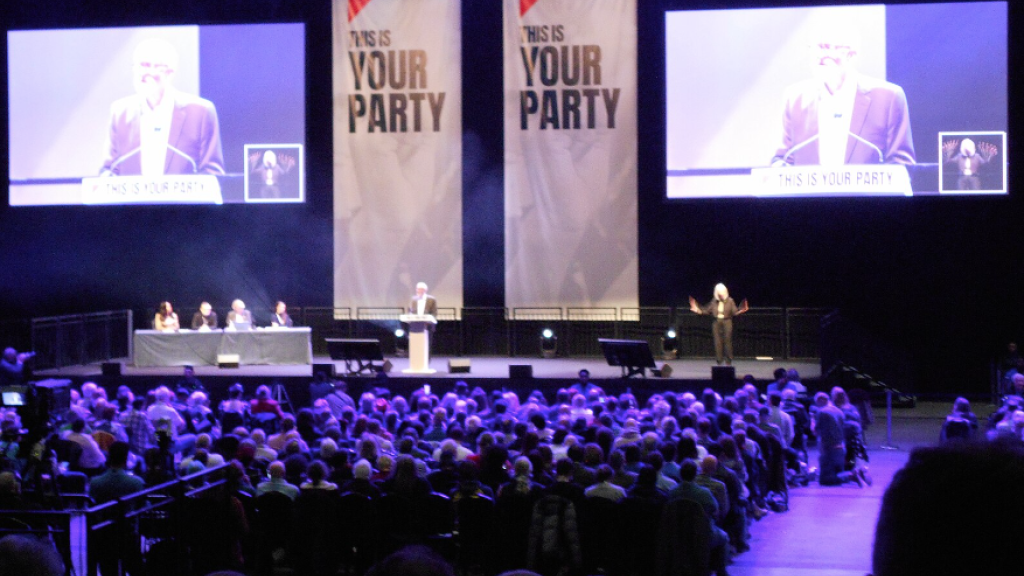
Your Party held its founding conference in Liverpool on 29-30 November. Despite the problems, a new left socialist and working-class party has been launched, and there is a crying need for it. This article is about the events at the conference, which was a mixed affair, but ACR remains committed to building an ecosocialist party, and Your Party is still a possible way to make that happen.
The rise of Zack Polanski’s Greens has also closed the space for another ‘left party’, so another crucial question is how Your Party can clearly stand out as a socialist party that is not merely electoralist.
Between the original launch/launches, little happened until well into November, meaning that people were only asked to come to Liverpool through this opaque and undemocratic sortition process late in the day — excluding many of those with less money, caring responsibilities, access needs, and so on.
The process at the conference was also unclear until the event. The agenda — circulated to the press before the membership — was dominated by platform speakers and was only available just before the conference started. There was no opportunity for the conference or the membership to amend the timetable or promote particular motions on the conference floor.
You can see which ‘motions’ got how many endorsements, but not why some made it onto the agenda, and others did not. No one knew how the chairs were selected or their relationship with the mysterious standing orders committee, which never reported.
There were some good changes before the conference, as feedback from the regional assemblies led to improved ‘evolved’ founding documents. Improved focus on the climate emergency, redefining who can be a member to include non-UK citizens and that the constitution/standing orders committee can be amended by a simple majority at the next conference, before raising the threshold to a 2/3rd super majority.
But despite all this, the conference was largely a success and showed that there is a serious left in Your Party that defied and beat the unelected bureaucrats running things behind the scenes on several key issues. Much debate needs to happen in local groups and other fora about how to build on the successes and address the weaknesses.
Witchhunt
There was an ominous mood the day before the conference as messages filtered through that SWP leaders had been expelled for being ‘members of a national political party’. This was one of the rules in the ‘interim constitution’ which was foisted on potential members. When John Rees from Counterfire queried Jeremy Corbyn about it, Corbyn replied that it probably only referred to registered (therefore potentially rival) political parties.
Nevertheless, on the eve of the conference, SWP leaders were expelled en bloc, including Alex Callinicos, who wasn’t even a member of YP. Then on Saturday morning, Counterfire’s Michael Lavalette, elected as an independent councillor in Preston, was excluded from conference too, as was James Giles, an independent councillor from Kingston who chaired Sultana’s Friday rally.
There was clearly a fear that the SWP and Counterfire — as part of the Socialist Unity Platform — would submit an emergency motion calling for the election of a collective leadership at the conference. A rumour had circulated that people might ‘storm the stage’ — which was not a real thing but was used as an excuse to ban people.
Because of these manoeuvres, Zarah Sultana’s eve of conference rally was electric. A packed room, hearing a range of speakers with a strong class-struggle message. By comparison, Corbyn’s rally was downgraded to a ‘cultural event’ featuring poetry, which had far fewer people in attendance.
Conference begins
The Conference itself on day one was a stage-managed affair. Attempts to challenge standing orders were shut down (the live feed was cut, which added to the Orwellian vibes). The ‘road map’ debates were simultaneously extensive — “should the new party be based on the working class?” — but also superficial. How can you debate the nature of class in a serious way at a conference with very little time?
That the party being socialist and working class was even a debate point was ridiculous. The balance between platform speakers and ordinary members was heavily tilted to the former. That the political statement could not be amended apart from the ‘road map’ pre-determined debates was poor and clearly politically motivated. As was the fact that you could not debate or amend the Standing Orders for the conference. This was undemocratic and short-sighted.
Due to expulsions and exclusions, the debate over dual membership dominated the day, which was a shame given everything else going on in the world. The two options were not great, but Option A, which allows the CEC to ‘white list’ organisations you can be in and still be a member of YP, was better.
The mood on Saturday, after the conference ended, was generally not positive. However, the results announced in the morning for the day’s votes showed that the left’s recommendations had an impact. In particular, the support for collective leadership was seen as forward-looking rather than nostalgic, and the vote against the ban on dual carding was seen as a victory against the witch-hunt.
Many people had been angry that Zarah refused to speak until after lunch on Sunday, but in practice, this was the perfect timing. Partly it allowed her to celebrate the success mentioned above, but also to intervene in a live debate.
At this point, members were asked to vote on both the political statement and the constitution, as amended the previous day. If these votes had not passed, there would be no agreed basis for moving forward. Despite this, several groups argued for rejecting the constitution. There was a rumour that the Corbyn camp was discussing this, but we saw no evidence — though we did see one person who could be defined as a Corbyn loyalist argue that position and back down when called out. Zarah made absolutely clear, to loud applause, that she was asking for endorsement.
In the end, both the political statement and the constitution were passed overwhelmingly. At the same time, there were other frustrations on the conference floor. One was that a high proportion of those speaking on Sunday had done so before — or more than once. That felt unfair — and definitely weighted towards organised groups despite the witchhunt.
Another was that there was no way to weigh debates by their importance or contention, so some seemed ritualistic, with no way to move to the vote earlier, while others were rushed or undermined by the fact that we were having to choose between two poor options rather than a multiplicity of nuanced ones.
The third was that some debates did not make it to the conference. We were relieved in some ways that the argument that Your Party should organise in the North of Ireland did not reach the conference floor — to prioritise that would have been bad news, and to agree to it would be a colonial disaster. Conversely, the fact that trans rights were debated and received overwhelming support in the hall was excellent.
But disabled people, while mentioned by several top table speakers, faced practical exclusion from a process that tokenised them by asking if they had access needs and not responding as to whether these could be met. Having signers is great — but failing to remind delegates to stop shouting because it blocks closed captions is not. Having no debate as to how Your Party can meet the needs of disabled people is not acceptable.
The other major topic excluded from debate was done in an even more grotesque manner — that of a worker’s wage. This had been selected for endorsement at the beginning of the weekend and was suddenly removed for what seemed like nebulous reasons, leaving everyone to assume objections were coming from those who would be most impacted.
Votes and names
Then there was the damp squib of the decision on the name. Most people we spoke to were unhappy with the limited choice and unconvinced by the argument that these were the only options the Electoral Commission allowed. There was no transparent report about what had been excluded and why. And many felt that the label was not the most critical question, although more than 10,000 voted in this poll. This, alongside the vote to make the party explicitly socialist and to incorporate support for trans liberation, was one of the three votes with the most participants.
On the members portal, you can see a bar chart showing the percentage of voters for each option, along with the absolute number for the winning option. The first thing is that the percentage participating is low — the portal on the constitution, for example, states: ‘Only active full members with verified identities could vote on this. The total number of members that fit these criteria was 22266’. So, of the more than 55000 members who signed up, less than half are ‘verified’. There is no way of knowing what percentage of that is because they are demoralised by the infighting, deterred by the tech or excluded in other ways.
The votes that came in on Monday from Sunday’s debates were more mixed for the left and represent the confused debates that took place. The positive result, following an impressive speech from Liz Wheatley from Camden UNISON and the SWP, was on incorporating anti-oppression principles — understood as particularly meaning trans liberation, certainly by anyone in the room or on the livestream. The support for the right to recall branch officers was also good, as was the proposal for an explicitly, if vague, anti-austerity stance by candidates in the May elections.
However, the end result was that the online votes agreed to enshrine online voting at the branch and conference level. No doubt some people did this for reasons of inclusion. Online voting is atomised and carried out by people who might not have heard any of the conference debates. The votes can also be subject to manipulation, with prominent social media personalities calling on people to vote in particular ways, with no account taken of the mood of conference delegates.
Having online votes on conference decisions also undermines the basis for attending the conference. For us, inclusion means that meetings should be hybrid and held in accessible venues. It means there needs to be a conscious effort to elect inclusive delegations and to take full reportbacks. Collective discussion is key to the mass working-class party that we need to build.
In a situation where the organisation is just being created, where there have not been assemblies in all areas or meetings called at very short notice, where adverts for meetings have not been sent to all paying members and where there have been sectarian carve-ups in some localities, that is not everyone’s experience.
So the conference decided that the next one should combine elected delegates with some sortition and that ‘local policy initiation is determined by online voting systems, open year-round for local member engagement’ and ‘Motions to conference are selected by an all year round voting system’. The total of these votes is confused, confusing and, whatever the intentions of those promoting them, ultimately undemocratic.
So this is where the work begins. The task is to build inclusive, accessible democratic branches where everyone has an opportunity to participate. Campaigning around elections needs to be combined with involvement in communities, local campaigns, and trade unions. National and regional structures and caucuses of the oppressed should be developed on the same principles. Big opportunities to go forward, huge responsibilities as well.
Your Party will be made or broken by how it turns out to the broader world and becomes a useful party in the class struggle. It has to reach out to provide alternatives to austerity, to all forms of discrimination and to imperialism and to argue for a socialist society. If it stays stuck in internal wranglings, it will wither and become a rump organisation.