Czechia: When Communism became illegal again
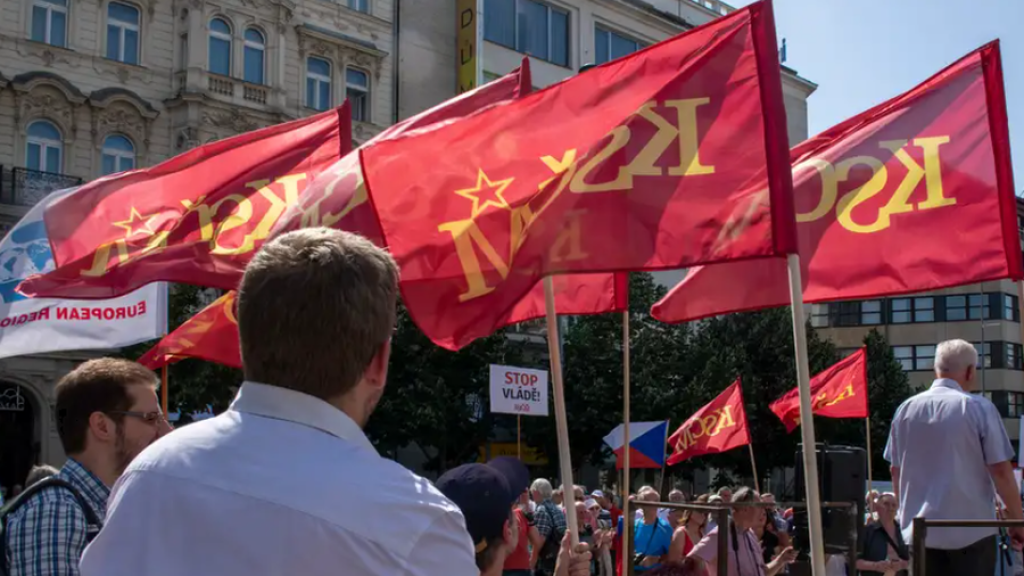
It is official now: as of 1 January, being a Communist in Czechia can make you a criminal, carrying a prison sentence of up to five years.
With a recent amendment to the Criminal Code, the state has written the “equalization” of Communism and Nazism into language that actually matters: punishment. The provision lumps together “Nazi, Communist or other” movements and threatens one to five years in prison for founding, supporting, or “propagating” a movement deemed to suppress rights or incite hatred, explicitly including “class hatred.” The sales pitch is familiar and tidy: two “totalitarianisms,” two symmetrical evils, therefore two symmetrical bans. But the symmetry is politics, not analysis, and once it is encoded as criminal law it stops being a debate about history and becomes a tool for governing the present.
The Czech case is also unusually clean in its logic: it does not simply condemn concrete crimes committed by concrete regimes. It targets the communicability of an idea. What counts as “promotion”? What counts as “a Communist movement”? Does a lecture, a book club, a slogan, a symbol, a song, or a historical argument become “propaganda” the moment an ambitious prosecutor decides it should? This is the point where the legal form does its real work: vagueness produces caution. A law like this does not need mass convictions to succeed. It only needs to create uncertainty, a chilling effect, and a credible threat that “Communism” is a suspect category of speech and association.
Czechia is not some exotic outlier. Across different jurisdictions, the concept of “extremism” has increasingly functioned as a legal solvent that dissolves the distinction between violent practice and theoretical critique. In Germany, the Hamburg Administrative Court ruled in April 2025 that the Marxistische Abendschule (Marxist Evening School) in Hamburg should not have been branded “left-wing extremist” in an intelligence report. But the controversy around the case exposed something deeper than one bad listing: a model of conditional tolerance, where Karl Marx may be read as long as the state is satisfied it remains harmless.
In Russia, the logic is less polite and more coercive: “extremism” and “terrorism” laws are used to police dissent and even political education, and the Ufa Marxist circle case shows the mechanism in miniature, with court-appointed experts interpreting Marxist and Leninist texts as indicators of violent intent rather than ideas to be debated.
Like 85 years ago, under the Nazi Protectorate of Bohemia and Moravia, Communism is illegal in Czechia. While East European liberal democracies claim to stand opposed to Nazism, they obviously unite with it in one respect: hatred of Communism. More awkwardly still, they unite in this respect with the very Russian authoritarian state they rhetorically denounce. Different flags, same reflex: criminalize the Communist idea.
The arc: From banning Nazism, to banning Communism, to declaring them equivalent
For most of the 20th century, the “banned ideology” in Europe had a clear name: Nazism. In the socialist bloc, that ban was not a matter of delicate liberal principle but of post-war legitimacy and state doctrine. After 1989, the target shifted. Communism was gradually added to the repertoire of prohibited symbols and suspect organisations, first through “memory” politics and restrictions on public display, then through the expanding language of “extremism” and “anti-constitutional activity.”
The newest and most consequential step is what we are now watching unfold: the formal equivalence, written into legal and quasi-legal frameworks, that treats Nazism and Communism as equally destructive, equally extremist, and therefore equally eligible for prohibition. This is not a movement driven by “old Europe,” where Communist parties and Marxist traditions have generally remained within the perimeter of lawful politics. It is driven disproportionately by former socialist states, where anti-Communism has become a tool of state-building and political boundary-making, and where the temptation to replace political argument with legal exclusion has proven strongest.
The Baltic states provided an early template for this shift: by constructing legal symmetry between Nazi and Soviet symbolism, they normalised the idea that the two belong in the same prohibited category. Lithuania’s 2008 ban on the public display of Nazi and Soviet symbols, and Latvia’s 2013 restrictions on the use of Soviet Union and Nazi symbols at public events, did not yet amount to the Czech-style criminalisation of “Communist propaganda,” but they did something arguably more important in the long run: they entrenched a juridical habit of pairing the two histories as a single moral and political problem.
At the EU level, this East European agenda has repeatedly been echoed and dignified through the language of “totalitarianism”: European Parliament resolutions in 2009 and 2019 promoted a shared remembrance framework in which Nazi and Communist regimes appear as comparable threats to Europe’s moral order, creating a soft-law narrative infrastructure that makes national hard-law moves easier to legitimise.
Ukraine is the hinge case because anti-Communist law there is not merely a condemnation of a past regime but a nation-building project in a high-conflict environment, where historical memory, security politics and identity are legally fused. The core “decommunisation” law passed in April 2015 condemned the Communist and Nazi regimes and prohibited propaganda and symbols. Shortly thereafter, the Communist Party of Ukraine was banned by court decision in December 2015.
Whatever one thinks of its stated aims, the legal logic is blunt: Communism is treated not as one political tradition among others, but as a delegitimised category to be removed from public space and, in practice, from lawful politics. This is also where the ethnonational dimension becomes concrete rather than rhetorical. Decommunisation functions as a tool for defining who counts as the legitimate political nation and which historical narratives are admissible, precisely at the moment when “security” arguments make exceptional measures feel normal.
If this trajectory were simply “post-socialist democracies versus authoritarian Russia,” the story would be easier. It is not. Russia’s current regime, best described as authoritarian security-state rule, has its own anti-Communist reflex, often wrapped in imperial nostalgia rather than Soviet ideology, and Putin’s attacks have extended beyond Vladimir Lenin to the Marxist canon itself. In his Valdai remarks on 21 October 2021, Putin spoke of the Bolsheviks “relying on the dogmas of Marx and Engels” to remake society and morality, presenting Marxism less as a legitimate intellectual tradition than as a doctrinal blueprint for coercion.
The Ufa Marxist circle case shows how this rhetorical posture can be operationalised through law: “expert” interpretation becomes a conveyor belt that turns reading and discussion into insinuations of criminal intent, with Marxist texts treated not as arguments to be debated but as suspect material that “explains” the accused. In public commentary around the case, this logic becomes almost literal: an expert commission is reported to have described Lenin’s State and Revolution as a kind of extremist or terrorist “manual,” collapsing political theory into contraband.
The convergence is politically awkward but analytically important: on the question of Communism, East European liberal democracies that present themselves as the opposite of authoritarianism often end up meeting Russia on shared terrain. Communism is treated as something to be policed rather than argued with.
How did they get there? Legitimacy, memory and the return of anti-Communism
The contemporary turn toward criminalising Communism in parts of Eastern Europe cannot be understood without returning to the original source of legitimacy of the post-war socialist regimes. Across the region, Communist parties did not come to power simply as bearers of a new social order, but as political forces whose authority was grounded in an anti-fascist pedigree. They fought Nazism, suffered mass repression under occupation, and organised armed resistance movements that could credibly claim to represent “the people” against foreign rule and domestic collaboration. This anti-fascist legitimacy was not ornamental. It was foundational.
The slogan “Death to Fascism, Freedom to the People” was not mere rhetoric. In Yugoslavia, it appeared in official documents and political language until the country’s disintegration in 1991, encapsulating a legitimacy narrative in which socialism, national liberation, and popular sovereignty were inseparable. Similar logics operated elsewhere.
In Romania, Hungary, Bulgaria, and other countries that had either allied with or accommodated the Axis powers, the Communist-led anti-fascist turn after 1944 played a crucial role in avoiding prolonged military occupation and in enabling the reconstruction of statehood under the banner of nominal independence. Anti-fascism functioned as a political absolution mechanism.
But this very mechanism had a long-term cost. Because legitimacy was reconstructed through Communist anti-fascism, de-Nazification remained shallow, selective or incomplete in many countries. Collaborationist structures were often absorbed, neutralised or selectively punished, rather than dismantled. As historians such as Dejan Jović have argued in the Croatian case, the post-war settlement displaced rather than resolved unresolved questions of fascism, collaboration and national responsibility. These issues were politically frozen, not settled.
The collapse of Communism radically altered this legitimacy equation. As Nazism receded from political memory and nationalist narratives gained strength across Eastern Europe, anti-fascism ceased to function as a usable political resource. New regimes no longer needed to ground themselves in resistance to Nazism; instead, they reconstructed legitimacy through pre-socialist national narratives, often reaching back to interwar or even pre-modern statehood traditions. EU accession later provided an additional, external source of legitimation: membership itself became proof of democratic credentials, effectively laundering historical ambiguities through the language of “European values.”
In some cases, this turn toward pre-socialist legitimacy has gone far beyond the inter-war period and into outright pre-modern mythmaking. The Croatian Constitution famously grounds contemporary statehood in the “millennial national identity” of the Croatian nation, tracing uninterrupted continuity back to the formation of Croatian principalities in the seventh (!) century. This is not an eccentric flourish. It is a political signal. When legitimacy is anchored in a mythical depth of time rather than in modern social struggle, anti-fascism becomes dispensable, historical responsibility becomes negotiable, and Communism emerges as the principal threat, not because of what it did, but because of what it still represents: a modern, materialist challenge to ethnonational continuity.
The intensity of this turn is not evenly distributed across the former socialist world. The legal hardening of anti-Communism has been led above all by post-socialist EU member states in Central and Eastern Europe, especially the Baltic states and Czechia, with Poland and Hungary representing more uneven, contested cases, and by Ukraine, where nation-building, geopolitical alignment, and a securitised politics of memory make “decommunisation” a state project rather than a cultural preference.
By contrast, “old Europe” has generally been more tolerant in practice, not because Western capitalism is less hostile to Communism as an idea, but because Communist parties and Marxist traditions were never wholly expelled from legitimate politics and often remained embedded in parliamentary life, unions, and intellectual culture.
The Western Balkans largely sit in a different register again: history wars and nationalist rehabilitation politics are intense, but explicit legal bans on Communist ideology have been far less central to regime legitimacy, partly because anti-fascist partisanship remained a core reference point, longer than in the EU’s eastern periphery.
And in much of post-Soviet Central Asia, where political control is achieved through party registration, policing and managed opposition, rather than “memory law,” there is little need for the European theatre of equivalence at all: regimes do not have to criminalise Communism to neutralise politics.
In that setting, the ideological enemy could and had to be reassigned. What returned to the foreground was not fascism, but Communism. Unlike fascism, Communism was not a defeated external enemy. It was the only intellectual tradition that had governed these societies for decades and the only coherent theoretical alternative to capitalism embedded in their historical experience. And unlike liberalism or conservatism, it retained the dangerous quality of being systemic.
Yet an outright ban on Communism posed a problem. Explicitly criminalising a broad political tradition risked clashing with constitutional guarantees, international norms and the self-image of these states as liberal democracies. The Commission repeatedly warned against vague bans on ideology and overbroad restrictions on political expression. Direct repression, in other words, looked politically awkward and legally vulnerable.
The solution was conceptually elegant and politically effective: equivalence. By placing Communism and Nazism in the same legal and moral category as “totalitarian” or “extremist” ideologies, states could present repression as neutrality. Communism was not banned as Communism, but as one half of a symmetrical moral equation. The move allowed governments to fight Communism while claiming not to take sides at all. What was prohibited was not an ideology, but “extremism.”
This equivalence did more than provide legal cover. It rewrote the post-war story. Anti-fascism, once the core legitimising resource of Communist rule, was hollowed out and redeployed against Communism itself. The very struggle that had legitimised socialist regimes became evidence of their supposed moral equivalence with the enemy they defeated. In this reversal, history is not denied — it is rearranged.
That is how they got there. Not through a sudden authoritarian turn, but through a slow transformation of legitimacy: from anti-fascism, to nationalism, to Europeanisation, and finally to a juridical framework in which Communism can be neutralised without ever naming capitalism as its beneficiary.
Why it matters
The accelerating criminalisation of Communist symbols, language and tradition matters for two reasons. The first is political-historical: once Communism is legally recoded as morally equivalent to Nazism, the anti-fascist story that shaped Europe’s 20th century is quietly hollowed out. If Communism is “the same kind of evil,” then those who fought Communists can be presented, by implication, as occupying the “right side” of history.
This does not require anyone to explicitly praise Nazism. It works through a softer and more effective mechanism: moral rearrangement. Anti-fascism stops being the founding language of post-war Europe and becomes, at best, a disputable partisan narrative. At that point, rehabilitation politics no longer looks like rehabilitation. It looks like “balance,” “national dignity” or “context.” As Slavoj Žižek put it, the very attempt to “compare rationally the two totalitarianisms” tends to yield the conclusion, explicit or implicit, that fascism was the lesser evil and an “understandable reaction” to the Communist threat.
This is not just a theoretical risk. In Antisemitism: Here and Now, Deborah Lipstadt describes what she calls a kind of national-level “soft-core denial” in parts of Eastern Europe: deliberate efforts to reorder wartime history in ways that rehabilitate nationalist collaborators, downgrade or relativise local participation in Nazi crimes, and reframe anti-Nazi resistance (especially where it was Soviet-linked) as treason rather than liberation. She notes a further, uglier consequence: these projects may not always be driven by antisemitism as intent, yet antisemitic insinuations can end up as one of their political “outputs,” precisely because the old association of “Jews with Communism” is so easily reactivated once anti-Communism becomes a state creed.
You can see this logic in the way parts of Eastern Europe have institutionalised a habit of pairing Nazi and Soviet histories as a single moral object, a pattern often justified through “double genocide” rhetoric that, as Rupen Savoulian has argued in the Baltic context, tends to minimise Nazi criminality while reclassifying the Soviet period as an equivalent “genocide” to conceal or soften local accountability for collaboration and participation in wartime atrocities.
Latvia’s recurring controversies around commemorations of World War II-era Waffen-SS formations show how quickly “they fought the Soviets” becomes a moral alibi, even when the symbolism and associations are obvious and internationally contested. Estonia has had similar disputes around public gatherings honouring Waffen-SS veterans, with critics warning that the line between “anti-Soviet remembrance” and the laundering of fascist collaboration becomes politically porous when anti-Communism is treated as a near-absolute virtue.
None of this means that these states are “Nazi.” It means something more banal and more dangerous: when Communism becomes the arch-crime, collaboration and ultranationalism can be reframed as unfortunate but understandable “defence,” and the moral hierarchy of the 20th century becomes negotiable. The historical irony here is clear: serious historiography has stressed that anti-Communism was not merely something fascism reacted to, but one of its organising determinants and rallying watchwords, including in its most extreme form.
Ukraine illustrates this dynamic in its sharpest form because the law is not merely about the past, but about the present: it fuses memory, security and nation-building. The 2015 decommunisation package did not only condemn Communist and Nazi regimes and restrict propaganda and symbols; it was adopted alongside legislation that legally honours “fighters for Ukraine’s independence in the 20th century,” a category that is politically explosive precisely because it pulls wartime nationalist formations into a state-sponsored narrative of legitimacy. Serious legal analysis (by the Venice Commission) has noted that this kind of “militant democracy” drafting risks vagueness, breadth and chilling effects, and that the law’s logic can impose a positive interpretation of contested history under implied sanction.
The consequences of this moral rearrangement are visible in public space. In Ukraine, annual torchlight marches honouring Stepan Bandera have become a routine feature of nationalist mobilisation, despite his deeply contested wartime legacy and despite the fact that his designation as a “Hero of Ukraine” was annulled by court decision in 2011. In the same vein, public commemorations of the Waffen-SS Division “Galicia” have taken place under the banner of “anti-Soviet resistance,” provoking repeated condemnation from Jewish organisations, Polish institutions and international observers. Once the state defines Communism as a security threat and delegitimises it as a category, it becomes easier to legislate national innocence and to discipline historical debate by law.
The second reason is more important, and it is the real core of the entire trend: anti-Communist legalism is not mainly about protecting democracy from dictatorship. It is about protecting capitalism from an alternative. Communism is not merely “a bad historical experience.” It is the only modern political tradition that explicitly targets the foundation of capitalist power: private ownership of the means of production, and the social order built around it.
That is precisely why the contemporary “equalisation” framework is so useful. An outright ban on Communist ideology looks awkward in societies that still market themselves as pluralist. So the solution is to smuggle the ban in through moral symmetry: declare Nazism and Communism equally extremist, equally hateful, equally beyond the permissible, and then treat the suppression of Communist speech as an act of democratic hygiene.
What makes the Czech amendment especially revealing is that it does not only rely on that moral symmetry. It quietly extends the “hate” logic into the domain where Communist politics actually lives: class antagonism. In the provision’s own wording, the prohibited movements are framed not only as those that suppress rights or incite racial, ethnic, national or religious hatred, but also those that advocate “class hatred.” That addition is not a technical detail. It is the pivot.
Communist politics is not organised around hatred of an ethnicity or a nation; it is organised around opposition to a social order grounded in private property and exploitation. By inserting “class” into the same criminal register as race and nation, the law offers a ready-made translation of labour conflict into criminal intent: collective struggle against capitalist rule can be re-described as “hatred” against a social group.
This is how the law narrows the future in a very concrete way. It does not merely make the discussion of alternatives to capitalism a legal risk in theory; it gives prosecutors a vocabulary for treating class struggle itself as extremist. And because class power in capitalist society is not symmetrical, the effect is structurally one-sided.
Workers mobilising against exploitation are the obvious targets of the “hatred” frame. Capital does not march en masse against labour; it disciplines labour through institutions, ownership and the state. The result is a perverse inversion: the language of emancipation is recoded as incitement, while the everyday coercion that keeps workers locked in unequal social relations remains unproblematised as “normal order.”
This is exactly the shift Sofija Kordić captures in the Czech case: what used to be fought in the arena of politics and public interpretation is now being moved into the courtroom. As contemporary reporting on the Czech amendment notes, the key novelty is not that extremist movements could never be prosecuted before, but that “Communism” is now explicitly named alongside Nazism in the criminal-law frame, and the practical effect will hinge on prosecutorial and judicial interpretation of what counts as “promotion.” The law becomes less a statement about history than a tool for disciplining the present through ambiguity, deterrence and the credible threat of selective enforcement.
This is also the point where “liberal democracy” begins to rhyme with Russia’s authoritarian security state in a way neither side likes to admit. Putin treats challenges to his rule as illegitimate by definition. The logic is sometimes stated with almost comic clarity. In a televised meeting with award-winning school teachers, Putin asked a history teacher what the Decembrists’ greatest mistake was. The Decembrists were aristocratic officers who rose against autocracy in December 1825 in the name of constitutional reform; the uprising was crushed and its leaders executed or exiled. The teacher began to answer in terms of social conditions and political prerequisites. Putin cut him off: their real mistake, he said, was that they violated their solemn oath to the Tsar. In that worldview, rebellion is not wrong because it fails, or because it misreads history. It is wrong because it breaks fidelity itself.
East European liberal regimes, meanwhile, increasingly treat challenges to capitalist property relations as illegitimate by rebranding them as “extremism,” “hate” or “propaganda.” This is precisely why Communist ideas are singled out. Marx does not offer a polite reformist critique; he calls for what he famously described as a “ruthless criticism of all that exists,” a criticism unafraid of its conclusions and unafraid of “conflict with the powers that be.”
In a system where property is sacred and state authority is allergic to being challenged, that kind of intellectual tradition is dangerous even before it organises anyone. It is “unacceptable” not because it incites ethnic hatred, but because it names exploitation, targets private ownership as the foundation of power, and treats the existing order as historically contingent rather than morally untouchable.
If that sounds like a merely Czech peculiarity, it is not. Political scientists and historians of memory politics have traced how “two totalitarianisms” narratives operate as a legitimising device in post-1989 Europe, especially in the former socialist periphery. Maria Mälksoo’s work on “becoming European,” for example, shows how East European states pushed their mnemonic agenda into the EU by elevating the Soviet experience into Europe’s core moral story, often via symmetry with Nazism.
Kristen Ghodsee argues more bluntly that the “two totalitarianisms” frame has functioned as a crisis narrative of capitalism itself, diverting anger over post-transition dislocation away from property and inequality and toward anti-Communist moral consensus. Jelena Subotić, working through the politics of Holocaust remembrance after Communism, shows how Communist “crimes” are frequently folded into a moral economy of memory in ways that serve contemporary legitimacy projects and narrow the space of acceptable politics.
That brings us back to a point I have made before: delegitimising the revolutionary tradition is not simply about condemning the past. It is to narrow what is considered politically thinkable today, by turning the idea of a systemic alternative into a moral taboo, and increasingly, into a legal risk. That is why the anti-Communist drift is so obsessed not just with regimes and crimes, but with symbols, books, songs, organisations and the very communicability of an idea.
At this point, the Communist Manifesto’s opening line becomes less a slogan than a description: a “spectre” haunting Europe, and a “holy alliance” of respectable powers formed to exorcise it. The effort is not to refute Communism, but to make it legally and morally unsayable. The spectacle is that “democratic values” are invoked to justify the policing of a tradition that, whatever one thinks of its historical outcomes, names a central contradiction of capitalist society: the private accumulation of social wealth.
The whole “two totalitarianisms” script works because it replaces an argument about property and power with a sermon about morality. Conveniently, sermons do not require evidence, only conformity.
Not two ‘extremisms’ but opposite moral and social logics
At some point this stops being an argument about historical memory and becomes an argument about intellectual honesty. Nazism and Communism are not comparable “extremisms” that just happen to sit at opposite ends of a spectrum. They are built on opposite moral and social logics, and the attempt to force them into symmetry is not clarification. It is a distortion.
Nazism is an ideology of exclusion. Robert Paxton famously argued that fascism is defined not by a coherent social theory but by hierarchy and mythic mobilisation against imagined enemies. Nazism represents this logic in its most extreme form. Its political project depends on hierarchy: it divides humanity into ranks of worth, assigns collective guilt by birth, and legitimises domination as destiny. Its ideological core is not a serious social theory but a repertoire of pseudo-science and mythic geopolitics — race hierarchy, blood-and-soil nationalism, and the fantasy of Lebensraum. Even where it borrows the language of modernity, it does so to organise conquest, enslavement and extermination in the interests of a “superior” nation.
Communism, whatever one thinks of its historical outcomes, begins from the opposite premise to Nazism. Its stated subject is not a race or a nation, but the working majority, and its horizon is universal emancipation. Marx and Engels famously insisted: “The working men have no country. We cannot take from them what they have not got.”
Even one of Marxism’s sharpest “bourgeois” critics, Max Weber, framed Communism’s declared aims in universalist terms: the attempt to realise Communist ideals, he noted, sought “universal material abundance and emancipation from domination,” even as he argued that such a project would likely intensify bureaucratic rule rather than dissolve it.
Marxism is anchored in a socio-economic critique of capitalist society and a theory of exploitation and crisis. It is not a cult of blood or territory; it is an attempt to explain how wealth is produced, how it is appropriated, and why private ownership of social production generates systemic inequality and periodic catastrophe. One can reject its prescriptions, criticise its historical record or dispute its conclusions. But it is a tradition of analysis, not a mythology of biological destiny.
This is also why Slavoj Žižek’s intervention is useful as a final marker of the difference. In his critique of “the two totalitarianisms,” he concedes that fascism did indeed arise as a reaction to the emancipatory rupture opened by October, but he insists that what changes in the passage from Communism to Nazism is not just “content” but form.
Fascism does not simply “oppose” communism. It mystifies what Communism names: it displaces a structural conflict internal to capitalist society into an invented racial struggle, naturalising politics as biology and translating class antagonism into the fantasy of a foreign contaminant inside the national community. The enemy moves from an exploitative social relation to an allegedly alien body. That shift is precisely where the Nazi ideological fraud resides.
This difference matters because the contemporary equivalence framework is not an innocent category mistake. It is a political technique. It takes a doctrine of racial domination and a doctrine of social emancipation, declares them equal as moral pollutants, and then uses the language of democratic hygiene to police the one that still poses an intellectual threat to capitalism. That is why the legal focus drifts so quickly from concrete crimes to symbols, texts, and “propaganda”. The aim is not to understand history, but to manage what can be imagined.
This is why the Communist Manifesto still lands with uncomfortable precision: a “spectre” haunting Europe, and a “holy alliance” forming to exorcise it. The real fear is not a return of 20th-century regimes. It is the return of a simple question that liberal capitalism prefers to treat as illegitimate: if the economy is social in its production, why is it private in its ownership?
So when Czech law places “Nazi” and “Communist” in the same criminal sentence, it is not only rewriting the past. It is narrowing the future. On New Year’s Day, a handful of Young Social Democrats marked that narrowing in a small but perfectly timed act: 11:55 outside Prague’s Ministry of Justice, five minutes to midnight, under the banner “First they came for the Communists…” They understood what the new law’s defenders pretend not to: once politics is moved into the courtroom, the courtroom does not stay politely limited. Like 85 years ago, under the Nazi Protectorate of Bohemia and Moravia, Communism is illegal in Czechia.