Ten years of the France Insoumise: A Marxist view
Slightly adapted by author from article originally published at International Socialism.
Next February, the France Insoumise,1 “France in Revolt”, largest organization of the radical left in France, will be ten years old, but in-depth Marxist writings on its nature and prospects, particularly those published in English, have been very few.2 This article aims to show what is specific about it, and give a view on how revolutionaries should engage with the movement. There are two other reasons that this article might be timely. Firstly, in the UK, the new radical left party around Zarah Sultana and Jeremy Corbyn has opened up questions about what sort of principled alliances are healthy and useful. Secondly, for the first time, one of Jean-Luc Mélenchon’s major books was published in English last year3 and so the France Insoumise project is being discussed more frequently among anglophone activists.
I will first look at the influence and activity of the France Insoumise in 2025, and its usefulness to the working class, before retracing the history of its ideas and organization. Then I will look at immediate and medium-term weaknesses of FI ideas and strategies. I will consider that it goes without saying that revolutionary Marxists must maintain their own analyses, voices, organizations and initiatives, and not dissolve all their activity into any such movement. Finally, I will look at how the revolutionary left in France has interacted with the infinitely more influential France Insoumise, and serious mistakes I believe are being made.
Reformism and/or revolution
The latest book by Jean-Luc Mélenchon, the most influential leader of the France Insoumise, is entitled Now, the People. Revolution in the Twenty First Century. LFI documents frequently speak of “a citizens’ revolution” and “spectacular change.” Mathilde Panot quoted Rosa Luxemburg in the closing meeting of the 2025 summer school,4 while the analyses of Karl Marx on capitalism are taught and discussed in LFI educational events. Further, a call for an insurgent people is common in leaders’ speeches: in August last, Mélenchon explained that when a France Insoumise government is formed, the job of activists will not be to obey but “to be in revolt everywhere, all the time”.5
Despite this, we have to see LFI principally as “new reformists.” This is not an insult, but the application of a Marxist category. The central strategy of the LFI leadership is to transform France by winning elections, changing the constitution radically to reduce presidential power and increase people’s democratic rights, and using the powers of the state to further the interests of the masses. In this way, they intend to sharply turn the economy and society towards the protection of our planet and the social wellbeing of citizens, and away from the dictatorship of profit and speculation. The stated objective is not to dismantle existing state institutions, disband the police and army and build new structures of workers’ democracy based on the workplaces, as we revolutionary Marxists tend to recommend. The LFI programme includes, for example, a section on “Restructuring the Police Force to Uphold Republican Principles.” Its economic programme explains the need for the establishment of powerful public banks, but not for expropriating existing banks. Elements of left Keynesianism – the idea of relaunching the economy through government investment — are central to FI policy.6
There are, nevertheless, a number of crucial points to be added to this initial characterization. The first is that this important categorization is one which is available to Marxists and not to the mass of French workers. Very large numbers of people favourable to LFI or firmly opposed to LFI consider its project to be revolutionary. There is absolutely no general understanding in the French working class of any difference there might be between “a citizens’ revolution” and “a workers’ revolution.” This fact must guide the attitude of all revolutionary activists. Remaining loudly distant from people who are demanding revolutionary change, using the excuse that we want a different kind of revolution, is not good strategy.
Secondly, if the dominant solution proposed by the organization’s leadership would fit alongside a reconfigured version of the existing state machine, the LFI is still very different from mainstream reformism. It has gained its complete organizational independence from those parties with a past in government and in managing austerity. Its leaders do not suggest people should stop fighting and wait for the next elections: LFI generally supports popular revolt. In his speech at the summer school this year, Mélenchon called for a general strike on 10 September. He has also called on young people to join active antifascist organizations such as “The Young Guard”, an organization banned by Macron last March. Mélenchon declared “these young people hate fascism. I say they are right. Well done, continue like that! The Minister of the Interior is trying to frighten us — [he] will never succeed!”.7
As I write, in late 2025, LFI local groups are very much involved in building strikes and setting up demonstrations, while one of the younger LFI members of parliament, Louis Boyard, has called on high school students to blockade their places of study.8 Last June, Mélenchon’s speech at a national demonstration ended “Long live struggle! Struggle is the only thing which keeps us alive and standing up!”.
On the level of theory too, the idea of breaking with traditional reformism is very much present. Three quotations from Mélenchon’s latest book will suffice to illustrate this. On the present situation, he explains that “Capitalism is inherently anti-ecological, and today neoliberalism is driven ever further into an authoritarian spiral”.9 On changing society, he declares “We are not talking about a patch-up job, but a change from this civilisation to a different one”.10 And on the attitude required to rebel effectively, he tells us that “Today, being an anti-capitalist is a precondition simply to make reasonable preparations for humanity’s survival”.11
This radicality attracts millions and is a real sign of hope. It would be hopelessly sectarian for revolutionaries to see LFI first and foremost as unwelcome competition, an organization to be caught out with “gotcha” articles brashly denouncing specific tactical decisions without putting together a general understanding of LFI strengths and weaknesses.12
Influence and activity today
So, how influential is LFI today, and how useful is it to workers and the oppressed in the building of combativity, confidence and consciousness? Let us look first at votes. The LFI candidate, Jean-Luc Mélencon, got 7.7 million votes at the presidential election of 2022.13 That was a rise from 7.1 million in 2017, even though in 2022 (but not in 2017) the Communist Party fielded a candidate against him.14 Working-class people were stronger supporters of LFI than others. In 2022, Mélenchon obtained 21.95 percent overall, but won the support of 28 percent of voters from really poor households.15 Twenty seven percent of blue-collar workers who voted chose LFI, 25 percent of white-collar workers. Mélenchon got more than 30 percent of voters under 34, and did particularly well in the larger towns (Montpellier and Lille over 40 percent, Toulouse 37 percent, Lyon and Marseille 31 percent, Paris 30 percent).16 Fully 69 percent of French Muslim voters chose Mélenchon, confirming his role as the first well-known national politician to take the fight against Islamophobia seriously, in the most Islamophobic country in Western Europe.
In 2017, the FI had seventeen members of parliament in the National Assembly. Today there are 71 (and 9 Euro MPs). The vast majority were new to political office, and many were recruited because of their role leading local protest movements or trade union struggles. Let me mention just a few. Euro MP Anne Sophie Pelletier had previously been the spokeswoman for a strike in care homes. Farida Amrani first made her mark as a local government trade unionist, Jean-Hugues Ratenon first organized against poverty in Reunion Island, Muriel Ressiguier began in a national antifascist campaign, Sébastien Delogu was spokesman for an important taxi drivers’ strike in Marseille, Rachel Kéké led strikes of hotel cleaning ladies. Alma Dufour was a leader of Friends of the Earth, Martine Etienne was a union activist in the Post Office for many years, while Abdelkhader Lahmar was an activist against police racism. The general profile is one of active class fighters, and certainly nobody’s yes-men or yes-women.
What about the FI programme? It takes into account the seriousness of the climate emergency, and insists on the need for a radical transformation of society (100 percent renewable energy and 100 percent organic farming count among the proposals). It proposes that a maximum salary be imposed by the government in each company, and that the minimum wage be raised sharply, while all wages should be indexed to inflation. Maximum inheritance is to be limited by law. Price freezes on basic food products are proposed, and free basic amounts of water and electricity for every household. Crèches are to be free. The full, crowd-sourced programme includes 831 measures, far too many to list here.17 This is obviously not a revolutionary Marxist programme, but equally obviously it is an exciting programme which is inspiring millions of French workers who are furious at the dictatorship of profit.
Constitutional change
An important objective of LFI is to found a “Sixth Republic.” The present French constitution (which gives huge powers to the president) is that of the Fifth Republic, put together under the supervision of General de Gaulle in 1958. The FI project for a new constitution attracts a level of support in France difficult to imagine for people in countries like the UK where constitutions are generally considered so boring there is no point in having one. In 2017, 100 000 people marched in Paris under the slogan “For a Sixth Republic.” If an FI candidate is elected president, they promise to call a constituent assembly to write a new constitution. The meaning of this proposal for constitutional change is hard to assess precisely, but is a sign of how the organization wants to foreground its determination to break with (neoliberal) business as usual.
Local elections, educationals
The next elections will be the local elections in March. At the last ones, in 2020, only 45 percent of the electorate voted, so LFI networks are hoping to mobilize the abstainers through mass door-to-door canvassing in particular,18 as they successfully did for the legislatives. LFI have already hit the headlines with their proposal to reverse privatization of water supply, to disarm municipal police forces, and to make school meals free.19 At the 2025 LFI summer school, a series of discussions covered the experience of left councils in the 20th century and today.
While there is not in LFI the development and debate on theory which we have in revolutionary Marxist organizations, ideas are taken seriously, as is the development of leadership. The national FI educational scheme, the La Boétie institute,20 sets up regular lectures and conferences. Recently there were events on “The Double Exploitation of women,” “The Length of the Working Week since the Fourteenth Century”, “How the State Serves the Market” and “What Strategy can Defeat the Far Right.” In addition to the audience on site, these lectures got between 5000 and 15000 views on YouTube.21
The FI summer school in August 2025 attracted nearly 5000 participants.22 The meeting rooms carried the names of revolutionary women and men, mostly from the French Revolution, Haitian Revolution, and 19th-century socialist movements.23 Meetings included “Historical Materialism”, “Capitalism according to Karl Marx”, “Capitalism and Exploitation today”, “Fighting Islamophobia”, training workshops on speaking in public and on graphic skills, and debates and lectures concerning practically all the key political questions of today, including secularism, feminism, homophobia and transphobia, antifascism, police violence and animal rights. Five hundred and fifty activists under 26 had attended a three-day youth camp a few days previously. It should nevertheless be noted that although there were many meetings on international and anticolonial issues (Kanaky, Mercosur, the conflict between China and the USA, etc), the words “French imperialism” appear nowhere in the programme. We shall come back to this question below.
Regular cadre schools for activists take place, generally consisting of a series of eight weekend courses, organized around the themes “on materialism, on the ‘age of the people’, and on global humanism”.24 Some effort is made to include people from working-class backgrounds (45 percent of the last participating group, of 70 people, had never been to university).
Parliamentary work
The action in parliament of the 71 MPs is intended both to show the capacity of the organization to govern the country, and also to serve as mass political education, given the wide media coverage of parliamentary debates. Parliamentary courtesy is thrown aside. In May 2024, LFI MP Sebastien Delogu was suspended for waving a Palestinian flag during debates; LFI MPs have shown in parliament documentaries on the genocide in Gaza, and demanded a minute’s silence for victims of racist murders by the police. In 2017, when Macron’s government reduced housing benefit by five euros a month, and dismissed the idea that this might matter to people, Mélenchon came to the assembly with a bag of groceries to show what can be bought by poor families with such a sum. All these actions help reinforce the idea that neoliberal reaction is not inevitable.
Elections are central to France Insoumise strategy, and this is one of the things which makes the movement popular. People see that elections change things. Trump gets elected: things get rapidly worse. My town near Paris, Montreuil, elected a Communist mayor, who builds council housing. Other towns around Paris, like Neuilly or Boulogne-Billancourt, with Conservative mayors, do not. It is a long time since major reforms for our class have been instituted by a government in France, but people remember reforms such as retirement at 60 (1981), the 35 hour week (2002), or the right for gays and lesbians to marry (2013) and they hope elections might bring real change.
This hope is no doubt even stronger after the magnificent strike movement of 2023, which failed to stop Macron from raising the retirement age by two years.25 Interest in electoral movements often rises after other movements do not succeed, and this tendency is strengthened by the fact that the left in France, (including the revolutionary left) are not clear on the reasons for the defeat of 2023.26
Workers also see clearly that elections can serve to temporarily brake the vicious drift to reaction. In 2024, the pressure from below for a united left electoral front against the far right was absolutely overwhelming. All the opinion polls without exception predicted a fascist government, and the fact that the fascists finally came third in number of seats constituted a crucial tactical victory, distancing, for a while, Le Pen’s National Rally from the prospect of power. If Marseille and Lyon have not seen this year the pogroms we have seen in Minneapolis, it is because of this tactical antifascist history.
But the France Insoumise has also gained much support for its activity on dozens of issues which are not directly connected to legislative activity. I would like to concentrate on three questions which are litmus tests for radical left organizations, subjects where establishment pressure is such that many organizations rush to toe the line: Palestine, police violence, and Islamophobia.
Palestine, police violence and Islamophobia
The France Insoumise elected representatives have used their position to mobilize against the genocide.27 FI Euro MP, Rima Hassan was the only elected representative on board the Madleen alongside activists and journalists in June 2025. The follow-up freedom flotilla in September counted a number of LFI leaders — including Thomas Portes (39 year-old railway worker and member of parliament), Emma Fourreau (25 year-old Euro MP and green activist) and Marie Mesmur (31 year-old MP). FI groups everywhere in France are active in the Palestine movement.
Police violence is an issue which generally pulls reformist forces into line, so it was refreshing to hear the reactions of LFI leaders when rebellion spread across France’s working-class suburbs in response to yet another racist police murder caught on video, that of Nahel Merzouk, in 2023.28 The LFI insisted in speaking of a “revolt” and not of “riots.” Jean-Luc Mélenchon declared “The [media] guard dogs [of the establishment] are ordering us to call for calm. We call for justice!… Suspend the police murderer.” FI MPs and action groups have been involved in campaigns against police violence in their towns.
Islamophobia, as many readers will be aware, has been even more central to government strategies in France than elsewhere. In recent years, ministers have claimed French universities are dominated by “islamo-leftists” or have insisted that high-school students wearing North African tunics are part of an infiltrating islamist fifth column. Huge pressure is put on sporting organizations to make sure women who wear hijab are banned from participating. The right wing has put Islamophobia front and centre because the left, including the far left, has been so catastrophically poor on this issue.29 Last year, almost nobody protested when French hijab-wearing athletes were banned during the Olympics.
Determined work over decades by Muslim activists and allies has obliged the French radical and revolutionary left to make slow progress on this question. So, whereas in 2010, the New Anticapitalist Party newspaper referred to women who wear a niqab as “birds of death” in an editorial, and, only six years ago, the FI summer school invited an “expert” on secularism who insisted he had “the right to be Islamophobic”,30 both organizations have moved forward. Today the FI is generally seen as the party of enthusiastic opposition to Islamophobia. Mélenchon’s keynote speech at the 2025 summer school put the question front and centre: “The heart of the struggle is to refuse racism and Islamophobia, which are just the system’s tools to dominate us… whatever your neighbour’s religion is, you have the same interests”.31 No other public figure of similar stature in France has ever done this. This is not to say that more progress is not needed. The FI is still divided, for example, concerning the abrogation of the racist 2004 law which bans Muslim headscarves for high school students.
One idea which has been put forward by Mélenchon as a response to institutional racism is that of “creolization” — the idea (adapted from that of Edouard Glissant, a black French philosopher from Martinique) that the new France is made up of a rich multiethnic mix which should be celebrated and can be the basis of a new unity. From the point of view of working-class politics, the question is not so much whether this viewpoint is beyond reproach (it needs to be debated), it is to note how much progress it represents compared with the traditional assimilationist and Islamophobic philosophies which have dominated the French left for many decades.
History of LFI ideas
The eclectic mix of ideas behind the France Insoumise has been developed by Jean-Luc Mélenchon and close allies over the last forty years.32 Mélenchon joined the revived Socialist Party as a student, when it was re-founded in the early seventies; he participated for some time in a Trotskyist grouping, but was rapidly disillusioned with small group politics. The atmosphere in the Socialist Party at this time was symbolized by the declaration of its new leader François Mitterrand: “Those who do not wish to break with the established order, with capitalist society, cannot be members of the Socialist Party”.33 Mélenchon was inspired by the LIP workers’ occupation in the early 1970s and by the Portuguese revolution of 1974. For a time he was a member of a Chilean far left organisation, the MIR, but was demoralized by the military coup in Chile in 1973.
The Communist Party, still very powerful, did not attract him. It was slow to embrace or learn from the new social movements (student revolt, feminist and environmental activism, anti-racist currents). And when Solidarnosc in Poland inspired those who really wanted change, the French CP leadership were very negative about it and supported the martial law declaration by Jaruzelski in 1981.
Inside the Socialist Party, after the turn towards austerity of the Mitterrand governments, Mélenchon organized a left-wing current. He became a senator and was later a junior minister for two years. At the time of the 2005 referendum on a neoliberal constitution for the European Union, he broke away from official PS policy to the left, and finally abandoned the party in 2008. The most visible options using the ideas of Marxism did not attract him. The PCF waved the hammer and sickle flag, but was less and less radical with each year that passed. The Trotskyist groups in France seemed small and sectarian. Mélenchon’s political development is that of an activist intellectual in a country where the traditions of active Marxists had some merit, but were very much flawed.34
He thought something new was required. It has often been noted that he borrowed several key ideas from the “left populism” of Belgian academic Chantal Mouffe.35 Many have overemphasized this debt, however: in a long-filmed conversation with Mouffe, available on YouTube, the two thinkers seem to have as many differences as similarities.36 Mélenchon has also often underlined his debt to sections of the South American left.
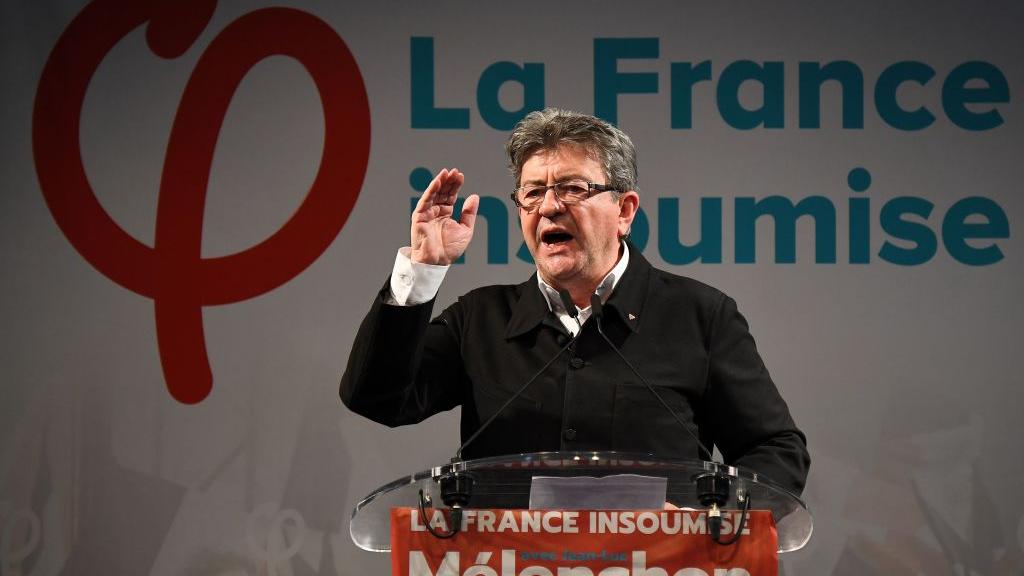
His newly formed “Parti de Gauche”, founded in 2009, never became a mass force, but after different experiences of electoral alliance across the radical Left, the France Insoumise has become the centre of gravity of left politics in France.37 The FI has invented a new symbolism — using not the hammer and sickle, but the Greek letter Phi, speaking of the people, not the proletariat; they speak of “rebels” (les insoumis) rather than “socialists”. The relative success of these innovations was facilitated by the negative connotations of the hammer and sickle and of the word “socialism” to radicals in France. However, the fundamental explanation for FI’s meteoric rise is elsewhere. As I wrote in ISJ 185:
Its emergence is the result of two phenomena. There is the generalisation of political class consciousness in France after the mass political strikes of 1995, 2006, 2010, 2013, 2019 and 2023 (against attacks on pensions or on labour protection legislation) and the popular revolts of 2005, 2018 and 2024 (against police violence or rural poverty). Then, there is the weakness and division of the Marxist left, which was unable to recruit massively from this rising consciousness.38
Today, apart from having a series of talented speakers – Manon Aubry, for example, and in particular Mélenchon himself,39 the FI has a dynamism and youth which are very valuable. It can popularize punchy slogans, such as “Macron and Le Pen — a duet, not a duel!”. But its key talent is in listening to and recruiting from the explosive movements which the crisis in French society regularly throws up — the Yellow Vests, the movement against police violence, or the left Muslim networks.
Marxist analysis is not about giving marks out of ten to different left political organizations, but about grasping their usefulness and potential. I have explained how the LFI has been useful to workers’ consciousness and left organization, and I will later speak of the opportunities opened up for Marxists. But first I must look at some of the weaknesses of FI ideas and practices.
People or proletariat?
The theory of social change put forward by Mélenchon and other FI leaders is based on their impression that revolutionary Marxism has not worked- the Leninist version is generally seen as having degenerated into Stalinism, the Trotskyist version into sectarian irrelevancy. Along with many readers of this journal, I do not agree. A theory for spectacular change which attracts millions, however, deserves serious consideration and debate, in particular when it has built the FI, a powerful movement which is so useful for workers and for the oppressed.
The first question to debate is the choice of appealing to “the people” rather than to “the workers.” Now, when (in 2023) we saw were millions on the streets to oppose the raising of the pension age, and the FI, with an audience of tens of millions, was saying that “the people” need to blockade the country until this attack was abandoned, it would rightly to be considered sectarian if the Marxists, with an audience dozens of times smaller, were concentrating on denouncing the use of the term “people” and not “working class.” As a term used in a movement slogan, “people” is a relatively harmless variant.40
As a term of analysis of capitalist society, though, it is problematic. The idea of the “working class” emphasizes that the power of the exploited is above all present in the workplace, where the essence of the system, profit, is produced. This is notably the case in moments of crisis: what terrified the rulers of France in 1968 was, fundamentally, not the huge student movement, but the ten million strikers.
When debate turns to foreign policy, moreover, the exclusive use of the idea of “the people” has very serious drawbacks. When we speak of domestic politics, the “people” can be active on the streets, on strike, and can be seen in various other sites of resistance. But on the international stage, the FI leadership’s idea of the actor who might be able to improve things radically is … the French state. FI declarations on French foreign policy can be excellent: when in 2023, Niger threw the French military out of its country, Mélenchon was almost alone on TV to say that the Niger government were the ones who had the right to decide. But the better future which is proposed is one where the French state would lead peace and justice initiatives around the world, using its power for good. Obviously we Marxists do not see this as realistic. FI leaders have played a good role in broadcasting demands from progressive movements in the overseas departments and territories such as Mayotte or Kanaky, but the FI does not openly campaign against French imperialism. France’s intervention in Mali from 2013-2022, for example, was presented as “a mistake” and a United Nations intervention was presented as the solution.41
This weakness on internationalism is even more visible if one looks at Mélenchon’s support for keeping French nuclear weapons. Interviewed in 2020, he explained:
Deterrence remains an irreplaceable tool for France as long as there are no military alternatives. […] there can be no question of asking the French to disarm first. It must be those who have the most nuclear weapons who start, namely the United States and Russia.42
Although he has backtracked somewhat on this recently, this is a very important disagreement.
Left patriotism
Mélenchon and the FI leadership often defend a form of left patriotism, which is very different from right-wing nationalism, but is still problematic. On the one hand, when Le Pen is saying that the true French tradition is Judaeo-Christian and other fascists are squealing about the Arabs invading and planning to replace the true French, and the FI is replying that the real French tradition is 1789, 1936, and 1968, and that the time has come to take the national motto of “liberty, equality and brotherhood” seriously, it would be a grave mistake to suggest the two discourses are in some way equivalent.43 And certainly it is true that a national anthem (The Marseillaise) which demands that our fields be irrigated with aristocratic blood, which calls citizens to arm themselves against tyranny, and which was a popular song both with the Paris Commune and the antifascist resistance against Vichy, has obviously not identical symbolic effects to dirges like “God save the King.”
Nevertheless, left patriotism is rightly opposed by Marxists. The use of symbols of the French Revolution should not be our main worry: that should rather be the explanation of where our class interests lie. Are workers in France supposed to be pleased when a French company wins a major contract over foreign competition? In 2021, when Australia cancelled an order for war submarines constructed in France, and opted to buy them elsewhere, Jean-Luc Mélenchon denounced Macron for “capitulating” and betraying France.44 Such positions make ideas of international common interests between peoples and between workers far harder to defend.
Can a left government bring radical change?
Obviously one of the biggest points of contention between revolutionary Marxists and defenders of a “citizens’ revolution” concerns the limits of what a left government can achieve, given the spectacular pressure the ruling class can turn on it. The capitulation of the Syriza government in Greece in 2015,45 the experience of the Mitterrand governments in France in the 1980s, or of Wilson in Britain in the 1960s are just a few of very numerous examples of negative final outcomes. Discussions about this problem go on inside the LFI, but often with little input from Marxists.
Mélenchon has produced lectures on the Mitterrand experience of the 1980s, one of them entitled “The Revolution Suspended”.46 He explains in detail his view on what Mitterrand’s left government was able to do, why it changed course, and how a future left government could be immeasurably more successful in bringing radical change. These interventions might have been the basis of an extremely fruitful debate with revolutionary Marxists in France, but, as I shall show below, simply dismissing serious debate with left reformists has been the most common far left attitude.
Finally, let us look at the fight against fascism, obviously a crucial issue. The France Insoumise is campaigning daily to discredit RN ideas and practices, showing them to be deadly enemies of the poor and the oppressed. The FI sadly does not recognize, though, the need for a national campaign of mass direct action to stop fascists meeting or marching or building. In this it has the same weak position as the vast majority of Marxist groups in the country.
Structure and democracy
No doubt the most important step forward made by the LFI is its complete organizational independence from the traditional left party of government, the Socialist Party. But the structure of the organization is also very particular. LFI leaders decided the organization should be founded as a movement not a party, without formal membership. There were a number of reasons for this. Firstly the umbrella “Left Front” alliance which brought together parties, groups and individuals for a number of years after 2008, was paralyzed by internal conflict. Secondly, there was the negative attitude to political parties within many French social movements, and thirdly, the FI leadership aimed to avoid the endless conflict between permanent factions which has been endemic in many left groups in France, both inside the Socialist Party and in those groups close to the Fourth International.47 Finally, the FI leadership considered that the rise of new technology allows many things to be done online which previously needed a party apparatus.
Rather than party branches, the FI has a couple of thousand local “Action groups”, which have a large measure of autonomy. My local group in Montreuil just outside Paris has been pressuring the Communist mayor to display a Palestine flag on the town hall, supporting local government strikers, campaigning for Macron to resign or be impeached, and preparing local elections, for example, as well as being involved in activities which are traditional to left reformists in France — collecting for foodbanks or collecting donations of back-to-school equipment for poorer families, organizing “know-your-rights” caravans and so on. In late 2025, as I write these lines, groups around the country are setting up public meetings on Palestine, collections of school supplies for kids, voter registration drives, flyposting or leafletting for the “Block everything” movement, or door to door canvassing. Although parliamentary activity is considered extremely important by the FI leadership, and publicizing the many causes they defend in parliament is a priority, campaigning on different causes is very much part of the DNA of FI action groups.
FI has been much criticized on the left for not organizing a traditional party with factional rights, regional conferences, elected national committees and so on. Certainly, the public face of the movement is dominated by its members of parliament, though local action groups have a lot of freedom concerning what campaigns to prioritize. The movement has regular national conferences attended by supporters chosen by lot, and crowdsourced pamphlets on a couple of dozen major issues. Decisions by consensus rather than voting are the norm, with the manifesto/programme considered as the glue which holds the movement together.
It does not seem to me to be excessively useful for revolutionaries in France to spend too much of our time describing in detail how we would organize a mass party if we were a hundred times more influential than we are. There are obvious downsides to a lack of party structure, but there are many advantages too, in particular for revolutionaries. Anyone can participate while at the same time being a member of another left political organization, producing independent publications, having whatever meetings seem useful, and so on. There are active FI people who are in the Communist Party or in far-left groups.
Strategies of revolutionaries48
How have organized Marxists reacted to all this? The general attitude of the far left in France has been to see the France Insoumise as unwelcome competition. Far-left groups are willing to work with the FI in specific campaigns and even occasional electoral alliances, but reviewing Mélenchon’s books, writing balanced pieces which are not “Gotcha!” articles, or organizing debates with representatives of the FI, is extremely rare.49 The excellent radical left bookshop close to the NPA in Paris regularly invites people to present books or ideas. I have found no trace of an LFI personality ever being invited. Two smallish organizations – the Parti Communiste Révolutionnaire and the Gauche Révolutionnaire are the exception, and work very close to or within FI networks.50
One of the tiny number of analytical articles on the FI published in the paper of the New Anticapitalist Party, Anticapitaliste, in 2023, has the title “with feet of clay” and repeats the right-wing nonsense that Mélenchon’s “personality” is at the centre of the France Insoumise.51 Philippe Poutou, presidential candidate for the New Anticapitalist Party (NPA) even at one point joined the smear campaign against the FI, suggesting Mélenchon was a careerist and in favour of Putin.52 Lutte Ouvrière explains that LFI is opposed to workers’ interests.53 Other Left critics denounce in very vague terms Mélenchon’s style of leadership or his personality.54
Standing against LFI
In 2017, and in 2022, two far-left candidates stood in the presidential elections against Mélenchon. Philippe Poutou of the NPA stood in 2022 under the slogan “Anticapitalist emergency. Our lives are worth more than their profits”. Mélenchon was using the slogan “Another world is possible”. Nathalie Arthaud for Lutte Ouvrière stood under the slogan “The workers’ camp”, while Roussel, the Communist candidate went for the slogan “The France of happier days.”
This decision of revolutionaries to stand against a mass insurgent left movement headed by Mélenchon could only strengthen sectarian tendencies. The differences between Poutou’s candidacy and Mélenchon’s were very difficult to see for ordinary people, since Poutou’s posters and leaflets headlined on very similar reforms to those proposed by Mélenchon.55 The result was that Poutou got 270 000 votes, and the separating of the not inconsiderable activist energy of the NPA from the main challenge to the status quo was unbelievably damaging.56
Smear campaign
Unsurprisingly, Jean-Luc Mélenchon has regularly been the target of vicious smear campaigns. He has been accused, by the right-wing media, and by people in or close to the Socialist Party, of being antisemitic, in favour of terrorism, being xenophobic, a friend of Putin’s, and other such things. The far left in France, with occasional honourable exceptions,57 has refused to put any energy at all into defending Mélenchon against these allegations. In a sense, there have been two smear campaigns: the second one came from the left, claiming that LFI only existed to serve Mélenchon’s ego and career.
In general, discussions in France on the far left about the France Insoumise have produced enough straw men to supply a whole stable of thoroughbreds. Ridiculous caricatures abound. Mélenchon is presented as some sort of megalomaniac careerist, when in fact one of the most notable aspects of his work in the FI has been the immense energy he has put into recruiting and training younger leaders, often people thrown into political responsibility by social movements : Rima Hassan, Mathilde Panot, Danièle Obono, Emma Fourreau, Marina Mesure, Sébastien Délogu, Ugo Bernalicis, and Thomas Portes are names which spring to mind. The average age of FI members of parliament today is 43, five years younger than the average for the whole parliament, and ten years younger than the average for Socialist Party MPs.58 The huge final rally of the 2025 summer school was not addressed by Mélenchon but by younger leaders.
Conclusion
To summarize, we have a tremendously high level of defensive class consciousness in France, an insurgent, radical, mass political organization which allows dual membership and other freedoms, which takes ideas seriously, and which has emerged at a time when ideological confusion across society is the rule rather than the exception. That is to say, fundamentally, it is Christmas come early for revolutionaries! The deepening of the crisis around the world throws up new mass movements, like the Yellow Vests or the France Insoumise in France, or Your Party in the UK. We need to throw ourselves into these milieux, and not be satisfied with business as usual.
Many readers of this journal, like myself, are convinced that a mass revolutionary party is an essential element to overthrowing capitalism. They will also have noticed that such a party is almost everywhere embryonic at best. How revolutionaries connect with newly radicalized masses is crucial. Personally, given that the FI allows dual membership, I think revolutionaries should join FI action groups, but even those who feel they have reasons not to do this should put ten or twenty times more effort than currently on working with the organization and debating with the FI on a dozen questions which have been ignored. We need to be fully involved in an insurgent movement, building trust and networks, while obviously not forgetting the indispensable role of political clarification which is part of our job.
France Insoumise has moved to the left over the last five years;59 what is its future? Will it get much better or will the radical dynamic be crushed by the innumerable weapons capital has at its disposal? Will it end up as a junior party in a government which capitulates to big capital, or will the movement be a first step to getting rid of capitalism? The ending is not written in advance. These questions can only be answered in practice, and what revolutionary Marxists say and do will matter.
Much of what I have said is open to debate, and many will feel I have been too generous to LFI. I hope comrades in disagreement will think to send fraternal replies or reactions.
John Mullen is a revolutionary socialist living in the Paris region. He is part of his local action group of the France Insoumise, and is on the slate of FI candidates for the local elections. His website is randombolshevik.org
References
Articles and books
Ali Benali, Sabrina, 2020, La Révolte d'une interne - Santé, hôpital : état d'urgence, (J’ai Lu)
Bekhtari, Gregory, 2017, “The Meaning of France Insoumise”, Jacobin, https://jacobin.com/2017/04/the-meaning-of-france-insoumise
BFM, 2023, “Fabien Roussel ‘approuve’ l'interdiction des abayas mais tacle l'exécutif sur l'école”, https://www.bfmtv.com/societe/education/fabien-roussel-approuve-l-interdiction-des-abayas-mais-tacle-l-executif-sur-l-ecole_AP-202308280365.html
Birch, Jonah, 2015, “The Many Lives of François Mitterrand”, Jacobin, https://jacobin.com/2015/08/francois-mitterrand-socialist-party-common-program-communist-pcf-1981-elections-austerity/
Choonara, Joseph, 2023, “Revolutionaries and Elections”, International Socialist Journal. https://isj.org.uk/revolutionaries-and-elections/
Chotsky, A. 2019, “La France Insoumise et le ‘droit d’être islamophobe’”, Révolution Permanente 04/09/2019, https://www.revolutionpermanente.fr/La-France-Insoumise-et-le-droit-d-etre-islamophobe
Clarke, Seán and Voce, Antonio, 2022, “French election 2022: full first-round results”, Guardian, https://www.theguardian.com/world/ng-interactive/2022/apr/10/french-election-2022-projected-result-and-latest-results
Curran Vigier, Catherine, 2025, “France: ‘Block Everything’ a new, radical movement of revolt is emerging” Rebelnews https://rebelnews.ie/2025/09/08/france-block-everything-a-new-radical-movement-of-revolt-is-emerging/
Fondation Jean Jaurès, 2022, “L'archipel électoral mélenchoniste”, https://www.jean-jaures.org/publication/larchipel-electoral-melenchoniste/
France Info, 2021, “Crise des sous-marins : Mélenchon dénonce ‘une capitulation’, Le Pen ironise après l'entretien entre Biden et Macron”, https://www.franceinfo.fr/monde/asie/crise-des-sous-marins-australiens/crise-des-sous-marins-melenchon-denonce-une-capitulation-le-pen-ironise-apres-l-entretien-entre-biden-et-macron_4780749.html
France Info, 2025, “Jean-Luc Mélenchon apporte son soutien à La Jeune Garde”, https://www.franceinfo.fr/politique/melenchon/jean-luc-melenchon-apporte-son-soutien-a-la-jeune-garde-groupuscule-d-ultragauche-menace-de-dissolution_7220577.html
La France Insoumise, 2022, “Mali: Sortir de l’impasse”. https://lafranceinsoumise.fr/2022/01/13/mali-sortir-de-limpasse/
La France Insoumise, 2025a, “Le programme”, https://programme.lafranceinsoumise.fr/
La France insoumise, 2025b, Summer School Programme 2025, https://amfis.fr/programme-2025/
Fournier, Jacques, 1983, “The LCR and the Mitterrand Government”, International Socialist Journal, https://www.marxists.org/history/etol/newspape/isj2/1983/no2-021/fournier.html
Godard, Denis, 2024, “The Popular Front in France: no solution to fascism”, International Socialist Journal, https://isj.org.uk/the-popular-front-in-france-no-solution-to-fascism/
Gresh, Alain and Stern, Jean, “Jean-Luc Mélenchon : A Gaza, “ce n’est pas de la légitime défense mais un génocide”, Le grand soir, 10/12/2023 https://www.legrandsoir.info/jean-luc-melenchon-a-gaza-ce-n-est-pas-de-la-legitime-defense-mais-un-genocide.html
Giudicelli, Vanina and Sewell, Dave, 2017, “Interview : The Meaning of Macron”, International Socialist Journal, https://isj.org.uk/interview-the-meaning-of-macron/
Giudicelli, Vanina, 2017 “Les deux âmes du réformisme : Mélenchon, ‘les gens’ et nous”, Autonomie de classe, 6 septembre 2017, https://www.autonomiedeclasse.org/situation-politique/les-deux-ames-du-reformisme-melenchon-les-gens-et-nous/
Houeix, Romain and Makooi, Bahar, 2022, “Un rajeunissement de l'Assemblée nationale porté par la Nupes et le RN”, France 24, https://www.france24.com/fr/france/20220623-la-nupes-et-le-rn-offrent-une-cure-de-jouvence-%C3%A0-l-assembl%C3%A9e-nationale
Ipsos, 2022, “Election présidentielle : sociologie des électorats et profil des abstentionnistes”, https://www.ipsos.com/sites/default/files/ct/news/documents/2022-04/Ipsos%20Sopra%20Steria_Sociologie%20des%20e%CC%81lectorats_10%20Avril%2020h30.pdf
Jaffard, Sylvestre, 2024, “The French elections and the defeat of the far right” Tempest Magazine, https://tempestmag.org/2024/08/the-french-elections-and-the-defeat-of-the-far-right/
Kimber, Charlie, 2023, “The French impasse” International Socialist Journal, https://isj.org.uk/french-impasse/
Le Moal, Patrick, 2023, “La France insoumise, un courant politique aux pieds d’argile qui domine la gauche”, Anticapitaliste, https://lanticapitaliste.org/actualite/politique/la-france-insoumise-un-courant-politique-aux-pieds-dargile-qui-domine-la-gauche
Lutte Ouvrière, 2017, “Mélenchon, insoumis aux intérêts des travailleurs” Revue Lutte de Classe https://www.lutte-ouvriere.org/mensuel/article/2017-05-15-melenchon-insoumis-aux-interets-des-travailleurs_91489.html
Marianne, 2025, “Nous, socialistes, continuons à refuser le terme d’islamophobie”, https://www.marianne.net/agora/tribunes-libres/nous-socialistes-continuons-a-refuser-le-terme-dislamophobie
Mélenchon, Jean-Luc, 2020, “ ‘La France doit être indépendante’ – Interview de Jean-Luc Mélenchon dans L’Opinion”, https://melenchon.fr/2020/12/01/la-france-doit-etre-independante-interview-dans-lopinion/
Mélenchon, Jean-Luc, 2025a, Now, the People! Revolution in the Twenty-First Century, (Verso).
Michel, Pierre, 2024, “‘LFI antisémite’ : une campagne au service de l’extrême-droite et du colonialisme israélien”, Révolution Permanente, https://www.revolutionpermanente.fr/LFI-antisemite-une-campagne-au-service-de-l-extreme-droite-et-du-colonialisme-israelien
Mullen, John, 2022a, “Elections and Class Struggle in France. Part One : Who is Jean-Luc Mélenchon?”, Green Left Weekly. https://www.greenleft.org.au/content/elections-and-class-struggle-france-who-jean-luc-melenchon
Mullen, John, 2022b, “Elections and Class Struggle in France. Part Two: Taming the Capitalist State ?”, Green Left Weekly, https://www.greenleft.org.au/content/elections-and-class-struggle-france-taming-capitalist-state
Mullen, John, 2023a, “French Trade Unions and the Present Revolt against Macron” The Left Berlin, https://www.theleftberlin.com/french-trade-unions-and-the-present-revolt-against-macron/
Mullen, John, 2023b, “Rioting across France after police murder teenager”, Spring Magazine, https://springmag.ca/rioting-across-france-after-police-murder-teenager
Mullen, John, 2025a “Election campaigns and antifascism in France: a response to Denis Godard”, International Socialist Journal, https://isj.org.uk/election-campaigns-and-antifascism-in-france-a-response-to-denis-godard/
Mullen, John, 2025b, “La France Insoumise prepares for a hot autumn”, The Left Berlin https://www.theleftberlin.com/la-france-insoumise-summer-school-2025/
Orr, Judith, 2022, “France- a Country Divided”, International Socialist Journal, https://isj.org.uk/france-a-country-divided/
Parti Communiste Révolutionnaire, 2025, “Pourquoi tant de haine (bourgeoise) contre la FI ?” https://marxiste.org/pourquoi-tant-de-haine-bourgeoise-contre-la-fi
Poutou, Philippe, 2016, “Philippe Poutou : “J’ai l’impression que Jean-Luc Mélenchon satisfait une ambition personnelle et que rien ne peut se discuter”, Anticapitaliste, https://npa-lanticapitaliste.org/actualite/politique/philippe-poutou-jai-limpression-que-jean-luc-melenchon-satisfait-une-ambition
Raguet, Alexandre, 2016, “Mélenchon, le dérapage de trop?”, Anticapitaliste, https://lanticapitaliste.org/actualite/politique/melenchon-le-derapage-de-trop
Sierra, Héctor, 2025, “Revolutionaries, hegemony and the united front”, International Socialist Journal, https://isj.org.uk/hegemony-and-the-united-front/
Supertino, Gaétan, 2022, “2022 French presidential election: Philippe Poutou gets 0.77 percent of the vote in third stab at the top job”, Le Monde, https://www.lemonde.fr/en/politics/article/2022/04/10/2022-french-presidential-election-philippe-poutou-gets-0-70-of-the-vote-in-third-stab-at-the-top-job_5980215_5.html
Trat, Josette, 2010, “Editorial: Non à une loi contre le voile intégral”, Tout est à nous 39.
Vion, Régine, 2017, “Mélenchon, le populiste de gauche”, Anticapitaliste, https://lanticapitaliste.org/opinions/politique/melenchon-le-populiste-de-gauche
Videos
Mélenchon, 2021, “La révolution suspendue” (The experience of the Mitterrand governments of the 1980s). https://www.youtube.com/watch?v=KpqO9Af0Z1Q&
Mélenchon, Jean-Luc, 2025b, “This political moment”, keynote lecture at the organization’s summer school, 22 August 2025. https://www.youtube.com/watch?v=Uk3Pj2i0vIY&
Mélenchon, Jean-Luc, 2025c, “Trois heures pour penser le XXIe siècle avec Jean-Luc Mélenchon” “Three hours to analyze the 21st century” Interview organized by Verso books (English subtitles) https://youtu.be/JJUpHvEunoA?si=tCkwJGPRMBcFI___
Mélenchon, Jean-Luc, 2025d, Interview on Radio France Inter August 2025 https://youtu.be/PCMm7tmuyzI
Mouffe, Chantal and Mélenchon, Jean-Luc, 2016, “L’heure du peuple” https://www.youtube.com/watch?v=FtriFMxsOWw
Nouveau Parti Anticapitaliste, 2025, “Que faire de l’Etat – débat entre Olivier Besancenot et Hadrien Clouet”, https://www.youtube.com/watch?v=cmSeJXkVRHA&
Panot, Mathilde, and others, 2025, Closing meeting of 2025 summer school https://www.youtube.com/watch?v=dqCa8r6TOLw
- 1
For reasons more linguistic than political, the best translation of “La France Insoumise” is “France in Revolt” rather than “France Unbowed”.
- 2
But see Bekhtari, 2017, and Mullen 2022.
- 3
Mélenchon, 2025a. Jean-Luc Mélenchon is the founder and best known leader of the France Insoumise.
- 4
Panot, Mathilde, and others, 2025. Readers should note that the automatically generated and automatically translated subtitles you can find in the settings of YouTube are sufficiently good to easily allow non-French speakers to follow the gist of the YouTube videos which I reference.
- 5
Lecture by Mélenchon at the organization’s summer school, Mélenchon, 2025b.
- 6
Mélenchon interviewed on France Inter August 2025, Mélenchon, 2025d.
- 7
France Info, 2025.
- 8
Catherine Curran Vigier’s piece in Rebel, the publication of the Socialist Workers Network in Ireland, makes clear the very positive role of the France Insoumise (Curran, 2025.)
- 9
Mélenchon, 2025a, p67.
- 10
Mélenchon, 2025a, p42.
- 11
Mélenchon, 2025a, p69.
- 12
This seemed to me to be the basis of the article by Denis Godard of the Class Autonomy group in ISJ 154 (Godard, 2024) which led to my response in ISJ 155 (Mullen, 2025). The website of Denis Godard’s group is https://www.autonomiedeclasse.org/
- 13
These are first round votes; there is a second-round run-off. See Orr, 2022 for a detailed analysis.
- 14
The PCF candidate clearly aimed at a space to the right of the LFI, and got 800 000 votes. Full results Clarke and Voce, 2022.
- 15
Ipsos, 2022.
- 16
Fondation Jean Jaurès, 2022.
- 17
Full details of programme in La France Insoumise, 2025.
- 18
This has not been an activist tradition in France these last fifty years at least.
- 19
There are right now 27 000 municipal police officers in the country and 58 percent are armed.
- 20
Named after a sixteenth century writer who denounced tyranny. Website: https://institutlaboetie.fr/
- 21
Mélenchon’s talks and interviews get between 50 000 and 350 000; younger leaders like Mathilde Panot frequently get over 200 000 views.
- 22
See my short report in Mullen, 2025b, and the full timetable in La France Insoumise, 2025b.
- 23
The choice of figures to honour in this way is obviously significant : twentieth century socialist revolutionaries are absent.
- 24
From email flyer.
- 25
See Kimber, 2023.
- 26
See Kimber, 2023 and Mullen, 2023a.
- 27
The FI leadership denounces the genocide, even if many leaders, such as Mélenchon, tend to believe a two-state solution is still possible.
- 28
See Mullen, 2023b.
- 29
Only last month a group of leading lights from the Socialist Party published an open letter “Why we reject the term ‘Islamophobia’”. Marianne, 2025.
- 30
Trat, 2010; Chotsky, 2019.
- 31
Mélenchon, 2025b, speech at Summer School.
- 32
In this long interview, with subtitles in English, Mélenchon goes over in some detail his political development over the decades. Mélenchon, 2025c.
- 33
Birch, 2015.
- 34
The ISJ published in 1983 a detailed article about how French Trotskyists had worked in the time of the Mitterrand governments. Fournier, 1983.
- 35
A critical presentation from the NPA newspaper: Vion, 2017.
- 36
Mouffe et Mélenchon, 2016.
- 37
The 2024 interview with a member of the New Anticapitalist Party (Jaffard, 2024) makes this clear.
- 38
Mullen, 2025a.
- 39
Older readers should think of a cross between Tony Benn and Paul Foot.
- 40
The popularity of the name “the People’s Party” in discussions in the UK this year concerning a name for the new party of Sultana and Corbyn is a sign of the mobilizing potential of the term.
- 41
France Insoumise 2022
- 42
From Mélenchon, 2020. My translation.
- 43
This serious mistake is visible in Raguet, 2016.
- 44
France Info, 2021.
- 45
Which Mélenchon sharply denounced.
- 46
Mélenchon, 2021. This lecture got 100 000 views on YouTube.
- 47
In the Ligue Communiste Révolutionnaire in the 1990s, the atmosphere was literally “Your faction can write this week’s editorial in the paper, if our faction can write the leaflet for Saturday’s demo”.
- 48
It is interesting to see in Britain, as Your Party slowly and shakily gets moving, sectarian criticism of this initiative is becoming more common, and in some ways can be compared with the conversation on the left in France concerning LFI.
- 49
The 9am on a Wednesday debate at the NPA 2025 summer school between the NPA’s best speaker, Olivier Besancenot, and one of FI’s less well-known MPs, is literally the exception which proves the rule. NPA, 2025.
- 50
The Parti Ouvrier Indépendant, somewhat larger, was involved in the FI from the start ( http://partiouvrierindependant-poi.fr/ ).
- 51
Le Moal, 2023.
- 52
Poutou, 2016.
- 53
Lutte Ouvrière, 2017.
- 54
While it is true he can be somewhat professorial at times (less these days), many of us find this less offensive than the “I used to work in a factory, innit?” style of Poutou, the NPA presidential candidate.
- 55
Retirement at 60, increase the minimum wage, a green energy plan, 32 hour week, and so on.
- 56
Supertino, 2022.
- 57
See Parti Communiste Révolutionnaire, 2025 and Michel, 2024.
- 58
Houeix and Makooui, 2022.
- 59
Provoking indeed the departure of a few MPs among the old-timers, who were looking for a less radical option.