Two tactics in the anti-Iran war movement
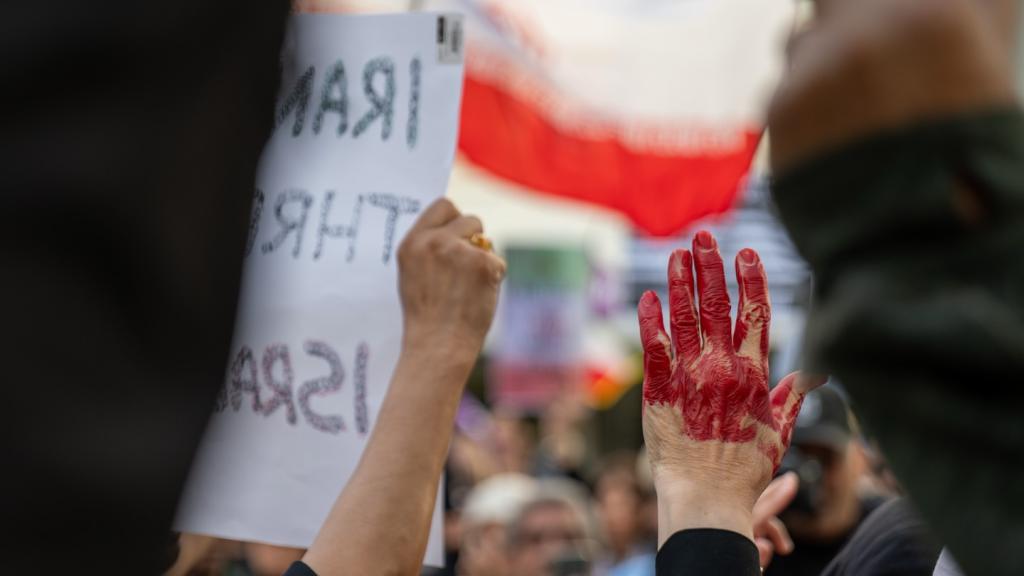
Among Iranian left-wing comrades, a pressing debate has emerged: what position should we take towards the US and Israeli military attack on Iran? Should we join anti-war protests if pro-Iranian regime supporters participate waving the Islamic Republic of Iran flag? And if so, under what conditions?
Before proceeding, let me first define the terms of the debate. First, and foremost, it is clear that virtually all left-wing Iranian activists condemn the war and any form of foreign intervention in Iran. Second, for well-established reasons, these same left forces oppose the Islamic Republic.
The critical question, therefore, is how to maintain a principled position while remaining committed to both premises. In other words, the problem can be formulated as such: how can best one oppose a war being waged against a regime we are in political struggle against? And how can one avoid being on the same side as genocidal and imperialist powers, such as the United States and Israel, in their war against that regime?
Two tactical approaches
In navigating participation in the anti-war movement, two distinct tactics have emerged. The first advocates for broad, inclusive unity, bringing together all forces within the anti-war movement in a single front. The second insists on participating only under the banner of “No to war, No to the regime” or, alternatively, “No to war, but down with the Islamic Republic”, and refuses to stand alongside protesters carrying the Islamic Republic flag.
Admittedly, such an independent stance is far more complex and politically sensitive, especially when adopted amid a devastating and catastrophic war, one that targets the social, civic and economic fabric of society, and in which children, innocent civilians, their habitats and their basic means of survival are among the primary victims.
In my view, political forces confronting this situation find themselves at a crossroads; they are forced to choose between bad and worse. If you are anti-war, you are in effect seen as siding with the regime. If you are anti-regime, you are in practice perceived as supporting the war. What gets sacrificed in this bind is the most immediate and urgent truth: the existential reality and survival of the people and society.
As someone who has opposed the Islamic Republic for more than four decades, whose brother was executed by this regime, who spent years in prison under torture and on the brink of execution, who has been forced into exile for three decades and carries the scars of this regime on his body, I believe that defending the truth must be the first priority.
Defending the truth means defending the existence of society and human beings. As long as society and its people face collapse and disintegration, speaking of political struggle or revolution is meaningless. When the regime’s overthrow becomes entangled with the dismantling of social and civilizational foundations and the destruction of society’s very existence, speaking of “regime change” becomes immoral and inhumane. Therefore, defending the existence of society and life, and defending the fundamental right to survival, is the most important political and ethical duty of any left force that considers itself accountable to the present and future life of society.
This is not the time for ideological auditions or radical posturing, debating in the middle of bombardments whose socialism is more crimson or whose position is more revolutionary. No radical or leftist performance justifies closing one’s eyes to the bombing of schools, hospitals, public infrastructure, residential neighbourhoods and the massacre of children and innocent civilians. That kind of politics belongs to those in pursuit of ideological purity, political ascetics who place their own doctrinal cleanliness above human lives.
Under the current circumstances, the demand for immediate ceasefire and condemnation of US and Israeli military aggression must be the first, loudest and most essential cry of any assembly that claims to stand for human dignity and social justice. This is the central and non-negotiable slogan.
The challenge of applying tactics
If we wish to participate in anti-war protests, however, we face serious challenges.
Neutralising and fragmenting the anti-war movement are strategic objectives of the US, Israeli and Australian governments. Mossad and CIA agents, in collaboration with Iranian monarchists, are engaged in extensive efforts to disrupt and divide the anti-war movement. Their political line is clear: sow internal division, prevent the formation of broad unity and solidarity, and provide wide-ranging support to royalist gatherings that back the war and oppose the Islamic Republic.
The aim is to ensure that mainstream media and public opinion come to portray these pro-war royalist rallies as representative of Iranian aspirations inside and outside the country, and thereby reframe the Australian government’s support for the war as an act of solidarity with the Iranian people.
The most potent instrument being deliberately and systematically deployed against the anti-war movement is the incitement of a “flag war” within its own ranks, pitting participants against those who carry the Islamic Republic flag or pressuring organisations to formally ban the flag. When agreement on mutual tolerance and cooperation breaks down, the inevitable outcome is a splitting of ranks.
This internal fracture disperses and atomises the movement, degenerates into a form of civil war within the anti-war camp, and produces increasingly smaller, demoralised gatherings, leaving us as spectators to the intensification of bombardment and the killing of innocent people.
The political strategy of the monarchists vis-à-vis the anti-war movement is precisely this: to infiltrate demonstrations without their Lion and Sun flag, presenting themselves as opponents of the Islamic Republic, and provoke conflict over the presence of Islamic Republic flags, agitating the crowd and, ultimately, fragmenting and dissolving the collective’s unity.
Is the flag war a class war?
Some comrades ask: how can a red flag stand beside the flag of a regime that has killed people for forty-six years? They say: this is not a flag war; it is a class war. But assigning class identity to a flag is a thoroughly non-class way of thinking.
A flag is not a class. It is not even the symbol of a class. Workers and capitalists live under the same flag. Class struggle and class repression unfold under the same flag. But repression of the labour movement is not carried out with a flag; it is carried out with coercive force. And working-class struggle is not waged with a flag either.
A flag is not even a symbol of capital. Historically, flags were primarily the emblems of monarchies and kingdoms. It was only with the French Revolution that the flag was transformed into a symbol of national unity, not class unity. Capital is not identified by a flag, and neither, in any meaningful sense, are regimes. Many countries that underwent revolutions did not change their flag: Chile, Cuba, Vietnam, Algeria, Nicaragua, among others.
The point is this: the Islamic Republic’s symbol is not its flag. The real symbols of the Islamic Republic’s repression and suffocation are its political figures, its faces, its institutions, not a piece of cloth. Those real symbols of repression have existed — and continue to exist — under any flag.
The flag war is the monarchists’ war. It is sacred to them precisely because the Lion and Sun are the emblem of the monarchy. For the left, it carries no such meaning, nor does the Islamic Republic flag. It is worth recalling that at past left-wing demonstrations, the Lion and Sun flag was sometimes brought along, and yet no one denounced that this symbol of dictatorship and crime was standing beside the red flag of the left.
Conversely, the red flag is not exclusively a symbol of class struggle. Countries such as Morocco, Turkey, Tunisia, Switzerland and Denmark all use red flags, none of which makes them left-wing. One might ask: what flag do Iranian oil workers, Haft Tappeh sugarcane factory workers, or the retired teachers’ movement in Iran carry? No single flag speaks for working-class struggle.
For all these reasons, the flag war is a hollow and manufactured conflict — a diversion. No flag holds any sanctity. What matters is social force. If a diverse array of people with different flags can be brought under the banner of a movement that the left organises and leads, that is not a weakness; it is a sign of political strength, maturity and strategic intelligence.
The anti-war movement is, in fact, a deeply class-based movement. Its political goal is the value and dignity of human life. The working class, through this movement, is defending its very existence against capital. After all, it is class that organises human beings according to their labour and social being, and in the war of existence, it is the survival and life of the working class that is at stake. Capital, by contrast, profits from war. Capital is, fundamentally, on the side of war.
The correct tactical path
We must be fully vigilant and refuse to fall into these traps. On the contrary, we must strive to maximise mobilisation and broaden participation to the widest possible spectrum of social forces in the anti-war movement.
The correct and principled tactic, in my view, is the one that builds the broadest possible social force against the war — a tactic that, by relying on mass social power, shifts the balance of forces in society. Here in Australia, we have already witnessed the successful outcome of this approach in the Palestinian liberation movement. We must build the largest possible united front (under whatever flag) against the war and against foreign intervention in Iran’s political affairs. Let us, as Iranians, determine the fate of our own society, not American and Israeli bombers.
Ali Keshtkar is an Iranian-Australian writer and political activist based in Melbourne, who has lived in exile for over three decades. A former political prisoner and survivor of a death sentence in Iran, he brings both lived experience and critical insight to his work. His brother was executed by the Iranian regime in 1982. He has been actively involved in labour rights, refugee advocacy, and international campaigns against capital punishment, including organizing efforts against stoning. He is a former member of the Central Committee and Political Bureau of the Worker-Communist Party.
His work spans politics, philosophy, and literature, with a particular focus on war, state violence, and the ethical responsibilities of political movements. His current literary project, a memoir reflecting on imprisonment and the final hours before execution, was shortlisted for the 2026 Hazel Rowley Literary Fellowship. Drawing on both lived experience and critical analysis, his recent writings explore the strategic dilemmas within the anti-war movement, particularly in the context of escalating tensions between the United States and Iran. You can find some of Keshtkar’s writings on Substack.