‘Capital’ Volume 1: Themes from Hegel’s ‘Phenomenology’
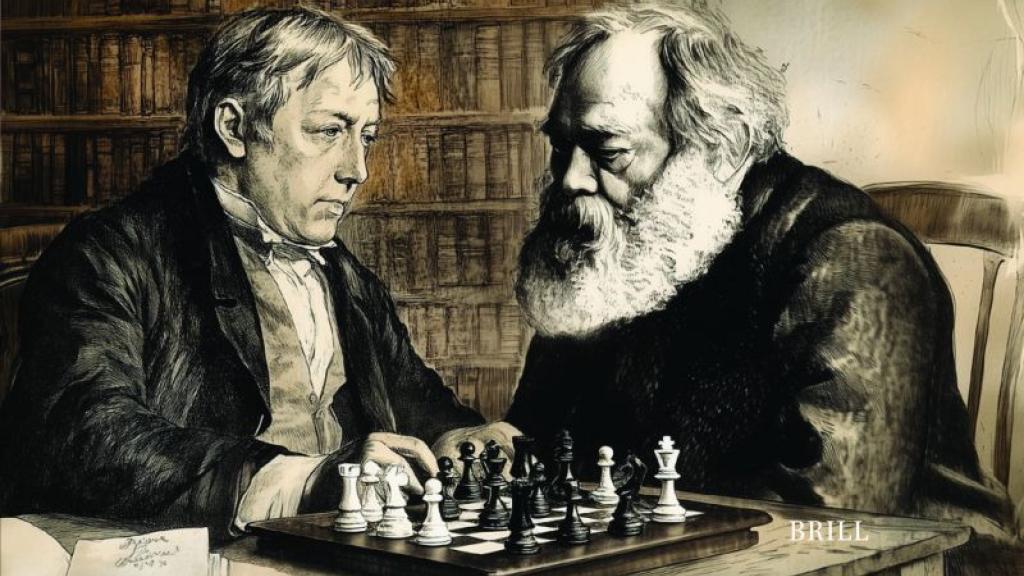
Roy Medvedev, in his mammoth critique of Stalinism, Let History Judge, reported the reminiscences of Yevgeny Frolov, an old Party member, concerning the attempts of Jan Sten to teach Stalin dialectics. Sten failed despite being a prominent Deborinist, a member of the Institute of Red Professors, and part of the leadership of the Marx-Engels Institute. Frolov, in the course of his anecdote, also reported the following as an aside: “In those years dialectics was studied by a system that Pokrovsky had worked out at the Institute of Red Professors, a parallel study of Marx’s Capital and Hegel’s Phenomenology of Mind.” While such a claim, on the surface, seems unremarkable, it is, in fact, a very remarkable claim to make. First, Pokrovsky was never recognised as an expert in Hegel, or as an outstanding philosopher, or as a member of the Deborinists, i.e. the group who emphasized the importance of Hegel to Marxism. Secondly, nowhere else has the claim ever been made that Capital was studied along with the Phenomenology. Thus, in all likelihood, Frolov misremembered what had actually occurred.
That does not mean, however, there is no rational kernel to his faulty memory. For, knowing the influence of the Deborinists during their dominance in Soviet philosophy, there undoubtedly was a system of studying Marx and Hegel in parallel. A more likely book though would have been the Science of Logic. Indeed, Engels had already written in 1891 that, if “you compare development from commodity to capital in Marx with development from Being to Essence in Hegel you will get quite a good parallel.” Similarly, Lenin, in his notes on Hegel (which were dedicated to searching for the influence of the latter on Marx) wrote that “The beginning — the most simple, ordinary, mass, immediate ‘Being’: the single commodity (‘Sein’ in political economy).” Whoever might have created such a possible study course and what exactly it could have entailed are, unfortunately, lost to time. Sill, a parallel study of Marx’s Capital, volume 1 and Hegel’s Science of Logic would be salutary for grasping dialectical logic.
Yet the question remains: Did the Phenomenology have any influence on Capital? We know that Hegel’s larger Logic had an immediate impact on Marx’s critique of political economy. As he wrote to Engels in 1858:
By mere accident — Freiligrath found me some volumes of Hegel originally belonging to Bakunin, and he sent me them as a present — I leafed through Hegel’s Logic again and found much to assist me in the method of analysis. If I ever have time for that kind of work again, I would find great pleasure in writing two or three pages on the rationale which Hegel discovered — but also mystified — to make it accessible for the common man.
This was during the time that Marx was working on the Grundrisse, i.e. the first draft of Capital. More importantly, in that letter he expressly noted the impact of the Logic concerning the method of political economy. Further, when looking at A Contribution to the Critique of Political Economy, the economic manuscripts of 1861–3, i.e. the second draft of Capital, the Economic Manuscript of 1864–1865, i.e. Marx’s draft of Capital vol. III, and finally Capital vols. I-III, it can easily been seen that Marx only ever referred to three works of Hegel: Science of Logic, Elements of the Philosophy of Right, and Encyclopaedia of the Philosophical Sciences in Basic Outline: Part I, Logic. The answer to the above question would appear, then, to be no.
Yet, knowing the influence that the Phenomenology played in Marx’s intellectual development it would be incorrect to accept that answer. First, the book “was the most important one for the theoretical basis of the” Young Hegelian movement. All the major elements, categories, and the basic logic utilised by its leading members, Strauss, Ruge, Bauer, etc. all came from the Phenomenology. Second, when Marx was conceiving his doctoral dissertation, his “choice of topic was taken from Hegel’s History of Philosophy and Phenomenology, while the framework for understanding Epicurean and Democritean physics was based on his Philosophy of Nature.” Finally, Marx had famously written in the Economic and Philosophic Manuscripts of 1844 that, in analyzing the Hegelian system of philosophy, one had to start with the Phenomenology, because it was “the true point of origin and the secret of the Hegelian philosophy.” These manuscripts were “Marx’s first attempt to systematically apply the dialectical method to political economy and, as such, were his first tentative steps towards writing Capital.” Therefore, the Phenomenology lies not only at the basis of Hegel’s system and the Young Hegelian movement, but was also the foundation for both Marx’s first major writing and his initial foray into a dialectical critique of political economy.
Download full article as PDF below.
| Attachment | Size |
|---|---|
| ‘Capital’ Volume 1: Themes from the ‘Phenomenology’ | 522.21 KB |