France: ‘The leadership of the movement belongs to the students themselves’
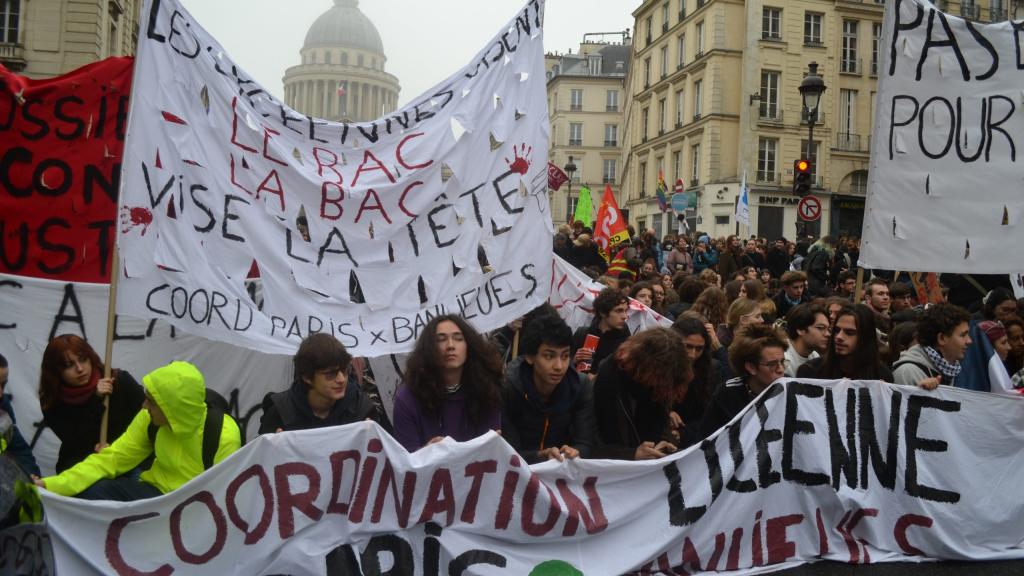
Stan Miller is a member of the French revolutionary socialist organisation Nouveau parti anticapitaliste — Révolutionnaires (New Anticapitalist Party — Revolutionary, NPA–R) in Montpellier. He spoke to Victor Osprey, for LINKS International Journal of Socialist Renewal, about the current youth uprising in France and the role being played by trade unions and the revolutionary left.
What were the immediate political results of the November 5 general strike called by French trade unions in response to cost-of-living pressures and public service cuts, which mobilised an estimated 1 million people or more?
Today [November 9], the prime minister [Sébastien Lecornu] met with union leaders for the first time in a while. This was a direct consequence of the mobilisation by high school students who strong-armed the unions to do anything. The prime minister said was willing to raise the minimum wage by 1.6 % (about €1502 a month), which is way below inflation.
There are eight national trade union confederations in France. Almost all local unions are affiliated to one of them. The politics of these eight confederations is shaped by history: for example, the CGT [Confédération Générale du Travail, General Confederation of Labour] used to be controlled by the Communist Party and was very strong in blue collar industries; the CFDT [Confédération française démocratique du travail, French Democratic Confederation of Labour] is more social democratic; the FSU [Fédération Syndicale Unitaire, United Trade Union Federation] almost exclusively covers teachers.
Some people divide them between “reformists” and “radicals,” but all defend the interests of their own bureaucracy rather than the interests of the movement. Some unions, such as the CFDT, say the wage hike is not high enough but believe the government is an honest partner and want to negotiate wages across different industries.
The CGT believes in negotiating but wants to convince the government that they cannot be ignored; that is why they have called a day of strikes and actions on November 17 to show off a bit of muscle. The CFDT has decided not to join the strike on November 17. The CGT called the November 5 strike just one month before, showing that they had no genuine desire to help the youth movement [which started in September], otherwise they would have called it sooner.
The spark for the general strike was the powerful movement of youth and students against the under-funding of the education system. Has it led to offers of further concessions from the French government, on top of previous offers given to youth and students? Is the government attempting to sideline the demands of organised workers and separate them from the students by appealing for “dialogue” with trade union leaders?
The prime minister invited youth organisations to discuss the future of education. Also present at the meeting was the far-right youth organisation UNI [Union Nationale Inter-universitaire, Inter-University Union] and several far-right MPs, so the left representatives walked out. We will not discuss anything in the presence of the far right.
There are several youth organisations and student unions, but participation in student elections is very low, generally only a few percent of students vote. They do not act as unions defending the immediate interests of students — though there are some exceptions at a very local level. Instead, they mainly act as political organisations defending a particular vision.
A few weeks ago, the education minister [Édouard Geffray] tried to calm the youth movement with scraps such as creating 15,000 additional higher education places. But youth organisations are asking for 260,000 new university spots.
The government is trying to divide workers and students, but many are not falling for it. Tomorrow [November 10] is a day of action and strike for both teachers and students.
How has the far-right Rassemblement national (National Rally, RN) reacted to the general strike and the movement overall?
This movement is polarising people. There are many instances of people reacting to police brutality against the youth. We have had almost as many police arrests of youth protesters in one month as we did in one year of Yellow Vest protests. But some workers are also saying the police should shoot the protesters.
Overall, it is a hard time for the far right because [President Emmanuel] Macron is kind of stealing their talking points: more police, more brutality, etc.
Can the movement effectively translate its anti-government activity against the Macron administration into anti-fascist action to confront the RN and far-right groups in the streets?
I feel we may not be there yet. In Montpellier, some fascists tried to organise their own “militia” to protect local stores against looting. They boasted that cops were working with them. The fascists have a lot of sympathisers in the police force, but the state is not really using them as its main tool at the moment.
But even without arming thugs to beat up workers, racism still kills: on October 23, a 26-year-old Black man was shot and killed by a far-right terrorist who wanted to target “Blacks and Arabs.” The far right clearly carries responsibility for this murder, and many others.
What is the role and status in these protests of the left-wing party La France insoumise (France Unbowed, LFI), which is led by Jean-Luc Mélenchon? Does LFI tend to initiate protests and attempt to assert a leadership role in them, or do they simply seek to influence them?
LFI controls one student union, L'Union Étudiante [Student Union], and they are part of the movement, but it is an exaggeration to say that they or any other organisation controls it. The ruling class pushes this narrative to paint youth as incapable of leading their own struggle and claim someone must be “behind” all of this.
In reality, youth organisations in general are quite small. The leadership of the movement really belongs to the students themselves through their general assemblies and national coordinations. All the universities and high schools on strike send delegates to a national coordination, which sets the agenda and decides what to do to ensure that students control the movement, rather than any specific organisation.
What is the NPA-R analysis of the upcoming 2027 French presidential elections?
For us, the election is a clear continuation of the current movement. That is why we are running a bus driver [Selma Labib] and not a professional politician as our presidential candidate. We want to tell people: rely on your own struggles, do not trust any politician even if they pretend to be your friends. Our motto is: those whose labour allows society to function should be the ones running it.
We are organising a series of meetings where the people addressing the audience are everyday people fighting against the system: healthcare workers who oppose the Islamophobic ban on head coverings which targets Muslims and people perceived as migrants; high school students who might not have the right to vote but are clearly the most conscious element of society right now; active and retired autoworkers whose wage or pension is too damn low.
The NPA-R has talked about forming a “revolutionary pole” in these elections. How does the NPA-R relate to the other revolutionary left parties running a presidential candidate in 2027, such as Lutte Ouvrière (Workers’ Struggle, LO) and Révolution Permanente (Permanent Revolution, RP)?
We had discussions with these organisations, but the talks failed and the recent mobilisations have proven we are not there yet. LO’s general propaganda for communism is on point, but we feel they are not waging a fight inside the youth movement against the prevailing anarchist mindset that opposes coordination and broadening the struggle.
We have also had some disagreements with RP. Since the start of the movement, local campuses have voted for delegates that meet somewhere in France on weekends. These meetings have so far taken place in Grenoble, Paris and Lyon, with the next one scheduled for Toulouse on November 21. This is called the CNE [Coordination Nationale Étudiante, National Students’ Coordination].
The main debate has been: should we do some outreach work to convince the mass of students to join us, or should we occupy universities with a few hundred people and organise conferences, movie screenings, etc. The NPA–R, who has a few members in the formerly social democratic student union UNEF [Union Nationale des Étudiants de France, National Union of the Students of France] as well as its own youth wing, defends the idea that we still have hundreds of thousands of students that we need to convince to join us.
Those who we call the “autonomists,” and who sometimes themselves identify themselves as such, defend an alternative university rather than mass mobilisation. Organisations such as RP change their political orientation depending on the general mood.
Is there any possibility of a common candidate of the revolutionary left being accepted by all these organisations?
For the moment, we are still presenting separate candidates, but my deep conviction is that the development of the social movements — this one or another — will allow us to discuss our differences in the light of the class struggle.
In 2024, the NPA split into two organisations, the NPA–R and the NPA–L’Anticapitaliste (New Anticapitalist Party — The Anticapitalist, NPA–A). Could you explain the background to that split?
To briefly explain, NPA–R believes in the independent political organisation of revolutionary-minded youth and workers, while NPA-A believes in the need to work within the framework of the radical left, especially in a time of a resurgent far right.
My opinion is that if we can influence Melenchon’s people, it will be on the terrain of class struggle. This youth movement has totally reshaped political discourse; even left-wing politicians do not feel confident enough to brush it off and say “vote harder next time”.
How do relations between the NPA-R and NPA-A stand? Both remain sections of the international revolutionary socialist organisation, the Fourth International. Will the split eventually be healed, or are the two organisations drifting further apart politically?
My roommate is in the NPA–A, so I have these discussions all the time! Times are tough for everybody, and even the people who call themselves revolutionaries in NPA–A do not share the same tactics. They are recruiting some new people, but how do you bring these new recruits to Marxism? The old guard of Marxists in the NPA–A still share many things with us, but they are capable of moving one way then another.