Spanish state: 11N been a long time coming
First published at Anti*Capitalist Resistance.
The socio-political scene in the Spanish State over the past few months has evolved at such a breathtaking rate, with so many unexpected twists and turns, that the hackneyed phrase “you couldn’t make it up” is for once well warranted. The apparent balance of forces between the self-styled, PSOE-led “most progressive government in history” and the right-wing and far right bloc has been constantly shifting, pendulum-like, first one way then the other without, however, eclipsing the development of independent social movements, with the tenants’ rights unions leading the way.
Many, but not all, of the longer-term trends underlying this situation are similar to those in other countries. Relative to its European neighbours, the Spanish State has enjoyed fairly good macroeconomic growth, but the benefits have not filtered down to the majority of the population. Inflation has far outstripped wages while wealth has become more and more concentrated at the very top of the class pyramid.
In the middle of a particularly hot summer, punctuated by torrential rains that again caused severe flooding as in 2024, 70,000 young people crossed into Ceuta, one of Spain’s two enclaves in the north of Morocco. This produced spectacular images shown endlessly on news broadcasts week after week serving as grist for the mill of an aggressive anti-immigration and ultranationalist discourse framing the events as an “invasion”.
Although it is true that the right has used its hefty presence in the judiciary to wage lawfare campaigns and overturn measures introduced by the government or passed by parliament, the governing Spanish Socialist Party (PSOE) has recently been wracked by a series of more-than-plausible corruption scandals involving several high-placed figures that have seriously harmed its image.
Rents and the rise of the tenants’ unions
Parallel to all this, the renters’ unions, which had been growing steadily for some time in most of the bigger towns and cities, suddenly achieved a major media breakthrough. After living in the same flat for seventy years, a partially disabled 87-year old woman was threatened with eviction following an exorbitant rent hike. But Maricarmen, as she became popularly known, refused to be a passive victim. Her resolute defiance, coupled with the backing of the Sindicato de Inquilinas (tenants’ union) and a support encampment set up in Madrid’s central Plaza del Sol, turned her into a state-wide symbol for the whole movement, aided by extensive prime-time TV coverage.
After three failed attempts to evict her, on 23 September Maricarmen was carried out to an ambulance on a stretcher while riot police opened up a passage among the hundreds of people trying to prevent it. In spite of this seeming defeat the movement refused to give up and continued to mobilise. The vulture fund that had acquired the building was forced to say it would allow her to move back in at an affordable rent. Before this could happen, however, on 7 October Maricarmen died in hospital triggering an even greater wave of anger and indignation.
Pace hots up: A general election and a general strike
Also under pressure, the government issued two emergency decrees providing tenants with certain protections, but these still needed to be passed by the Spanish parliament. But on 2 October, the conservative Catalan nationalist party Junts joined the main right-wing parties in voting down both bills. Three days later prime minister Pedro Sánchez, though clearly trailing in the polls, decided to up the ante and call a general election for 29 November.
With short-term perspectives of even limited favourable legislation thwarted, demands for a general strike from the tenants’ movement and the more militant minority trade unions intensified. Having appeared for a long time as marginal, this now emerged as a viable prospect. The momentum that had built up brought the leaders of the two majority trade unions, CCOO and UGT, to the Plaza del Sol to discuss the matter with the renters’ union representatives. Finally, on 19 October, these developments resulted in all the renters’ unions and all the trade unions calling a one-day general strike for 11 November, 11N, the first for 14 years and thus the first for a new generation of activists.
In the Spanish State, so-called “political” strikes are illegal; strikes are allowed only for employment issues such as pay and conditions. To get round this, demands regarding housing (no evictions, indefinite contracts, affordable rentals) were combined with those for wage rises. This made for a perfect fit: lower rents and higher wages to combat the escalating cost of living.
Another unexpected twist
Then, on 28 October, a high-speed train ploughed into the back of another, killing 69 people. For a while this overshadowed almost everything else. The government naturally came under fire but made matters worse for itself by attempting to lay the blame on a single control centre worker, thereby provoking a further outbreak of indignation. Structural failings had been revealed by investigations into another high-speed rail accident at the beginning of the year in which 46 people died. There had been insufficient spending on maintenance and safety with disastrous consequences resulting from splitting responsibility for track and rolling stock, competition among state and private operators and a very large increase in passenger traffic.
This indignation was compounded by deep dissatisfaction among the millions of users of deteriorating and unreliable local and regional trains who nevertheless depend on them for travelling to and from work every day. For decades the construction of a prestigious high-speed network radiating from Madrid has taken priority over such vital services.
The strike in Catalonia
The remainder of this article will focus on developments in Catalonia. Under the slogan Ens costa la vida (It costs us our lives), talks had already been going on for months among all the renters’ unions and militant trade unions with a view to organising a strike to fight back against the high cost of living, especially rentals. A survey had even been held to test the receptiveness for such a proposal.
In the early evening of Saturday 24 October, one more unforeseen happening disrupted “the normal course of events”. Convened through various social media, groups of black-clad young people, mostly between 14 and 20, suddenly turned up in Barcelona’s central shopping district where they attacked and looted a number of stores. They were not part of any organised group but simply responded to a call put out by a mysterious Blocus. Despite the name echoing the school blockades in France, there was no political connection or similar purpose involved.
Once again spectacular images played their part in exaggerating the importance of a relatively small-scale event and, in this case, helping to create a social panic. Some 130 people were arrested, about 90 of them minors. Conservative and far right parties were joined by the “extreme centre” in demanding exemplary punishments and making parents paying for damage caused by their children (incomparably less than that produced whenever Barça wins La Liga). For the following Saturday, many stores were completely boarded up (nothing happened) and again for the general strike. There were a few minor incidents at the end of the day, but the authoritarian atmosphere created was probably a factor in the over-the-top manner in which they were dealt with by the police.
Local strike committees
In the short time available before the 11N, local strike committees were set up throughout Catalonia based on towns, municipal districts and universities. There were few workplace committees. Members of Anticapitalistes were involved in over 40 of the former.
These committees were generally formed at open public meetings convened by members of Ens costa la vida. They attracted people from the tenants’ unions, militant trade unions, social movements, left-wing political parties and people not belonging to any organisation. Young people were present in large numbers, but immigrants — a significant portion of the working class — tended to be under-represented.
In most cases the main tasks the committees set themselves were publicising and arguing for the strike among the population, workers in particular, making plans for the day in question and, of course, carrying them out. While organising in the bigger workplaces was often left to the trade unions, local committees typically went round smaller businesses, health and welfare centres, schools, shops, bars, restaurants and so on letting workers know that a strike had been called, explaining the reasons for it, urging them to join it and informing them of their rights.
The big day itself started at midnight the day before with pickets in many towns going round reminding everyone that it was a 24-hour affair. In Barcelona, residents are asked to put their rubbish outside the entrance to their buildings between 8 and 10 every evening, so the effects of the strike were highly visible almost right away with piles of uncollected refuse lining many streets.
From about 5 in the morning local committees set up road blocks, sometimes consisting of hundreds of people, in about 60 localities throughout Catalonia. At the same time, pickets visited bus garages and train sheds to ensure transport was completely disrupted.
In some areas of Barcelona most shops, bars and restaurants didn’t open in the morning, while a few that did were shut down by pickets. Otherwise, there was little activity. The city centre was virtually deserted until several strike committees met and marched there. The picture was similar in many towns across the metropolitan area and the rest of Catalonia.
In addition to urban areas, the strike affected most of the industrial estates, including the big SEAT/Volkswagen car plant in Martorell, goods transport, Barcelona’s wholesale market and Barcelona’s container port. There is no doubt that the strike brought most economic activity to a standstill. It remains to be seen what impact it will have in regard to achieving its central demands.
In the rest of the Spanish State, the response to the call was uneven, weakest in Extremadura, strongest in Galicia and the Basque Country, in both of which most workers are organised by national unions rather than state-wide federations such as CCOO and UGT. In many places the demonstrations were considerably greater than the numbers who had been on strike.
Huge demonstration in Barcelona
When a strike is called in a public sector such as education, health or transport, the Catalan government decrees a minimum level of service provision. Sometimes the “minimum” is so high that, if enforced, it would negate the right to strike. This time, the levels set were not so drastic and allowed many people to come into Barcelona for the main demonstration at 5.30 pm. Even so, the commuter network is so bad that some were unable to make it.
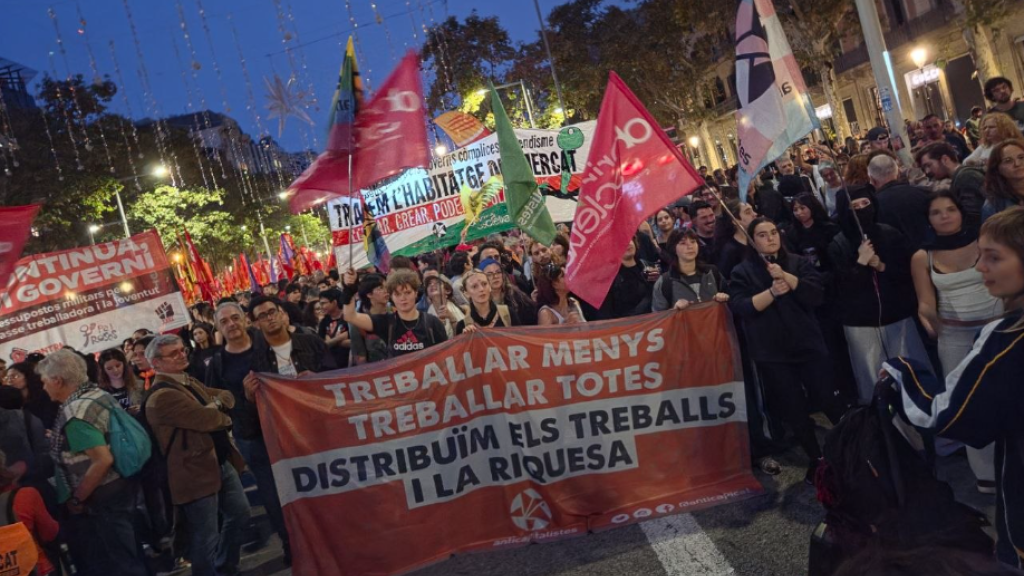
With columns marching in from several directions to join it, the demonstration soon swelled to fill the whole of the extremely wide boulevard known as Passeig de Gràcia. Accurate numbers are hard to come by, but most observers put the figure at several hundred thousand. In Madrid it was even bigger, despite the heavy rain from which Barcelona was spared until right at the end.
The major blocs with their multitude of banners and flags included the main renters’ union Sindicat de Llogateres leading the way; the trade unions CGT, CCOO and UGT; Palestine solidarity, antiracism and LGBTIQ+ contingents; and political organisations. Anticapitalistes and the youth group Obrir Escletxa (Opening up a crack) organised a strong, lively, predominantly young contingent with a hand-held banner at the front and a large, eye-catching banner borne aloft on poles at the back. The slogans on the big banner read: “Stand up to the governments complicit with rentierism. Let’s kick housing out of the market. Struggle, create people’s power”. (see photos)
Major new development on the far left
Whereas everyone in the committees had for the most part worked well together in the weeks prior to 11N, a few days before the strike sectarianism suddenly made an unwelcome appearance. To understand who and what was involved, and what the disagreements were about, requires a fairly lengthy digression but covers some politically interesting material.
In the past few years, a new far-left current has burst onto the scene in the Spanish State. Known generically as the Socialist Movement (MS), it arose originally in the Basque Country out of a split from the mainstream pro-independence left that had gradually drifted further and further to the right, its nationalist inclinations predominating over its socialist aspirations. This was followed, for similar reasons, by a split in Arran, the youth wing of the Catalan pro-independence left and another in the Communist Party youth organisation in Madrid.
The MS has relatively few people in it under 30, but in Catalonia the Organització Juvenil Socialista (Socialist Youth Organisation, OJS), like its counterparts elsewhere in the Spanish State, is by far and away the largest far-left group with hundreds of members most of whom are dedicated militants. Since its inception, the OJS has concentrated on building itself, going so far as to organise demonstrations entirely on its own. It does not work in the major tenants’ union, preferring to set up a Socialist Housing Union which it sees as part of the MS. It lays great stress on the centrality of the working class, often in a propagandistic way, and has popularised the slogan “Long live working class struggle” well beyond its ranks. It has never joined the Palestine solidarity movement.
Sectarian blips
Rather than adopt a united front perspective and participate in movements and campaigns containing forces it defines as reformist with a view to engaging them in debate while achieving unity in action, the MS mostly opts to stay aloof and go it alone.
The involvement of CCOO and UGT in the general strike posed a dilemma for it. Other than perhaps in the Basque Country or Galicia, without the two major trade union federations the strike would have been far less effective. This goes for Catalonia too. But could the OJS allow itself to march alongside them? Unfortunately, the answer was No: it would call a separate demonstration of its own.
Attempts to justify this decision by arguing that the presence of these unions implied the strike was in favour of the government raised the question why it was taking part in the strike at all. Worse, it was not above saying it refused to march on a demonstration led by CCOO and UGT, when it was clear all along that the Sindicat de Llogateres would be at the front.
Another instance of sectarianism came from Arran, the youth group from which the OJS had split. A couple of days prior to the strike in which it was going to participate, Arran chose to denounce the Workers’ Commissions (CCOO) by occupying their headquarters. There are plenty of criticisms to be made of them, but the way chosen to do it was all about promoting itself irrespective of any possible negative consequences for the strike.
Reconstituting unity to face a difficult future
Disagreement with the hostile attitude shown by the OJS and Arran towards these two key organisations of the working class notwithstanding, how exactly to work with them and at the same time criticise their leaders’ politics and methods is not easy. Normally a strike entails making demands on the government able to grant them. With just a fortnight to go before the general election, that is not the case here. This circumstance leads some people to question its immediate usefulness and appropriateness. Many on the left wonder whether it will favour the performance of the current government and its bloc in the upcoming vote. This is undoubtedly what the leaderships of both CCOO and UGT would want to happen and probably played a big part in their decision to join the strike call.
Another reason was the pressure put on them by the renters’ movement bolstered by its deserved popularity and prestige. Although well aware that they could not afford the strike to fail completely, they seemed a bit reluctant and tended to downplay its prospects. When its success became plain to see, they acknowledged their surprise.
As to the utility of a strike in these circumstances, whatever government is formed after the votes are counted — and most bets are on a PP-Vox hard right coalition — the working class needs to prepare as of now for stepped-up attacks on its living standards and rights. In this light, the strike has tilted the balance slightly in favour of the working class and the oppressed, and helped to prepare for the inevitable struggles to come. In spite of the sectarian hiccoughs, it looks as though the strike committees will soon come together again to make a balance sheet of the experience and discuss where to go from here.
Brian Anglo is a member of Anticapitalistas in Barcelona.