‘Spiralling global contradictions are upending Philippine politics’
Rasti Delizo is a global affairs analyst, veteran Filipino socialist activist and former vice-president of the Bukluran ng Manggagawang Pilipino (BMP, Solidarity of Filipino Workers).
In the second of a three-part series, Delizo talks to Federico Fuentes from LINKS International Journal of Socialist Renewal about the impacts of US-China tensions on Philippine politics and the left. Part I, which looks at the factors underpinning US-China tensions and the dangers posed for the Asia-Pacific region can be read here.
How do you explain current dynamics within global capitalism?
There is a distinct but related set of dynamics that generates global capitalism’s endless conflicts. The imperialist world system does not just produce full-scale wars of aggression by traditional imperialist powers. It also induces sub-imperialist powers in the semi-periphery of world capitalism to launch regional wars for capital accumulation. This is another material factor expressing capitalism’s utterly decomposing nature. These complexities deepen the international order’s structurally exploitative, oppressive, and repressive circumstances.
Here, I would clarify that the Russian Federation is an imperialist great power rather than a sub-imperialist state (as I explained in a prior LINKS interview). Russia is a close strategic ally of China and belongs to the same imperialist bloc. The China-Russia bloc is a fraction of the imperialist core. As a direct consequence, this duo is caught in a competition with its rival imperialist bloc, led by the US and allied imperialist states of the G7.
These two groups compete to win predominance over the imperialist world system. These disparate blocs — representing diametrically opposed pro-capitalist camps — chase superprofits for the ruling-class elites of their respective capitalist states. They use capitalist mechanisms of exploitation, via their extensive territorial spheres of influence reinforced by military force, to guarantee greater capital accumulation.
Returning to your first question: a complex reality of varied but constantly moving parts moulds and propels the international system of monopoly-finance capital. The imperialist world system’s evolving globalised structures and processes are critically driven by paradoxes creating worldwide tensions and hostilities.
These global antagonisms are primarily caused by the uneven and combined development throughout the world. These unequal features, when combined with asymmetrical material realities (imperialist powers, sub-imperialist states, subjugated countries), causes international conflicts among diverse state actors operating within the capitalist system. It is this universal setting that causes non-imperialist great powers to also wield military power beyond their borders to secure capitalist profits from their immediate spheres of influence.
As a result, there are a cluster of sub-imperialist nation-states operating throughout various regions. Some rose from imperialism’s post-1945 phase of development , while others appeared after the end of the Cold War. These sub-imperialist countries play a specifically combined economic, political and military role within global capitalism.
Today even smaller nations such as Turkey and Saudi Arabia, among others, exert military power beyond their borders, either directly or through proxies. Is that what you mean by sub-imperialist?
As a part of the structures underpinning the international division (and redivision) of labour — mainly along particular zones of capitalist production-distribution-consumption — sub-imperialist states are located within the semi-periphery.
Core imperialist states are composed of hegemonic and generalised monopoly-finance capitalist powers and possess hi-tech capabilities. Sub-imperialist entities are those hegemonised and subordinated by monopoly-finance capitalist states, which have a mix of hi-tech and low-tech capabilities with relatively expansionist policies at the regional level. Peripheral economies, which represent the dominated and dependent non-monopoly-finance capitalist countries with low-tech capacities, are subjugated and oppressed by both imperialist and sub-imperialist powers.
Imperialism’s main features create a capitalist world order that shapes and directs exceptional geopolitical and geoeconomic tendencies. Within this systemic configuration, sub-imperialist states in the semi-periphery subordinate themselves to definite imperialist blocs in exchange for security support, while carrying out regionwide political-security tasks for that imperialist camp. At the same time, they drain surplus value from the periphery (via unequal exchange mechanisms) for their own sub-imperialist economic advantages.
Some current sub-imperialist countries are Australia, Brazil, India, Indonesia, Iran, Saudi Arabia, South Africa, Turkey, Qatar, the United Arab Emirates (UAE) and Israel. They all carry out various forms of military initiatives across their adjacent geographical areas to sustain their superprofit-seeking schemes and expansionist agendas. These sub-imperialist states maintain aggressive militarist stances toward their neighbouring nations to negate any threats to their regional spheres of influence.
How have all these dynamics affected Philippine politics?
The Philippines continues falling into a deeper socioeconomic and political-security quagmire. This is largely due to growing capitalist-driven mayhem affecting global affairs.
Given the conjuncture of internal and external circumstances, the Philippines perennially plunges to an ever-deteriorating status. As this national dilemma deepens, the country’s socioeconomic fabric worsens due to the generalised crisis of international capital impinging upon it (economic, diplomatic and security challenges).
In response, the Philippines’ major political forces enter into an ascending policy competition with each other. Manila’s sitting regime and its rival political parties increasingly clash over their contending foreign policy frameworks, even as they battle it out on equally pressing domestic policy agendas. This is how modern-day domain Philippine political affairs proceeds amid the impacts of the current world situation.
The Philippines persists as a maldeveloped peripheral semi-colonial state in Southeast Asia. This status quo is due to its structurally subordinated role and historical development along prevailing capitalist socioeconomic lines.
Being a national-level socioeconomic unit for capitalist production, distribution and consumption, the Philippines is a capitalist nation-state project plugged into globalised circuits of capital. Its capitalist mode of production is anchored in a decades-old neoliberal paradigm, which lingers in a retrograde manner while maintaining fundamental paradoxes upheld by the Filipino capitalist-ruling class.
A prime example of this is that, even as the Philippine economy remains highly dependent upon global capital for development (international loans, conditional foreign direct investments, etc), huge amounts of its surplus value is simultaneously siphoned off abroad for the interests of the imperialist core.
Another major contradiction is that core states are reimposing protectionist tariffs on traditional trading partners (including for flawed geopolitical reasons). On the other hand, the Philippines insists on protecting its more than four-decade-old neoliberal economic framework — despite it being a destructive pathway for national development.
Both approaches have hugely negative implications beyond any immediate, short-term economic or social gains. Yet, Manila continues pursuing this long-discredited economic policy track of detrimental neoliberal measures with catastrophic consequences. By upholding neoliberalism as its macroeconomic policy model, the Filipino ruling class knowingly and deliberately throws the country’s social majority into harm’s way.
What about the country’s relations with the US, amid rising tensions with China?
Linked to the direction of its political economy, the Philippines continues its integration into the US imperialist bloc’s security architecture in the Asia-Indo-Pacific area. This web of interlocking regional security alliances buttresses Washington’s array of regional economic networks that exploit this vast geographical realm.
These dual areawide entities form the backbone of US monopoly-finance capital’s strategic capability to sway and project power far beyond the US mainland. Functioning as US imperialism’s sphere of influence and dominance, it involves the AUKUS (Australia–United Kingdom–United States) and Quad (Quadrilateral Security Dialogue, comprising Australia, India, Japan and the US) projects, among other regional security mechanisms, to militarily fortify its dominance in the area.
However, aggravating the Philippines’ economic-security arrangements are its oligarchic elites. Its central policy agenda is chiefly controlled and contained within a national set of regressive institutional parameters. The Philippine state’s political domain is one whose operative infrastructure and methods are worsened by varied forms of political retrogression, immaturity and decline.
This is justified and fuelled by the small-minded and parochial-type thinking characteristic of the dictatorship of the Filipino capitalist class. The Philippines, as a class society, is consensually hegemonised and ruled by the Filipino oligarchs, who retain economic and political power via a series of national regimes.
They have done so for nearly eight decades, since the Philippines became a formally independent bourgeois-democratic state in July 1946. Underpinning this is a reactionary form of conducting Philippine politics. This has wrought a domestic political system centring on the narrowly anti-poor socioeconomic interests and of the contending fractions of the Filipino elites.
Acting as a comprador bourgeoisie, these imperialist agents of the Filipino capitalist ruling-class guarantee that the Philippine state apparatus (as the US’s first colony in Asia) is forever subjugated by US monopoly-finance capital. The Filipino oligarchs ensure the preservation of US foreign policy’s geostrategic designs aimed at Southeast Asia (and the Eastern Hemisphere).
This outlook is upheld via Manila’s pro-Washington external policy blueprint in exchange for US imperialism’s continued protection of the Philippine state’s governing regimes. This overall context maintains the reactionary dispensation of Philippine bourgeois-democracy and its ensuing traditionalist politics.
But the spiralling contradictions of the global political economy are upending Philippine politics. The Philippines faces a sweeping set of organic predicaments that are also roiling most bourgeois states around the world. These state- and society-wide conundrums are rooted in capitalist structures and processes emanating from outside and inside the country.
The parallel but distinct competitions of capital agglomeration on a global scale have combined with a domestic one. Complicating this dialectic, the imperatives of the regional economic and security rivalry among imperialist great powers, specifically the US and China (primarily focused on attaining strategic dominance over the Southeast Asian Sea, including the Taiwan question), spillover into the Philippines. This complex reality has direct ramifications on domestic politics and Manila’s external relations.
In this regard, the negative impacts of the external situation fundamentally affects the Philippines’ national political struggles. Unless amicably resolved, inter-imperialist competition between Washington and Beijing will remain an external challenge to Manila’s sitting regimes.
If this regional status quo lingers, the repercussions from such an unresolved situation can only strain the Philippines as a frontline state. It could also unlock further political destabilisation and turmoil along pro- versus anti-US/China foreign policy agendas. Only a minority of principled, progressive political forces — chiefly the revolutionary socialist movement — actively advance a “Neither Washington nor Beijing” foreign policy line in the Philippines.
Has any of this led to splits or divisions in the ruling class?
This evolving situation impels the contending fractions of the Filipino capitalist ruling-class towards an urgent reactionary competition among themselves. These oligarchic elites scramble to defend their self-serving financial and material stakes from any threats emanating from the global order’s polycrises.
They manoeuvre and counter-manoeuvre against their perceived socioeconomic and political adversaries via all means necessary. Still, as a class, their most powerful thrust will ultimately be an aggressive counterrevolutionary offensive against the Filipino revolutionary working-class movement. This scenario can be expected to occur once Filipino capitalism’s internal disputes are settled in favour of one fraction or another.
Filipino elites are closely observing the external stirrings impinging on the Philippines with a sensitivity towards their own self-preservation. They are concerned that an extended global slump could affect the Philippines’s growth prospects. As a key strata of the Filipino ruling-class, the oligarchy is apprehensive about looming economic uncertainties mixed with elevated geopolitical tensions. A melding of these potential blowbacks will cause nationwide instability.
The top echelons of Filipino capital sense the need to protect their socioeconomic claims and possessions from any fallout. To shield their financial and material wealth from ruin, they fiercely scour for a way out of this quandary. One option available to them involves an actively partisan participation in state-based politics.
The country’s foremost competing elites have arrived at a desperate self-realisation. Reflecting their ruling-class character, the competing oligarchic factions are once more seeking to overcome these perceived risks through electoral politics. The antagonistic Filipino capitalist camps are frantically gearing up to battle each other for national power in the next presidential election in May 2028.
What can you tell us about these elections and how this contest is shaping up?
With this forthcoming contest, traditional political leaders are already breaching the Philippine state’s laws and rules. With their main reactionary allies from among the many elitist political dynasties and warlord clans operating across the country’s 82 provinces, they are committing many criminal acts to bolster their chances of winning. This includes using graft and corruption to snag financial resources to fuel their respective bids for the presidency, together with other top posts.
The vying fractions of the Filipino oligarchy are looking to further monopolise national power for themselves. They have begun a race to reconsolidate their formal hold over the capitalist state apparatus by (and beyond) mid-2028. Redeploying their political forces, the capitalist ruling-class elites have launched a new cycle of pre-electoral transgressions. These include incitements and provocations with destabilising effects.
All throughout 2025, a series of impactful — even violent — politically-associated events shook the Philippine state and its social fabric. The situation was worsened by political violence surrounding the earlier May 2025 midterm elections. Last year alone, more than three dozen election-related killings and political assassinations occurred.
Furthermore, at least 224 anti-corruption protesters (most of them young) were arrested during violent clashes in downtown Manila on September 21 — the 53rd commemoration of Martial Law in the Philippines. This militant mass action, which was small in size but was a form of anarchist-inspired direct action, happened about one kilometre from Malacañan Palace (the official residence of the President of the Philippines). This was in stark contrast to two peaceful, though mammoth-sized mass mobilisations, on the same day.
All three synchronous mass protests, which strongly condemned ongoing cases of sweeping state-based corruption, took place at geographically distinct (yet symbolic) locations within Metro Manila. Outside the national capital region, more mass mobilisations were held against reactionary forms of traditionally elite-based politics.
Following the two enormous protest rallies, a pair of massively attended anti-state corruption rallies were held on November 30 in Metro Manila. This date commemorated the 162nd birthday of the great Filipino proletarian revolutionary leader and founder of the Katipunan, Andres Bonifacio (the Katipunan was an underground revolutionary movement that spearheaded the victorious revolutionary war of national liberation against Spanish colonial rule in the Philippines in August 1896). This symbolic date in Philippine revolutionary history is observed by the organised workers’ movement through mass mobilisations and other large-scale protest actions.
These two big rallies were separately organised and led by the distinct mass-based forces of the revolutionary and reformist left. However, the reformist left remains in an opportunistic political alliance with parties and organisations of the opportunist right.
Could you explain in more detail the differences among the revolutionary and reformist left?
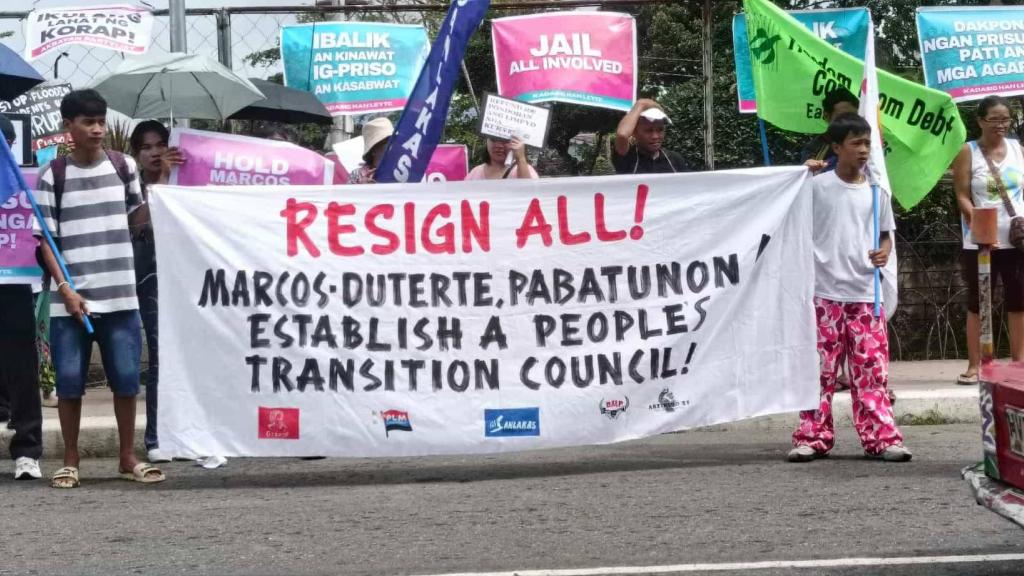
A very notable feature of the latest anti-government/counter-state mass mobilisations was the substance of their respective political calls. The revolutionary left called for extra-constitutional ways to overcome the Philippines’ escalating national crisis under the rule of corrupt-reactionary political dynasties. The Partido Lakas ng Masa (PLM/Party of the Labouring Masses) put forward the line: “Resign All! Establish the People’s Transition Council (PTC)! End political dynasties!”
On the other hand, the reformist left–opportunist right alliance sees a need to preserve the existing bourgeois-democratic constitutional framework, including its corruption-prone elitist processes. This latter political alliance — anchored on the local Catholic Church’s mainly conservative leadership — remains vacillating and bogged down in a political marsh; it apparently lacks any critical alternative for the immediate future, except to wait for the next electoral cycle’s elitist procedures favouring candidates of the same political dynasties.
The stirring political situation in the Philippines is defined by the country’s overall balance of national political forces. This condition, likewise, traces the country’s domestic political spectrum. Any assessment of the national balance of forces must recognise that it is a constantly evolving dynamic, subject to influence by ever-changing objective and subjective factors.
Yet, the Philippines’ non-static correlation of class forces is a predominant factor in social relations, which will be crucial to determining the country’s future political direction. This will especially be the case if there are any genuine systemic changes that can result from the deepening national political crisis. As the country’s political milieu faces rising pressures, its traditional political forces will opportunistically alter their extant alliances for mainly short-term tactical considerations and gains in relation to the rising consciousness of the Filipino working-class masses.
Given the context you have set out so far in broad brushstrokes, could you give us a better sense of the contending political forces within the country’s domestic political arena and how and what they represent specifically?
I will confine my descriptive scope to a very simple left-right axis for a basic view of Philippine politics today.
Such a depiction requires at least four columns categorising the country’s basic ideological-political formations. The left and right require an extra two sub-columns each. The Philippine left, for example, comprises ideological-political forces representing revolutionary and reformist movements. On the other hand, the Philippine right is composed of an opportunist and a counterrevolutionary sector.
Right-wing formations maintain hegemonic sway throughout the Philippines. In objective terms, they sustain dominance over the country’s capitalist economy, bourgeois social order and its reactionary state machinery.
Accordingly, the Philippine right has pervasive control over the Philippine state’s bourgeois-democratic framing. The right-wing formations have command and clout over the country’s political structures, conventional processes and, particularly, its financial-material resources.
The Philippine political-electoral system is led by the two major crony-capitalist factions of the counterrevolutionary right. The first right-wing bloc is anchored around the state-based leadership of Philippine President Ferdinand “Bongbong” Marcos Jr, while the other reactionary bloc is aligned with Vice President Sara Duterte and her father (jailed former president Rodrigo Duterte).
These two blocs had a tactical electoral alliance for the 2022 presidential election. But now they are entangled in a vicious political power struggle to protect their very questionable economic interests. Even as the Marcos and Duterte factions are caught up in an intense struggle to win the 2028 presidential election, this counterrevolutionary duo actively express hostility towards the broad Philippine left movement.
In terms of the Philippines’ external dynamics, the intense inter-imperialist competition between the US and China is a dire factor complicating the country’s internal politics. The reactionary Marcos-led bloc is aggressively ramping up its pro-Washington foreign policy as a populist posture to retain mass support from the Filipino public, which remains greatly pro-US. In contrast, the Dutertes have taken a nominally pro-Beijing stance, although this is a tactic; the autocratic Duterte bloc remains pro-US imperialism in content (especially when push comes to shove) as proven in the past.
In response, the leading political formations from the reformist left and opportunist right seek to challenge the counterrevolutionary right (primarily the Duterte camp’s potential return to power) by acting in unison. Given they share a political objective via principally constitutional means, and specifically electoral, these reformist left and opportunist right forces sense a common exigency.
This stems from a fast-growing recognition that the Philippines’ contracting bourgeois-democratic space is rapidly becoming a national threat to the country’s registered political parties, partylist organisations and legal mass organisations (and, subsequently, the Filipino people’s inherent rights and democratic freedoms). The political forces of the reformist left and opportunist right are collaborating to build an acceptable political-electoral vehicle that could conceivably derail the presidential bids of the Marcos and Duterte camps in 2028 (or perhaps even before that year’s national electoral race).
The opportunist right is largely embodied by the country’s bourgeois-democratic political formations. By self-identifying their ideological orientation with that of liberal democracy, their political agenda frequently reeks of socioeconomic policies biased toward capitalist elite-rule.
Their current array of more engaged political groups include: the Liberal Party (LP), the second-oldest traditional political party in the Philippines; the Mamamayang Liberal (or ‘Liberal Citizens’ in English) partylist organisation; and the Tindig Pilipinas (Stand Up, Philippines) multisectoral coalition. In practice, these three organisations project the same fundamental political calls and public slogans.
The bourgeois-democrats have kept a generally circumspect attitude toward the major currents of the progressive mass movement. Since at least the late 1970s, the liberal democrats have had a reasonably good working relationship with the social democratic movement at different levels of struggle. Yet, the bourgeois-democrats still have an innate bias against the social democratic forces; even as they are often forced to collaborate, the bourgeois-democrats still view the social democrats with a respectful disdain.
At the same time, opportunist right groups tend to be wary of the revolutionary left. The bourgeois-democrats often shy away from revolutionary Marxist-oriented political organisations due to their “very radical” positions and class-based agenda on a wide range of issues and concerns.
In terms of Philippine foreign policy, the opportunist right parties are among the staunchest advocates of US imperialism. The Filipino bourgeois-democrats are vocal about the need to secure US foreign policy interests and actions across the Asia-Indo-Pacific area.
Their public political figures constantly amplify Washington’s narratives around US imperialism’s geostrategic objectives. The liberal democrats relentlessly assert certain pro-US code-phrases that justify US foreign policy imperatives. Such claims include Washington’s need to uphold “the rules-based international order,” “freedom of navigation operations” and “a free and open Indo-Pacific,” among others.
What about the left?
With regard to the reformist left, its primary forces are ideologically oriented to social democracy in theory and practice. The main social democratic formations are led and influenced by the Akbayan partylist organisation and its constellation of allied mass organisations. Reformist left politics inside the country tends to gravitate around Akbayan’s program.
As a social democratic party, Akbayan is a consultative member of the Socialist International (SI); it represents the Philippine section within this reincarnation of the historically right-opportunist Second International.
At present, the social democrats ground their political agenda within the parameters of the 1987 Philippine Constitution. This is both the country’s basic law and the Philippine state’s fundamental legal framework, which provides the rationales for bourgeois-democratic principles and governance in the Philippines.
The social democratic forces still engage in varying forms of progressive mass struggles in the streets, schools and workplaces. However, their ultimate mode of struggle for social change centres on winning huge numbers of votes in elections.
Due to this Philippine social democracy is badly compromised and susceptible to all kinds of right opportunist tendencies. Over time, this strategy will quickly become a danger to the working-class base of the Filipino social democratic movement — in a way, tailism in permanence.
The great majority of reformist left forces in the Philippines openly accept the leadership of US imperialism versus Chinese social-imperialism to guide Philippine foreign policy. Due to this capitulationist position supporting one imperialist bloc against another, Philippine social democracy unquestionably pursues an international line of social chauvinism.
And the revolutionary left?
The revolutionary left is marked by two major ideological-political currents centred on revolutionary Marxism.
The dominant of these two revolutionary left blocs is guided by the Maoist-oriented national democratic movement. Comprising a distinct revolutionary left bloc, the national democrats have been led by the underground Communist Party of the Philippines (CPP) since December 1968.
As a Marxist-Leninist-Maoist (MLM) party, the CPP’s main form of struggle is a nationwide “people’s war”. The CPP’s armed struggle, militarily led by its New People’s Army (NPA), has been bolstered by a mix of dual forms of political struggles as part of its revolutionary strategy.
Pursuing the political objectives of their national democratic revolution, the national democrats essentially conduct national and local-level mass campaign struggles. These militant modes of struggle are further augmented by their elected partylist leaders inside the Philippine House of Representatives, via high-profile legal activities and public interventions.
Usually operating in joint fashion, the national democratic bloc’s main legal mass movement formation is the Bagong Alyansang Makabayan (Bayan/or New Patriotic Alliance), while its parliamentary component is the Makabayan coalition (Patriotic Coalition of the People).
There is another vanguard party in the Philippines that continues advancing the revolutionary socialist project. The Partido ng Manggagawang Pilipino (PMP/Party of the Filipino Workers), which was founded in August 2002, is an underground revolutionary Communist party that consciously upholds and promotes the Marxist-Leninist line of march.
Operating clandestinely across Philippine society, especially within the broad ranks of the working-class masses, the PMP is guided by Lenin’s “two-stage, uninterrupted revolution” — through a revolutionary strategy of mass insurrection — to achieve socialism in the Philippines.
The PMP is committed to the proletariat’s historic mission of world socialist revolution. Toward this aim, the party leads concrete revolutionary mass struggles to help shift the national correlation of class forces.
Other revolutionary left organisations exist in the Philippines that similarly share the PMP’s revolutionary socialist principles and outlook. Unlike the PMP’s secret and illegal organisational character, these revolutionary left formations openly carry out national and local-level militant mass campaigns for certain policy reforms. They wage revolutionary mass struggles to bring about genuine systemic change.
Among the leading mass organisations exemplifying this current of the revolutionary left are: Bukluran ng Manggagawang Pilipino (BMP/Solidarity of Filipino Workers), a revolutionary socialist political centre of the Filipino working-class movement; the socialist political party, Partido Lakas ng Masa; the progressive anti-imperialist democratic coalition, SANLAKAS; the socialist mass organisation of agricultural workers and small fishers, AMA (Aniban ng Manggagawa sa Agrikultura/Union of Agricultural Workers); the socialist-oriented national confederation of urban poor mass organisations, KPML (Kongreso ng Pagkakaisa ng Maralitang Lungsod/Congress of Unity of the Urban Poor); and the anti-fascist/anti-imperialist youth and student-based formation, SPARK (Samahan ng Progresibong Kabataan/Association of Progressive Youth), among others.
Lastly, the foreign policy positions of the two leading currents of the revolutionary left are identical. In stark contrast to the reformist left, the CPP’s and PMP’s general lines on international affairs are consistently anti-imperialist.
These revolutionary Marxist parties similarly (yet separately) uphold and advance a principally anti-imperialist revolutionary proletarian line, which guides their common global viewpoints. Both the national democrats and the revolutionary socialists stand firmly against US and Chinese imperialisms concurrently.
These two revolutionary left blocs invariably advocate a “Neither Washington nor Beijing” posture for the Philippines. The principled foreign policy stance asserted by the revolutionary left — which stands in sharp variance with the country’s reactionary and opportunist political forces — maintains a coherent form of revolutionary class independence.