Students shut down French high schools in the face of class and racial oppression
First published at MROnline.
Beginning in the marginalized banlieues, France’s high school revolt has become national in scope, taking on economic and racial oppression as well as police brutality.
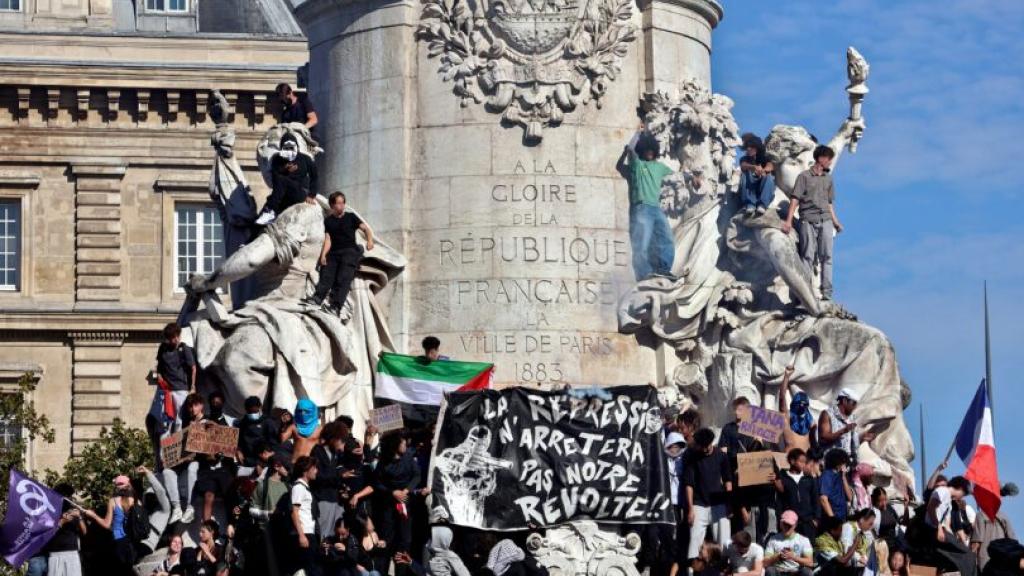
By October 13, the high school protest movement in France had mushroomed, prompting up to half a million people to take to the streets across the country. On that day, Swedish climate activist Greta Thunberg made a solidarity visit to one of the high schools where it all started, Lycée Paul Eluard, in the impoverished Paris banlieue (suburb) of Saint-Denis. Thunberg intoned that “the whole world is watching” and that it is “proud of the French students.”1 With a two-week school vacation beginning on October 16, it remains to be seen if this remarkable movement, which has already lasted over three weeks, will be able to continue. Nevertheless, a new challenge from the left, and from the youngest of the youth, has been hurled at a racialized capitalist system which in France, as in so many other places, is moving in the direction of outright neofascism.
Some three years ago, France experienced another nationwide uprising across its impoverished and ethnically oppressed banlieues and poorer city neighborhoods. On June 27, 2023, police gunned down Nahel Merzouk, a seventeen-year-old of Algerian descent who had refused to stop for questioning. As Nahel lay dead, the banlieues and other marginalized communities exploded, with teens and preteens in the lead. By the time the dust had settled five days later, 250 police stations and outposts had been attacked, 700 police injured, much property had been destroyed, and 3,000 youths had been arrested, many of them to be prosecuted mercilessly and jailed. For the French dominant classes, the mainstream media, the politicians, and the trade union bureaucrats, 2023 was seen as an irrational outburst of little long-term political or social import, something to be swept under the rug and forgotten. Little or nothing was done to address the underlying issues, least of all the country’s rampant police brutality and racial profiling.
In some ways, the September–October 2026 youth uprising has been a repeat of 2023. The communities where the current uprising originated are essentially the same as in 2023, and confrontations with the police, or rather vicious police violence against the youth, show that little has changed. The dominant rhetoric among politicians and the corporate media continues to characterize those in revolt as “savages” and the like.
But 2026 is more than a larger version of 2023. First, this year’s uprising’s size, scope, and staying power have been greater. In the first week, it spread across high schools in poor and marginalized areas of the Paris region. As it did so, it became no longer only a spontaneous revolt, but also a movement making very concrete demands.
Second, it has also spread from the banlieues and poorer city districts to more advantaged, even privileged high schools. It also involved parents, university students, and trade unions. All of this has helped break down the isolation of the banlieues, even if only for a time. Moreover, it has put into action the kinds of social forces that, if acting together, could really uproot the system.
Third, partly as a result of these wider solidarities, the movement has been more organized and more political, and has expressed clear and comprehensive demands. This was facilitated by the fact that the uprising was centered in the schools, a more structured venue than an urban community, making its participants, even in the banlieues, less isolated and less vulnerable to demonization as street thugs, “savages,” and so on.
Fourth, a greater number of key political figures have openly backed the youth than in 2023.
Finally, all this has forced the center-right government to make a few small concessions, even though its main response has been demonization and repression.
Because of these wider valences, 2026 is sometimes compared — both in the French media and globally — to the mass student-worker uprisings that were the high-water mark of the revolutionary year 1968, when ten million workers went on strike in the wake of university and workplace occupations. The comparison is surely an exaggeration. Nonetheless, 2026 is indeed a sign of wide and deep unrest of a type that cannot easily be contained by political regimes—like that of the neoliberal Emmanuel Macron in France—that represent a capitalism of austerity and whose support is plummeting. For the two sides of that conjuncture are a surge toward new leftwing political parties like La France Insoumise (LFI), and on the other side, toward the neofascist Rassemblement National (RN).
How the 2026 revolt unfolded
On Friday, September 18, students at Lycée Saint-Exupéry in Créteil, a Paris banlieue, began to demonstrate at their school, soon after their return to classes after the summer break, and following a one-day teachers’ strike. This took place after climate change and massive wildfires had led to an unbearable summer across the country. Students experienced classrooms without air conditioning, in intolerable heat. In addition, classes were too large, school days too long, teachers missing due to lack of replacement hires, and buildings dilapidated. Even toilet paper was sometimes missing. An online student survey carried out by the government amid the ensuing protests found that school days as long as 8:00 am to 6:00 PM were one of the principal complaints, especially given climate change and lack of air conditioning.
By the week of September 28, the mobilizations spread across the Paris region and then France as a whole. By Friday, October 2, protests had burst out in over a thousand high schools, with some two hundred being blockaded by students. Violence against property took place in a few locations, with a small fire set at Lycée Rosa Parks in Nantes in northwest France, to take one example. This was seized upon by the center-right government and the far right to brand the students as “savages,” rhetoric in turn used to justify the harsh police response.
While the movement began and was most active in the banlieues and poorer urban districts, encompassing both trade schools and academic high schools, it became truly national and multi-class very quickly. For example, students at the prestigious Lycée Henri IV in a wealthy area of Paris — whose alumni include Jean-Paul Sartre, Michel Foucault, and President Macron himself — also went on strike, hanging a banner that read “Solidarity with the high schools.”2 As journalists for Le Monde observed, “Some mobilized out of necessity, others rather from solidarity.”3
In a number of extensively reported cases, police brutalized young students, among them a fifteen-year-old boy whose hand was torn off by a police “stun grenade.” This device is severely restricted or banned outright in many other European countries. After two weeks, the police announced that they had detained at least briefly some 6,877 people, 86 percent of them minors. Clearly, the goal of such a wide dragnet was to use fear to discourage participation.4
Still wider solidarities emerged on October 6, when hundreds of thousands, perhaps even half a million people, took to the streets across France in support of the high schoolers. Some were university students and other older adults, many of whom wore white armbands as a sign that they were there to protect the country’s youth from the police — if necessary, by interposing themselves. Parents and other adults were doing the same outside many high schools. In Saint-Denis, another marginalized Paris suburb, Mayor Bally Bagayoko, a Black activist recently elected as a candidate for LFI, joined student demonstrators in an attempt to shield them from police attack.
At universities, including the prestigious Sciences Po in Paris, where Palestine solidarity demonstrations over the past few years have faced surveillance and repression, students also engaged in solidarity actions. After taking over a nearby street, however, Sciences Po students were beaten back by a violent police attack.
Grievances and demands
Almost everywhere, students mentioned a multiplicity of issues. In Lille, seventeen-year-old Fanny (who prudently wanted to be quoted only by her first name) singled out “bad conditions in which to study, overcrowded classrooms, and buildings in need of repair.” But Fanny also went deeper, calling out “the climate catastrophe, artificial intelligence that is gobbling up jobs, and the risk that the RN will win the elections,” referring to Marine Le Pen’s neofascist party.5
On October 8, a declaration from the Coordination Antifasciste also noted the “carceral atmosphere in the high schools.”
Others referred to racial and ethnic exclusion and oppression. An in-depth account of the protests in the Paris banlieue of Saint-Denis was published by Christophe Ayad, a journalist who has long distinguished himself by his coverage of both Middle East conflicts and France’s immigrant communities. As Ayad reported, student speakers at an October 4 rally asked, “Why do we have fewer chances than those from Paris?” Others declared, “There is a segregation dividing Paris and the suburbs due to Parcoursup” — a much-criticized online university selection system — “which is totally arbitrary. These inequalities are not normal!” Student speakers also decried media narratives that separated the banlieues from the rest of Paris and demonized banlieue students of color as the source of all violence: “There are the whites on one side, the Blacks and the Arabs on the other,” one said, adding, “When a student is non-white, police violence increases tenfold.” Other student protestors noted anti-Muslim discrimination: “Muslims are treated as enemies.” Still others raised wider, more political slogans, like support for Palestine. While expressing deep alienation, the students also referred to themselves as “the new France,” thus pointing to the more multiethnic and inclusive future society they envision. Mayor Bagayoko received huge applause when he told a crowd, “You honor the Republic; you honor its values; your demands are legitimate.”6
Everywhere, the slogans reflected the anger, but also the imagination and verve, of a new generation. Referring to the militarized CRS riot police, students chanted, “You were sent an SOS and we received your CRS.” Adopting directly — and in English — a slogan associated with US Black Lives Matter movement, others chanted “ACAB” (All cops are bastards). One handmade sign read “ACAB” and “July 1830,” referring to the revolution that ended Restoration attempts re-establish France’s absolute monarchy.7
What has been achieved
While the specific gains so far are very small, promises to hire three thousand teachers and to suspend layoffs of teachers, this movement’s mere existence and persistence is itself a kind of victory in the face the far-right surge that has been gripping Western Europe, including France. This is particularly significant at a time when both social media and traditional TV and other mass media are increasingly under the control of rightwing oligarchs. The militancy and creativity of the youth have broken through those barriers, just as they have of late in India with the Cockroach Janta Party.
The fact that such a militant and large-scale movement took place not in the Global South, but in Western Europe, illustrates the truly international scope of the struggle for human emancipation today.
The French high school uprising of 2026 also shows, in a most dramatic manner, that the ballot box is far from the only way to enact social change, or at least to put it on the agenda. Taking to the streets and occupying key institutions is also a model, and a more radical one.
Finally, the French youth revolt of 2026 has crossed barriers of race and class that have so often been used by dominant classes, from the days of slavery to today’s racialized capitalism, to keep oppressed sectors apart from each other and from critical intellectuals, thwarting the kind of cross-fertilization that is needed to truly challenge the system. What we have witnessed in France this year is not only an agenda of “unite and fight.” What has emerged is a movement in which the most oppressed sectors of society — youth of color, descendants of immigrants, and children of the working class — have taken the lead.
- 1
Charlotte Bozonet et al., “Mouvement lycéen,” Le Monde, October 14, 2026.
- 2
Arthur Carpentier et al., “Le mouvement lycéen s’étend en France,” Le Monde, October 3, 2026.
- 3
Rémi Ducasse et al., “Nous, on ne veut rien casser, on veut se faire écouter,” Le Monde, October 7, 2026.
- 4
“Lycéens: ce que nous dit le recours massif à la garde vue,” editorial, Le Monde, October 12, 2026).
- 5
Carpentier et al., “Le mouvement lycéen s’étend en France.”
- 6
Christophe Ayad, “Dans les quartiers populaires, un mouvement lycéen très politisé, accompagné, mais pas manipulé,” Le Monde, October 7, 2026.
- 7
Lorraine de Foucher et al., “Les lycéens maintiennent la pression dans la rue,” Le Monde, October 10, 2026.