climate change
Nnimmo Bassey interviewed by Democracy Now! (Transcript below).
April 21, 2010 -- Democracy Now!
AMY GOODMAN: Among those who spoke at the opening ceremony for the World Peoples’ Climate Conference was Nnimmo Bassey. He’s the
prominent Nigerian environmentalist and chair of Friends of the Earth
International. By contrast, at the UN climate summit in Copenhagen in
December, his group, along with several other mainstream environmental
organisations, was barred from the talks.
Democracy Now! producer Sharif Abdel Kouddous spoke with
Nnimmo Bassey outside the conference gates here in Tiquipaya. He began
by asking to talk about the significance of the Bolivian summit.
NZ socialists endorse Bolivia's call for a world referendum on climate change
Socialist Worker-New Zealand statement to the World People’s Conference on Climate Change and the Rights of Mother Earth, in Bolivia April 19-22, 2010
April 19, 2010 -- Socialist Worker-New Zealand agrees with the statement made by Bolivia's President Evo Morales in his invitation to the World People’s Conference on Climate Change and the Rights of Mother Earth that “climate change is a product of the capitalist system”.
The pursuit of growth and profit is hard-wired into capitalism. Corporations and politicians wedded to capitalism cannot bring about the urgent reduction in greenhouse gas emissions we need to avert catastrophic climate change.
Therefore the transition to societies living in harmony with nature requires fundamental system change. The way we use resources, the way we produce things, the way we live has to change. This is the challenge that climate change, peak oil and other looming global crises place on the shoulders of all of us living today. Yet too many of our leaders are shirking their responsibilities, not only to those they claim to represent, but to future generations.
Video report from Democracy Now! (Full transcript of report below)
Prensa Latina
April 20, 2010 -- Cochabamba, Bolivia -- Bolivia's President Evo Morales Ayma condemned the capitalist system in the opening session of the World People's Conference on Climate Change and the Rights of Mother Earth today.
Morales, speaking at the April 20 conference inauguration, started his speech with a slogan, "Planet or death, we shall overcome". He said that harmony with nature could not exist while 1 per cent of the world's population concentrates more than 50 per cent of the world's riches. Capitalism is the main enemy of the Earth, only looking for profits, to the detriment of nature, and capitalism is a bridge for social inequality.
Can capitalism fix climate change?
By Simon Butler
April 14, 2010 -- Albert Einstein defined insanity as doing the same thing over and over again and expecting different results. It has taken capitalism about 250 years to generate enough waste and pollution to press dangerously against nature’s limits. With such a damning record, there should be no grounds to expect a different outcome in the future.
Yet the mainstream discussion about how to tackle the climate crisis still assumes that, this time around, capitalism can be made sustainable.
In an April 3 Sydney Morning Herald piece arguing for capitalists to take a leading role in resolving the climate crisis, Paddy Manning said it “was an article of faith for this column” that a free market could respond effectively to the challenge of climate change. But, struggling to come up with Australian capitalists responding positively to the challenge, he was forced to admit: “Faith is needed, because climate change is proof of colossal market failure.”
Photo essay: `Stop the coal rush!' -- people's blockade halts exports from world's biggest coal port
Ship movements cancelled at the world's biggest coal port, Newcastle (Australia) -- March 28, 2010 from jagath dheerasekara on Vimeo.
Photo essay and story by Jagath Dheerasekara
March 28, 2010 -- Newcastle, Australia -- A mass community protest at the biggest coal port in the world, Newcastle, succeeded in preventing coal ship movements all day. Hundreds of peaceful protesters occupied the harbour from 10 am.
South Africa's poor to pay for dirty World Bank loan

By Patrick Bond, Durban
April 14, 2010 -- Just how dangerous is the World Bank and its neo-conservative president Robert Zoellick to South Africa and the global climate? Notwithstanding South Africa's existing US$75 billion foreign debt, on April 8 the bank added a $3.75 billion loan to South Africa's electricty utility Eskom for the primary purpose of building the world's fourth-largest coal-fired power plant, at Medupi. It will spew 25 million tons of the climate pollutant carbon dioxide into the air each year. [For more background go to http://links.org.au/node/1570.]
South Africa's finance minister Pravin Gordhan has repeatedly said that this is theWorld Bank's "first" post-apartheid loan, yet the bank's 1999 and 2008 Country Assistance Strategy documents show conclusively that Medupi is the 15th credit since 1994.
Bolivia: Ambassador Pablo Solon on why thousands will attend World People's Climate Summit
Pablo Solon, part 1. Parts 2 and 3 below.
April 11, 2010 -- World People’s Conference on Climate Change and the Rights of Mother Earth via Climate and Capitalism.
Capitalism and food: Let them eat junk

An interview with Rob Albritton
March 2010 -- Rob Albritton’s Let Them Eat Junk: How Capitalism Creates Hunger and Obesity (2009), published by Arbeiter Ring Press in Canada and Pluto Press in the UK, offers a welcome and urgently needed analysis of “how the profit fixation of capital has led us deeply into a dangerously unsustainable system of food provision, a system that totally fails when it comes to distributive justice and to human and environmental health” (p. 201). His analysis takes us inside capitalism and shows how its “deep structures” manage our agricultural and food systems in irrational ways.
Socialist Project’s Relay magazine recently asked John Simoulidis to interview Robert Albritton about his book and current global struggles to address the failures of our agriculture/food system. Posted at Links International Journal of Socialist Renewal with permission.
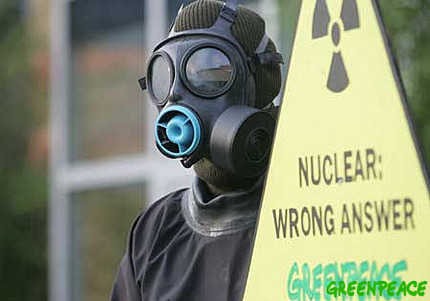
Why James Hansen is wrong on nuclear power
By Renfrey Clarke
April 8, 2010 -- “When the facts change, I change my mind. What do you do, sir?” Attributed to economist J.M. Keynes, that retort has always been good advice. Now that carrying on with “business as usual” greenhouse gas emissions has been revealed as a road to disaster, should environmentalists change their minds on nuclear power?
To be sure, the dangers of the nuclear industry have not gone away. A major nuclear war, by creating “nuclear winter” conditions, would end most life on Earth. Humanity, however, has managed the threat of nuclear war in the past, and the chances are that we will continue to do so.
If thousands of nuclear power reactors were in operation, reactor accidents would be frequent enough that they would almost stop being news. But deaths would probably be few, and other losses would be relatively minor compared to the dead oceans and scorched grainlands of the greenhouse future.
Fourth International: Mobilisation for the climate and anti-capitalist strategy
[The following documents dealing with capitalism's climate crisis were presented at the 16th World Congress of the Fourth International, held in Belgium in February 2010.]
* * *
By Daniel Tanuro
February 2010 -- Three billion human beings lack the essentials of life. The satisfaction of their needs requires increased production of material goods. Therefore increased consumption of energy. Today, 80 per cent of this energy is of fossil origin, and consequently a source of greenhouse gases which are unbalancing the climatic system.
However, we can no longer permit ourselves to unbalance the climate. We are probably no longer very far from a “tipping point” beyond which phenomena which are uncontrollable and irreversible on a human timescale are likely to be set in motion, which could lead to a situation that humanity has never experienced and which the planet has not experienced for 65 million years: a world without ice. A world in which the sea level would rise by approximately 80 metres compared to its level today.
‘Socialism of the 21st century’ and left unity

By the Socialist Alliance, Australia
[The following is the text of a leaflet being distributed by the Socialist Alliance in Melbourne.]
April 2, 2010 -- The triumphalism spouted by capitalist apologists in the early 1990s with the collapse of the Soviet Union has long gone. Today the problems are so obvious: global warming and the world economic slump are shaking the capitalist world and casting a growing shadow over the future.
“Capitalism is the road to hell”, as Venezuela’s leader Hugo Chavez said at the Copenhagen climate conference. The revolutionary process in Venezuela and the bold stand taken by its leader have resurrected the idea of socialism in the consciousness of millions. His call for a “socialism of the 21st century” has inspired people around the world. And now Chavez has called for a new international socialist organisation which would unite parties and movements that want to fight imperialism and neoliberalism.
But important as solidarity with Venezuela is and much as we may admire Chavez, our fundamental task is to fight for social change right here.
Survival of humanity is at stake
After Copenhagen: Can we save the world? Video: Is the climate sick of us?
* * *