Communal Councils
Michael Lebowitz on the socialist alternative and real human development
Prof. Michael Lebowitz on the socialist alternative from Dangerous Minds at Vimeo.
August 30, 2010 -- Michael Lebowitz is a Canadian Marxist economist. He is the director of the “Transformative practice and human development” program at the Venezuela-based left-wing think tank, the Centro Internacional Miranda. He is professor emeritus of economics at Simon Fraser University and author of Build it Now: 21st Century Socialism and the 2004 Isaac Deutscher-prize winning Beyond Capital: Marx's Political Economy of the Working Class. His latest book is The Socialist Alternative: Real Human Development.
Venezuela: Communal power in Caracas

John Bellamy Foster on Venezuela: Marxism and `vernacular revolutionary traditions'
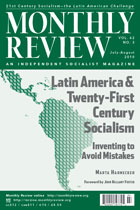
The following article is the Foreward to the July-August 2010 issue of the US socialist magazine Monthly Revi
Eric Toussaint: Venezuela's Bolivarian revolution at the crossroads?
By Eric Toussaint
[See parts 2 , 3 and 4 below.]
Building socialism from below: The role of the communes in Venezuela

Antenea Jimenez interviewed by Susan Spronk and Jeffery R. Webber
June 13, 2010 -- The Bullet -- We met with Antenea Jimenez, a former militant with the student movement who is now working with a national network of activists who are trying to build and strengthen the comunas [communes]. The comunas are community organisations promoted since 2006 by the government of Venezuela's President Hugo Chávez government as a way to consolidate a new form of state based upon production at the local level. She told us about the important advances in the process, as well as the significant challenges that remain in the struggle to build a new form of popular power from below.
Can you tell us about the barrio where you live and the comuna?
I live in a barrio [neighbourhood] in the north part of Caracas and work in a national network that is building comunas. Currently we operate in seven states; the majority of the comunas are situated outside Caracas.
Venezuela: New moves to build workers' power; Revolution in the electricity industry
By Federico Fuentes, Caracas
March 22, 2010 -- The free, sovereign and independent homeland of our dreams will only come true if we radicalise the process and speed up the transition to socialism”, Venezuela's President Hugo Chavez wrote in his March 14 weekly column “Chavez Lines”.
The Venezuelan government has launched a number of initiatives in recent weeks aimed to tackle threats to the revolutionary process — including from elements within the pro-Chavez camp that seek to undermine plans to deepen the revolution.
Central to this are new measures aimed at speeding up the transfer of power to organised communities.
Chavez wrote in his February 21 column: “The time has come for communities to assume the powers of state, which will lead administratively to the total transformation of the Venezuelan state and socially to the real exercise of sovereignty by society through communal powers.”
Participatory democracy
The previous day, Chavez announced the creation of the federal government council in front of thousands of armed peasants that are part of the newly created peasant battalions in the Bolivarian militia.
Venezuela’s revolution faces crucial battles; Chavez: `Towards a communal state!'

By Federico Fuentes, Caracas
February 20, 2010 -- Decisive battles between the forces of revolution and counter-revolution loom on the horizon in Venezuela. The campaign for the September 26, 2010, National Assembly elections will be a crucial battle between the supporters of socialist President Hugo Chavez and the US-backed right-wing opposition. But these battles, part of the class struggle between the poor majority and the capitalist elite, will be fought more in the streets than at the ballot box.
So far this year, there has been an escalation of demonstrations by violent opposition student groups; the continued selective assassination of trade union and peasant leaders by right-wing paramilitaries; and an intensified private media campaign presenting a picture of a debilitated government in crisis — and on its way out.
Venezuela plans deeper popular democracy to address economic crisis
By Federico Fuentes, Caracas
September 24, 2009 -- Faced with the growing impact of the global economic crisis, Washington’s intentions to establish seven military bases in Colombia and growing challenges in solving structural problems, Venezuelan President Hugo Chavez reaffirmed the need to build a new state.
“We have inherited a capitalist state that serves the interests of the bourgeoisie and is still penetrated by interests contrary to the revolution. We need to carry out an internal shake up of the government structures”, Chavez said on September 19 during the second expanded council of ministers meeting, which also involved governors and mayors aligned with the Bolivarian revolution.
The meeting was called to discuss a series of new measures the revolutionary government plans to announce in coming weeks to confront some of the challenges it faces on the economic, political and social fronts. In all, 54 new measures have already been approved by his cabinet.
Global economic crisis
New figures released by the Central Bank of Venezuela (BCV) showed the national economy contracted by 1% in the first half of the year, including a 2.4% drop in the second quarter.
Marta Harnecker: Popular power in Latin America -- Inventing in order to not make errors

Venezuela: New mission, laws to extend popular power; trade union movement rebuilds
By Federico Fuentes
Caracas, September 6, 2008 -- The August 24 announcment by Venezuelan President Hugo Chavez to officially launch the social mission April 13, and the decreeing of 26 new and reformed laws on July 29, represent a further push to empower the poor communities.
Moreover, these moves represent a new offensive as part of Chavez’s stated aim of building “socialism of the 21st century” and eradicating poverty by giving power to the people.
Among other things, the new mission and laws build upon the communal councils that have been established across the country with the goal of organising the Venezuelan people, in order to transfer responsibilities until now in the hands of the state bureaucracy inherited by the Bolivarian revolution.
Mission April 13 is named in honour of the successful struggle of the poor majority, who along with the majority of the armed forces, defeated the coup organised by Venezuela’s business federation, Fedecamaras, on April 11, 2002. The coup briefly removed Chavez from the power, but an uprising resorted him two days later.