Communist International


Black liberation and the Communist International

Claude McKay.
By John Riddell
September 11, 2011 -- This article also appears at http://johnriddell.wordpress.com, posted at Links International Journal of Socialist Renewal with John Riddell's permission -- The influence of the Communist International was decisive in the early 1920s in winning a generation of black revolutionaries to Marxism. On this the historians agree. But what did this influence consist of, and how was it exerted?
The Comintern’s unknown decision on workers’ governments

"Workers of the World, Unite!", by Gustavs Klucis. Produced for the 1922 Fourth Congress of the Communist International.
On the meaning of ‘popular front’

The Bolivarian movement led by Hugo Chávez contains bourgeois forces and has been th
Paul Le Blanc: Marxism and organisation
By Paul Le Blanc
The Communist Women’s International (1921-26)

"Emancipated woman -- build up socialism." Poster by Strakhov-Braslavskij A. I., 1926.
By John Riddell
June 12, 2011 -- The following working paper was presented to the Toronto conference of Historical Materialism on May 16, 2010. It first appeared on John Riddell's blog and is posted at Links International Journal of Socialist Renewal with the author's permission.
* * *
When we celebrate International Women’s Day, we often refer to its origins in US labour struggles early last century. Less often mentioned, however, how it was relaunched and popularised in the 1920s by the Communist Women’s International. Moreover, this movement itself has been almost forgotten, as have most of its central leaders.
The Communist Women’s International was founded by a world gathering of communist women in 1921, which elected a leadership, the International Women’s Secretariat, reporting to the executive of the Communist International, or Comintern. It also initiated the formation of women’s commissions in national parties, which coordinated work by women’s bodies on a branch level, and called periodic international conferences of Communist women.
R. Palme Dutt's 'Fascism and social revolution'
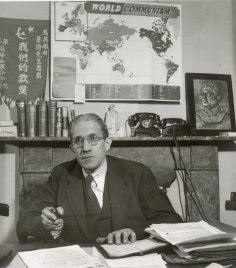
By Graham Milner
In the present situation in the world, with the intermittent resurgence of fascist and neo-fascist movements in some countries, an avowedly Marxist treatment of the subject of fascism, such as Palme Dutt's Fascism and Social Revolution, deserves the attention of new generations of readers.
Rajani Palme Dutt (1896-1974) was born in England of an Indian father and a Swedish mother.[1] He grew up in a political household, where socialism and Indian independence were familiar subjects of discussion. A brilliant scholar at Oxford University (he took a double first), Dutt was a conscientious objector during the World War I, and was expelled from university in 1917 for disseminating Marxist propaganda.
Tariq Ali on Mao Zedong and communism in China

"Mao images are for sale, popular in China and not just with tourists, hi
The German Communist Party and the crisis of 1923

Rosa Luxemburg and Karl Liebnecht, murdered by the Social Democrat government.
By Graham Milner
The German Communist Party (KPD) was founded in the very heat of revolutionary struggle. One of the party's major problems from the beginning was that it was formed as a separate organisation too late to influence significantly the course of the German Revolution of 1918-19. If there had been in existence at this time a mass revolutionary party along the lines of Lenin's Bolshevik party, then there could well have been a radical reconstruction of German society into a republic of workers' councils. Instead of such an outcome, the stunted bourgeois-democratic regime of Weimar came into being, in which most of the existing state machine, including the army, judiciary and civil service, was preserved intact.[1]
John Riddell: (Audio) The Comintern, 1919-1923: The two souls of centralism
Clara Zetkin’s struggle for the united front

* * *