Latin America
Split amongst Cuban contras, cracks in the blockade
June 11, 2010 -- A major split over the US blockade of Cuba has emerged between domestic "dissidents" in Cuba and their former partners in Miami. The US corporate media is paying attention to what appears to be a new anti-Cuban strategy.
A letter signed by 74 of the "dissidents" on the island calls for an end to Washington's ban on US citizens travelling to Cuba. On the other hand, most of the Cuban-American members of Congress are fiercely defending the nearly 50-year-old economic blockade, in all its forms. The "new contras" are now up against the old.
The split represents a genuine difference in counter-revolutionary tactics, but is also linked to squabbles over money. For many years "dissidents" in Cuba have privately complained that most of the millions of dollars pledged by Washington -- for a "transition" to capitalist "democracy" in Cuba -- is snapped up by Miami.
There have been scandals over the misuse of the millions of US government dollars funnelled into propaganda channels aimed at Cuba. Miami-based Radio Marti and Television Marti were recently criticised by US Foreign Relations Committee chair John Kerry as corrupt, ineffective and of little interest to young Cubans.
Building socialism from below: The role of the communes in Venezuela

Antenea Jimenez interviewed by Susan Spronk and Jeffery R. Webber
June 13, 2010 -- The Bullet -- We met with Antenea Jimenez, a former militant with the student movement who is now working with a national network of activists who are trying to build and strengthen the comunas [communes]. The comunas are community organisations promoted since 2006 by the government of Venezuela's President Hugo Chávez government as a way to consolidate a new form of state based upon production at the local level. She told us about the important advances in the process, as well as the significant challenges that remain in the struggle to build a new form of popular power from below.
Can you tell us about the barrio where you live and the comuna?
I live in a barrio [neighbourhood] in the north part of Caracas and work in a national network that is building comunas. Currently we operate in seven states; the majority of the comunas are situated outside Caracas.
Michael Lebowitz: `We must choose socialism over capitalist barbarism'
Michael Lebowitz was interviewed by Srećko Horvat during the Subversive Film Festival and
Support Tamils not Sri Lanka’s war-criminal government -- Eva Golinger misinterprets solidarity

By Ron Ridenour
June 1, 2010 -- Eva Golinger is known for her analysis in the service of Venezuela’s peaceful revolution against the local oligarchy and the United States empire. She is a noted author (The Chavez Code: Cracking US intervention in Venezuela). A dual citizen of the US and Venezuela, she is an attorney, and a personal friend of President Hugo Chavez. She is a frequent contributor to left-wing media around the world, and is the English-language editor of the Venezuelan newspaper, Correo del Orinoco.
Capitalism is the cause of climate illness! Global movement begins the cure!
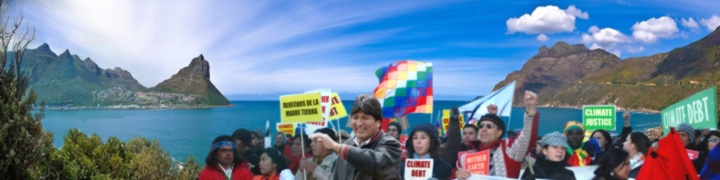
[For full coverage of the World People's Conference on Climate Change, including the full text of the documents, click HERE.]
By Ron Ridenour, Cochabamba
May 15, 2010 -- Presenting the People’s Agreement — “Mother Earth does not belong to us, we belong to it” — worldwide was the first act of the Global People’s Movement for Mother Earth. This was carried out in May by Bolivia’s President Evo Morales and representative activists from five continents.
Representing 35,000 people from 147 countries, they presented the conclusions of 17 workshops — held April 19-21 at the World People’s Conference on Climate Change and the Rights of Mother Earth (WPCCC) — to United Nations Secretary-General Ban Ki-moon, to the Non-Alignment Movement (now 130 Third World countries) plus China (the world’s second greatest polluter), and then to leaders of the European Union.
Justice in Wonderland: The untold story of the Cuban Five
By Ricardo Alarcón, president of Cuba’s National Assemby
I. Remember Elian?
Hugo Chávez and Cuba condemn Israel's brutal massacre of aid activists

Ministry of People's Power for Foreign Affairs, Caracas
May 31, 2010 -- The President of the Bolivarian Republic of Venezuela, Commander Hugo Chávez, emphatically condemns the brutal massacre perpetrated by the State of Israel against the members of the Liberty Flotilla, as a result of the war action started by the Israeli Army against defenceless civilians, who tried to carry humanitarian aid supplies to the Palestinian people of the Gaza Strip, who are victims of the criminal blockade imposed by the State of Israel.
President Hugo Chávez, on behalf of his government and the Venezuelan people, expresses his deepest regret and sends his deepest condolences to the families and relatives of the heroes who have been victims of this state crime, and commit to honour their memory and to give the necessary help so that the responsible of this murderers are severely punished.
The revolutionary government of Venezuela will continue denouncing the terrorist and criminal nature of Israel, and it reaffirms, today more than ever, its unbreakable commitment with the fight of the Palestinian people for freedom, the sovereignty and the dignity.
Venezuela's economic and energy woes?

By Federico Fuentes, Caracas
May 23, 2010 -- In recent weeks, local and international media have attacked the left-wing Venezuelan government over alleged “economic woes” and electricity problems (see article below). Pointing to Venezuela’s inflation rate — the highest in Latin America — and an economy that shrank 3.3% last year, the private opposition media is raising fears of a serious economic crisis.
These same media outlets, which have been predicting the fall of President Hugo Chavez for years, argue recent government actions will worsen the situation. Venezuelan business federation Fedecamaras warned on May 5 that Venezuela faces an “economic and social crisis”. The federation helped organise a 2002 military coup against Chavez that briefly installed Federcamaras leader Pedro Carmona president before a mass uprising restored Chavez.
`Foro Social Latinamericano', issue #3 of Green Left Weekly's Spanish-language supplement
The tide of rebellion and revolution now sweeping Latin America is posing a serious challenge to imperialism’s brutal global rule. For anyone who wants an end to war, exploitation and oppression, Latin America’s struggles to create alternatives are crucially important.
Australia's leading socialist newspaper Green Left Weekly is strongly committed to supporting the growing “people’s power” movement in Latin America. We are proud of the fact that GLW is the only Australian newspaper to have a permanent bureau in Latin America, based in Caracas, Venezuela. Through our weekly articles on developments in the region, GLW strives to counter the corporate media’s many lies about Latin America’s revolutions, and to give a voice in English to the people’s movements for change.
Bolivia’s mining dilemmas: Between Mother Earth and an ‘extraction economy’

By Federico Fuentes, Cochabamba
May 15, 2010 -- The tremendous success of the April 19-22 World People's Summit on Climate Change and Mother Earth Rights held in Cochabamba, Bolivia, has confirmed the well-deserved role of its initiator — Bolivia's President Evo Morales — as one of the world’s leading environmental advocates.
Since being elected the country’s first Indigenous president in 2005, Morales has continuously denounced the threat posed by the climate crisis and environmental destruction. Morales has pointed the figure at the real cause of the problem: the consumerist and profit-driven capitalist system.
Evo Morales: United, the developing countries can save Mother Earth
“The response to global warming is global democracy for life and for the Mother Earth.… we h
