Rosa Luxemburg
Comparing 1911 and 2011: What's relevant for socialists today?

The German gunboat, Panther, tried to halt French claims to Morocco in 1911.

Introduction by Mike Treen
May 2, 2011 -- Links International Journal of Socialist Renewal -- Below is the latest entry from the Critique of Crisis Theory blog by Sam Williams [posted here with Williams' permission]. In it he analyses the current stage of the industrial cycle and asks, “Is the economic crisis over?”.I hope that reading this post will encourage people to look more closely at the entire series on Critique of Crisis Theory, which has taken the form of a developing book on crisis theory.
The first chapter explains the biggest challenge the author faced — the fact that Marx did not leave a completed crisis theory. It was certainly the plan when Marx began Capital, but in the end only one volume was completed before his death and volumes two and three only took partial steps to a completed theory.
The German Communist Party and the crisis of 1923

Rosa Luxemburg and Karl Liebnecht, murdered by the Social Democrat government.
By Graham Milner
The German Communist Party (KPD) was founded in the very heat of revolutionary struggle. One of the party's major problems from the beginning was that it was formed as a separate organisation too late to influence significantly the course of the German Revolution of 1918-19. If there had been in existence at this time a mass revolutionary party along the lines of Lenin's Bolshevik party, then there could well have been a radical reconstruction of German society into a republic of workers' councils. Instead of such an outcome, the stunted bourgeois-democratic regime of Weimar came into being, in which most of the existing state machine, including the army, judiciary and civil service, was preserved intact.[1]
Alex Callinicos on imperialism, two reviews
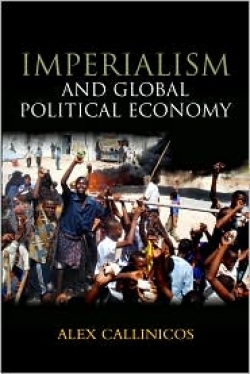
Review by Barry Healy
Imperialism and Global Political Economy
By Alex Callinicos
Polity, 2009
227 pages
October 2, 2010 -- The topic of “imperialism” greatly occupied the minds of late-19th and early-20th century socialists. Some of the tradition’s greatest minds toiled mightily to discern the fundamental changes in capitalism that were occurring before their eyes.
Capitalism, as analysed by Karl Marx, had grown fat in its European heartland through the ruthless exploitation of colonies and the brutal factory system in its coal dark cities. But suddenly new phenomena started to appear in the late 1800s.
Banking capital moved from being a support for industrial capital, first merging into and then dominating manufacturing. This agglomeration of money power created massive industrial complexes, like Germany’s famous Krupps steelworks.
The colossal scale of these industrial works dwarfed human beings.
Clara Zetkin’s struggle for the united front

* * *
Rosa Luxemburg and Marxist politics

Leninism: It’s not what you think

By Paul Kellogg
[This article first appeared in Socialist Studies: the Journal of the Society for Socialist Studies 5(2), Fall 2009. It has been posted at Links International Journal of Socialist Renewal with the author's permission.]
If socialism fails: the spectre of 21st century barbarism
July 27, 2008 -- From the first day it appeared online, Climate and Capitalism’s masthead has carried the slogan “Ecosocialism or Barbarism: there is no third way.” We’ve been quite clear that ecosocialism is not a new theory or brand of socialism — it is socialism with Marx’s important insights on ecology restored, socialism committed to the fight against ecological destruction. But why do we say that the alternative to ecosocialism is barbarism?
Marxists have used the word “barbarism” in various ways, but most often to describe actions or social conditions that are grossly inhumane, brutal, and violent. It is not a word we use lightly, because it implies not just bad behaviour but violations of the most important norms of human solidarity and civilised life. [1]
The slogan “Socialism or Barbarism” originated with the great German revolutionary socialist leader Rosa Luxemburg, who repeatedly raised it during World War I. It was a profound concept, one that has become ever more relevant as the years have passed.
15 years since the murder of Chris Hani
On April 10, 1993, South African Communist Party (SACP) leader Chris Hani was asassinated by right-wing extremists hoping to derail South Africa's transtion to democratic rule. On the 15th anniversary of his death, Links reproduces a speech by socialist and African National Congress (ANC) veteran Pallo Jordan delivered to mark the 10th anniversary of the assassination.
***
By Dr Pallo Jordan
Allow me first to thank the leadership of the SACP and the central executive committee of Congress of South African Trade Unions (COSATU) for inviting me to deliver this inaugural Chris Hani Memorial Lecture. I consider it a great honour to have been chosen for this task because Comrade Chris was a close and very dear friend of mine.