Two blue waves upend ruling parties: US flows left, South Africa drifts right
Two elections generated opposite ideological results last week. In the United States, the Democratic Party’s blue tsunami on November 3 washed Donald Trump’s red Republicans out of Congress and many state houses. Meanwhile, in South Africa’s municipal elections the next day, the black-green-gold of the African National Congress (ANC) — once a liberatory force led by Nelson Mandela that took power in 1994 and ended apartheid, but immediately imposing (quick-failing) neoliberal economic policies — was partially drowned by the blue-led centre-right Democratic Alliance (DA), with far-right xenophobic sharks circling as well.
It was not a wave in South Africa: just a DA ripple, with a rise in support of less than 3% compared to the 2021 election. But there are serious changes underway in political loyalties. The ANC had won every democratic election before 2019 with 62–70% of the vote, but its support has since collapsed to 40% in the 2024 National Assembly election — compelling a Government of National Unity with the DA and a few other small parties — and today can barely claim 30% support, mostly winning municipalities in rural areas.
Because of the DA’s suburban strength, even with just under a quarter of the national vote, its very-white, sometimes openly neo-colonial managers (especially de facto leader Helen Zille) will probably soon grab mayoralties in the five largest cities: Johannesburg, Cape Town, Tshwane (Pretoria), Gqeberha (Port Elizabeth) and eThekwini (Durban). Coalition talks could last for weeks, as there were only clear 50%+1 winners in 68 of the 257 municipalities.
The DA has for two decades run the country’s second city, Cape Town, in a manner favourable to the wealthy, as University of the Western Cape Professor of Government Greg Ruiters shows. But in other metros, extreme decay is witnessed in even middle-class neighbourhoods (such as Johannesburg). So, the DA is expected to make some quick-fix improvements, especially of broken water pipes and delinquent rubbish removal. In desperate low-income urban communities, DA rule will likely lead to intensified class war waged over municipal services in the months and years ahead, thanks to its tendency to impose higher electricity prices and punitive services disconnections. Dale McKinley, of the International Labour Rights Information Group, explains:
What we are seeing is the inevitable consequence of decades of neoliberal policy choices, factional greed, and systemic neglect of poor communities. The working class has realised that waiting for salvation from above is a dead end.
Across the country, with 99% of the vote counted, the ANC won 50%+1 in only 44 councils (2753 seats), the DA in 11 councils (1204 seats), uMkhonto weSizwe Party (MKP) in 3 councils (614 seats), and the Inkatha Freedom Party in 5 councils (417 seats). With so many hung councils, negotiations will be excruciating. Given the weaknesses of the neoliberal-nationalist ANC and contenders to its left, the DA will probably evict the ANC from even junior-partner coalition rule in the major metros. But one objective the two lead parties share in Durban — the third largest city — is to recreate their Government of National Unity to keep former President Jacob Zuma’s MKP out of power, in spite of its 40% support there.
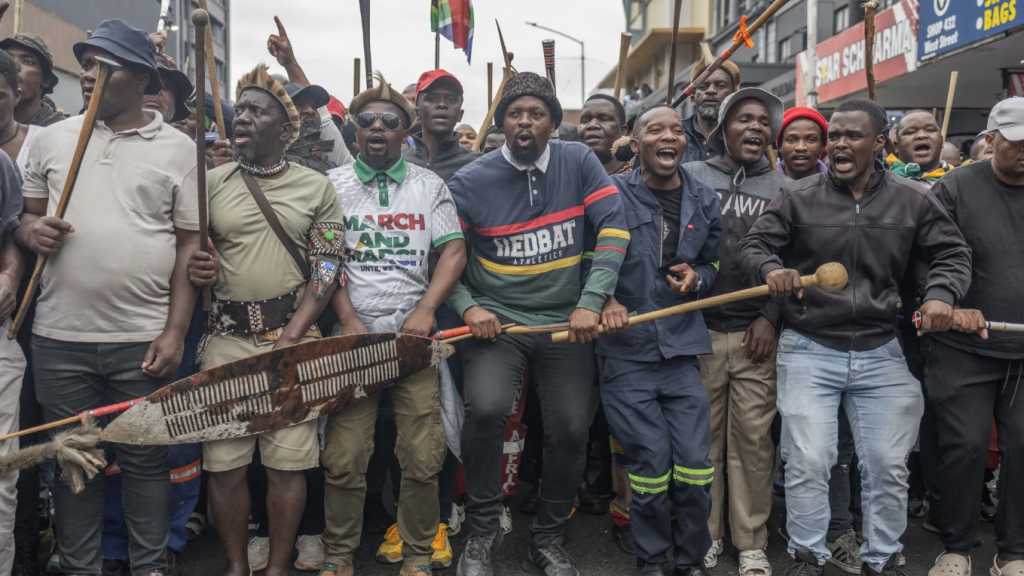
Across the province of KwaZulu-Natal, the MKP attracted sympathy votes for Zuma, who was pushed out of the ANC by Cyril Ramaphosa in 2018 after debilitating corruption scandals that left him briefly jailed in 2021, and who was hospitalised last month after a mild stroke. His party’s revived Zulu ethnicism includes public support for the main xenophobic social movement, March and March. However, instead of the nearly 15% received in the 2024 national poll, MKP’s support dropped below 10% in this vote.
ANC’s choices
There were two explicitly socialist parties of substance, but they did not win any councils: the Economic Freedom Fighters (EFF, 359 seats), led by Julius Malema, which has witnessed leadership desertions and a fall in voting share from a peak 11% in 2019 to just over 6% this week; and the South African Communist Party (SACP, 186 seats), which contested national elections for the first time in its 105-year history, winning a surprisingly high 2.5%.
In prior months, the SACP had drawn together the MKP, EFF and a few others into a “Council of the Left,” but Zuma’s right-wing populism led this network to ideological incoherence, notwithstanding that all three are ANC breakaways. On November 9, the SACP — which split from the ANC-led alliance late last year, after MKP did in 2024 and the EFF in 2013 — will reconvene the network to establish some sort of coalition-forging strategy.
If that group sticks together, there’s a distinct possibility — slim but real — that at least some of the ANC leadership now facing oblivion will put a break on the rightward drift under Ramaphosa, and try to stitch together 50% coalitions of these Black-led parties in the short-term, as well as steer the ANC away from the DA before the 2027 party leadership election and 2029 national election. If they fail, a revival of ANC-DA collaboration will likely occur via Ramaphosa’s brother-in-law, Patrice Motsepe — purported to be the most popular personality in South Africa — or someone like him.
Motsepe is the main South African profiting from coal sales to fuel Israel’s genocide, and his support base includes a pro-Israel grassroots movement with millions of members, the Zion Christian Church. Motsepe will host another huge evangelical religious festival with six-figure attendance on November 29, where pro-Israeli preaching is provided by the chief rabbi. A few weeks after last year’s event, evangelicals descended on the Mandela Foundation to protest its leader, Naledi Pandor, a former foreign minister renowned for accusing Israel of genocide at the International Court of Justice.
Will the Council of the Left’s reconstruction of the ANC contribute to solving the underlying municipal crisis or just give current municipal mismanagers a new lease on life? Local-level neoliberalism and austerity are already major reasons behind rising voter discontent and sustained apathy; only 40% of about 40 million eligible voters came to the polls.
Both the ANC and DA support Public Private Partnerships — vehicles for public-private plundering by allied “tenderpreneurs” — instead of building state capacity. (Of the major parties, only the EFF and SACP oppose outsourcing and demand “insourcing”. They are also anti-xenophobia, especially the EFF.) Both the ANC and DA comply with International Monetary Fund “fiscal consolidation” commands, ever since a $4.3 billion COVID-19 loan in 2020. The South African Treasury has since chopped the annual (per-resident) national-to-local operating subsidies by 11% and municipal capital grants by 1.5%. (Finance minister Enoch Godongwana regularly fibs about this austerity regime: last month he claimed subsidies for Free Basic Services — electricity and water — reach 11 million households; in reality, fewer than 3 million qualified, given the state’s obnoxious means-testing barriers.)
In opposition, South Africa’s labour movement still occasionally strikes, such as the 35,000 Johannesburg municipal workers who stopped work the day before the election, blocking the main highway through the city and forcing an ANC agreement to make good on overdue back payments (thus violating Finance Ministry instructions). But most of organised labour is mired in various crises.
The largest federation — the Congress of South African Trade Unions (COSATU) — nearly split in half last month, over whether to support the ANC or SACP in the election. There, too, a narrow-minded, anti-solidaristic self-interest is sometimes on display, with one of the federation’s lead officials recently confirming COSATU’s support for a proposed law which could, as he advocated, “limit the number of foreign workers in workplaces … and designate certain sectors for South Africans only.”
On the positive side, the 2017 COSATU breakaway, South African Federation of Trade Unions (SAFTU), and its small but vibrant affiliate, the General Industries Workers Union of South Africa, are solidly Pan African and anti-xenophobic. Nevertheless, another SAFTU affiliate (and the largest union in South Africa), the National Union of Metalworkers of South Africa, is rapidly decomposing due to a vicious leadership battle.
Another barrier is that most community-based movements and NGOs have failed to generate a strong ideology against Afrophobia, with the exceptions of the Abahlali baseMjondolo shack dwellers movement, the Mining Affected Communities United in Action network and a few outstanding local movements such as the Thembelihle Crisis Committee in Johannesburg South. The main network of progressive internationalists that has emerged to fight xenophobia, Siyafana Sonke (We are the same, everyone), has provided humanitarian emergency aid during forced deportations and confronted xenophobes, mainly in Johannesburg and Durban. In the courts and streets, Lawyers for Human Rights, the Consortium for Refugees and Migrants in South Africa, Kopanang Africa Against Xenophobia and others regularly battle for a justice that transcends Cecil Rhodes’ old borders. A good example of their consciousness-raising is a recent statement by 43 organisations that unpacks why Ramaphosa’s surface-level critique of xenophobia is actually pathetic.
Enter the forces of Afrophobia
The danger of contagious right-wing MAGA-style grassroots populism in South Africa is becoming acute, judging by the November 4 vote. The third (MKP), sixth (ActionSA) and ninth (Patriotic Alliance, PA) most popular parties are led by conservative, Afrophobic nationalists. Of these, only the latter has a seat in power: PA leader Gayton McKenzie is minister of sports, arts and culture, from where he continues making xenophobic remarks (unpunished by Ramaphosa).
ActionSA leader Herman Mashaba was already openly Afrophobic a decade ago, when he served as Johannesburg’s DA mayor. In 2022 he was called out by the DA, after he acrimoniously quit the party, for disinformation about immigrants that made him “partially liable for every bout of murderous xenophobia that plays out on South African streets.” However, because ActionSA had the most improved voting rate — an impressive 4% rise on its 2021 municipal results, led by a double-digit performance in Gauteng Province — some on the far right anticipate Mashaba joining several new metro ruling coalitions.
In the vision of Rob Hersov, the charismatic heir to a gold mining fortune, those pacts would unite ActionSA with the DA, with the Afrikaner party Freedom Front+, and the PA. The goal would be a takeover of most if not all the eight metropolitan governments. (The other right-wing ally Hersov suggested is the Inkatha Freedom Party, the original home base of violent Zulu nationalism.) For white South Africans, the Freedom Front+ and AfriForum are the main institutional Afrikaner voices for misinforming Trump about their alleged oppression.
In contrast, the numerically-smaller but economically-dominant English-speaking white conservatives have an even more obnoxious voice: Hersov. After two years of military duty during apartheid — he still today calls Mandela a “terrorist” — Hersov went AWOL from South Africa for 31 years, during which he worked at Goldman Sachs and was mentored by right-wing media mogul Rupert Murdoch. Hersov appears in Jeffrey Epstein’s black book, and after his 2017 return to South Africa, he created a “ Smutby Group” (“Rugby, Smut and Philosophy”) Old Boys network whose mutual aid system solves problems such as “How can we survive as pale males.” Hersov’s libertarian distortions of reality are now amplified through a minor media empire, Truth Report, which is full of e-gambling lad-lines such as “fancy laying Helen Zille.” He also works closely with the influential white-bourgeois mouthpiece, BizNews.
The likes of Hersov, Mashaba and McKenzie are in tune with broader society’s blame-the-Other tendency. This cancer has spread rapidly, with this year witnessing about 1000 Afrophobic demonstrations led by March and March and often turning violent against immigrant workers from the rest of the continent.
At the national state level, some blame can also be laid on the ANC, among whose leaders include confirmed Afrophobes running the national health ministry and the province bordering Zimbabwe, as well as the party’s xenophobia-denialist general secretary. As for the DA, its national alliance with the ANC gives it control of the national Home Affairs ministry, where the party brags of carrying out 111,000 deportations of immigrants over the past two years — a 53% increase on prior years. Together, they run a national state often guilty of practices, including police shakedowns of immigrants typically for $75 bribes, that are unnecessarily hostile, and often brutally so, against low-income immigrants.
South Africa’s proto-fascistic momentum appears to be, as in Brazil, a logical reflection of an economy that has, for at least a decade, continually reduced working-class living standards (with momentary alleviation in the form of increasing consumer debt, repaid at inordinately high interest rates). The situation worsens daily thanks to savage deindustrialisation, with local capital accumulation also reliant upon a subimperialist political economy whose regional super-exploitation and extreme climate damage — South African capitalism has the world’s highest greenhouse gas emissions per person per unit of GDP since the early 1900s — pull desperate immigrants from neighbouring countries (such as the victims of rising Lake Malawi temperatures, which ruin local fishing).
Inspiration from ascendant US democratic socialism
In this awful context, is there any merit in taking optimism from the Democratic Party’s blue tsunami, especially the splashes from some of its high-profile leftist luminaries? Can those ripples be felt as far away as South Africa, especially given Trump’s hatred of ANC affirmative action programs? On those grounds, Trump cancelled South Africa’s African Growth and Opportunity Act tariff benefits on November 2.
Trump’s party still won votes from a US electorate that includes a large share of working-class xenophobes, especially white men from a dethroned labour aristocracy. But thankfully, they mostly retreated from the political stage last week. Some abstained from voting, realising that their own paleo-conservative, America First sentiments were not, after all, shared by the corruption-riddled, war-addicted, tech bro-manipulated Trump regime. Others voted for progressive Democrats. After all, a decade ago, a similar trajectory was noticeable in Britain when a sixth of the white working-class voters who backed the isolationist, pro-Brexit UK Independence Party in 2015-16, broke with Nigel Farage and supported left-wing Labour leader Jeremy Corbyn in the 2017 election.
The blue defeat of reds in the US is heartening; but dialectically, the same colour coding is terribly disheartening in a South Africa which just a decade ago boasted the world’s highest degree of class confrontations (according to the World Economic Forum Global Competitiveness Survey) plus a community-based “rebellion of the poor” evident in tens of thousands of post-apartheid service delivery protests. Rebuilding that power will require a sober awareness of electoralism’s limits, of the temporary character of these changing fortunes, and of the exceptional damage we can still expect from Trump — who, like a black mamba snake whose ability to bite with fatal venom even when dying, should not be forgotten.
The viper’s nest of Trumpism, and of its not-so-distant South African relatives, contains quite a prolific brood: many more proto-fascists whose success in this week’s elections should not disguise their plans for respectable-appearing political coalitions built upon neoliberal policies, Afrophobic ethnic cleansing and a revanchist vengeance against those who have failed to govern well on behalf of the majority — and against that majority, too.