France
French politics after the fall of Sarkozy

A young supporter of the Front de Gauche (Left Front).
Tariq Ali: The rotten heart of Europe (video)
May 15, 2012 – Tariq Ali's keynote lecture on the state of Europe presented at the annual
France: Sarkozy facing defeat as polarised electorate leans left
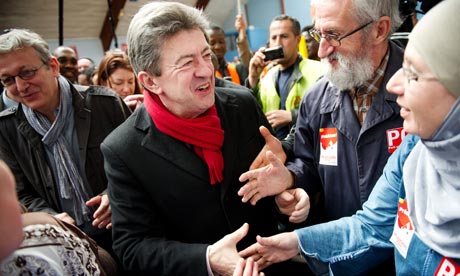
Jean-Luc Mélenchon.
By Dick Nichols
April 30, 2012 -- Links International Journal of Socialist Renewal/Green Left Weekly -- The results of April 22 first round of the presidential elections in France directed a powerful spotlight on a society polarised by economic crisis and the austerity regime of President Nicolas Sarkozy and his ruling Union for a Popular Movement (UMP) government.
As in the 2002 presidential poll, candidates to the left of the Socialist Party (SP), including Europe Ecology-The Greens (EELV), won more than 15% of the vote, while the xenophobic National Front (FN) of Marine Le Pen registered its highest vote ever—17.9% (up 7.5% from the 2007 presidential poll).
However, unlike the 2002 contest, this far-left vote did not come at the expense of the SP (which in 2002 was beaten into third place by the FN). This time the SP’s François Hollande took first place, with 28.6% of the vote (up 2.8% from 2007).
France: Front de Gauche's Jean-Luc Melenchon shakes up presidential poll
On March 18, the 141st anniversary of the Paris Commune, organisers were expecting 20,000 to 30,000 to show u
Britain: The space to the left of the Labour Party just got huge
By Socialist Resistance (Britain)
Pierre Bourdieu, a thinker of emancipation

Pierre Bourdieu.
By Dimitris Fasfalis
February 3, 2012 – Links International Journal of Socialist Renewal -- Ten years after his death, Pierre Bourdieu’s work and commitments are commemorated throughout the world by friends and foes alike. Le Monde, for instance, described him as a “classic thinker”: second-most quoted author of the academic world after Michel Foucault.
Academia thus recognises Bourdieu as a major sociologist of the 20th century whose concepts (habitus, fields, types of capital, symbolic violence) have become pillars of the social sciences. Few voices, however, have reclaimed Bourdieu’s radical legacy, while his work is of great interest for all those committed to emancipation.[1]
Europe: Old racist poison in new bottles

Marine Le Pen, daughter of the racist founder of the National Front in France, Jean Marie Le Pe
On the meaning of ‘popular front’

The Bolivarian movement led by Hugo Chávez contains bourgeois forces and has been th
Review: `The Muslim revolt: A journey through political Islam'

By
June 25, 2011 -- http://rupensavoulian.wordpress.com, posted at Links International Journal of Socialist Renewal with permission -- Since the September 11, 2001, twin tower attacks, there has been renewed interest in the questions of Islam, political Islamism and jihadism. Books have been published by the truckload, seminars bringing together various political scientists and experts have been held, reams of paper analysing the origins and trajectory of political Islam have been published, and the airwaves resonate with talkback from pundits about the impact of Islam and Islamism in the world. How can one make sense of all this? Where does one begin?
R. Palme Dutt's 'Fascism and social revolution'
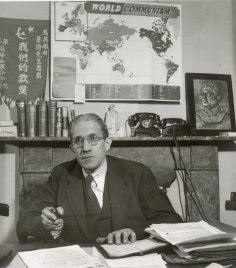
By Graham Milner
In the present situation in the world, with the intermittent resurgence of fascist and neo-fascist movements in some countries, an avowedly Marxist treatment of the subject of fascism, such as Palme Dutt's Fascism and Social Revolution, deserves the attention of new generations of readers.
Rajani Palme Dutt (1896-1974) was born in England of an Indian father and a Swedish mother.[1] He grew up in a political household, where socialism and Indian independence were familiar subjects of discussion. A brilliant scholar at Oxford University (he took a double first), Dutt was a conscientious objector during the World War I, and was expelled from university in 1917 for disseminating Marxist propaganda.