Ukraine and Putin’s Great Russian chauvinism against Lenin
First published at CADTM.
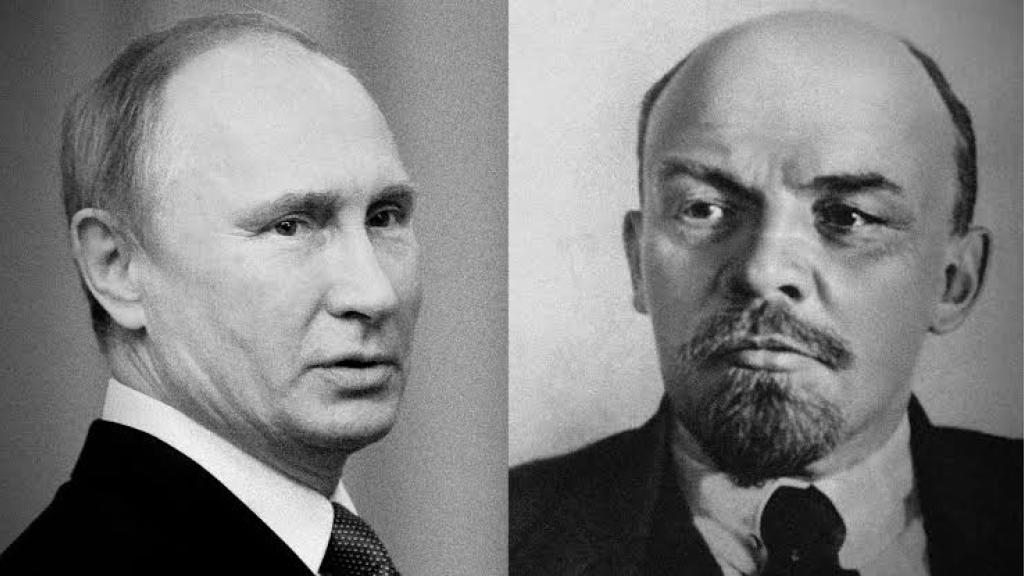
Why does Vladimir Putin accuse Lenin of having “created Ukraine”? Behind this statement lies far more than a mere dispute amongst historians: it expresses an imperial conception of Russia under Putin’s leadership and constitutes one of the ideological foundations of the war against Ukraine. To understand this statement, we must look back at the debate between Lenin and Stalin in 1922–1923 concerning the creation of the USSR and what Lenin termed ‘Great Russian chauvinism’.
Vladimir Putin denounces Lenin’s ‘crime’ against Russia at the time of the USSR’s creation. He claims that Lenin favoured Ukraine over the legitimate interests of the Russian people. He also condemns the Russian Revolution of 1917, accusing the Bolsheviks led by Lenin of staging a coup against Russia’s interests by bringing the war against Germany to an end. In reality, Putin considers that the Tsarist empire served Russia’s interests.
Vladimir Lenin’s (1870–1924) criticism of ‘Great Russian chauvinism’, expressed in numerous writings throughout his life, and his stance in favour of the right of peoples to self-determination are key factors in understanding the political structure of the Soviet Union and the contemporary debates surrounding its legacy.
In a text published in 1916, in the midst of the First World War, Lenin wrote
Victorious socialism must achieve complete democracy and, consequently, not only bring about the complete equality of nations, but also give effect to the right of oppressed nations to self-determination, i.e., the right to free political secession…
The right of nations to self-determination means only the right to independence in a political sense, the right to free, political secession from the oppressing nation…
In Russia — where no less than 57%, i.e., over 100,000,000 of the population, belong to oppressed nations, where those nations mainly inhabit the border provinces, where some of those nations are more cultured than the Great Russians, where the political system is distinguished by its particularly barbarous and medieval character, where the bourgeois-democratic revolution has not yet been completed — the recognition of the right of the nations oppressed by tsarism to free secession from Russia is absolutely obligatory for Social-Democracy in the interests of its democratic and socialist tasks.
From 1922 to 1923, during the discussions about the creation of the Union of Soviet Socialist Republics (USSR), Lenin was concerned about the persistence of behaviours inherited from the Russian Empire within the Soviet state apparatus. He used the term ‘Great Russian chauvinism’ to describe the tendency of Russian political elites to regard the other peoples of the former empire as naturally subordinate to Russia. In his view, this imperial mentality posed a major threat to a multinational socialist state, as it risked transforming the new Soviet state into a mere continuation of the empire in a different ideological guise.
These concerns were clearly evident during the debate on the structure of the future Soviet state. Joseph Stalin, then People’s Commissar for Nationalities, proposed a plan for ‘autonomisation’ under which non-Russian republics would be integrated into the Russian Soviet Federative Socialist Republic as autonomous units. Lenin opposed this proposal and instead advocated the creation of a formal federation of legally equal republics. Under this model, each republic would join the union voluntarily and retain, at least in theory, the right to withdraw from it.
The so-called ‘Georgian’ crisis of 1922 further radicalised Lenin’s position. Georgian Bolshevik leaders accused Stalin and other representatives of the central government of brutally imposing their country’s integration into a Transcaucasian federation. In his notes, dictated at the end of 1922, Lenin severely criticised the conduct of Stalin and his collaborators, arguing that their methods were precisely indicative of the Great Russian chauvinism which he considered particularly dangerous. In his view, nations that had been victims of Russian domination must be accorded special treatment in order to guarantee genuine equality between peoples (see the box on Lenin versus Stalin regarding the Georgian question).
Lenin’s approach explains the institutional logic adopted during the founding of the USSR in December 1922. The Soviet state was conceived as a union of national republics possessing their own state institutions and, under the constitutional texts, the right to secede. For Lenin, this arrangement was intended to provide guarantees to the peoples formerly dominated by the Russian Empire and to prevent the new socialist union from being perceived as a reconstituted Russian Empire.
A century later, this institutional architecture has become a central focus of Vladimir Putin’s criticism of the Leninist legacy. In several public addresses, particularly in the early 2020s, he asserted that the federal structure, based on national republics with the right to secession, constituted a ‘time bomb’ planted within the Soviet state. According to this interpretation, the Bolsheviks artificially created national entities with borders, state institutions and a constitutional right to secession, which contributed to the dissolution of the Soviet Union in 1991.
Putin versus Lenin: The rehabilitation of Great Russian chauvinism
Here is an extract from the speech delivered by Putin on the eve of the invasion of Ukraine in February 2022:
"Let me therefore begin by stating that modern Ukraine was entirely created by Russia, or more precisely, by Bolshevik and Communist Russia. The process began almost immediately after the 1917 revolution, and Lenin and his comrades-in-arms carried it out in a manner that was very brutal for Russia itself – through secession, by tearing away parts of Russia’s historic territories.”
Here is a second extract from the speech delivered on the eve of the invasion of Ukraine in February 2022, in which V. Putin affirms his support for Stalin’s position as opposed to that of Lenin and the majority of the Bolshevik leadership:
Allow me to remind you that after the October Revolution of 1917 and the civil war that followed, the Bolsheviks began to build a new state despite numerous disagreements amongst themselves. Stalin, who in 1922 held the dual roles of General Secretary of the Central Committee of the RCP(b) and People’s Commissar for Nationalities, proposed building the country on the principles of decentralisation, that is to say, granting the republics – the future administrative-territorial units – broad powers as and when they joined the unified state.
Lenin criticised this plan and proposed making concessions to the nationalists, as he called them at the time – the ‘independents’. It was Lenin’s ideas on an essentially confederal state structure and on the right of nations to self-determination, including secession, that formed the foundation of the Soviet state: first in 1922, they were enshrined in the Declaration on the U Union of Soviet Socialist Republics, and then, after Lenin’s death, in the 1924 Constitution of the USSR…
From the perspective of the historical destiny of Russia and its peoples, the Leninist principles of state-building were not merely a mistake; they were, as they say, far worse than a mistake. After the collapse of the USSR in 1991, this became perfectly clear...
In fact, as I have already said, Bolshevik policy led to the emergence of Soviet Ukraine, which, even today, can rightly be called ‘Vladimir Lenin’s Ukraine’. He was its creator and architect. This is fully confirmed by archival documents, including Lenin’s strict directives on the Donbas, which was literally embedded within Ukraine.1
Putin’s critique is rooted in a historical vision that runs counter to Lenin’s. It is based on the idea of historical continuity between the Russian Empire, the Soviet Union and the contemporary Russian Federation, as well as on the concept of a shared civilisational space encompassing several peoples descended from the former empire.
Putin develops a historical vision according to which Russians, Ukrainians and Belarusians form a single historical people descended from mediaeval Russia. The main argument centres on a ‘triune Russian nation’ comprising Russians (Great Russians), Ukrainians (Little Russians) and Belarusians (White Russians). This is the position that Putin sets out in a lengthy article published on the Kremlin’s website in July 2021.
From this perspective, the organisation of the USSR into national republics is seen as a political error, or even a crime, that undermined the unity of a historical space regarded as fundamentally integrated.
This divergence highlights a striking contrast between two conceptions of the national question in the post-imperial Russian sphere. Lenin sought to prevent the political domination of the historically dominant nation by establishing a theoretically voluntary federation and recognising the people’s right to self-determination. By contrast, the contemporary criticism of this legacy by Putin and his supporters emphasises the need to preserve the political unity of a shared historical space and tends to call into question the right to national secession.
Thus, the current debate surrounding the structure of the USSR and its legacy can be interpreted as a revival, in a new form, of the problem that Lenin had already identified in the early 1920s: the tension between building a multinational state based on the formal equality of peoples and the temptation to reconstitute a form of centralisation inherited from the former empire.
For Lenin, the creation of national republics and the right to secession were means of avoiding Russian domination and of building a voluntary union of the peoples of the former empire.
For Putin, by contrast, these decisions are presented as a historical crime committed against the Russian people, one which weakened the Russian state and led to the fragmentation of the Soviet space after 1991.
Thus, when Putin speaks of ‘Lenin’s Ukraine’, it is not merely a historical observation: it is a direct criticism of the Soviet federal model based on national self-determination, which Lenin had specifically designed to combat ‘Great Russian chauvinism’.
Conclusion
Ultimately, the conflict between Lenin and Stalin over the national question is not merely a matter of Soviet history. It sheds direct light on the ideology underpinning Vladimir Putin’s policies. Whereas Lenin saw ‘Great Russian chauvinism’ as a mortal danger to equality among the peoples of the former Tsarist empire, Putin, on the contrary, claims the historical continuity of that empire and condemns the right of nations to self-determination. His attack on ‘Lenin’s Ukraine’ is therefore not merely a historical critique: it constitutes an ideological justification for denying the political existence of the Ukrainian nation and, in the final analysis, for the war being waged against it.
Recognising the right of peoples to self-determination does not mean endorsing all the policies pursued by their governments. It means, amongst other things, refusing to accept that a state can deny the existence of a neighbouring nation in the name of so-called historical or imperial continuity.
Lenin versus Stalin on the Georgian question
Regarding nationalities, Lenin considered that the Tsarist empire had forcibly ‘integrated’ a whole series of oppressed nationalities.2 Without going into detail on this point, it should be noted that Lenin emphasised the need to guarantee equal rights for oppressed nations, such as the Ukrainians, Georgians, Tajiks, Uzbeks, Turkmen, Armenians and others. He added that the Soviet government must take strong measures to ensure that oppressed nations could ‘rise’ to the same level as the traditionally dominant Russian nation. He considered it essential that the various oppressed nations be able to develop their own culture and communicate in their own language with the central authority in Moscow. In this context, Lenin asserted the establishment of a federation of Soviet republics instead of a single multinational republic.
Joseph Stalin was responsible for the national question within the party and the state. Lenin clashed with him over the Georgian question. Stalin had come into conflict with the Georgian Bolshevik leadership, which was demanding relative autonomy in order to implement communist policy in Georgia. Stalin, himself a Georgian, sent one of his ‘representatives’, Ordzhonikidze, to bring the Georgian leadership in line. The methods employed were particularly brutal, as Ordjonikidze went so far as to strike a Georgian Communist leader during a leadership meeting. When Lenin learnt of this, he sent a letter to the Georgian Communist leadership in which he expressed his full solidarity with them and decided to look into the matter thoroughly. He drafted a text that was a veritable denunciation of Stalin’s methods, whom he described as a ‘Great Russian chauvinist’.
On 30 and 31 December 1922, Lenin dictated several very important notes, from which the following are some extracts:
I think that Stalin’s haste and his infatuation with pure administration, together with his spite against the notorious “nationalist-socialism” [Stalin criticised the minority nations for not being “internationalist because they did want to unite with Russia], played a fatal role here. In politics spite generally plays the basest of roles…
A distinction must necessarily be made between the nationalism of an oppressor nation and that of an oppressed nation, the nationalism of a big nation and that of a small nation. In respect of the second kind of nationalism we, nationals of a big nation, have nearly always been guilty, in historic practice, of an infinite number of cases of violence; furthermore, we commit violence and insult an infinite number of times without noticing it. It is sufficient to recall my Volga reminiscences of how non-Russians are treated; how the Poles are not called by any other name than Polyachiska, how the Tatar is nicknamed Prince, how the Ukrainians are always Khokhols and the Georgians and other Caucasian nationals always Kapkasians…
That is why internationalism on the part of oppressors or “great” nations, as they are called (though they are great only in their violence, only great as bullies), must consist not only in the observance of the formal equality of nations but even in an inequality of the oppressor nation, the great nation, that must make up for the inequality which obtains in actual practice…
The Georgian [Stalin -ed.] who is neglectful of this aspect of the question, or who carelessly flings about accusations of “nationalist-socialism” (whereas he himself is a real and true “nationalist-socialist”, and even a vulgar Great-Russian bully), violates, in substance, the interests of proletarian class solidarity, for nothing holds up the development and strengthening of proletarian class solidarity so much as national injustice; “offended” nationals are not sensitive to anything so much as to the feeling of equality and the violation of this equality, if only through negligence or jest- to the violation of that equality by their proletarian comrades…
The political responsibility for all this truly Great-Russian nationalist campaign must, of course, be laid on Stalin and Dzerzhinsky. 3
- 1
Vladimir Putin, “Address by the President of the Russian Federation”, Kremlin, Moscow, 21 February 2022.
- 2
This is an extract from Éric Toussaint, Lenin and Trotsky confronting the bureaucracy – Russian revolution and transitional societies, published in French in the journal Lutte de Classe, edited by the Léon Lesoil Foundation in Belgium. Issue No. 2, dated February 1990.
- 3
Lenin, The Question of Nationalities or “Autonomisation”, 1922, Lenin: Collected Works (edition in French) Volume 36, pp. 619 - 622, Moscow Edition.