Trump’s new National Security Strategy outlines US imperialism’s policy for a multi-polar world
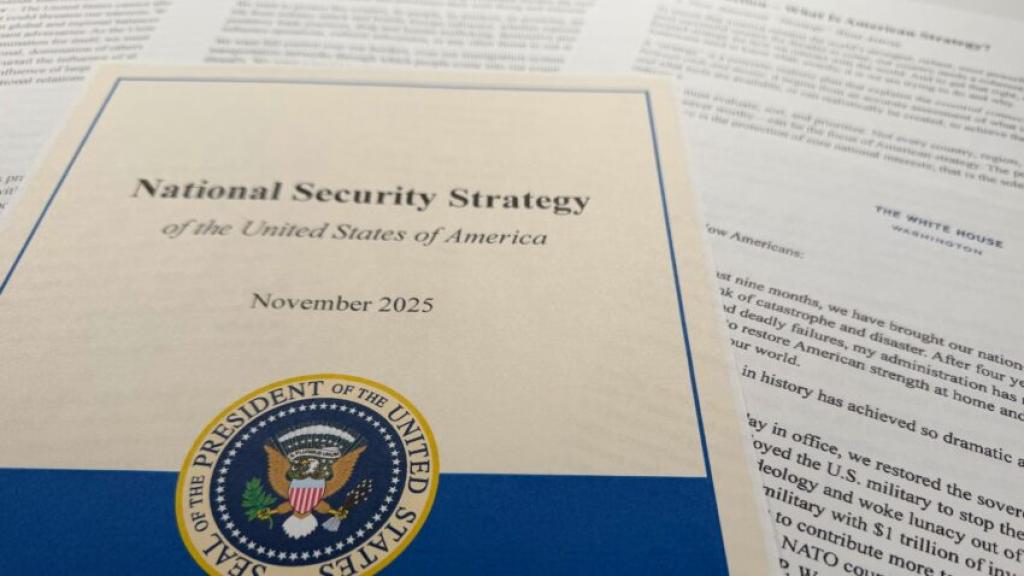
The Trump administration’s new National Security Strategy (NSS) is a crucial document for understanding the current state of US imperialism.1
In a previous article about a draft of this document, I noted it represents “a dramatic reversal in the foreign policy of U.S. imperialism” as it “marks the end of its attempts to defend its status the global hegemonic power.”2 The now published official version confirms this assessment.
The new National Security Strategy recognises that the US can no longer play the role of global hegemon:
After the end of the Cold War, American foreign policy elites convinced themselves that permanent American domination of the entire world was in the best interests of our country. Yet the affairs of other countries are our concern only if their activities directly threaten our interests. Our elites badly miscalculated America’s willingness to shoulder forever global burdens to which the American people saw no connection to the national interest. They overestimated America’s ability to fund, simultaneously, a massive welfare-regulatory-administrative state alongside a massive military, diplomatic, intelligence, and foreign aid complex.
A few pages later, the document repeats: “The days of the United States propping up the entire world order like Atlas are over.”
A longer, unpublished version of the NSS is even more explicit. It discusses the “failure” of US hegemony and states: “Hegemony is the wrong thing to want and it wasn’t achievable.”3
Focus on the homeland and the Western Hemisphere
Instead, the official document states Washington must focus on what it calls “America’s core foreign policy interests.“ Among the first “core interests” are the homeland and the Western Hemisphere — the focus of a strategy it calls “a ‘Trump Corollary’ to the Monroe Doctrine”.
After years of neglect, the United States will reassert and enforce the Monroe Doctrine to restore American preeminence in the Western Hemisphere, and to protect our homeland and our access to key geographies throughout the region. We will deny non-Hemispheric competitors the ability to position forces or other threatening capabilities, or to own or control strategically vital assets, in our Hemisphere…
We want to ensure that the Western Hemisphere remains reasonably stable and well-governed enough to prevent and discourage mass migration to the United States; we want a Hemisphere whose governments cooperate with us against narco-terrorists, cartels, and other transnational criminal organizations; we want a Hemisphere that remains free of hostile foreign incursion or ownership of key assets, and that supports critical supply chains; and we want to ensure our continued access to key strategic locations. In other words, we will assert and enforce a “Trump Corollary” to the Monroe Doctrine.
In other words, Washington wants to fully dominate North and South America and keep its imperialist rivals — most importantly China — out of the region. Trump’s military threats against Venezuela, but also Colombia and Mexico, are part of this strategy that aims to replace governments in the “Western Hemisphere” with loyal lackeys.4
Deterrence against and détente with China and Russia
While the US finally recognises it can no longer dominate the world, it is determined to stop China replacing it. As I have previously explained, China has emerged as a key imperialist power.5 In the past decade it has come to occupy first place in global trade and manufacturing and second in the top global corporations and billionaires. It is also second in military spending (only behind the US) and third among the nuclear powers (behind the US and Russia).6
Consequently, the NSS argues for a continuation of Washington’s current policy of containment of China via tariff wars, export control and military deterrence:
Going forward, we will rebalance America’s economic relationship with China, prioritizing reciprocity and fairness to restore American economic independence. Trade with China should be balanced and focused on non-sensitive factors… Importantly, this must be accompanied by a robust and ongoing focus on deterrence to prevent war in the Indo-Pacific…
A related security challenge is the potential for any competitor to control the South China Sea. This could allow a potentially hostile power to impose a toll system over one of the world’s most vital lanes of commerce or—worse—to close and reopen it at will. Either of those two outcomes would be harmful to the U.S. economy and broader U.S. interests.
However, remarkably the document uses less threatening militaristic language compared with past issues of this document (the NSS is published every four years at the start of the president's term of office). While the Trump administration wants to contain China, it does not seek a military conflict in the coming period. The reason for this is, of course, not any pacifist motivation but rather a recognition of Washington’s decline and its inability to defeat China in the foreseeable future.
Hence, the Trump administration wants to create a kind of détente with Beijing and, even more, with Russia. According to the longer version of the NSS document, Washington proposes to create a “Core 5” group made up of the US, China, Russia, India and Japan. (Note that this Core 5 does not include a single European power.) This body would meet regularly for summits with specific themes.
Trump’s consistent efforts to end the Ukraine War are part of this strategy of détente with Russia. His attempts to push Ukraine towards capitulation and acceptance of huge territorial losses (even of regions that the Russian army has not conquered) are driven by the desire to strike a deal with Russian President Vladimir Putin to exploit Ukraine’s raw materials and open business with Russian monopolies.7
Correspondingly, Washington wants European powers to end their “Cold War” with Russia. The document accuses its allies of “lack of self-confidence … in Europe’s relationship with Russia” and urges them to “reestablish strategic stability with Russia”.
According to the Wall Street Journal, the Trump administration wants Europe to accept such a détente with Russia. It is pushing Brussels to agree to “plans for U.S. financial firms and other businesses to tap roughly $200 billion of frozen Russian assets for projects in Ukraine.” Furthermore, Washington wants to bring “Russia’s economy in from the cold, with U.S. companies investing in strategic sectors from rare-earth extraction to drilling for oil in the Arctic, and helping to restore Russian energy flows to Western Europe and the rest of the world.”8
Unsurprisingly, European officials are not amused by such plans. The WSJ reports:
… one official compared them to President Trump’s vision of building a Riviera-style development in Gaza. Another, referring to the proposed U.S.-Russia energy deals, said it was an economic version of the 1945 conference where World War II victors divvied up Europe. ‘It’s like Yalta,’ he said.
Destroying the EU and transforming European states into US vassals
Another goal of Trump’s NSS is to destroy the European Union and install pro-US governments in European states. This goal is wrapped in right-wing chauvinist rhetoric about “dangers” of migration and defence of “sovereign nations” against “transnational institutions”.
In countries throughout the world, mass migration has strained domestic resources, increased violence and other crime, weakened social cohesion, distorted labor markets, and undermined national security. The era of mass migration must end…
But this economic decline is eclipsed by the real and more stark prospect of civilizational erasure. The larger issues facing Europe include activities of the European Union and other transnational bodies that undermine political liberty and sovereignty, migration policies that are transforming the continent and creating strife, censorship of free speech and suppression of political opposition, cratering birthrates, and loss of national identities and self-confidence.
The document also states:
We will oppose elite-driven, anti-democratic restrictions on core liberties in Europe, the Anglosphere, and the rest of the democratic world, especially among our allies.
Needless to say that this is a particularly cynical statement coming from an administration that imprisons thousands without trial, persecutes anti-fascist groups, terrorises large sectors of the population with heavily armed ICE squads, and sends the National Guard to the streets of Los Angeles, Washington DC, and other cities. It is also remarkable that the Trump administration laments “anti-democratic restrictions on core liberties” among its allies, but not in Russia and China.
Such anti-EU rhetoric has been a consistent element of Trump’s foreign policy in the past 12 months.9 To many observers it seems absurd that Washington is turning with such vehemence against Europe. But there is a rationale behind this shift that breaks with transatlanticism.
As a declining imperialist power, the US is no longer able to carry the costs of the financial and military obligations resulting from such an alliance. As a result, it wants to refocus on dominating the Western Hemisphere and weaken Europe, forcing it to subordinate itself to Washington.
Hence, Washington wants to destroy the EU, leaving the continents’ nation states to deal with the US individually; that is, from a weaker bargaining position. To achieve this goal, it wants to support right-wing parties on the continent that share its chauvinist outlook, oppose the EU and support Trump:
American diplomacy should continue to stand up for genuine democracy, freedom of expression, and unapologetic celebrations of European nations’ individual character and history. America encourages its political allies in Europe to promote this revival of spirit, and the growing influence of patriotic European parties indeed gives cause for great optimism.
Realistically, the US can not expect to transform all European states into vassals, but it hopes to succeed in this with at least several countries. The unpublished longer version lists Austria, Hungary, Italy and Poland as countries the US should “work more with … with the goal of pulling them away from the [European Union].” It concludes:
And we should support parties, movements, and intellectual and cultural figures who seek sovereignty and preservation/restoration of traditional European ways of life … while remaining pro-American.
Retreat from the Middle East and the Abraham Accords
As part of the US’s general retreat, Trump’s NSS also states that Washington will reduce its military engagement in the Middle East:
Conflict remains the Middle East’s most troublesome dynamic, but there is today less to this problem than headlines might lead one to believe… But the days in which the Middle East dominated American foreign policy in both long-term planning and day-to-day execution are thankfully over — not because the Middle East no longer matters, but because it is no longer the constant irritant, and potential source of imminent catastrophe, that it once was. It is rather emerging as a place of partnership, friendship, and investment — a trend that should be welcomed and encouraged. In fact, President Trump’s ability to unite the Arab world at Sharm el-Sheikh in pursuit of peace and normalization will allow the United States to finally prioritize American interests…
America will always have core interests in ensuring that Gulf energy supplies do not fall into the hands of an outright enemy, that the Strait of Hormuz remain open, that the Red Sea remain navigable, that the region not be an incubator or exporter of terror against American interests or the American homeland, and that Israel remain secure. We can and must address this threat ideologically and militarily without decades of fruitless “nation-building” wars. We also have a clear interest in expanding the Abraham Accords to more nations in the region and to other countries in the Muslim world.
Washington hopes to stabilise the Middle East by keeping Israel as the strongest regional power while expanding the “normalisation” process between Israel and Arab states, reinforcing this by deepening US business relations with the Gulf monarchies. This would be sufficient to keep the Middle East under control without forcing the US to engage in “forever wars”:
We want to prevent an adversarial power from dominating the Middle East, its oil and gas supplies, and the chokepoints through which they pass while avoiding the “forever wars” that bogged us down in that region at great cost.
Such a concept, however, is totally delusional. The Middle East is a region prone with explosive national and social contradictions. The genocide against the Palestinian people and the expansionist nature of the Zionist settler state, the tyrannical nature of the Arab regimes, tensions between Israel, Türkiye, Iran and Saudi Arabia — all this guarantees that the next years will continue to see wars and popular uprisings.10
The illusion of peace through business in a multipolar world
In summary, Trump’s new NSS represents a dramatic shift in US imperialism’s foreign policy. Under the previous administrations of Barack Obama and Joe Biden, Washington tried to keep its hegemonic position. The Trump administration is no longer attempting this. As I noted in my article about the draft version of the document:
In short, the policy of the Trump Administration is characterised by a retreat from its main adversaries — China and Russia — and an attempt to plunder and dominate the weaker allies in the Western Hemisphere. The declining former hegemon sets itself more realistic goals.
The Trump administration claims that it can create a peaceful world by retreating, enforcing ceasefires in several places, and creating a détente with China and Russia. Such a détente would create the conditions for expanding trade, investments and economic growth.
However, this is a complete illusion. We are living in a period of economic stagnation and crisis. Every few weeks or months, another armed conflict erupts. Just think about the past six months: India-Pakistan, Pakistan-Afghanistan, Thailand-Cambodia, Israel-Iran, Gaza War, civil wars in Sudan, DR Congo, Burma/Myanmar, etc.
Add to this that tensions between imperialist powers are rising and global armament has reached new record levels. The renowned institute SIPRI institute reports in its latest yearbook:
Estimated global military expenditure rose for the 10th consecutive year in 2024, to reach $2.7 trillion, driven by the Russia–Ukraine war and other armed conflicts and geopolitical tensions. The 9.4 per cent increase in total military spending in 2024 pushed estimated world spending to the highest level recorded by SIPRI.11
Trump believes he deserves the Nobel Peace Price, which is not surprising since he is also his biggest cheerleader and modestly considers himself as a “very stable genius”. In the real world, tensions between global and regional powers are inevitably rising, as the capitalist crisis destabilises the world economy, the climate, living conditions and political relations between states. All the global armament and regional tensions are harbingers of major wars in the future — regionally and globally.
The end of a debate
Washington’s new foreign policy doctrine closes a debate that began one-and-a-half decades ago with the onset of the new historic period in 2008/09. Since then, we have argued that China (and Russia) have become new imperialist powers, effectively ending the US’s position as absolute hegemon. Consequently, rivalry between these two Great Powers has been the most important element in global political relations.
In this period, I have engaged in numerous debates and polemics with left-wing organisations and intellectuals who denied this reality. Some claim China and Russia represent socialist or “objectively anti-imperialist” states, which should be supported in conflicts with the US.12 Others recognise the capitalist nature of these states, but say they are not imperialist powers as they are either too weak to challenge the US or effectively cooperate with Washington.13
Such theories are often combined with the idea that inter-imperialist contradictions between the US and Europe no longer exist, as the latter is simply part of the “US-led Empire”.14 Many of these “socialists” have adopted Putin’s and Xi’s propaganda and advocate a “multi-polar” world order, claiming this will result in global peace.15
Trump’s new NSS is an official confirmation of our theses. Now, even the White House admits it is no longer dominating the world. It is evident for everyone that China and Russia were able to force the US to retreat. And it is equally obvious that the US and Europe do not constitute a joint Empire led by Washington but are rather rivalling imperialist powers.
Finally, one does not need to be an Einstein to see that the “multi-polar” world is not at all peaceful but instead prone to tensions and conflicts between states. In the end, reality has ended the debate.
Michael Pröbsting is a socialist activist and writer. He is the editor of the website http://www.thecommunists.net/, where a version of this article first appeared.
- 1
The White House: National Security Strategy of the United States of America, November 2025. All quotes are from this document if not indicated otherwise.
- 2
Michael Pröbsting: A Major Shift in Washington’s Foreign Policy Doctrine. The draft of the Pentagon’s newest National Defense Strategy reflects the dramatic decline of U.S. imperialism, 10 September 2025, https://www.thecommunists.net/worldwide/global/a-major-shift-in-washington-s-foreign-policy-doctrine/; see also by the same author: A Kind of Official Confirmation. U.S. Secretary of State Marco Rubio admits the end of U.S. hegemony and the beginning of the multipolar world order, 3 February 2025, https://www.thecommunists.net/worldwide/global/u-s-secretary-of-state-rubio-admits-end-of-u-s-hegemony/
- 3
Quoted in: Meghann Myers: ‘Make Europe Great Again’ and more from a longer version of the National Security Strategy, 9 December 2025, https://www.defenseone.com/policy/2025/12/make-europe-great-again-and-more-longer-version-national-security-strategy/410038/
- 4
Michael Pröbsting: Trump’s Looming War against Venezuela. What is behind Washington’s military threats and which position should Marxists take in this conflict? 6 November 2025, https://www.thecommunists.net/worldwide/latin-america/trump-s-looming-war-against-venezuela/
- 5
See: Chinese Imperialism and the World Economy, an essay published in the second edition of “The Palgrave Encyclopedia of Imperialism and Anti-Imperialism” (edited by Immanuel Ness and Zak Cope), Palgrave Macmillan, Cham, 2020, https://link.springer.com/referenceworkentry/10.1007%2F978-3-319-91206-6_179-1; China: On the Relationship between the “Communist” Party and the Capitalists. Notes on the specific class character of China’s ruling bureaucracy and its transformation in the past decades, https://links.org.au/specific-class-character-chinas-ruling-bureaucracy-and-its-transformation-past-decades; China: On Stalinism, Capitalist Restoration and the Marxist State Theory. Notes on the transformation of social property relations under one and the same party regime, https://links.org.au/transformation-social-property-relations-under-chinas-party-state-regime; China‘s transformation into an imperialist power. A study of the economic, political and military aspects of China as a Great Power (2012), in: Revolutionary Communism No. 4, https://www.thecommunists.net/publications/revcom-1-10/#anker_4
- 6
See: Michael Pröbsting: Anti-Imperialism in the Age of Great Power Rivalry. The Factors behind the Accelerating Rivalry between the U.S., China, Russia, EU and Japan. A Critique of the Left’s Analysis and an Outline of the Marxist Perspective, RCIT Books, Vienna 2019, https://www.thecommunists.net/theory/anti-imperialism-in-the-age-of-great-power-rivalry/; The Great Robbery of the South. Continuity and Changes in the Super-Exploitation of the Semi-Colonial World by Monopoly Capital Consequences for the Marxist Theory of Imperialism, RCIT Books, 2013, https://www.thecommunists.net/theory/great-robbery-of-the-south/
- 7
See RCIT: Trump’s “Peace”-Plan Favours Russian Imperialism and Sells Out Ukraine, 21 November 2025, https://www.thecommunists.net/worldwide/global/trump-s-peace-plan-favours-russian-imperialism-and-sells-out-ukraine/
- 8
Joe Parkinson, Benoit Faucon and Drew Hinshaw: U.S. Blueprint to Rewire Economies of Russia, Ukraine Sets Off Clash With Europe, 10 December 2025, Wall Street Journal, https://www.wsj.com/world/europe/u-s-blueprint-to-rewire-economies-of-russia-ukraine-sets-off-clash-with-europe-72484515
- 9
See Michael Pröbsting: Trump-Putin Rapprochement Signals End of “Trans-Atlantic Partnership”. On the decline of U.S. (ex-)hegemon, the deep crisis of European imperialism and consequences for socialist tactics, 21 February 2025, https://www.thecommunists.net/worldwide/global/trump-putin-rapprochement-signals-end-of-trans-atlantic-partnership/
- 10
See RCIT: Gaza Deal: A new Stage of the Liberation Struggle with Dangers and Opportunities. No disarmament of the resistance! Gaza must not become an American–Zionist protectorate! Advance the Arab Revolution! Continue and intensify the global boycott of Israel! 10.10.2025, https://www.thecommunists.net/worldwide/africa-and-middle-east/gaza-deal-a-new-stage-of-the-liberation-struggle-with-dangers-and-opportunities/; see also Yossi Schwartz, The Zionist Wars. A History of the Zionist Movement and Imperialist Wars, 1 February 2021, https://www.thecommunists.net/theory/the-zionist-wars/; Michael Pröbsting: War and Revolution in the Middle East. The transformation of the Zionist War on Gaza into an Israeli-American war against Arab peoples brings the region as well as the world closer to revolutionary explosions, 1 February 2024, https://www.thecommunists.net/worldwide/africa-and-middle-east/war-and-revolution-in-the-middle-east/
- 11
SIPRI: Armaments, Disarmament and International Security, SIPRI, 2025, Summary, p. 4
- 12
See Michael Pröbsting: One Should Not Camouflage Capitalist and Imperialist China as “Socialist”. A Reply to Immanuel Ness and John Bellamy Foster, https://links.org.au/one-should-not-camouflage-capitalist-and-imperialist-china-socialist-reply-immanuel-ness-and-john
- 13
See Michael Pröbsting: China: An Imperialist Power … Or Not Yet? A Theoretical Question with Very Practical Consequences! Continuing the Debate with Esteban Mercatante and the PTS/FT on China’s class character and consequences for the revolutionary strategy, 22 January 2022, https://www.thecommunists.net/theory/china-imperialist-power-or-not-yet/
- 14
See Michael Pröbsting: Age of ‘Empire’ or age of imperialism? (3rd Reply to Claudion Katz), https://links.org.au/age-empire-or-age-imperialism
- 15
See Michael Pröbsting: “Multi-Polar World Order” = Multi-Imperialism. A Marxist Critique of a concept advocated by Putin, Xi, Stalinism and the “Progressive International” (Lula, Sanders, Varoufakis), 24 February 2023, https://www.thecommunists.net/worldwide/global/multi-polar-world-order-is-multi-imperialism/