Defining Trumpism, defeating Trump
“Defining Trumpism, defeating Trump” is based on talks given by Paul Le Blanc in Potsdam, Hamburg, Frankfurt and Mannheim, during a May speaking tour in Germany. It is appearing simultaneously on LINKS and Communis.
I will begin this presentation with a brief overview of the global context. I will then offer some comments about the Donald Trump phenomenon and what I call “Trumpism.” I will also briefly touch on the debate of whether we are dealing here with fascism. Finally, I will conclude with comments on the upsurge against Trump and Trumpism, some strengths and limitations of this resistance, and what the future may bring.
Three snapshots of the overall context
But first, let me sketch out three snapshots of the overall context.
1. We are in a period of transition
Just as three decades ago we transitioned from the Cold War era to the age of globalization, we have now entered an age of crisis, chaos and unraveling. The structure and dynamics of the global economy generate deepening inequalities, instabilities and destructiveness, which throw into question the future of human civilization.
This has been accompanied by a sharp tilt to the right by a significant section of the ruling class but also within the larger population, even if this is fiercely resisted by many others. Trump’s right-wing extremism is only one manifestation of a larger, deeper trend. The eroding quality of life for more and more of the world’s laboring majorities is being matched by growing authoritarianism, irrationality and imperialist violence.
Most serious of all, however, is the imminent threat to humanity’s survival: a voracious market economy designed to further enrich incredibly wealthy elites is intimately connected with the immense environmental destruction engulfing our world with cascading floods, wildfires, pollution, climate change, and more.
2. There has been a deep erosion and partial collapse of the organized labor movement
The workers movement in the United States persists, in large measure, as a bureaucratic and largely ineffectual shell of what it once was. Related to this is a generalized disintegration and melting away of the traditional organized left. This amounts to a dramatic erosion of the organized source of practical political perspectives, accumulations of experience, and seasoned cadres and organizers.
In the late 20th century, the two major currents on the left were essentially reformist, entangled in the liberal capitalist Democratic Party. One was the social-democratic milieu, at the core of which was the Socialist Party of America. The other was the Stalinist and post-Stalinist milieu, at the core of which was the Communist Party USA. In addition, there was an array of independent Marxists, left-wing pacifists, Trotskyists and would-be Trotskyists, a temporary groundswell of Maoists, and successive waves of a very broad, vibrantly active “New Left.”
This multi-faceted array was given a coherence and weight largely because of its complex interrelationship with the larger working-class movement. With the transition from the Cold War to globalization, with the fading and erosion of the left-wing subculture, and with the aging and falling away of cadres and organizers, traditional left organizations failed to renew and replenish themselves adequately, continuing to exist only as fragmentary remnants.
3. The present age of crisis, chaos and unraveling has had a radicalizing impact on new layers of young people who are essentially part of a precarious but expanding working class
This was reflected in the Occupy Wall Street insurgency, the Black Lives Matter insurgency, a multi-faceted women’s liberation insurgency, and in new manifestations of union organizing and strike actions. It has also been reflected in the Bernie Sanders campaigns and other substantial electoral efforts to bring socialism into mainstream US politics, generally within the context of the Democratic Party.
It has furthermore been reflected in the substantial growth of Democratic Socialists of America (DSA), with a paper membership now of 100,000. Although influenced by social-democratic reformism, DSA has been a magnet for a variety of radical currents.
Trump and Trumpism
Every day a cascade of news headlines tells us of new and often mismanaged developments related to the Trump regime: horrific, but often blundering, policies of imperialist expansion and overreach, from Gaza, Venezuela and the Iran fiasco, to threats against Cuba, Greenland and even Canada; intensification of vicious (but seemingly unsustainable) anti-immigrant repression; growing scandals related to the mishandled files of the late sex offender Jeffery Epstein, whom Trump — himself long embroiled in sex scandals — befriended for years; and economic policies that benefit billionaires but have devastating consequences for most Americans.
I want to focus not on the headlines, but on the underlying ideology and social forces behind the Trump regime, and explore our growing anti-Trump resistance.
Before examining the ideology sometimes labeled as Trumpism, let us pause to consider the mediocrity with whose name this “ism” is identified. Trump’s qualities certainly include arrogance and bigotry, and he is notorious for being a fundamentally dishonest person, with an inclination to be a bully and a braggart. He is a self-promoting “go-getter” who compulsively highlights his achievements but also claims to have gone further and gotten more than is the case. An ignorant man who glorifies his ignorance (with the aggressive assertion “I don’t read books!”), he claims to know far more than he does. He takes credit for accomplishments that are not his.
His billionaire status has added luster, resources and authority to the narcissistic self-construction of the person that is Trump. He is quintessentially, and very proudly, a capitalist. Some critics insist Trump is a fascist. Others question whether he is consistent and coherent enough to be even comparable to a Benito Mussolini or an Adolf Hitler. But Trumpism transcends the dysfunctionality, corruption and desperate but dangerous flailing about of this ageing individual and his regime. Several essential elements help define Trumpism.
One element is armed and dangerous; namely, the forces that came together to storm the Capitol on January 6, 2021, which included the Proud Boys, the Oath Keepers, militant components of the Tea Party movement, latter-day partisans of the old Southern Confederacy, and various Nazi and white supremacist groups. These once-marginalized elements have come into the political mainstream and grown substantially, with the active encouragement of Trump and others around him. But this cunning, avaricious, profoundly limited individual and his acolytes were hardly capable of controlling them. Indeed, as a whole, the huge and diverse MAGA movement cannot be understood as being under his control.
Blended into segments of this pro-Trump constituency is something called “Christian nationalism,” which rejects the ideals of radical democracy enshrined in the Declaration of Independence. Instead, it asserts that the US was founded by Christians who wanted to build a nation on the foundation of God’s will, as defined by right-wing fundamentalists who see the notion of equal-rights democracy as a heresy incompatible with Christianity.
Another essential element of Trumpism can be found in a quite different cluster of conservative entities and individuals drawn together in The Heritage Foundation’s Project 2025. Founded in the 1970s, the Heritage Foundation has served as a center for conservative academics, intellectuals and policymakers since the Reagan presidency.
Its most recent big effort was a 900-page, Mandate for Leadership: The Conservative Promise, which is meant to serve as a policy-making guide for the second Trump administration. According to its self-description:
This book is the product of more than 400 scholars and policy experts from across the conservative movement and around the country. Contributors include former elected officials, world-renowned economists, and veterans from four presidential Administrations.
The bottom line of this conservative manifesto is a defense of unrestrained capitalism. The US president’s primary goal , we are told, should be to unleash “the dynamic genius of free enterprise.” This vision of capitalism dovetails with proposals to impose a centralized authoritarian regime that can enforce a wide range of right-wing policies.
Another essential element in Trumpism has been the Republican Party. Leading party figures and staffers, much like the conservative mainstream as a whole, did not start out as Trump supporters. Yet, as explained by Tim Miller, one knowledgeable ex-Republican operative, to win elections he and others like him “advanced arguments that none of us believed” and “made people feel aggrieved about issues we had no intent or ability to solve.”1
Miller confessed that a quiet and unacknowledged racism was often employed:
These tactics became not just unchecked but supercharged by a right-wing media ecosystem that we were in bed with and that had its own nefarious incentives, sucking in clicks and views through rage hustling without any intention of delivering something that might bring value to ordinary people’s lives.
Another ex-Republican operative, Stuart Stevens, insisted Trump “is the logical conclusion of what the Republican Party became over the last fifty years or so,”2 a natural product of the seeds of racism, self-deception and anger that became the party’s essence.
Regardless of what happens to Trump, the larger phenomenon of Trumpism will be with us for some time. Trump is not the disease, he is the symptom of a malaise that has been prevalent within the US for many years.
This is a global phenomenon involving powerful movements — and sometimes governments — in various countries: Argentina, Brazil, France, Germany, Greece, Hungary, India, Italy, Norway, Russia, Turkey, the US, and more. A combination of terms is used to describe what is happening: right-wing populism, authoritarian xenophobic ultra-nationalism, etc. All seek to capture its complex content.
Sometimes the word “fascism” is applied, but we are dealing with something that is not yet a fascist regime. There is room to protest and organize against what Trump represents. There are broad forces, not just on the left, in opposition to him. Democratic Party liberals and centrists have helped organize recent protests. They see Trumpism as a threat to stability and any kind of coherent, durable system. Those of us on the left need to work with some of these forces where there is agreement. But, at a certain point, we need to go beyond what some of these people represent, because they are part of the problem. They helped to bring Trump into being through their own limitations and inadequacies.
Looking beyond Trump
To be effective in resisting Trumpism, we must understand it. But to do that adequately, we must look beyond Trumpism. From Democratic Party liberals and centrists to moderately conservative Republicans, the old political establishment has been discredited over the past several decades: facing problems, dealing with problems, failing to deal with problems, unable to deal with problems that are hurting and scaring large numbers of people. The American Dream that a majority felt they could finally start enjoying has been disrupted and seems to be fading.
Democrats and the old-line Republicans have been unable to face this. They have lied about it, saying, “Oh no, everything’s fine.” But people knew everything was not fine, and this fueled a radicalization within the US population, the US working class and the electorate. Another aspect of working-class experience is that the labor movement and trade unions tied in with the Democratic Party proved increasingly unable to help workers. Unions were progressively eliminated as a key force on the US economic and political scene.
People who are hurting and increasingly finding their lives disrupted are looking for solutions. The solutions offered by the Democratic Party and the old version of the Republican Party do not work anymore. Trump presented a new way of seeing things that was not part of the US political mainstream. He made all kinds of inflated promises while attacking and scapegoating people of color and immigrants, saying that they are the problem. Trump was projected as the kind of man who was going to “solve” the problem.
A large segment of the American people — though not a majority — have been drawn to that outlook. A segment of the US ruling class (not all of it ) has also concluded that Trump’s authoritarian policies can help maintain a certain stability. Instability is threatening their profits and system, so they are prepared to embrace his policies.
Such a situation did not exist during the Vietnam War period of the 1960s and early ’70s. Many had illusions about the system’s long-term viability, illusions that are harder to sustain today. This affects the kind of politicians people are inclined to support and the solutions they look for. It poses a more complex situation than one that could presumably be resolved simply by ending the war and providing civil rights legislation to advance equal opportunity for all. Addressing this complexity is a matter to which I will return shortly.
Throughout much of the 20th century, the organized left was a dynamic force of considerable significance in the US. Among workers and the oppressed, it mobilized effective struggles that won genuine victories. It inspired hopes for further struggles that would advance human rights, improve the lives of the working-class majority, and bring to birth a better world. Among the wealthy and powerful, it inspired fear and rage.
By the end of the 20th century, however, the organized left had largely been absorbed into the Democratic Party. Some of its rhetoric, many of its values, and much of its reform agenda (often diluted) can now be found in that party; but a sincere and practical commitment to replace the economic dictatorship of capitalism with the economic democracy of socialism is no longer on the table.
The most powerful elements in the Democratic Party are entwined in the capitalist economy. With capitalism entering an era of disintegration and decay, they have no real solutions to offer. Campaign rhetoric aside, they are incapable of providing a durable alternative to Trumpism. They have compromised working-class interests for decades to help maintain capitalist profitability, wreaking havoc on the party’s working-class base.
Putting forward a resistance that makes possible a revolutionary breakthrough
There have been waves of protest demonstrations over the past year. The first big one was in April 2025, under the slogan of “Hands Off” — hands off the health care system, education system and various other things that are being dismantled or attacked by the Trump regime. This was followed by smaller but still huge May Day demonstrations, focusing especially on social and economic issues, but also referencing foreign policy: Palestine, Ukraine, etc.
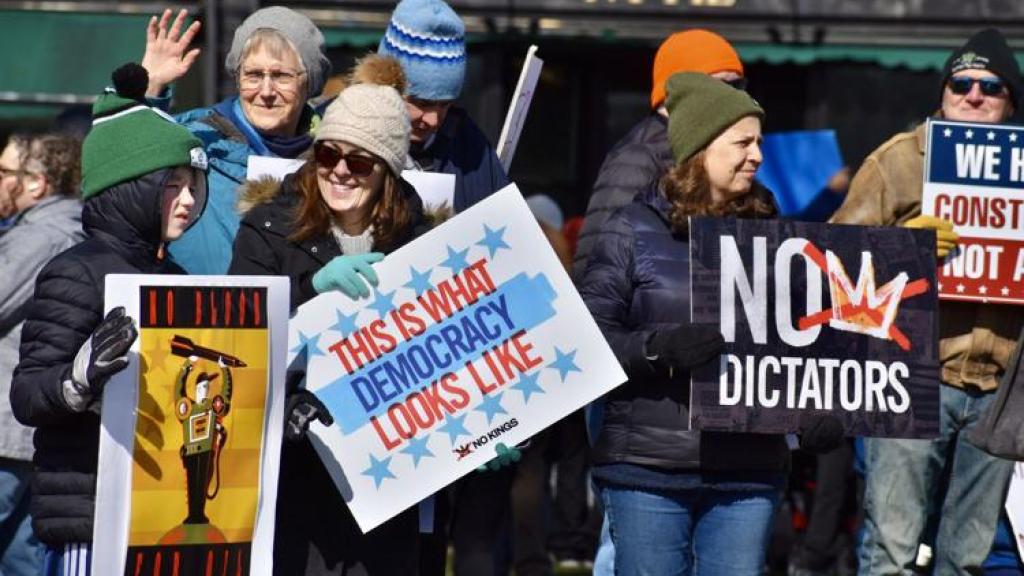
The biggest protests of all were the “No Kings” demonstrations: a huge outpouring of anger, rage and ridicule of Trump’s pretensions of being popular and powerful. People said, “No Kings,” with many accusing him of being a fascist, a totalitarian, a dictator. There was agreement on defending principles in the revolutionary Declaration of Independence, and in the more conservative US Constitution, both of which he is walking all over. These mass actions of resistance have continued into the Spring of 2026.
Pro-Trump elements have not come close to mobilizing anything on this scale. Trump claims to have an overwhelming mandate from the people — that is a lie. He won an electoral majority, but certainly not a landslide majority. He did not get an absolute majority among the people. He was able to rack up more popular votes than his competitors in 2024, but his mandate is razor thin. And he is eroding his base of support with policies that hurt us all.
Mass mobilizations on the streets of Los Angeles, Minneapolis, Chicago and elsewhere have defeated concerted and violent efforts by Trump forces deployed to intimidate and overwhelm resistance to Trumpism’s policies. Those policies are supported by a hard core of Trump supporters, in the belief that this will Make America Great Again. But the hearts and minds of a majority cannot be found in that right-wing hard core.
Equal opportunity and a better life for all, the things that have been central to the American Dream, are not on the cards right now. Increasing numbers of people are facing this reality and thinking through their situation in new ways. There is a radicalization. Some of it has been drawn in a right-wing authoritarian direction, but there are also more left-wing ideas in circulation now than at the start of this century.
In terms of electoral efforts and educational outreach, Sanders has been putting forward socialism as a solution. So has a radical cluster in Congress, the so-called Squad. Most dramatically, Zohran Mamdani was overwhelmingly voted in as New York City mayor running as an open democratic socialist. All of this has had a big impact.
The way these figures define socialism tends to be vague and sometimes goes too far in compromising with the political establishment and capitalist system. But the idea of socialism, of economic democracy, of the economy being controlled by the majority — that is, by the working class — is part of the solution. That is a difficult thing for some people to grasp or feel comfortable with, but realities are fluid right now, and there is tremendous discontent.
As the recent demonstrations indicate, there is a growing rejection of Trump’s phony so-called solutions. The process may stop or push back some of Trump’s worst policies. But such protests and acts of resistance by themselves will not solve the underlying problems. Those problems remain. Some people involved in the protests and resistance still harbor illusions and hopes in the Democratic Party. But for significant numbers of people, it is no longer a credible solution to the problems we face.
Socialist perspectives must be put forward in a way that makes sense to people. They need to be tied to actual struggles to improve working-class people’s lives. But it must be understood that these are just initial steps; we have to go much further. The current economic system will continue to undermine improvements and protections we are fighting for. Those in control of the system will do all they can to undermine and defeat our efforts to create a decent life for all. We need an economic democracy — that is what socialism is about.
The mass protests and struggles to defend and improve people’s lives are needed , but by themselves are not enough. As more people come to understand this through their lived experience, a revolutionary breakthrough becomes possible. Such a breakthrough will depend, however, on the ability of left-wing and socialist forces to grow and mature in ways that help make this happen.