Lessons of the Serbian revolution
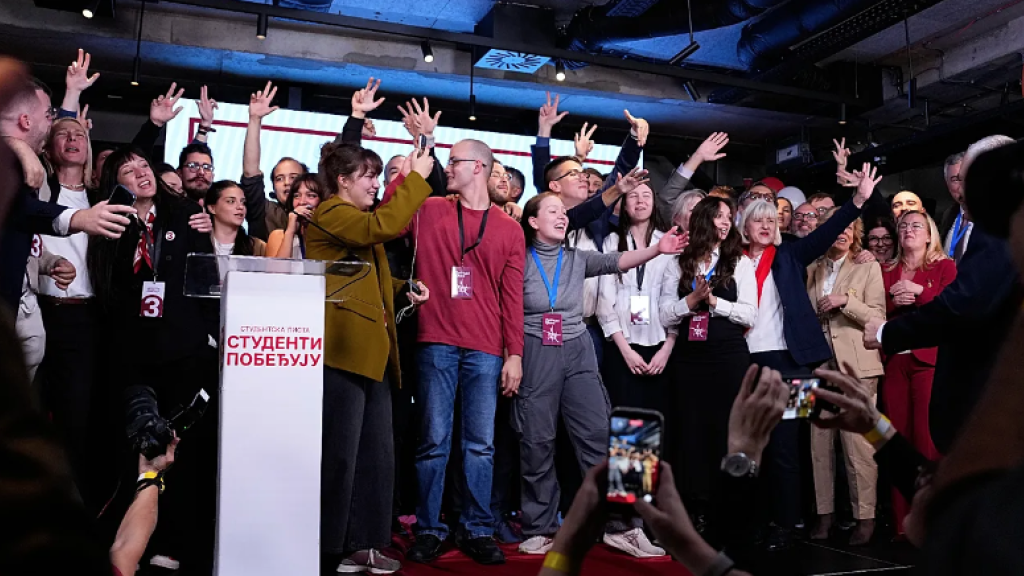
The newly-created Student List won more than half the vote and a parliamentary majority in Serbia’s October 25 snap parliamentary elections. Outgoing President Aleksandar Vučić conceded defeat. Nearly two years of protests, sparked by the tragedy at Novi Sad railway station, culminated in victory over the political force that had governed the country since 2012.
In an analysis published in February 2025, I questioned whether the protests could develop into a political force capable of overcoming fragmented labour, clientelist dependence and the crisis of representation. The movement’s subsequent trajectory calls for a reassessment: which obstacles did it overcome, and which continue to limit the substance of change?
Supporters call this victory a revolution; opponents describe it as a foreign-orchestrated “colour revolution”. Yet its political scale exceeds the socioeconomic ambitions of the victors’ program. Serbia’s experience raises questions about the forces driving contemporary movements, the organisation that turns discontent into power, and the opportunities for socialist politics within capitalist democracy.
The five lessons that follow examine what made this breakthrough possible and what might turn it into lasting social change.
Lesson 1: This Is not a social revolution
A change of government is not necessarily a social revolution. In the classical Marxist understanding, the decisive question is whether class rule and property relations change. This distinction should guide the use of “revolution” as an analytical concept.
The protests that began in November 2024 were predominantly peaceful. Their principal forms were marches, student blockades, commemorative gatherings and civic self-organisation. Armed insurrection and the forcible seizure of government buildings did not become the movement’s strategy. The contrast with the street battles, smashed shops and looting accompanying ongoing protests in France and Italy, and now Germany, demonstrates that radical political goals can coexist with restraint in the means used to pursue them.
The Student List achieved victory through elections under conditions of competitive authoritarianism: a system in which political competition remained real, but the ruling party systematically tilted the playing field in its favour. Pressure from the streets helped secure an election, translating mass mobilisation into a parliamentary majority.
To portray this route as incompatible with Marxism is historically mistaken. In his Amsterdam speech of 1872, Karl Marx explicitly acknowledged that workers in some countries could achieve their aims by peaceful means. The decisive criterion, therefore, is the social relations the victors intend to change, rather than the presence of barricades.
The prospects for a peaceful transition also depend on the depth of the proposed transformation. The less it challenges the foundations of ownership and class rule, the less reason capital has to mount a united resistance, although particular sections of it may fiercely defend their privileges.
In Serbia, the preservation of the economic system goes hand in hand with an ambition to restructure political power profoundly. Removing party control over public institutions, introducing lustration and dismantling the former ruling group’s grip on power could give the process the character of a political revolution.
In class terms, this project can be interpreted as dismantling the monopoly of a narrow group that combined state power with capital accumulation, while opening up decision-making to a broader range of property-owning and professional groups. The project, however, has yet to be implemented.
The Student List’s election program is close to contemporary reformist social democracy. It proposes free textbooks, more affordable housing, uniform medicine prices and the restoration of rural healthcare. To strengthen workers’ protection, it wants to reduce the maximum duration of fixed-term employment from two years to one. These measures sit alongside support for domestic entrepreneurs, farmers and innovative businesses, stronger links between research and production, and a move away from an economic model based on cheap labour. Confiscating illegally acquired assets is intended to return misappropriated funds to the public purse.
But the program does not seek to socialise the economy by giving workers and society effective power over production, investment and the distribution of wealth. It was precisely this democratisation of economic power that Erik Olin Wright placed at the heart of a socialist alternative, distinguishing it from a mere expansion of state ownership.
Russia’s October 1917 revolution cannot be reduced to a change of government: the seizure of power was followed by a fundamental transformation of ownership and society’s class structure. How much power workers actually exercised under the resulting system is a separate question, one that does not diminish the scale of that transformation. The proposal in Russia’s State Duma to “rename” the October Revolution a coup overlooks this distinction.
In Serbia, the victors’ programme does not, at present, envisage comparable changes: the scale of the proposed political restructuring substantially exceeds the depth of the socioeconomic reforms.
Lesson 2: Nor is it a colour revolution
The second lesson concerns the movement’s origins. Vučić and representatives of his Serbian Progressive Party (SNS) portrayed the protests as a “colour revolution” orchestrated by outside forces. As early as February 2025, Vučić announced plans to write a book entitled How I Defeated the Colour Revolution in Serbia. Shortly before the election, he predicted it would become a worldwide bestseller — especially after his anticipated victory.
The search for a foreign mastermind has become an increasingly common way of discrediting unwelcome political developments. Russian authorities label any dissent “foreign interference”; the British prime minister spoke of Russian interference in the Brexit referendum; in Israel, Likud accuses its opponents of using foreign funding to mobilise Arab voters. Some Russian opposition commentators reproduce this narrative too: Yulia Latynina links the Serbian activists’ success to alleged funding from pro-Western NGOs.
Despite the differences between these cases, invoking interference shifts attention from the domestic causes of collective behaviour to an external adversary. Actual attempts at interference require investigation, but do not, by themselves, explain the motives of millions of people.
Vučić had long been a convenient partner for external actors with divergent interests. As researchers at the Centre for Eastern Studies observed, cooperation with the European Union, the United States, Russia and China was one of the resources sustaining his rule. European criticism of authoritarianism and support for student demands from some EU institutions did not end that cooperation, while Moscow openly endorsed the “colour revolution” narrative.
Dejan Jović’s analysis shows that the Student List’s foreign policy platform envisages substantial continuity. It calls for maintaining the partnership with Russia, coordinating positions on Kosovo in the UN Security Council and rejecting sanctions against Russia. These commitments sit alongside support for Ukraine’s territorial integrity, cooperation with the EU and the US, and a strategic partnership with China.
If “After Tito – Tito” was a popular slogan in Yugoslavia, the formula suggested here is “After Vučić – Vučić”. Such continuity does not, in itself, rule out external involvement, but it weakens the claim that the movement was an instrument for geopolitical realignment.
The movement’s symbolism reinforced this emphasis on domestic change. As I noted in an earlier piece, its dominant imagery (blood-red handprints, Serbian flags, faculty insignia and commemorative banners) foregrounded domestic grievances rather than geopolitical alignment. By excluding symbols of outside organisations and foreign powers, including the EU, NATO and Russia, the movement asserted its independence from competing geopolitical camps.
The reasons for the victory should be sought primarily in the government’s accumulating crisis of legitimacy. Protests against authoritarianism, political violence, environmental threats and electoral irregularities began long before 2024, unfolding in at least three major waves starting from 2017. The collapse of the station canopy and the deaths of sixteen people provided the immediate catalyst that brought this accumulated discontent together. For a substantial part of society, the tragedy became definitive proof that opaque decision-making and unaccountable government threatened human life itself.
Yet the political crisis was not accompanied by an economic crisis. The government built its election campaign around economic growth, infrastructure projects and rising wages and pensions. Despite some slowdown in growth and persistent social problems, the IMF projected an acceleration to 4% in 2027. However, economic achievements proved insufficient to sustain public consent.
Economic performance has limits as a source of legitimacy. In Johannes Gerschewski’s model, legitimation is one of three pillars of authoritarian stability, alongside repression and co-optation. Remaining in power is therefore not the same as retaining public consent. Rising incomes can strengthen support for a regime, but do not necessarily compensate for the absence of justice, political participation and government accountability. The importance of these demands also depends on which social forces lead the movement and shape its agenda.
The day after Vučić’s defeat, I struck up a conversation with a Belgrade taxi driver, a man in his early sixties. Playing devil’s advocate, I listed the achievements the ruling party took pride in. He had an answer to every argument.
But GDP grew at a decent rate.
It would have grown even faster if they hadn’t stolen half the country!
Wages and pensions went up too.
And prices rose three times as fast! I’m a pensioner, yet I still have to work as a taxi driver.
But schools, hospitals and roads were built…
Do you know that a kilometre of road costs three times as much here as it does elsewhere in Europe?!
One conversation cannot represent an entire society, and the driver’s assertions are no substitute for verified evidence. But it illustrates how achievements become grounds for indictment: growth is judged against opportunities lost to corruption, pensions against the cost of a decent life, and construction against suspected theft. Outcomes matter, but so does perceived justice.
This also reveals the limits of applying Vladimir Lenin’s description of a revolutionary situation. In Serbia, the refusal to go on living in the old way took, above all, the form of a demand to change how power was exercised. To reduce it to worsening material hardship would be to overlook the significance, in their own right, of political powerlessness and public perceptions of injustice.
The second lesson extends beyond a critique of the “colour revolution” framework: neither foreign support nor economic achievements guarantee legitimacy. Here, Marxist analysis of social contradictions and Lenin’s injunction to look behind political statements for the interests of social classes acquire particular importance. External influence can sharpen social contradictions, but it does not create them out of nothing.
Lesson 3: Justice unites
The absence of a revolutionary program does not mean the absence of a profound demand for social change. People may support private enterprise while finding the distribution of wealth created through collective labour unacceptable. Thomas Fazi observes that today’s youth protests in Europe are fuelled by the gap between the promise that education and hard work will open the way to a decent life and the experience of a generation facing insecure employment and unaffordable housing.
It is in this context that anti-corruption demands gain mass support. Behind the demand to punish those responsible lies the question of whom the state serves and who benefits from economic development. Misappropriated funds mean underfunded hospitals and schools, while allocating jobs through party patronage makes people dependent on those in power. The fight against corruption becomes the language of a broader demand for justice.
Yet the post-Soviet experience reveals the limits of this agenda. Volodymyr Ishchenko links the recurrence of “Maidan revolutions” to the failure to overcome a crisis of political representation: leaders change, but the social aspirations of the majority still lack organised political expression. In his Critique of the Gotha Programme, Marx identified a deeper foundation of the problem: the distribution of goods depends on the distribution of the conditions of production. Removing corrupt officials does not, by itself, change relations of ownership and economic power.
Serbia has already experienced a similar cycle. Having come to power in 2012 on an anti-corruption platform, the SNS turned the arrest of oligarch Miroslav Mišković into a symbol of the new government’s resolve. The campaign helped Vučić consolidate his position; now corruption has become one of the principal grounds for removing his party from power. This does not diminish the importance of fighting corruption, but it shows that success depends on society’s capacity to hold those in power accountable and secure material improvements.
The demand for justice and opposition to the existing regime united groups with different expectations of change. As Marx showed in The Class Struggles in France, a common enemy can temporarily obscure contradictions within a movement; Serbia’s coalition against former president Slobodan Milošević also fractured after victory in 2000. Preserving today’s coalition will require agreement over concrete interests: who benefits, who bears the costs, and who determines the course ahead.
Lesson 4: The driving forces change. Organisation still matters
Whose interests does the Student List represent? The breadth of its support does not, by itself, answer this question: the composition of its electorate, the movement’s organising core and the substance of its program are different things. Members of different classes may vote for the same political force without gaining equal opportunities to shape its course.
In the early stages of the protests, analysts noted the movement’s limited capacity to involve workers. Later, students established links with trade unions and supported demands for changes to labour legislation. Yet attempts to bring about a general strike did not lead to a widespread shutdown of production, and the organised labour movement did not become the leading force in the protests. Workers’ electoral support does not necessarily mean that they participate independently in shaping the political program.
The working class has not disappeared, but its composition and the conditions under which it organises have changed. In Serbia, International Labor Organization estimates show that the share of employment in services rose from 41.5% in 2000 to 54.9% in 2025. Dependence on selling one’s labour power unites the factory worker, the programmer and the lecturer, but a shared position does not automatically create the capacity to act collectively. As Boris Kagarlitsky emphasises, reconciling the interests of different groups of workers requires political work. Fragmented workplaces, insecure employment and the risk of losing income make collective action more difficult.
Against this background, students’ organisational advantages become apparent. Universities bring people together and provide regular contact, premises and equipment. During the blockades, university faculties became places of continuous discussion and coordination, where working together built trust. Social media platforms expanded the movement’s audience, but its staying power rested above all on the ability to spend time together consistently. There is a functional analogy here with the large factory: physical concentration helps turn individual discontent into collective strength.
With support from their families and the wider community, some students could put their studies on hold and devote almost all their time to organising. This came at a cost (delayed graduation, lost earnings and risk of repression) but enabled them to become full-time organisers, something akin to “professional revolutionaries”. Lenin’s observation that “organisation increases strength tenfold” thus remains relevant.
Given the leading role of the university community and educated professional groups, the movement might provisionally be described as a “middle-class revolution”. This characterises its organising core and aspirations, rather than implying a homogeneous class composition. Many participants are themselves wage earners. They share demands for recognition of their qualifications, professional autonomy and opportunities for advancement without party patronage.
As I argued in an earlier analysis of the movement, the gap between education and available opportunities is particularly painful for these groups, whereas less affluent citizens are more acutely sensitive to the risks of change. The geography of the vote is consistent with this: the SNS-led list retained its advantage in the less economically developed areas of southern and eastern Serbia.
Students can radicalise a political crisis without representing the working class or the broader population. Their aspirations are also shaped by the prevailing ideological environment: where capitalism appears to be the only viable order, fair access to professional life may take precedence over transforming economic power.
Marx and Friedrich Engels’ argument about ruling ideas helps illuminate this constraint. Deeper change requires workers’ independent organisation and the broad social bloc advocated by Kagarlitsky. Without influence over the new government’s decisions, workers risk remaining recipients of reforms rather than participants in determining their substance.
Lesson 5: Organisation without a single leader
Serbia’s experience shows that the capacity to organise does not necessarily require a rigid hierarchy or leadership concentrated in one person. One of the movement’s distinctive features was its decentralised character: numerous autonomous groups connected through a shared agenda, coordination and everyday interaction. Horizontal organisation meant distributing authority and responsibility among participants.
The movement’s foundations were the student plenums: regular general assemblies open to all students enrolled in a particular faculty. The plenums determined demands and subsequent action, while working groups implemented their decisions. Joint action was coordinated across plenums at different faculties and universities.
This form of self-organisation was not invented by the current protest wave. It developed during student protests in Serbia from 2006 onwards and became widely known during university occupations in Croatia in 2009. Zagreb students even compiled their experience in The Occupation Cookbook, a practical guide to organising occupations and running plenums. What distinguishes the present Serbian movement is its ability to sustain collective organisation for nearly two years, extend its connections beyond universities, and move from protest demands to an electoral list and an election program.
In March 2025, the student movement called on citizens to hold local assemblies (“citizens’ assemblies”) using a legally established form of direct participation in local government. Meanwhile, the “A Student in Every Village” initiative took shape: student groups travelled to communities across the country, explained the movement’s demands, answered questions and discussed residents’ concerns. Plenums, citizens’ assemblies and travelling student groups created numerous overlapping connections through which local initiatives became part of a nationwide movement.
The ruling SNS relied on large rallies, its party apparatus and organised transport for supporters. Behind these displays of mass support lay material incentives and dependence on those controlling public institutions and employment. The student campaign rested on voluntary participation and direct communication, gradually turning sympathisers into active participants. This difference helps explain why the government’s advantages in money, organisation and television access did not give it a comparable capacity to mobilise society.
In a Balkan political environment accustomed to personalised parties and powerful leaders, this organisational model marked a significant departure from the norm. Even broad anti-corruption movements often coalesce around a prominent individual. This happened in Ukraine in 2019: the success of Servant of the People was inseparable from Volodymyr Zelensky. No comparable focal point emerged in Serbia. Alexander Baunov observes that the Student List differed from the Ukrainian example precisely in lacking a political leader to whom the new organisation owed its existence and success.
This structure made it harder for the authorities to undermine the movement, strengthen its resilience and frustrated attempts to portray it as a vehicle for the personal ambitions of yet another contender for power. If any individual united the Student List, it was Vučić himself — as the embodiment of the order its participants opposed.
It is therefore more accurate to describe the movement as independent of political parties rather than apolitical. Demands for government accountability, independent institutions and elections were political in substance. Students rejected the established system of party representation and sought to create their own means of participation. The Student List even contested the election as a citizens’ group — a legal arrangement in Serbia that allows an electoral list to be submitted without establishing a political party.
The defeat of the traditional opposition parties provides indirect evidence of the demand for this alternative. Their failure to cross the electoral threshold shows how deeply distrust extended to the political class as a whole. This resembles a crisis of hegemony: existing parties lose their capacity to represent social interests or secure consent.
Kagarlitsky links the success of the right to the retreat of the left and its loss of connection with its social base, while Ishchenko analyses the crisis of representation that opened the way for Zelensky. The political space left vacant is not necessarily occupied by forces offering a socialist alternative. Horizontal organisation does not guarantee superiority in every situation. In Serbia, however, it helped sustain prolonged mobilisation and participation across established party divisions.
Victory brings a new test: can participation and accountability be preserved in government decision-making? Whether the Student List will become a party, remain a coalition or split apart is still unknown. Victory over personalised rule will acquire deeper significance if the new organisation avoids reproducing the same model.
Victory opens up possibilities
The significance of the students’ victory should be neither overstated nor understated. A radical change of government does not, by itself, guarantee profound socioeconomic transformation — or even the implementation of the victors’ moderate program. The movement has yet to demonstrate its capacity to turn a parliamentary majority into lasting change.
The risks of fragmentation, concentrated power and renewed rule by a dominant leader remain. Antonio Gramsci described a crisis as a situation in which the old is dying and the new cannot be born; in this interregnum, morbid phenomena emerge. Removing the former ruling group does not, in itself, create a democratic order. Declining public participation and deepening disagreements could open the way to a Bonapartist solution: the rise of a leader promising to reconcile divergent interests in the name of society as a whole.
The government will face resistance from established networks of influence, budget constraints and external pressure. Serbia’s peripheral position limits its room for manoeuvre, but does not dictate a single course. The question is whose interests will be protected in the inevitable compromises, and who will be able to influence decisions. The direction and depth of future change remain open.
This makes what has already been achieved all the more significant. A mass movement defeated a government with vastly greater resources, dominance over the media and years of experience in confronting the opposition. Moreover, this political breakthrough proved possible without worsening economic hardship: rising incomes did not extinguish demands for justice, democracy and government accountability. For the left, this means that the possibility of mass mobilisation cannot be tied exclusively to economic crisis.
Yet the route to victory also mattered. Serbia’s constrained democratic freedoms still provided openings for organisation, public mobilisation and electoral challenge. In more deeply authoritarian states, such as Russia, these channels are largely closed, effectively blocking a comparable peaceful electoral breakthrough. The left therefore has a direct stake in defending and expanding democracy under capitalism, exposing authoritarian developments and building broad coalitions against them.
Such cooperation need not mean abandoning an independent socialist program. Democratic rights are themselves achievements of struggles by working people and their allies; defending them preserves the conditions under which those struggles can develop further. The question now is how the political opening will be used: whether participation will extend into the workplace, whether workers will gain influence over investment and distribution, and whether demands for accountability will reach economic power itself.
Even if Serbia’s reforms remain within moderate social democracy, the experience of collective action can build capacities for struggles that go further. Victory does not guarantee a more just and humane society, but it opens up possibilities for the struggle to achieve one.