Boris Kagarlitsky on war, crisis, imperialism and the left
First published in German at nd – Journalismus von links. Translation from original Russian by Dmitry Pozhidaev.
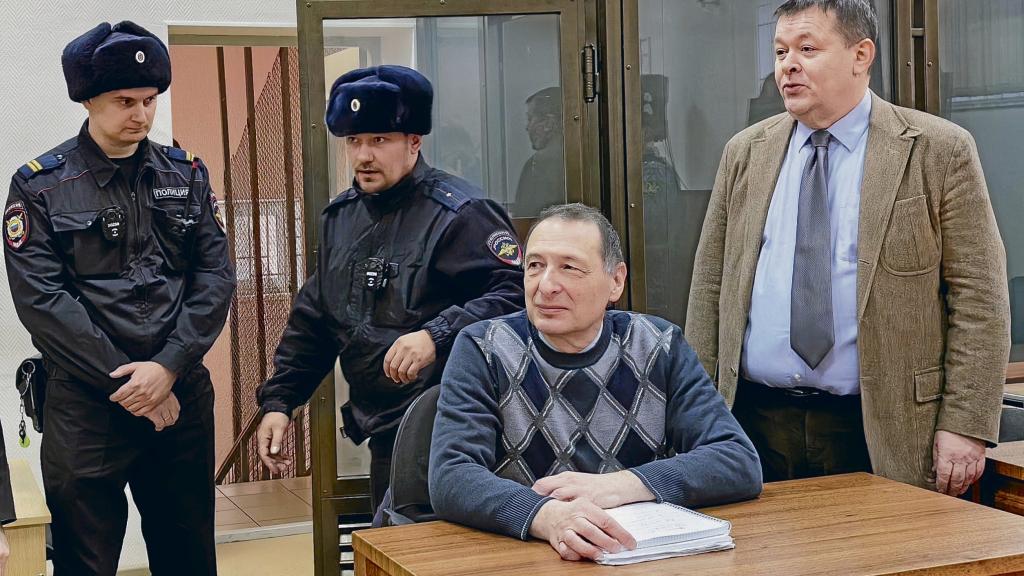
You have been in a penal colony since 2023 and were convicted in connection with your critical stance on the war in Ukraine. Perhaps you could begin by telling us about the conditions in which you are being held?
I only arrived at the penal colony in May 2024. Before that, I had been held in various prisons, from Syktyvkar to Moscow, Tver and Rzhev. There was even a brief period in December 2023 when I was released, in the hope that I would leave the country. But I was determined to stay, and I was imprisoned again.
As for the conditions of detention, they vary from place to place. But Penal Colony IK-4 in Torzhok has comparatively lenient conditions. I know about the situation of many other political prisoners, and things are much better where we are.
In your case, however, contact with the outside world has not been severed. To what extent does the prison administration control your communication with the outside world? Are there certain limits to political criticism that you are not allowed to cross?
Formally, the censorship rules are quite modest and straightforward. You cannot discuss escape plans, disclose prison staff’s personal information or send threats to people who remain at liberty. Naturally, censors in different places interpret their duties differently. I have been told that in other institutions even completely innocuous things were blacked out in letters. But that does not happen here. And in Zelenograd, the censor was an educated woman who used to come and discuss with me the philosophical and historical questions raised in my correspondence.
In an interview with the Russian outlet Rabkor last year, you said that prisoners were often offered reduced sentences in exchange for taking part in the war in Ukraine. How widespread was the response to such offers? Did a significant number of prisoners actually go to the front in this way?
Every month, statistics for the penal colony are posted for everyone to see. As a sociologist, I find this extremely interesting. When I was brought here in May 2024, 35–40 people a month were leaving to join the “special military operation” [the official Russian term for the war in Ukraine]. I am told that in 2023 the figure reached as high as 200. Last year, it had already fallen to 8–12 people a month. This year, the record is four in a single month. Usually it is one or two, and there are months when no one goes at all.
In recent years, two contrasting views of Russia have emerged within the international left. Some regard Russia as “the principal authoritarian threat of our time” and even embrace the liberal narrative that Russia stands behind Donald Trump. In Global South countries, by contrast, the prevailing view is that Russia is a victim of NATO and that the conflict in Ukraine was provoked by Western imperialism. You subscribe to neither of these interpretations. How would you explain your own understanding of what is happening?
In fact, the debate about the nature of the war largely repeats the arguments that took place in 1914–18. As we know, part of the left at the time supported its own imperialism. We remember very well the role played by German Social Democracy in those events. Georgi Plekhanov, by contrast, supported Tsarism. Others, such as the Russian Menshevik leader Julius Martov, essentially said: “A plague on both your houses!”
[Vladimir] Lenin, however, posed the question in a fundamentally different way. The point was not to decide which imperialism bore greater responsibility for starting the war, but to determine how the situation could be used in the interests of revolution. Clearly, the defeat of Tsarism opened up opportunities for revolutionary change in Russia. It was for this that Lenin was called a “defeatist”. But he never supported Kaiser Germany, although his opponents tried, slanderously, to accuse him of doing so. Lenin’s position seems extremely relevant to me today.
Several years ago, you wrote Empire of the Periphery. In it, you argue that although Russia has repeatedly followed an imperial logic throughout its history, this expansion has at the same time been driven by its economic weakness. In relation to Western Europe, Russia was itself a “victim” of imperialist policies, while simultaneously pursuing a colonial policy in Asia. Would this be a fair summary of your position?
You have understood me perfectly. It is very important here to note not only that, after losing first the Crimean War in the 19th century, then the Russo-Japanese War of 1904–05 and, finally, World War I, Russia each time entered a period of socio-political transformation.
It is equally important to understand that these wars were by no means simply the result of the ill will of individual rulers. On the one hand, they reflected the systemic contradictions of global capitalism; on the other, they reflected the internal and equally systemic crisis of the regime that existed in Russia.
This is also highly relevant to the present conflict. Again and again, we are playing out the same scenario, although our own era naturally has its particular features.
Could you offer us a contemporary analysis of imperialism? As we understand it, you consider it essential to retain the materialist foundation of the very concept of imperialism. What does this mean when applied to Russia today?
In my book From Empires to Imperialism, I explain the differences between these phenomena and concepts. Imperialism presupposes a particular structure of capital and a corresponding regime of accumulation, in which the state is closely connected to the leading monopolistic corporations. This, in turn, shapes the ruling circles’ understanding of the national interest. But expansion, conquest and domination have by no means always served as instruments for accumulating capital or securing markets for domestic corporations. Policy is determined by what might be called the vector of interests of the dominant groups.
In this respect, Russia is a very interesting phenomenon. Its commodity corporations are wealthy, but structurally, technologically and organisationally weak. The state is trying to behave like a normal imperialist power, albeit one more characteristic of the 19th than the 20th century, occupying territories and defending its spheres of influence. But it lacks the resources to do so. The concept of “failed imperialism” can be applied to this situation.
How are Russia’s armed conflicts in Georgia and Ukraine related to the country’s economic crises? In your work, you emphasise that the nature of Russia’s dependent development has remained largely unchanged, in particular its dependence on commodity exports. To what extent is Russian geopolitics connected to this economic vulnerability?
Russia’s vulnerability is not political but economic. The ruling circles parasitically consume the resources inherited from the Soviet Union. Incidentally, the same thing was happening in Ukraine. After the war began, there were some attempts at modernisation and even reindustrialisation, primarily, of course, in the defence sector, but not only there. Yet these efforts stumbled not so much over the technological backwardness that is so often discussed, but over the structure of interests of the ruling elite. It is impossible to modernise the country without removing these parasitic groups from power. But they themselves are the power.
What remains relevant today in Lenin’s conception of imperialism as “monopoly capitalism”, in which capital becomes concentrated, expands beyond national borders and thereby comes into conflict with other national powers? After all, the contemporary transnational interdependence of capital has very different characteristics from traditional monopoly capitalism.
Transnational interdependence existed even before World War I, though not on the same scale. [Immanuel] Wallerstein convincingly showed that capitalism first takes shape as a world-economy, and only subsequently do national capitalisms emerge on that basis. The present war has demonstrated both the inevitability of conflicts and the extent of this interdependence. Why has it lasted so long? In 2022–23, Russian state ideologues were fond of talking about the West’s weakness. The situation has now changed, and Western Europe, at least from the Russian perspective, no longer looks weak. On the other hand, the West does not look united. Why?
It is perfectly clear that in 2022–24, Western elites saw no need to fight their Russian neighbours. Despite all the rhetoric about Putin’s regime, they were quite comfortable with that regime. It was a kind of policy of bringing Russia to its senses: you made a mistake by attacking Ukraine; we are not going to punish you severely for it, but we have to put a little pressure on you so that you realise the absurdity of the situation. In Russia, however, this was interpreted as weakness.
By the end of 2025, the European Union and Britain had moved from this policy of persuasion to tougher measures, even though they recognised that a possible change of regime in Russia could have socio-economic consequences that Europe’s ruling circles have absolutely no desire to deal with. The Trump administration in the United States, by contrast, continues the policy of persuasion, partly because it sees Europe and China as the real problems, while Russia could potentially be used against them. But that will not work.
Serious Marxist scholars such as Costas Lapavitsas and William I. Robinson point out that capital today is integrated internationally through investment funds and the shadow banking system. In this sense, US-based funds include Russian, Arab and even Chinese capital. Why, then, do conflicts between states continue to intensify?
William Robinson and I have debated this issue extensively. Of course, much has changed with regard to transnational capital. But transnational corporations do not possess the institutions that would allow them to control territories and populations. They have no armies, police forces or courts of their own. Nor do they control the development of fundamental science, without which their applied technological developments and so-called “innovations” would be impossible.
Libertarians like to reproach leftists for using iPhones made by Apple. But they forget that, according to economists’ estimates, at least a third of the technologies used in the iPhone were developed thanks to publicly funded research (see, for example, Jonathan Haskel and Stian Westlake, Capitalism without Capital: The Rise of the Intangible Economy). Without the state, there can be no stable markets and, indeed, no capitalism at all. The slogan of the “powerlessness of the state”, popular in the 1990s and 2000s, largely served to conceal a deliberate state policy aimed at rolling back the social gains won by working people.
Interestingly, in his book Technofeudalism, Yanis Varoufakis describes precisely the emergence of large corporate communities tied to particular states and regions: the United States, China and Western Europe, which he regards as considerably weaker. I simply do not like the title of the book. There is no “feudalism” here whatsoever. It would be more accurate to speak of techno-imperialism.
But there is also a social dimension to the problem. Contrary to expectations, no unified transnational bourgeoisie has emerged. National bourgeois institutions, however, have weakened, their networks of connections have become less dense, and the interests of the ruling classes are less consolidated at the national level. Since the 1990s, and perhaps even earlier, a kind of declassing of the bourgeoisie has been under way. André Gunder Frank wrote about the lumpenbourgeoisie in relation to Latin America as early as the 1960s. Now the phenomenon has become widespread. Russia is an extreme case: here, the entire ruling class has become lumpenised.
How does the Russian public view the West? Do people believe the threat narrative?
Russian society, like any other, is heterogeneous. There is a broad range of views, from idealising the West to demonising it. That said, I have not encountered people who regard the West as an immediate threat. Rather, nationalist circles tend to see the West as the bearer of unacceptable values and therefore as something that, ideally, should be destroyed. Or, at the very least, they believe that one should seek to inflict as much damage on it as possible.
A rational understanding of imperialism, by contrast, is characteristic of left-wing circles. The intellectual influence of the left has, of course, grown noticeably.
And what does Russian society think of China? Viewed from the outside, there appears to be an alliance, but China is likely just as distant to many Russians as it is to us Germans.
Fear of Chinese expansion is quite widespread in Russian society. Sometimes it is rational: China buys up resources for next to nothing, Chinese companies encourage the reckless destruction of forests, and so on. At other times, it is irrational. When I worked in Irkutsk, I discovered that there were plenty of people there who believed that the Chinese were planning to take all the water out of Lake Baikal and drink it.
All over the world, the willingness to go to war and authoritarian projects are on the rise. How do you explain this development?
The neoliberal model of capitalism has exhausted itself. This was already clear during the Great Recession of 2008–10. But the ruling circles essentially refused even to adjust course, let alone change it fundamentally. As a result, liberal-centrist politics inevitably went bankrupt, and with it “moderate” social democracy.
The problem, however, lies not in that, but in the weakness of the left alternative, which those same liberals and right-wing social democrats had in fact succeeded in politically marginalising by the beginning of the 21st century. The resulting ideological and political vacuum is being filled by right-wing populists.
In the absence of genuine substantive alternatives, the institutions of parliamentary democracy become useless in the context of crisis. And it is easy to understand why ordinary people become disillusioned with democracy. Paradoxically, the situation in Russia is better: ordinary Russians have become disillusioned with authoritarianism.
How do you perceive the confrontation between people from Ukraine and Russia? Is this a repeat of the tragedy of 1914, when the working classes allowed themselves to be swept up in a nationalist frenzy, or are comparisons of this kind unhelpful?
The parallels between 1914 and our own time are justified. But in Russia there was no enthusiasm for the war in 2022–23 of the kind seen in Germany, France or the Russian Empire after the outbreak of World War I. What prevailed instead was bewilderment and a kind of fatalistic submission to the state: “We’ve been told we have to fight, so we’ll fight.” But no more than that. A third of the population was opposed to the war from the outset, which explains the large number of political prisoners who had no connection with any political parties or organisations.
In Ukraine, things are somewhat different. Here it is worth recalling World War I. When German troops were 70 kilometres from Paris, it was rather difficult to conduct anti-war agitation. The imperialist character of the war became apparent in France only in retrospect. It seems to me that something similar is happening in Ukrainian society.
In the US, socialist positions are gaining strength. In Europe, the centrist regime is crumbling. Do you have hope for political change in Russia?
I have been following the successes of the US left with admiration. Although the Democratic Socialists of America were for a long time a semi-marginal organisation, while left-wing intellectuals in New York or Berkeley complained that society did not understand them, the DSA is now winning primaries and has succeeded in getting its candidate elected mayor of the “Big Apple”. I do not know how [Zohran] Mamdani’s career will develop from here, but right now he is simply magnificent.
Against this backdrop, the European left is doing considerably less well. Nevertheless, there is nothing inevitable about a victory of the far right. The main struggle still lies ahead. And in fact, it is the left that is becoming the principal force defending democracy. But much more serious, and more radical, socio-economic programs are needed. The left has forgotten about public ownership, replacing the struggle for structural reforms with the defence of minority rights. Unfortunately, this policy does little good even for minorities and immigrants themselves, most of whom suffer not only from discrimination but also from the economic crisis.
How serious are the prospects for the left in Russia? We will be able to judge that fairly soon, when the failure of the current political course leads to an open political crisis. I cannot claim that we are prepared for it. It is impossible to prepare for such things in advance. And yet we are better prepared than any other political tendency in Russia.