Remaining true to socialism — and wrestling with its meaning
This review is being simultaneously published on LINKS and Communis.
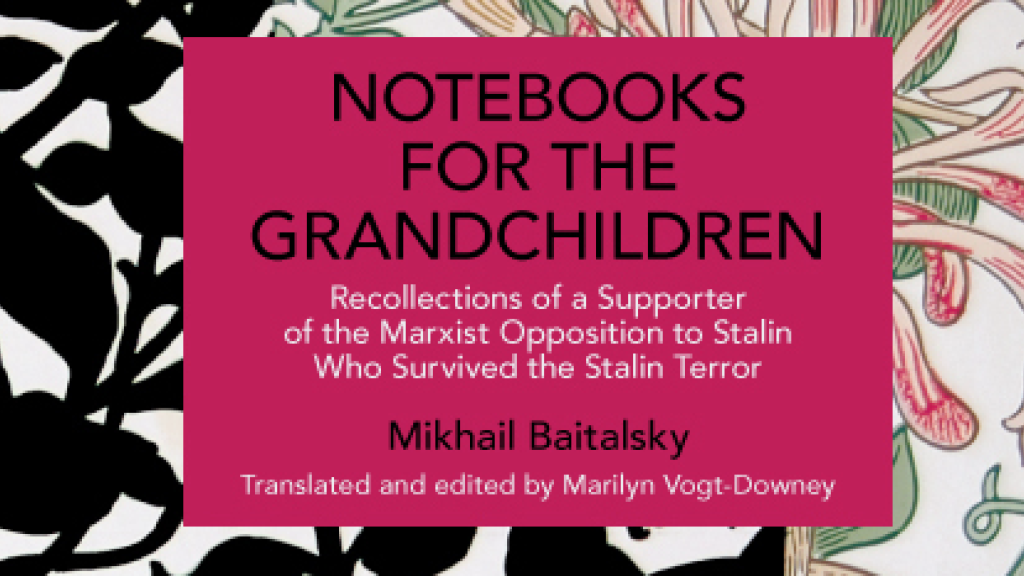
Notebooks for the Grandchildren: Recollections of a Supporter of the Marxist Opposition to Stalin Who Survived the Stalin Terror
By Mikhail Baitalsky
Translated and edited by Marilyn Vogt-Downey
Leiden/Boston: Brill, 2025, $185
Chicago: Haymarket Books, 2026, $45
Here is a gift for all who care about the human spirit, freedom, democracy and socialism: a volume of first-person, first-hand recollections about how something that seemed so extraordinarily promising — the 1917 Russian Revolution — took a tragically dark turn, and how some people sought to understand and push against such a fateful and terrible development.
Mikhail Baitalsky (1903-1978), whose occupations included “poet, journalist, mechanic,” had from his early teen-age years to his death, lived as a dedicated Communist. His life-activity included contributing to the creation of the Union of Soviet Socialist Republics and — amid an evolving and often murderous bureaucratic dictatorship — to experiencing and surviving repression and years in forced labor camps (the notorious gulag). During his final decades, he sought to understand, describe and explain the meaning of all this for the benefit of future generations. He was forced to do this surreptitiously in the still-repressive atmosphere of the latter-day Soviet Union. In the December 1986 issue of the Bulletin in Defense of Marxism, his English-language translator explained:
In early 1977, we received a copy of the samizdat memoirs of Mikhail Baitalsky, who, in the early 1920s in the Ukrainian Republic of the Soviet Union, had become a supporter of the Left Opposition. Baitalsky was arrested three times during the Stalin era and served two terms in the notorious Vorkuta forced labor camp. He was released from his second term in 1955 during the liberalization following Stalin's death. In 1958 he began writing about his experiences. This project took him 12 years to complete and ended up in the form of nine “notebooks” totaling over 450 pages in length. He called them “Notebooks for the Grandchildren,” and it is one of the most stunning documents to have emerged from the post-Stalin period.1
Marilyn Vogt-Downey’s conscientious and elegant English-language translation of this remarkable book had its origins in the 1980s, as a several-year serialization in a small revolutionary socialist journal produced by an expelled fragment (the Fourth Internationalist Tendency) of the US Socialist Workers Party. In 1996, this completed translation was published as a book by Humanities Press. For the most part, it was ignored and had little impact. Now it is available in a revised translation — complete with glossaries, notes, chronologies, maps, photographs and other supporting materials — from the Historical Materialism Book Series, published by Brill in hardcover, and in an affordable paperback by Haymarket Books.
This volume is in some ways more substantial than many of the other classic “insider” accounts of the Stalinist terror and repression. University professor Eugenia Ginzburg’s illuminating and moving two-volume Journey into the Whirlwind and Within the Whirlwind (made into an excellent 2009 motion picture, with a stunning portrayal by Emily Watson) is very much worth engaging with. So is the clear and informative survey Nothing But the Truth (also published under the title Shipwreck of a Generation), by a founder and leader of the Palestinian Communist Party also active in the Communist International, Joseph Berger.2 The fact that, like Baitalsky, Ginsburg and Berger were dedicated Communists (although in their cases never affiliated with the Left Opposition) provide their accounts with rich sensibilities.
Baitalsky gives serious attention to Alexander Solzhenitsyn’s monumental three-volume Gulag Archipelago — which he sees as a powerful achievement seriously marred by clear traces of antisemitism and by an overly tolerant attitude toward Nazi collaborator, former Red Army General Andry Vlasov. (“To surrender when there is no hope of resisting is permissible,” he argues, “but to take up arms for the enemy is not.”) In addition, there is Solzhenitsyn’s authoritarian Russian nationalism, as well as an unremittingly anti-Communist orientation. For Solzhenitsyn “a Communist is an unredeemable individual, barely a human at all. To him, a person’s moral character is determined by his political convictions: A devoted ‘orthodox’ Communist is a degenerate, while a devoted Christian is an uplifted soul.” Baitalsky notes from his own experience that heroes and scoundrels could be found on all sides of such ideological divides. The gulag experience “revealed and strengthened the good or the bad in everyone.”3
The bulk of Baitalsky’s memoir — similar to the other memoirs cited here — is taken up with vivid descriptions of the brutal interrogations to which the victims of the terror were subjected and, even more, to the many revealing incidents in the daily, ongoing, years-long experience in the forced labor camps. The horrifically degrading quality of life in the camps is bitterly contrasted with words from one of Stalin’s speeches (posted as a sign in the gulag) that “life has become better, life has become joyous.” Particularly notable is Baitalsky’s substantial description of the 1936–37 militant work stoppage and mass hunger strike by forced laborers, led by Left Oppositionists at the notorious Vorkuta camp, which ultimately led to a systematic and wholesale slaughter of imprisoned Trotskyists. Baitalsky’s first notebook opens with the words: “For 30 years now, the memory of the Vorkuta executions has been like an open wound inside me.”4
Notebooks for the Grandchildren shares with The Gulag Archipelago a breadth of vision that encompasses philosophy, psychology, history and historiography, politics, and more in a quest for “the meaning of it all.” On that level, it seems to this reviewer, Baitalsky’s stands as a far richer account than Solzhenitsyn’s of the why and how of the Stalinist terror and gulag.
In the remainder of my exploration of Baitalsky’s powerful account, I will focus on distinctive aspects of the text in which he wrestles with “the meaning of it all.”
Revolutionary youth
If one wishes to understand the Soviet experience — including the meaning of Communism and of its Stalinist negation — one must come to grips with what seemed to millions throughout the world to be the great promise of the 1917 revolution.
When Baitalsky was thirteen and fourteen years old, as the Bolshevik insurgency swept through Russia and its empire (which included his native Ukraine), he and many close friends were drawn into the struggle for a socialist future. It was punctuated by hopeful and transformative upheavals of the 1920s that unfolded in the wake of a hard-fought civil war (1918-1921), during which, with many others, he had served as a volunteer in the Red Army.
Baitalsky, with friends and comrades throughout Russia and its borderlands, became part of an organization of Communist youth (ages 14–27): the All-Union Leninist Young Communist League — Vsesoiuznyi leninskii kommunisticheskii soiuz molodëzh (popularly known as Komsomol). This was an independent network of young activists inspired by and supportive of the Bolshevik wing of the Russian Social Democratic Labor Party, led by Vladimir Lenin and like-minded comrades, which in the wake of the 1917 revolution renaming itself the Russian Communist Party and soon became the Communist Party of the Soviet Union.
The League mushroomed as dozens, hundreds and many thousands of young people formed vibrant clubs throughout what had been the Russian empire, animated by a flourishing of “independent thought and concern about people.” Baitalsky recalls in his first notebook: “Our views were not hammered into our brains but were freely derived from our own reflections over our experiences, from our concern over the people’s misfortunes and our sense of justice.” He adds that “our exhilaration with the ideas of the revolution, our feelings toward Lenin, our hatred for the bourgeoisie — all this came from the depths of our soul.” In these early revolutionary years, when it was not clear how things would turn out, “Komsomol membership brought with it no privileges,” and “we formulated our views in absolute freedom. Those who did not share them did not join the Komsomol…” He elaborates:
The Komsomol was a voluntary organisation and, therefore did not have lies and hypocrisy at its very roots. It was based on a Communist faith – pure and unsullied – probably much like the faith of the first pre-Christian societies on the shores of the Dead Sea, with their Doctrine of Justice and in their reading of sacred texts many hours each day. In those days, we spent whole evenings in our club without ever being bored…5
These young people were voraciously reading and animatedly discussing a variety of Marxist texts: works by Lenin and other Bolsheviks — particularly The ABC of Communism by Nikolai Bukharin and Yevgeni Preobrazhensky — as well as writings of Karl Marx, Friedrich Engels, the early Karl Kautsky and Georgi Plekhanov, Franz Mehring, etc. “The study of Marxism was necessary to every one of us, since it was the torch with which we would light the road for the masses,” Baitalsky explains.6 But he reflects:
We quickly and firmly mastered a few popular formulas of Marxism, and for us they took the place of the entire philosophy: “Being determines consciousness” (the most important and most frequently repeated of our dicta); “the proletariat has nothing to lose but their chains”; “religion is the opiate of the masses”; “bourgeois marriage is prostitution”; “whoever is not with us is against us”. And the more often we used these words, the smoother they became, like coins, and it was no longer possible to make out the ideas minted beneath the hammer and sickle.
His retrospective conclusion:
Having become absolutes for me way before I was able to understand the entire doctrine from which they were culled, these formulas closed me off from the doctrine as a whole… I imagined that I already knew it all.7
Running far deeper than their comprehension of Marxist theory, however, was a youthful dedication to genuine democracy — rule by the people. “Democratism is directly related to sincerity in human relations,” Baitalsky tells us. “I speak not about democracy as a social institution but about democratization as an element of social norms.” He goes on to explain:
The February revolution opened up an era of democratism: meetings, elections, and discussions … Democratism, having suddenly entered the scene for people who had for centuries been trained to be obedient to higher-ups, frequently expressed itself in distorted ways and led to excesses; it could be crude, cruel, and even unreliable. But we were still young and had not yet grown coarse… We viewed ourselves as people of the future. This consciousness was not clothed with any triumphalism or arrogance. On the contrary, it seemed natural and totally normal. We carried in ourselves democratism as a consciousness of something akin to a mission, an extraordinary mission for the universal equality of all people.8
Baitalsky gives considerable attention to the dynamics of democracy, which he views as central to the socialism that he and his young comrades were fighting for. Of particular interest is his stress on the importance of opposition. “If there is no opposition,” he warns, “the powers roll along, meeting no resistance, in one direction — toward omnipotence — trampling the very people for whose sake (and with whose blood) power was won.” But he specifies additional reasons that an opposition is essential:
A party can have its own program, tactics, regulations, emblem, banner, and slogans. However, it can have a theory only under the conditions required of all theories: On the condition that the theory is constantly being tested, analyzed, and, consequently, re-examined.
He adds:
Society lives, people think and change: One person shifts from the minority to the majority; another shifts from being satisfied or indifferent to being dissatisfied. Those who are dissatisfied (whether they be called troublemakers, oppositionists, innovators, revisionists, or whatever else) are seeking changes… Society needs those who are dissatisfied.
He concludes:
Genuine democracy combines, in addition to rights about electing and recalling officials, a third more important right: the right of the opposition minority at any time to raise a question of confidence in someone elected by the majority.9
Downward slide
Animated by such ideals, Baitalsky proudly joined the Communist Party in 1923 and became a journalist who helped generate and focus attention on the perceptions, criticisms and complaints of “worker correspondents” in the pages of the newspapers and other publications he worked on. “The worker – and peasant – correspondents were the most interesting phenomena of the revolutionary period,” he asserts. “These were not leaders pushed forward FROM THE MASSES but people who remained with the masses, feeling what the masses felt and more sharply than anyone else perceiving and comprehending any evil.”10 It should be stressed that this was not a clandestine protest project — it was openly promoted and supported by Russian Communist Party members as part of the effort to advance workers’ power and socialism during the 1920s.
Nor is there anything special that Baitalsky perceives in his own actions and those of his closest comrades. “It is not true that we were all exceptional people for our time: brave, truthful, and unflinching, seeking no rewards,” he insisted. “We fully reflected the spirit that was prevalent at the dawn of the Revolution; and we were not the exception, but the rule: ordinary people of our time.” The idealistic Komsomol and Communist Party activists were fueled by a profoundly optimistic perspective: “With hopes fixed on the future, a feeling of personal participation in the world revolution, and a readiness to share full responsibility for it – and it was just about to happen – this uplifted and fortified us in all matters, even in very ordinary ones.”11
By the mid-1920s, however, with the absence of the anticipated revolutionary expansion beyond Russia and its borderlands, a different mood began to spread in the Soviet Republic, and increasingly made itself felt in Communist ranks:
A mood of conciliation reigned among the people during those bygone years. The New Economic Policy [an economic retreat advanced by Lenin, which stabilized the economy] was in full bloom. For the first time since 1914, people felt that they had enough to eat. The cities always had meat, not to mention bread. After many years of world and civil war, the village and city alike longed for peace… I lived then in the Donbass [an industrial and mining region in eastern Ukraine] where I worked for a newspaper and read thousands of workers correspondence. The Donetsk workers in those years were for the most part seasonal workers — semi-peasantry who came to the mines to work during the winter to supplement their income. The main themes of the letters to the newspaper were the bureaucratism, the inattention to the workers’ needs, and the disorder in the mines. From them, one general demand emerged: Put things in order — not to change things or restructure them or come up with innovations, but just to put things in order. Thinking back over this epoch, I think that the sentiment in the Donbass reflected the mood of the entire country in those years among the workers and among the peasantry: We want order and peace!… The so-called Lenin levy, which brought an enormous number of people pouring into the party overnight, brought this mood right into the party with it. We want peace! We don’t want more changes! We don’t need arguments! Just let us live in peace!12
Yet revolutionary internationalism had been a central element in the Bolshevik orientation of 1917 — which Lenin and others had consistently emphasized. A successful transition to socialism in Russia was seen as absolutely dependent on triumphant revolutions in the industrialized capitalist countries that would bring them into the socialist orbit. “When we started the international revolution, we did so not because we were convinced that we could foretell its development,” as Lenin and his comrades put it in 1921, “but because a number of circumstances compelled us to start it… It was clear to us that without the support of the international world revolution, the victory of the proletarian revolution [in Russia] was impossible.”13
The necessity of world revolution was colliding with the growing sense of exhaustion among broad layers of the population. The intensifying pressures to somehow square this circle were latched onto by the very forces associated with the growing abuses that the worker correspondents had been protesting against. The dramatically evolving Soviet bureaucracy was increasingly inclined to justify its existence with a new-found possibility: building socialism in a single country, independently of the fortunes of world revolution. This blended with policies of growing centralized authority in the party and state apparatus, as well as growing inequalities.
Passionate young rebels such as Baitalsky, naturally resistant to what was happening, were drawn in a very different direction. “We followed a simple internal path. Before us stood a choice: democracy or suppression of democracy; the possibility to be sincere or the necessity to lie; the right to have our own opinions or the loss of this right. And we made a choice.” Baitalsky and his comrades favored a positive response to the complaints and protests of the workers, “implementation of Lenin’s plan for the gradual organization along cooperative lines,” and the understanding that “Soviet Russia is the cradle of the world revolution,” requiring policies to help advance the global spread of socialist revolutions.14
This aligned them with the evolving positions of the Left Opposition in the early 1920s and the United Opposition of 1927–28. Baitalsky recalls an early city-wide party meeting in which a popular and influential young veteran of the revolutionary movement, Misha Yugov, delivered an oppositional supplementary report:
A half-century has passed and I cannot remember a word of his speech. But it is impossible to forget the effect it had. Misha gathered all his inner strength and put it into his speech. It was astounding for its passion, for its brilliance and for its force. If one were to weigh on a scale the development of the attitudes in the hall, it would have been obvious: Each of Misha’s words fell like a weight into the pan of the scale. The last word fell, and Misha — red and flushed — left the podium.15
Such open and critical-minded discussion at Communist Party gatherings — which had been common up until then — was soon eliminated by the Stalin leadership. Leon Trotsky and those who are in complete or partial agreement with the perspectives he advanced (which were essentially those of Lenin’s 1917 Bolshevism) would no longer be tolerated in the refashioned Communist movement of the 1930s and beyond.16
Berger, one of many mainstream Communists caught up in the Stalinist purges initiated in the mid-1930s, recalls meeting an aging anarchist with whom he briefly shared a cell when both were imprisoned. “You communists complain about the repressions,” the old man scolded, “but in fact you’re only getting what you deserve.” Berger recalls the anarchist claimed “it was Lenin and Trotsky who had established one-party rule and thereby ‘laid the basis for this mockery of the people in general and people in principle in particular’.” Berger continues: “Although he criticized Trotsky in no uncertain terms as a person who bore much of the guilt for what was happening, the anarchist had many words of praise for him as an outstanding revolutionary figure and compared him favorably with Stalin.”17
Although Stalin presented himself as a far more loyal disciple of Lenin than “the Judas Trotsky,” Baitalsky certainly did not see it that way — not only citing Lenin’s “testament” criticizing Stalin as untrustworthy and calling for his removal as party General Secretary, but contrasting Lenin’s modest and frugal day-to-day mode of functioning, which Baitalsky and many others (including Trotsky) embraced, with new norms encouraged by Stalin. In particular, “we … stood for equality of wages for a worker and for a secretary of the provincial committee. Nor did we approve of preferential provisioning [in special stores for party ‘higher-ups’]; we considered party maximum an institution necessary to the interest of the party itself. This was not asceticism. It was a principle.”18
Berger usefully elaborates:
In the early years of the regime the ascetic tradition of the revolutionaries was maintained. One of its outward manifestations was the “Party maximum” — the ceiling imposed on the earnings of Party members. At first this was very low — an official was paid scarcely more than a manual worker, though certain advantages went with a responsible job. Lenin set the tone by refusing an extra kopeck or an extra slice of bread. Later the ceiling was raised, more money for expenses was allowed and it was possible to earn extra on the side by writing. Some people slipped into bourgeois ways, but this was frowned on as a sign of “degeneration.” NEP struck a further blow at the tradition, but as long as Lenin was alive something more than lip service was paid to it. A man might earn 120 rubles a month and use the special shops and restaurants opened for the privileged, but he was still not completely cut off from the rank and file of the Party or from the masses. The change came with Stalin and his high material rewards to his supporters. In preparation for the final struggle with the Opposition, the struggle against privilege was finally given up.19
Crystallization of ‘Stalinism’
Baitalsky — while unremittingly critical of Stalin — does not invest him with supernatural powers as the All-Powerful Evil One. His explanations are far more down-to-earth:
Where did Stalin’s immense power come from? The post of General Secretary during Lenin’s time was not the post of the main party leader. It was an “organisational” position, and in it Stalin grew. He used this position to select his own people, those who were personally loyal to him. His personal authority in those years was no greater in any way than the authority of the other members of the Politburo. But this he knew: First get the apparatus in place, and from that will come the authority…
The selection of people he liked logically led the General Secretary to remove those he didn’t like. And the intrigues linked with this resulted in an accumulation of secrets about what was happening “in high places”. And in most of these secrets, there was not a grain of ideology; they were secrets typical of a sultan’s court. But their number grew and grew, and in time there arose the need to conceal, in addition to the court intrigues, a number of other things: Lenin’s letter, an objectionable book, the eyewitness testimony of the participants in October. And finally, by the inexorable logic of events, it becomes necessary to bury the witnesses themselves even deeper.
Neither concealing the documents nor removing witnesses has clearly defined limits. And what should be done with witnesses to the removal of witnesses? And what should be done with the executioners? How do you silence those who are asking too many questions?
Having at first been the master and manager of the slippery means of his own choosing, the leader in the end unavoidably became their captive. And what began as a campaign to dispatch into internal exile several hundred of his ideological opponents ultimately led him to dispatch millions to forced labor camps.20
Nor does Baitalsky refuse to consider that perhaps Stalin was sincere in wanting to advance the very same revolutionary cause to which he himself was committed. “Let us believe for a moment that Stalin’s aim was party unity. But the methods he used to achieve this were slander, demagogy, lies, falsification of history, and executions. And all this was on an incredible scale.” He goes on to argue that the authority he was given by the party leadership body in 1934 — on the eve of the purges — was certainly not to launch such a breath-taking campaign:
Stalin did not propose that the Seventeenth Party Congress adopt a resolution that 60 percent of its delegates be shot within three years’ time. He had proposed a resolution that was quite different. And it is impossible to imagine that the party congress by unanimous vote would have approved in advance its own execution. Stalin’s cause, his practical measures, did not correspond to any resolutions. It was proposed, in fact, to strengthen the party and its leadership, not to kill the majority of its Central Committee. It is not just that vile means undermine high goals. But they also lead to results that are totally different, unforeseen, unwanted, and often opposite what had been intended.21
Little of what would soon happen was clear to most people in the Soviet Union of the early 1930s. This placed additional pressure on those resistant to Stalin’s policies and attracted to the program of the Left Opposition. This made it possible for Baitalsky — along with many other oppositionists — to give way in the interests of “party unity.” He was under the illusion that signing a simple statement renouncing his oppositionist standpoint would end the matter. “And I, fool that I was, consoled myself by thinking that with time I would comprehend the scientific wisdom that the party majority had manifested in rejecting Trotsky’s conceptions and adopting Stalin’s.” But the actual dynamics of the situation soon went in a very different direction. Capitulating oppositionists were soon accused of being insincere: “You did not say everything! Confess more!!” Even when he signed his early statement of renunciation, Baitalsky recalls, “I began to feel my moral inferiority,” and his later judgment was: “It would have been better to die.”22 Given the necessity of transforming the Communist Party into something that was qualitatively different from what it had been, the repressions inevitably increased, even overtaking more and more comrades who had never been involved in any of the oppositions.
In his discussion of “Trotskyists” in the forced labor camps, Berger notes a clear distinction between those, such as Baitalsky, who had capitulated and the much smaller group of “purists” who refused to compromise their beliefs and rejected the capitulators. “When I accused the Trotskyists of sectarianism, they said that what mattered was ‘to keep the banner unsullied’.”23
Yet for many the banner was to become hopelessly sullied. The equation of socialism and “progressive” politics with Stalinism was highlighted in the mid-1940s with the publication in the United States of a popularly written tract, The Great Conspiracy Against Russia by Michael Sayers and Albert E. Kahn, that even won endorsement from some prominent political figures who were New Deal liberals, and which was quickly translated into Russian and circulated widely by the Soviet government, including serialization in Pravda. One of the book’s central themes — utilizing transcripts from the Moscow trials of the 1930s — is that (as Baitalsky summarizes) Trotsky was “the main inspiration for all the espionage, all the sabotage, all the terror and treason” conducted against the Soviet Union and its peoples. Baitalsky elaborates:
The story goes that even before the Revolution began, he [Trotsky] had sold himself to German intelligence, as had Krestinsky, Bukharin, Rosengolts, and many, many others. The truth is that all of them, this entire detachment of spies under Trotsky’s command, carried out their espionage work while Lenin was alive, while they were extremely close to, valued, respected, and advanced by him. But the book was written in such a captivating way that this side of the matter could easily escape the notice, not only of the ordinary readers but also of Stalin himself.
This narrative has recently begun to gain circulation within some left-wing circles.24 It powerfully affects how many understand socialism. Instead of a political and economic order of the people, by the people, for the people, it is seen more simply as a nationalized and planned economy run — in the name of the people, to be sure — by an elite of benevolent decision-makers. This is how Stalin himself came to define socialism: “Our Soviet society is socialist society, because the private ownership of the factories, works, the land, the banks and the transport system has been abolished and public ownership put in its place.” Control of all this by the Communist Party led by Comrade Stalin took the place of democratic control by the laboring people.25
How October 1917 could give way to Stalinism
There were surely comrades who went along with whatever Stalin wanted for unscrupulous, corrupted and cowardly reasons. But Baitalsky does not argue that Stalin’s base of support among the comrades in the Communist Party of the Soviet Union was made up of only such types. He personally knew many who were far better than that, including Yeva, the dedicated Komsomol comrade with whom he fell in love and had two children — and who divorced him once he was denounced, in 1937, as an enemy of the Communist Party.
Reflecting on how she and many others approached matters, he wrote that “the 1920s invested Yeva with a noble love for the people and the party (for her they were one and the same), a devotion to the revolution, and a respect for scientific truth.” But it seemed to him that “almost all Yeva’s shortcomings have their origins in these great virtues of hers.” The meaning of her life became defined through an act of deification: “She could not think of herself outside of the revolution. For her the revolution was totally merged with the party, and she could not think of herself outside the party, which in her heart was always written with capital letters: The Party, One and Only, Sacred and Infallible.”26
An important part of Yeva’s political education had been The ABC of Communism, whose authors (Bukharin and Preobrazhensky) were denounced in the 1930s as enemies of the people, of the revolution, and of the Party. By the late 1930s the primary book for reliable political guidance was History of the Communist Party of the Soviet Union (Bolsheviks) Short Course, composed by a commission of the Central Committee of the Communist Party of the Soviet Union, but according to historian Roy Medvedev, “with Stalin’s participation and under his leadership.” As Baitalsky explains, “the allegedly scientific Short Course was transformed into the gospel, which she accepted without question. While remembering she had also considered The ABC of Communism to be the gospel, but that it had turned out to be apocryphal, she was now able to revere the new work with no qualms because it had been approved by the Central Committee of our party.”27
Baitalsky adds:
If the party sanctioned the execution of yesterday’s leaders as spies and murderers, that meant that they were unquestionably spies and murderers. No further evidence was required for Yeva if it had been a Decision of the Party Majority (which rather soon became a Unanimous Decision).28
At the same time, he links seemingly individual decisions and inclinations with larger historical patterns. Because Solzhenitsyn has followed “a linear (and therefore ahistorical) method,” the great novelist has “lost his way” in dealing with the sweep of Russian history. Baitalsky insists on a different approach:
Some see the influence of the ideology of Marxism as responsible for all the unpleasant phenomena in Russia. Others squeeze all the events into a schema of the struggle of the classes. Still others (who seem to me to be closest to the truth) put primary emphasis on the inertia caused by the mentality of servitude that towered over Russia for six to seven centuries: first Mongol rule, then the shackles of serfdom and along with it enslavement to the autocratic regime.29
We have seen the vibrant quality of Baitalsky’s understanding of genuine democracy and its centrality to the socialist vision. Yet “a tradition of democratism is acquired only through broad popular practice, assuming universal equality and democratic rights for all. That did not exist in Russia before 1917.” He goes on to pose the question: “How did more than six centuries of subservience, lack of any rights, and silence with short historic minutes of mutinies and rebellions — which always ended with defeats and executions — how do these centuries affect the psychology of a people, their character, their understanding of freedom?” And his substantial, essentially historical materialist, answer adds a new dimension to his analysis:
The West freed itself from feudalism one and a half centuries earlier than Russia did. It was learning parliamentary government while Russia still lay in shackles, hardly able to move. The Russian working class was formed later in Russia than in the large countries of Europe. Developing out of the peasantry from which it had been torn only yesterday (and some of them were not yet torn from it completely), the new proletariat retained many of the traits of the peasantry. But it could not learn what all the classes of Western society had learned from the bourgeoisie, which in its struggle against the political structures of feudalism developed the fundamental institutions of freedom (what we now disparagingly call bourgeois democracy): elections, the parliamentary system, freedom of speech, open airing of views, freedom of movement, the inviolability of one’s place of residence, and other rights of the individual. Russia never had freedoms, bourgeois or otherwise. The people simply never managed to learn what freedom tasted like.30
Leading up to the upheavals of 1917, and through the subsequent fifteen years or so — as Baitalsky shows us — large sectors of the peoples inhabiting the old Russian empire were swept into a rich variety of freedom struggles and meaningful reforms finally achieved, which gave millions, especially multiple sectors of the oppressed and exploited, such tastes of freedom. This impacted profoundly on workers, peasants, women and youth, oppressed nationalities, artists and intellectuals — not only in Russia and its borderlands, but throughout the world, and this still reverberates down to the present. But he suggests that the revolutionary upheavals of — at most — twenty years or so provided “too little time to create a tradition of freedom” capable of overcoming the effects of subservience that permeated the previous six centuries. “The power of yesterday over today always has an impact on any society.”31
Relevance for today and tomorrow
Understanding what happened in the course of humanity’s “yesterdays” — and especially how and why things went wrong with the great Russian revolutionary “experiment” — can help us as we seek to make our way into the future. This is especially urgent for those engaged in struggles against the deepening oppressions and immense destructiveness central to capitalism, and who are reaching for socialist alternatives.
The reader of this book can expect to engage with splendid writing — often eloquent, sometimes poetic — offering a powerful narrative of discovery and survival, with many insights into social complexities and human dynamics. More than this, he helps to focus our attention on much of the rich experience of the Soviet revolution of 1917 and its aftermath. Inseparable from that are discussions highlighting the meaning of socialism and democracy.
- 1
Marilyn Vogt-Downey, “Introduction to the Baitalsky Memoirs,” Bulletin in Defense of Marxism, No. 36, December 1986, 8; https://www.marxists.org/history/etol/newspape/bidom/n36-dec-1986-bom.pdf.
- 2
Eugenia Ginzburg, Journey into the Whirlwind (New York: Harcourt, Brace and Co., 1967) and Within the Whirlwind (New York: Harcourt Brace Jovanovich, 1982); Joseph Berger, Nothing But the Truth (New York: John Day Co., 1971); Alexander Solzhenitsyn, The Gulag Archipelago: An Experiment in Literary Investigation, (New York: Harper Perneniel, 2023). Maria Joffe, Lev Kopelev, Leopold Trepper, Nadezhda Mandelstam and others have also produced important first-hand accounts.
- 3
Baitalsky, 20-22, 24, 28, 46, 49.
- 4
Baitalsky, 56. Additional attention on the Vorkuta struggle and massacre is provided in Solzhenitsyn, but for important details, see: Berger, 96-8; Maria Joffe, One Long Night (London: New Park, 1978); and M.B., “Trotskyists at Vorkuta,” in George Saunders, ed., Samizdat: Voices of the Soviet Opposition (New York: Pathfinder Press, 1974).
- 5
Baitalsky, 13-14.
- 6
Baitalsky, 107.
- 7
Baitalsky, 113.
- 8
Baitalsky, 14.
- 9
Baitalsky, 29, 31, 33, 34.
- 10
Baitalsky, 126.
- 11
Baitalsky, 78, 83.
- 12
Baitalsky, 37-38.
- 13
Quoted in Baitalsky, 133-4.
- 14
Baitalsky, 15, 132-3.
- 15
Baitalsky, 77.
- 16
See Leon Trotsky, The Challenge of the Left Opposition, 1923-1929, 3 volumes, edited by Naomi Allen and George Saunders (New York: Pathfinder Press, (1975, 1980, 1981), and Paul Le Blanc, Leon Trotsky (London: Reaktion Books, 2015).
- 17
Berger, 83.
- 18
Baitalsky, 105.
- 19
Berger, 89-90.
- 20
Baitalsky, 142-143.
- 21
Baitalsky, 129, 130.
- 22
Baitalsky, 31-2, 147, 165.
- 23
Berger, 95.
- 24
Baitalsky, 362-3; Michael Sayers and Albert E. Kahn, The Great Conspiracy Against Russia (New York: Boni and Gaer, 1946), available online at https://babel.hathitrust.org/cgi/pt?id=mdp.39015074199681&seq=7; Paul Le Blanc, “Stalin’s Latter-Day Defenders,” New Politics, Winter, 2026, https://newpol.org/review/stalins-latter-day-defenders/, a review of Douglas Greene, In Stalin’s Shadow: Leon Trotsky and the Legacy of the Moscow Trials (London: Resistance Books, 2025).
- 25
“Interview Between J.V. Stalin and Roy Howard, March 1, 1936,” Marxist Internet Archive, https://www.marxists.org/reference/archive/stalin/works/1936/03/01.htm.
- 26
Baitalsky, 108, 110.
- 27
Baitalsky, 111; Roy Medvedev, Stalin and the Short Course (2004), ed. by Tim Davenport (Corvallis, Oregon: 1000 Flowers Publishing, 2026), 26, (Digital Only), https://archive.org/details/04-medvedev-stalinandtheshortcourse/page/26/mode/2up. Also see: David Brandenberger and Mikhail Zelenov, eds., Stalin's Master Narrative: A Critical Edition of the History of the Communist Party of the Soviet Union (Bolsheviks): Short Course (New Haven, CT: Yale University Press, 2019); N. Bukharin and E. Preobrazhensky, The ABC of Communism: A Popular Explanation of the Program of the Communist Party of Russia (London: Communist Party of Great Britain, 1922), https://www.marxists.org/archive/bukharin/works/1920/abc/ABC-of-Communism.pdf.
- 28
Baitalsky, 108.
- 29
Baitalsky, 42, 43.
- 30
Baitalsky, 39, 44-45.
- 31
Baitalsky, 39.