Student uprising in France: An interview with Basile Copin from La France Insoumise Youth
First published at Amandla!.
Basile Copin is a law student at Nanterre University and co-organiser of the “Jeunes Insoumis” (La France Insoumise Youth Group) of Pantin and Aubervilliers- Seine Saint Denis.
There are reports that this is a movement from below, originating in working-class high schools in the Paris suburbs. Is that correct? How did it start? What sparked it?
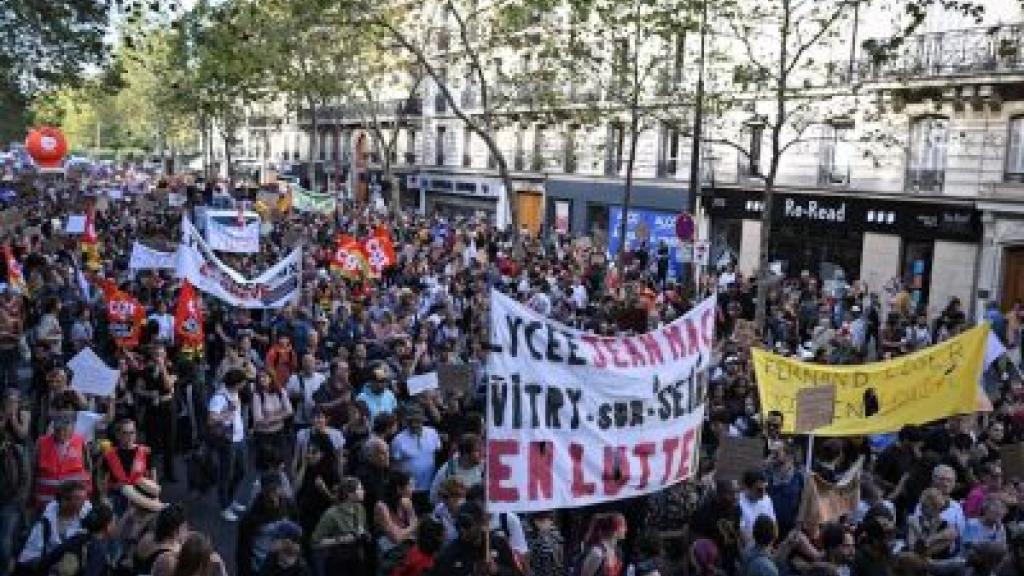
In Hexagonal France, secondary-school students have been mobilising since 18 September to protest against the lack of resources in the national education system, which prevents them from pursuing their studies properly and looking to the future with confidence. The first mobilisation took place in Créteil, following a teachers’ strike at Saint-Exupéry secondary school. Very quickly, many other schools across the country followed suit, particularly in the poorest areas, such as Seine-Saint-Denis.
Protests had already broken out earlier in the overseas territories (Mayotte, French Guiana, the Antilles, etc.), but they had been ignored — there was no mention in the media, which now claims that the protests began in September. The erosion of the national education system, and of public services more generally, affects residents of the overseas territories more severely. They have less money to live on, problems accessing essential services such as water, inadequate infrastructure and greater social inequalities: unemployment is two to three times higher than in metropolitan France. They are also more severely affected by climate change. One of the main triggers is the increasing impoverishment of families living in areas that already lack the resources needed to guarantee decent living conditions.
How did it spread and become a national protest movement?
Through social media, many Parisian secondary schools joined the movement ‘in solidarity with the 93’. This refers to the department of Seine-Saint-Denis, a largely working-class area in the northeastern suburbs of Paris where blockades have been particularly widespread. The movement then spread throughout the country. Many other movements quickly expressed their support for the secondary-school students, beginning with university students, who had already mobilised at the start of the month to protest against the risk of universities being privatised.
In my view, media coverage and government repression raised awareness among some people who had traditionally shown little solidarity with young people from working-class neighbourhoods. Many university campuses were closed, including institutions that have historically been reluctant to protest, such as the private Institut Catholique de Paris. Better-resourced Parisian secondary schools, including some private ones, also organised blockades. Public-sector trade unions, including those representing teachers and firefighters, also joined the movement. The firefighters had mobilised at the same time after having had to confront months of record summer heat and fires with ever fewer resources. Former prime minister Gabriel Attal had notably cancelled an order for two new Canadair firefighting aircraft.
This is therefore an unprecedented mobilisation, bringing together a wide range of people exasperated by the deterioration of French public services. A major Yellow Vests mobilisation has also been called for 17 October.
What are the demands of the movement and are they evolving as the protest grows?
There are a wide range of demands, but most concern the underfunding of national education and public services, a consequence of the accelerating liberalisation of the country over several decades. Secondary schools have suffered funding cuts for several years. Urgent repairs cannot be carried out, particularly in the poorest areas on the outskirts of Paris. Buildings are poorly insulated (making indoor temperatures almost unbearable in summer and winter), and there are either not enough toilets, or they are not always available.
Where the uprisings began, secondary-school students are demanding the resources they need to study in decent conditions, particularly the effective replacement of teachers who are absent. In the vast majority of secondary schools, most pupils are missing at least one teacher because of inadequate staffing. Even when teachers are absent for long periods (as much as several months), they are not replaced, except in the years leading up to examinations. Teachers are only recruited from within their own educational district, which means that sometimes there are fewer applicants than vacancies. In Seine-Saint-Denis, a pupil loses an average of between 12 and 18 months of learning over the course of their schooling; that’s above the average for French pupils. Because of the increasing impoverishment of society, nearly one in four children have to skip at least one meal a day. School meals are supposed to be affordable, but the dilapidated state of schools in the suburbs makes these meals unfit to eat, with food sometimes contaminated by parasites or insects.
Access to water is also a very important demand because a considerable number of schools, especially in overseas territories, lack access to drinking water. Some schools are even contaminated, with faecal matter found in tap water. Finally, students are demanding decent premises: for example, many secondary schools and universities have mould in their buildings, which is extremely dangerous for respiratory health; cracked ceilings collapse onto pupils or staff; there are sometimes rats; and prefabricated classrooms intended as temporary solutions have remained in place for 20 years. University students are also demanding more affordable access to housing.
How is it organised? There are always challenges for such movements, with tension between horizontal and vertical forms of organising. Is a form of national organisation emerging or is this still a collection of local organisations?
What is notable about the emergence of this movement is that it was organised by the secondary-school students themselves. They organised independently and succeeded in coordinating their actions. Some, after ending their own blockade, went to support students at neighbouring schools or in nearby towns.
This large-scale mobilisation naturally drew organisations and trade unions into the struggle, while ensuring that they did not impose a top-down organisational structure. Social media also enabled young people throughout France to come together and create large-scale movements nationally, rather than limiting mobilisation to the local level. For example, a call to ‘retake the Bastille’ emerged on social media, leading to one of the largest gatherings on Thursday 8 October. This is a reference to the storming of the Bastille on 14 July 1789, during the French Revolution, commemorated on France’s national day.
There are some suggestions that this is broader than just about issues of schools; it is a mobilisation also against the rise of the right – a youth response to that, in the light of elections coming next year. How far is that the case?
Beyond demands relating to education, the movement has also taken a stand against neoliberal and far-right policies. This is not surprising when one considers that the parties supporting President Macron have voted together with France’s largest far-right party, the Rassemblement National (RN), on as many as 86% of its measures in the National Assembly. Many slogans have been heard, including ‘Everybody hates the RN’, ‘Youth says fuck the National Front’ (the RN’s former name), and the Italian slogan ‘Siamo tutti antifascisti’ (‘We are all anti-fascists’), making clear that young people reject reactionary policies. Record youth participation is anticipated in the next presidential election, and nearly one young voter in two is considering voting for Jean-Luc Mélenchon, the candidate of France’s radical left.
There’s a lot of violence against the protestors, with reports of 215 students and 85 teachers badly injured. How are the students responding to this?
Unfortunately, the number of abuses committed against secondary-school students has increased dramatically since you asked your question. This unjustified violence has deepened the already widespread distrust of the police and other public institutions. Many elected representatives of La France Insoumise (LFI), the movement represented by Jean-Luc Mélenchon in presidential elections, have supported young people facing violence. They have even gone as far as to intervene directly against the police, as the mayor of Saint-Denis, Bally Bagayoko, did. He and other elected representatives have also been roughly treated by the police.
Reactions have varied: some young people are terrified of an institution that is supposed to protect them but instead chooses to repress them, while a whole section of the population is outraged. They include elected members of the radical left, but also parents, teachers and lawyers mobilising to defend the children.
There are reports that university students, parents, and also workers are becoming mobilised. To what extent is this true?
Large numbers of activists, parents and workers have mobilised alongside the young people. Some have formed human chains in front of the pupils to act as a barrier against the security forces. This is very important: the mobilisation has grown and is supported by a much broader section of the population than university and secondary-school students alone.
This unprecedented mobilisation presents an opportunity to put intersectionality and the convergence of struggles and demands across society into practice, as people express concern about the country’s future. Although many elected representatives and trade unions are present alongside the young people, they leave the young people at the front of the demonstrations, to emphasise the desire for change expressed by Gen Z and those who are even younger.
We have heard that, unlike other youth uprisings (including ours here in 2015), political party representatives are being welcomed rather than being treated with suspicion as opportunists. Is that the case? If so, why?
Many movements and political parties have joined the movement, but it is important to distinguish between them on the basis of what they say and what they do. The vast majority of parties that have joined are on the Left or identified with the Left. But there are significant differences in how they act. On one side are movements such as La France Insoumise, whose elected representatives have put themselves on the front line to protect young protesters from police violence. This movement is committed to responding to secondary-school students’ demands and investing heavily in education. As a result, its representatives and activists are welcomed by secondary-school students and young people.
On the other side is a significant section of ‘social democracy’, represented in particular by the Socialist Party, which has long demonstrated that it is neither social nor democratic. Its elected representatives promise support for young people in struggle, but their record when in power paradoxically demonstrates the opposite. Former president François Hollande, from the Socialist Party, was responsible for the largest cuts to funding for French public schools (before Emmanuel Macron) and facilitated Macron’s rise to power by appointing him economy minister. The right and far right have not even deigned to pretend to listen to the young people, preferring to call them ‘thugs’ and ‘layabouts’ on television. There is therefore only one bulwark left against the destruction of public education in France, which is why the radical left enjoys so much support among young people today.
Of course, as activists from far away, as soon as we hear of a student uprising in France, we think of May 68. We are probably dreaming. To what extent is there any resemblance?
There are strong parallels with the events of May 1968. Although the current movement has not yet reached the scale of that uprising, it is one of the largest youth mobilisations since then. The French government has expressed fears about the movement continuing, and some people are describing the days ahead as ‘the return of the Yellow Vests’, the mass movement that brought the country to a standstill in 2018 and 2019, with a first mobilisation planned for 17 October
It is encouraging to see that France’s young people still recognise that the French people are revolutionary by nature and have always known how to rise up when those in power take away their rights. Today, Gen Z and those who follow must decide: would they prefer to continue with a neoliberal system that is preparing to put the far right in power in 2027? Or are they ready to break with the logic of dismantling public services by rebuilding a new, more egalitarian society through the creation of a Sixth Republic, as advocated by La France Insoumise and Jean-Luc Mélenchon?