‘People, not generals, win wars’: Independent student organising in Ukraine
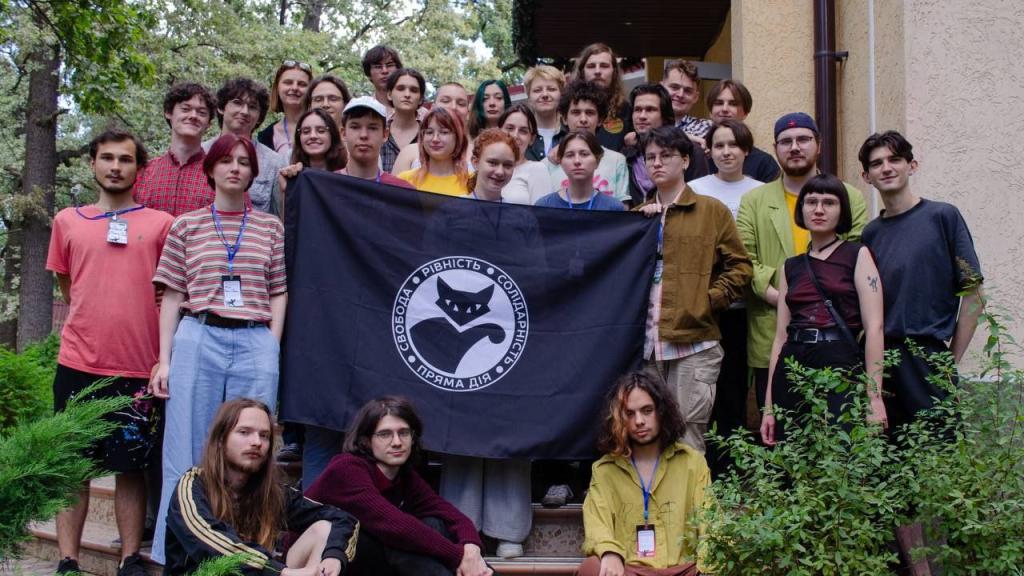
Priama Diia, meaning “Direct Action,” is an independent student union in Ukraine and a unique, vital example of grassroots working-class resistance. Refounded in February 2023 amid Russia’s full-scale war on Ukraine, the union has consciously built a horizontal, anti-bureaucratic structure to fight what it sees as the “yellow” state-affiliated unions that dominate universities. Operating in the shadow of war, martial law and a government it criticises for neoliberal policies and authoritarian tendencies, Priama Diia argues that the fight for free, quality public education is inseparable from the struggle against Russian imperialism and the Ukrainian state’s pro-business agenda.
Their work is a powerful example of how to organise for social and economic justice in an extreme context — and the union is actively seeking international solidarity. To learn more about their grassroots model, Florence Oppen spoke with Priama Diia activists Dzvinka and Aistra (names changed), who explained how they function and organise on the ground.
You have described yourselves as fighting on a “double front” — against Russian imperialism and against the Ukrainian government’s neoliberal policies. Can you explain how the war has both enabled the government to push through policies such as university “optimisation” and cuts to social spending, while also creating a new space for organising and demanding a different future?
Dzvinka: The Ukrainian government has increasingly treated education, healthcare, housing, and other social expenses as costs to be reduced rather than public goods to be defended. Centralisation (mainly via mergers) and commercialisation (mainly through attacks on universal coverage in favour of user pays) were on the government’s agenda long before the war started. The Russian invasion acted as an accelerator; students, teachers and staff are expected to accept ever worse conditions and higher insecurity under patriotic motifs, while oligarchs receive further tax cuts.
In our view, however, collective self-defence realities reveal how vital education and democratic self-government are for people to protect themselves. We document problems, put collective pressure on authorities, volunteer to help our fighting comrades materially, and keep our eyes on the goal of universal high-quality public education and dignified and participatory conditions for students and staff.
Aistra: The war has revealed a series of paradoxes to Ukrainian society. The first of these is that people have come to feel the need for large-scale structures such as the army — even anarchists have joined the army, because at present it is the only possible form of direct resistance against such a powerful empire as Russia. Meanwhile, civilians, faced with a humanitarian crisis, have come to realise the need for consistent social policies. At the same time, the masses have come to understand their own strength, since economic and military activities rely precisely on them. It is not generals and leaders who win, but the people themselves, upon whose shoulders all these challenges have fallen.
The second paradox is that Ukrainian society must unite to become stronger, but the government often does not facilitate this by making decisions that favour the minority. These two factors have led people to increasingly unite around common demands and actions, either opposing or supporting large institutions. This inevitably means an escalation of these contradictions in the future, but right now we find ourselves in a precarious position, balancing between an external aggressor and internal problems. The task of our union and progressive forces is to turn this situation to the majority’s advantage.
In a war that has destroyed so much, you argue that free, accessible education is vital for survival and post-war reconstruction. What is the concrete vision you are fighting for? What are your immediate campaigns? Can you tell us about your efforts to force universities to carry out essential repairs in dormitories?
D: Let me reiterate some of our long-term goals. First, universities must be free, accessible and ecologically sustainable — education is the foundation of survival in the modern world, let alone any reconstruction and progress. Second, students, teachers and staff must all be allowed and encouraged to participate in democratic self-governance — anything about our material conditions must be decided upon from the bottom-up with our involvement. Third, scholarships must match the minimum wage, since our education is active full-time intellectual labour.
For our immediate campaign efforts, we begin by speaking with students who live in dormitories and documenting their problems and stories through photos and videos. We turn individual complaints into collective demands, identify which institution is responsible, and request concrete explanations and timetables for fixing the issues. If the administration keeps delaying the work or treating our demands like a favour for them to grant or reject, rather than a student right that is their job to administer, we escalate through demonstrations involving the press and viral social media publicity. Winning a repair is not by itself a radical transformation of the university, but it creates relationships, practical experience in collective action and a foundation for grassroots belief that we can achieve more together.
A: It may not be obvious, but sometimes a radical campaign can start with the most basic things. We simply drew attention to the fact that many Ukrainian universities lack a cafeteria and access to free drinking water. They used to exist, but they were removed or privatised in the name of “efficiency.” As a result, students have to make do and buy bottled water at a higher price. To speak out against this is to challenge the status quo by appealing to absolutely basic needs — needs that even our opponents usually understand.
Right now in Lviv, such simple considerations have led to plans to take over an old, unused university building and, together with the students, set up a cafeteria on their own — without the government or private capital. In my view, this is a truly revolutionary practice capable of serving as a bridge between a basic social demand and the university’s broader revolutionary path. Moreover, it would mean genuine student control over this process.
Another telling example is how, last year, we secured a major renovation of the dormitories, where conditions had been simply appalling. The administration did not respond to statements and appeals, but we helped students organise and form unions — and, thanks to two major protests, they achieved their goal. The struggle at this educational institution is still ongoing, and we remain actively involved. Of course, these are just a few examples, but in my view, they say a lot.
In July 2025, you joined mass anti-corruption protests that became known as the “cardboard revolution,” which forced the government to back down. You said this showed mass action is no longer “taboo”. How has this moment changed the political landscape for organising in Ukraine? Do you see it as a turning point for social movements or was it a unique moment that may not be repeated?
A: At the start of the war, we were practically the only group organising people for protests. We wrote educational materials explaining that this was legal and highlighted our successes, but we still faced scepticism. After the “cardboard protests,” protesting became the norm. It was a small “May ’68,” after which there was no turning back. The government got scared after that and has been trying to put a spoke in the wheel of mass movements, but in doing so, it faces even greater resistance. My prediction is positive in this regard.
D: Cardboard protests became a blueprint for simple and inexpensive political demonstrations all over the country, leading to high youth participation. However, they were organised and promoted by media personalities with a different agenda, and online communities dedicated to them are filled with right-wing libertarians and nationalists, even overt old-school boneheads, that are hostile to any declarations or symbols of social justice movements. In one case, the libertarians called the police on Priama Diia, trying to force us out.
Corporate social platforms also seem to have lowered the reach of cardboard protests that leftists organise, for example, against neoliberal reforms of public transit, with rising prices costing a lion’s share of student scholarship. Individual accounts trying to invite participation in relevant discussions about public transit repeatedly got shadow-banned or limited on Facebook and Instagram, though, curiously, not on TikTok.
Regarding the mainstream, neoliberal-led cardboard protests, most of us support NABU (National Anti-Corruption Bureau of Ukraine) and SAPO (Specialized Anti-Corruption Prosecutor’s Office),1 because anti-corruption investigations help money allocated to social programs reach intended recipients. But we are split when it comes to supporting specific political figures, such as [First Deputy Prime Minister and Minister of Digital Transformation Mykhailo] Fedorov, given their technocratic, marketing-driven, anti-information security positions and their good terms with oligarchs such as Elon Musk (which would be impossible without a certain anti-social mindset).
In general, we realise that while we can and should critically join the existing political movements when our demands at least partially match, we have to keep building our own mobilisation and organisation potential, as well as channels independent from corporate social media.
The government is introducing mandatory military training for university students. Priama Diia wants to “scrutinise and democratise oversight” over this process. What does that mean in practice? What are your main concerns about this training? How are you organising around it?
D: In anything compulsory, students must have a role in deciding how it should work and monitoring how it is actually done. This includes what is being taught, who selects people teaching it, and what institutions are responsible for fixing issues we bring up. Neither university administrators nor military institutions should dictate what we learn in university.
Students must not be seen as a generic reserve of humanpower units. Disabled students, working students and students already serving must be protected against discrimination and not be punished for raising concerns. Military preparation must not impose right-wing indoctrination or normalise authoritarian relations.
We will be collecting accounts from students, comparing how different universities implement the policy, and helping students understand their rights. We will consult veterans, enough of whom are among us now or were our members before graduating and remain on friendly terms. Resistance to imperialism must be based on empathy, participation and accountability.
You describe the official union structures in Ukrainian universities as “yellow unions” — organisations that formally represent students but are closely tied to university administrations. Many of these structures have roots in the Soviet-era system, where unions were integrated into state and workplace administrations rather than function as independent organisations. How do you counter this inherited model and convince students that independent, democratic self-organisation is possible and worth the risk — especially when the “yellow union” is presented as the normal or default form of student representation?
А: Yellow unions often have thousands of members; some students do not even know they are members. We recently handled a case where they tried to unlawfully expel a student. It turned out he was a member of such an organisation but the union tried to justify his expulsion and sided with the university! We were able to win that case thanks to a loophole in the law, since he was also a member of our union — though in our case by his own choice. Stories like this alone show others that such organisations are anti-social and cannot protect students’ rights in any way. But we can.
The problem is that there are very few unions like ours, so people are disillusioned with the labour movement as a whole, since their experience with unions is limited to this “yellow” model. The only way for us to combat this is through direct action.
D: An independent trade union relies on active participation of the majority of members. We implement protections against the possible usurpation of power by union leaders: our finances are transparent before the assembly, our positions are formulated collectively, and our local groups decide and act autonomously, using coordination chats only for coordination. Participation is voluntary, free of the coercion that is usual for yellow unions; when possible, we stand in solidarity with any student experiencing bad living conditions or inadequate administration responses, regardless of whether they are a dues-paying member.
Of course, we encourage them to join and suggest activities they can take part in to move us closer to our common goal. But we do not ask students to believe in abstract ideals; we show them that we are capable of changing our material conditions when we act together. Also, we do not hide the risks: hostility from the administrators or even the government is to be expected. However, whenever students choose to remain atomised or hope for protection from the yellow unions, they also risk remaining individually vulnerable to arbitrary decisions by the campus administration and government ministers. We encourage students, and we encourage each other, to actively participate in collective, democratic self-defence of their own rights.
Your union’s horizontal, anti-representative structure is central to your politics. You have coordinators for specific roles and a “Coordination Headquarters”. How do you choose them? How do you practically balance this commitment to non-hierarchical, ultra-democratic decision-making with the need for efficiency, especially as the union has grown to a hundred members?
D: We do not have central coordinators, but coordinators for working groups. They are elected at the Annual Assembly through a procedure similar to a two-winner Borda count [a ranked-choice voting system by order of preference designed to elect candidates with the broadest overall support among voters]. They are mainly responsible for reporting to the membership on what work is being led, documenting repeated procedures, and passing that knowledge to coordinators elected in their place the next year. It is a position of responsibility, not of power.
The roles are not set in stone; the assembly decides whether to give mandates, and to whom, based on annual proposals for the work to be done and how to do it. The person voicing the proposal is expected to develop a practical plan and help onboard volunteers who want to join their working group. Also, headquarters do not approve major expenditures and strategic decisions (that is, which initiatives to partner with and whether to do so); the entire membership votes on them. Headquarters exists to channel focused requests between working groups without overwhelming a hundred people with the requirement to participate in every chat and meeting, thereby reducing busywork.
A: An important principle of our work is the autonomy of local chapters and working groups. Priama Diia is often referred to as a labour union, but in my view, we should be talking about something more: depending on the type of work, we combine the characteristics of a federation of labour unions with those of a unified organisation with a single program. We encourage the formation of activist groups centred around universities — these are our primary units of action. And while we are united by shared principles and approaches, local strategies may vary — and the autonomy of each local chapter is extremely important to us.
At the same time, we organise along regional lines, since some universities have switched to remote learning due to the war; meeting in person with people who live nearby can be much easier than with students from one’s own university. However, for national campaigns and in the fight against systemic attacks on the social and educational sectors, we present a united front, as we share a common ideology forged in the class struggle. This is also how we participate in mass protests.
Your union encompasses a broad political spectrum, from apolitical students to anarchists and Marxists. How do you maintain unity and a shared vision across these differences? How does this diversity shape your campaigns — for example, do you consciously choose “social” issues (such as dormitory conditions) that everyone can rally around, rather than more overtly political ones?
D: Unlike mainstream politicians who make their positions fuzzy and implicit to reach the widest but amorphous base (as first-past-the-post elections encourage), we formulate our values and demands openly and clearly, so that people know what they are joining and are motivated by it. Our program consists of suggestions from members that we have collectively discussed, developed and voted on during the yearly assembly.
Student fight for student rights is political, so I would say if someone participates in the union, they already are not apolitical. We focus on policy proposals, not affiliation labels, while we clearly stand against authoritarianism and imperialism. As our Manifesto puts it “knowledge is an effective tool of emancipatory struggle, our response to authoritarianism and imperialism.” It also situates student organising within a broader class struggle: “Students have always been, are, and will be part of something larger — the workers’ movement.”
Practical disagreements between people with different but closely linked explicitly progressive political affiliations are far less pronounced in activist groups than in meme channels, YouTube and Reddit threads, or wide-umbrella non-governmental organisations. One interesting approach we tried, to help people understand each other’s positions better during the assembly, was asking them to come up with arguments for somebody else’s proposal, as part of randomly assigned groups.
A: I would add that in a situation where progressive forces are in the minority, where we face attacks from the far right, Russian aggression and the government’s neoliberal policies, the only strategy for survival is unity and solidarity. Of course, in our union we have political discussions, some of which are deeply theoretical in nature. For us, theory complements practice — and vice versa. However, in the past four years, I cannot remember a single instance where someone’s political stance on a specific issue hindered our work. When we are working to support and organise students, we are all working toward a common goal.
Union members have been physically attacked by far-right groups, and you have faced surveillance from the Security Service (SBU) and threats of accusations of “treason”. How does this climate of repression shape your activism? What specific tactics and challenges do you face in organising protests and building a mass movement when any demand for change can be framed as destabilising national unity?
A: We are aware that we are under threat and speak openly about this with new members of our organisation. But it is important to provide some context: first, attitudes toward law enforcement agencies in Ukraine are quite negative, and it is no secret to most people that the police and the SBU are corrupt and exert pressure on independent activists and mass movements. We inherited this from the Soviet Union, when political persecution was part of the system.
Second, we are not the only ones facing state pressure. Our case is certainly unique, but because environmental, journalistic, and LGBTQ+ movements also face similar challenges, we receive their support by extension. Recently, independent human rights organisations have been paying special attention to repression in Ukraine, and we ourselves are actively involved in investigating the situation, countering it and covering it in the media. We have adopted a strategy of maximising unity among pro-democracy movements — and so far, it is working.
One recent case illustrates this pressure particularly clearly. Maksym Shumakov, a Marxist activist, former organiser with Priama Diia in Lviv, and member of the editorial team of the Ukrainian left-wing journal Commons, is currently facing prosecution under Ukraine’s law banning Communist and Nazi symbols. The case is based on social media posts from 2021–23 that included Marxist educational materials. Shumakov and his lawyer argue these materials fall under the law’s exemptions for educational and academic purposes. Shumakov sees the prosecution as politically motivated and connected to his years of student and left-wing activism. His case has prompted a campaign for the charges to be dropped and international solidarity from left-wing organisations.
However, this is not to say it has had no effect on us. It is very stressful. The security services came to see me personally to “talk.” I managed to get rid of them, but it takes a mental toll, and I am not the only one who has gone through this. But what I do fills me with energy and confidence. And, of course, my comrades support me.
D: In agitation, we prioritise policy proposals, clear demands and mutual aid over symbols and affiliation statements. Outside the established political subcultures, moderate and radical alike, people are not stupid; they realise they have been fed bogeyman images by propaganda machines once they meet actual demonstrators, talk to us, discover shared issues and backgrounds.
Regarding a mass movement, the challenge I sadly see is people’s impulses being successfully channelled by media influencers into greatest-common-divisor protests for somebody else, for institutions and personalities, rather than for yourself, for improving your own economic and political position. That is a sprint not a marathon, and it burns people out very quickly. One other challenge without a clear answer is how to evolve from periodic protests and online reporting, which would more correctly be seen as mobilising tactics, into continuous organised effort with a realistic security culture — a powerful collective self-defence mechanism rooted in daily life at the university and workplace.
You draw inspiration from the idea of “students as workers”. How does this translate into your organising? What is your relationship with the wider Ukrainian and international labour movement? How do you build solidarity? What can international unions learn from your experience?
D: We do not just consume education as a service; we perform intellectual and creative labour through study, practice and research. Also, many of us have to work outside the university to pay for our education. Students share many issues with workers: housing, accessibility, payment (for internships), defence against harassment.
We try to integrate with independent trade unions around shared demands over public services and social rights. We participate in each other’s educational events, support each other’s media campaigns and exchange experience. We hope that participating in a student trade union helps activists enter new workplaces prepared with knowledge of the benefits of democratic control and the power of solidarity. Also, we expect student campaigns to become stronger once we figure out how to build bridges with workers who remain in the university after graduation — the teachers and staff.
From our experience, international labour unions can learn that students are not a separate body, a temporary population outside the working class, but also workers (future and current), and active participants in the production of knowledge and its practical application in our society.
A: When the government infringes on the interests of working people, it affects both workers and students alike. For example, when the Kyiv city council raised public transportation fares, students and nurses were hit the hardest, as the new prices proved to be a hardship for them. This naturally creates an opportunity for solidarity, and we stood together at the protests.
People who are no longer students and have left our union have also founded a new organisation called Workers’ Perspectives. They decided to pursue blue-collar careers together and study the working class from the bottom up, with the goal of building a new movement based on their experience as student activists. Of course, we would like to expand our cooperation with the working class; however, it is characteristic of Ukraine that independent workers’ organisations are in an even more dire situation than student organisations. The rise of our labour movement is still ahead of us — I truly hope that we will play a part in bringing it about.
Your union is a member of the International Labour Network of Solidarity and Struggles. What are the most effective ways for international supporters to show solidarity with your work beyond simple fundraising? What kind of support — material, political, or organisational — is most helpful to you right now?
A: Resistance against empires is usually successful when the people fighting are supported by mass movements around the world. The US defeat in Vietnam, France’s defeat in Algeria, and the Palestinian Intifada unfolding right now are examples of this. We need wider publicity of the Ukrainian situation and our struggle, first and foremost among progressive circles. We need supporters to participate in demonstrations in support of the Ukrainian resistance and condemning Russian and US imperialism, as well as those supporting other self-determination struggles in Palestine, Iran and elsewhere.
At the same time, we must spread the word about what is happening to our comrades in Ukraine — we know for certain that the Ukrainian government fears a negative perception of itself abroad, so public demonstrations outside the embassy can significantly influence its actions. This can translate into social victories here in Ukraine.
D: It is important not to understate the value of fundraising: with the cost of living in Ukraine skyrocketing, student scholarships remaining tiny and covering very few people, salaries stagnating, and many students migrating abroad, it is difficult to rely on dues and still cover legal assistance for our members under pressure from the university administration and the government, achieve moderately accessible conditions for the assembly, print and spread materials, maintain independent online presence, travel for intercity and international solidarity etc.
But money alone cannot build a union. So, please translate our materials (do not leave the burden on those of us who are more integrated with the European Union and speak languages of former empires — try also learning ours as we do yours!). Share our statements. Help us remain visible as organisers and self-defenders — in need of returning at least some resources that the centres keep extracting from the periphery — not as victims or objects of top-down reforms and the war.
When we protest, we organise solidarity demonstrations and communicate them through the media. The state puts considerable resources into ensuring that international audiences see its humane façade. Take, for example, the protests around Fedorov, a prominent government figure who became closely associated with its digitalisation and technology-driven modernisation agenda. When he was removed as defence minister in July 2026, a new wave of the cardboard protests demanded he be returned to the position. We support the democratic initiative and willingness of the public to criticise officials and make demands, but while some of our members critically participated in the mass movement with this motivation, in general we remember the lessons of Maidan and remind people that we must not let opportunistic politicians reap the fruits of our effort and make careers on the shoulders of the masses.
Whatever one thinks of Fedorov, mobilisations centred on who occupies a government post do not in themselves require significant material concessions from the state or challenge its broader neoliberal economic agenda. By contrast, grassroots student initiatives making direct economic demands — for increased scholarships, affordable public transportation, better dormitory conditions or greater public investment in education — are different: meeting these demands requires resources and changes in policy. Such campaigns can only achieve comparable visibility and protect themselves against repression if they receive grassroots, global and independent support.
A: I would like to add that the Ukrainian revolutionary movement is still in a fairly early stage. We also need advice on how to build mass movements. Since the Ukrainian leftist tradition was cut short during the Soviet era, we are basically starting from scratch. Of course, we are constantly learning and improving based on our own experience, but it is always valuable to draw on the experience of other comrades. For example, we are actively studying the experiences of Polish and French student organisations, as we are in contact with them through the International Labour Network of Solidarity and Struggles. And we are open to new knowledge — simply sharing experiences can be helpful to us.
- 1
NABU (National Anti-Corruption Bureau of Ukraine) and SAPO (Specialized Anti-Corruption Prosecutor’s Office) are Ukraine’s principal institutions for investigating and prosecuting high-level corruption. In July 2025, parliament passed legislation subordinating the agencies more closely to the prosecutor general, prompting large demonstrations in Kyiv, Lviv, Odesa and other cities. Following the protests, parliament restored their independence on July 31.