Africa
South Africa’s ANC: things fall apart
BY Dale T. McKinley, Johannesburg
November 15, 2008 -- At some point in the not-too-distant future, we might just look back at 2008 as the year in which things really started to fall apart for the African National Congress (ANC).
Africa’s oldest liberation movement, which has enjoyed overwhelming political hegemony and electoral success since South Africa’s democratic breakthrough in 1994, is in deep trouble.
Crucially, this is not mainly as a result of the more recent domestic manifestations of the ever-widening crisis of capitalism nor of any kind of immediate threat to its 18-year hold on political power.
It is rather more simple — the “big happy family” whose members range from crypto-communists to die-hard capitalists, from ethno-nationalist chauvinists to cosmopolitan liberals — is beginning to break apart because there remains little to hold the heterogeneous clan together anymore.
Close the US military base on Diego Garcia! Complete the decolonisation of Mauritius!

US-occupied Diego Garcia
By Lindsey Collen, Lalit (Mauritius)
October 26, 2008 -- Five separate judgments were handed down in the House of Lords’ October 22 judgment on the appeal of the British government against the Chagossians’ right of abode on Diego Garcia. Lords Hoffman, Rodger of Earlsferry and Carswell found against the Chagossians’ right of abode, while Lords Bingham of Cornhill and Mance found in favour. In this article, we’ll summarise the arguments the judges relied upon and also briefly comment on the numerous mentions of Lalit in the judgment, before moving on to the question of Diego Garcia in more political terms; the illegal military occupation of Diego Garcia and the Chagos islands by the British and US, which is the reason for the horrendous banishment of the Chagossians from their home islands is an eminently political problem.
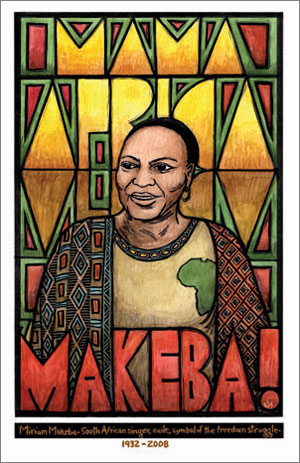
By Ricardo Levins Morales
Miriam Makeba passed away on November 10 at a concert in Italy. The link below is to a poster I made in tribute to Makeba as soon as I heard the news.
When I was a child, my father would occasionally travel to the United States. When he returned to Puerto Rico he would sometimes bring back a music record. Sometimes it would be Makeba. I only understood the words to a few of the songs she was singing (Makeba sang in many languages), but I understood the sprit and the rhythms. The sounds of drumming has always made sense to me. I also new that she was in some way connected to the struggle for a better world.
Miriam Makeba was banned from her homeland by the apartheid regime after addressing the United Nations committee on apartheid and spent the next thirty years in exile. As with all of those who pass out of this world she will continue to be with us as long as we carry her. This poster tribute is one more vessel in which to bring her along with us. The road toward justice is a long one. I know that as long as I walk it Miriam Makeba's songs will be with me.
Can Africa survive Obama's advisers?

Hamba kahle Mama Africa (Miriam Makeba)
Mama Afrika (Miriam Makeba) passes, November 10, 2008
Congo: Western intervention behind bloodbath
By Tony Iltis
November 7, 2008 -- Despite Western media and politicians having largely ignored a decade of genocidal warfare that has cost 6 million lives, the recent upsurge in fighting in the east of the Democratic Republic of the Congo (DRC) has drawn not only media attention, but visits to the region by the British and French foreign ministers and United Nations Secretary-General Ban Ki-Moon.The current round of fighting in North Kivu province, which began on October 26 with an offensive by the Rwandan-backed rebel forces of General Laurent Nkunda, is indeed a humanitarian catastrophe — 200,000 people have been displaced, many not for the first time.
‘Transformation’ from above: the upside-down state of the `beautiful game' in South Africa

Bafana Bafana (and Kaizer Chiefs) supporter
By Dr Dale T. McKinley
For the better part of the past century, the most popular sport in South Africa (both in relation to public entertainment and active participation) has been soccer. From its initial introduction into South Africa as a sport played almost solely by the propertied (white) gentry, soccer quickly became, by the turn of the twentieth century, the sport of choice amongst the non-white population and white lower classes.
Meanwhile, in Africa ... a tale of two `bailouts'

Rwandan President Paul Kagame distributes mosquito nets. Studies show that malaria, which kills more than a million Africans every year, could be contained in just a few years at the cost of $3 billion a year.
By Jean-Paul Piérot
Original October 11, 2008, l'Humanité article in French: ``Et pendant ce temps, l’Afrique …''. Translated by Gene Zbikowski
While Africa needs US$72 billion a year in aid, hundreds of billions are being freed up to pay Western banks for the consequences of speculation.
New African resistance from below to global finance

By Patrick Bond
October 25, 2008 -- A far-reaching strategic debate is underway about how to respond to the global financial crisis, and indeed how the North's problems can be tied into a broader critique of capitalism.
The 2008 world financial meltdown has its roots in the neoliberal export-model (dominant in Africa since the 1981 World Bank Berg Report and onset of structural adjustment during the early 1980s) and even more deeply, in 35 years of world capitalist stagnation/volatility. Africa has always suffered a disproportionate share of pressure from the world economy, especially in the sphere of debt and financial outflows. But for those African countries which made themselves excessively vulnerable to global financial flows during the neoliberal era, the meltdown had a severe, adverse impact.

John Pilger: The downfall of Mbeki -- The hidden truth
By John Pilger
October 7, 2008 -- The political rupture in South Africa is being presented in the outside world as the personal tragedy and humiliation of one man, Thabo Mbeki. It is reminiscent of the beatification of Nelson Mandela at the death of apartheid.

This is not to diminish the power of personalities, but their importance is often as a distraction from the historical forces they serve and manage. Frantz Fanon had this in mind when, in The Wretched of the Earth, he described the "historic mission" of much of Africa's post-colonial ruling class as "that of intermediary [whose] mission has nothing to do with transforming the nation: it consists, prosaically, of being the transmission line between the nation and a capitalism, rampant though camouflaged".
Mbeki's fall and the collapse of Wall Street are concurrent and related events, as they were predictable. Glimpse back to 1985 when the Johannesburg stock market crashed and the apartheid regime defaulted on its mounting debt and the chieftains of South African capital took fright.