Asia
Thailand: Comparing the 1976 and 2006 coups
By Giles Ji Ungpakorn
India: Lalgarh’s battle for dignity and justice
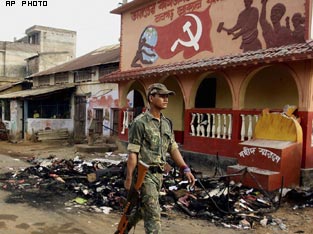
By the Communist Party of India (Marxist-Leninist) Liberation
September 27, 2009 -- The following appeared as the editorial in the July 2009 issue of Liberation, the central organ of Communist Party of India (Marxist-Leninist) – CPI (ML). Since then, while the paramilitary campaign in Lalgarh has ended, repression against the adivasi (tribal) people of Lalgarh continues, with incidents of rape and violence reported. It must be remembered that the People’s Committee against Police Atrocities (PCPA) began in Lalgarh after adivasi women were sexually assaulted by police during an anti-Maoist raid; one woman was blinded. The state government of West Bengal [formed by the pro-business Communist Party of India (Marxist)-led Left Front] initiated an enquiry that established the assaults had taken place – but only offered some monetary ``compensation’’ to some of the victims, refusing to meet their demand of punishment for, and a public apology by, the police authorities concerned.
East Timor: The struggle for full independence — 10 years on

By Mericio Akara, translated by Vannessa Hearman
September 30, 2009 -- Dili -- What is commemorated as Timor Leste’s (East Timor) “liberation” is the United Nations-facilitated referendum on August 30, 1999.
East Timor, which had been a Portugese colony, was already an independent country, as a result of the pro-independence political party Fretilin declaring East Timor independent on November 28, 1975. But barely days after the independence proclamation, on December 7, 1975, the Suharto dictatorship in Indonesia used all its military firepower to invade Timor Leste.
The invasion was brutal and the occupation lasted 24 years before the UN referendum in 1999. During the occupation, the Indonesian military tortured and slaughtered our people. Such terrible acts became an everyday spectacle in Timor Leste.
Philippines: Flood relief appeal from Partido Lakas ng Masa
By Reihana Mohideen, international desk, Partido Lakas ng Masa (Party of the Labouring Masses)
Thailand: When King Pumipon dies ...

By Giles Ji Ungpakorn
People's Republic of China at 60: socialist revolution, capitalist restoration

[Click HERE for more analysis of the Chinese Revolution and its evolution.]
By Chris Slee
September 23, 2009 -- October 1 will mark 60 years since Mao Zedong proclaimed the creation of the People's Republic of China. This followed the victory of the People’s Liberation Army, led by the Communist Party of China (CCP), over the US-backed Kuomintang (Chinese Nationalist Party, KMT).
In 1921, when the CCP was founded, China was in chaos. Western intervention — military, economic, political and cultural — had destroyed or undermined traditional Chinese institutions. New, stable institutions had not been created. Various imperialist powers grabbed pieces of Chinese territory.
Some modern industry was established, mainly in the coastal cities. But most Chinese people were peasants, heavily exploited by big landowners.
People's Republic of China at 60: Maoism and popular power, 1949–1969

Youth demonstrate during the Cultural Revolution.
[Click HERE for more analysis of the Chinese Revolution and its evolution.]
By Pierre Rousset
With the proclamation of the People’s Republic of China on October 1, 1949, the Chinese Communist Party (CCP) found itself at the head of a country three times larger than Western Europe, with a population of some 500 million. The internal situation was favourable to the revolutionary regime. At the end of a long series of civil and foreign wars, the population sought and relied on the new leaders to achieve peace while the ongoing people’s mobilisation opened the way for a deep reform of society.
People's Republic of China at 60: 1925–1949 -- Origins of the Chinese revolution

Los! Hau Bele! -- `Yo! Si Puedo' comes to Timor Leste: Cuba assists the eradication of illiteracy

By Bob Boughton
In Timor Leste [East Timor], which is one of the world’s newest countries and Australia’s poorest Asia-Pacific neighbour, Cuba is delivering an educational aid program which aims to eradicate illiteracy, currently affecting nearly 50% of the adult population, within a period of less than 10 years. The Timor Leste national literacy campaign, utilising the Cuban-developed Yo! Si Puedo (Yes! I can) audiovisual teaching method, opened its first classes in the capital Dili in June 2007.
Eighteen months later, by December 2008, nearly 18,000 adults had completed a course of 65 lessons, led by local village monitors who work under the close supervision of 36 Cuban education advisers deployed throughout the country. If it continues at this rate, the literacy campaign can be expected to have a major impact on the stabilisation and development of Timor Leste, providing a model for other Pacific countries struggling to overcome their educational disadvantage.
Coup anniversary reveals two faces of Thailand

PAD organised a demonstration on September 19 to attack Cambodian villagers at the anc
Thailand: The September 19 coup, three years on
By Giles Ji Ungpakorn
On September 19, 2006, the Thai army staged a coup toppling the elected government of Prime Minister Thaksin Shinawatra. Soldiers sported yellow royal ribbons and the military junta claimed that it was staging the coup to protect ``democracy with the king as the head of state’’. It certainly was not protecting democracy, but most Thais believed that this was indeed a “royal coup”.
The coup came after mass street demonstrations against the elected government by the royalist and conservative Peoples Alliance for Democracy (PAD), in which many PAD members and leaders of the so-called Democrat Party had called for the king to sack the elected prime minister and appoint another one. Later, the yellow-shirted PAD took on a semi-fascist nature, using extreme nationalism and having its own armed guard. The PAD used violence on the streets of Bangkok.
The rise and fall of the Communist Party of Thailand
September 9, 2009 -- ESSF -- The communist movement was first established in Siam (renamed Thailand in 1939) mostly in the Chinese ethnic migrant communities, then proliferated in the seemingly disparate surrounding regions in the north, northeast and south of the country. Following a long, difficult period of transition, the Communist Party of Thailand (CPT), once an urban party, retreated to the jungle and engaged in armed struggle. Its national expansion, during the 1970s, occurred while the kingdom was transformed into a US base for military intervention in the Vietnam War. The party eventually saw its decline during the Sino-Indochinese conflict of 1978–9 and disappeared from sight in the mid-1980s.