Indigenous struggles
India: Statement condemns government military offensive against the Indigenous people

Adivasi women protest in West Bengal.
October 14, 2009 -- Sanhati is a collective of activists/academics who have been working in solidarity with peoples' movements in India by providing information and analysis (see http://www.sanhati.com).
We have been profoundly disturbed by the Indian government's reported plans to launch an unprecedented military offensive in the huge forested regions of central India, populated by millions of Indigenous tribes (adivasis), for stamping out an alleged Maoist insurgency. We feel that this will be a democratic and humanitarian disaster. Hence we have taken the initiative, in consultation with progressive intellectuals, to draft a statement of protest against the Indian government's military offensive and have circulated it among democratic and peace-loving citizens of India and the world for endorsement.
Below is the statement, the list of signatories (which includes many eminent intellectuals/academics) and a background note which puts the current conflict into perspective.
To Dr. Manmohan Singh Prime Minister,
Science and empire in the Pacific

Mai (aka Omai), the first Pacific Islander to visit Europe, with Joseph Banks in 1774. Painting by William Parry.
By Barry Healy
More than 240 years ago, on April 13, 1769, the peace of Tahiti was interrupted by the visit of Captain James Cook, supposedly observing the transit of Venus across the Sun, but really following secret orders to investigate the Pacific Ocean and its islands for the benefit of British colonialism.
Mainstream Australian history raises James Cook to a pinnacle because he established a white, British dominion on the Australian continent. However, at the time his fame was eclipsed because on board his ship was gentleman scientist Joseph Banks with a posse of staff.
Banks’ star outshone Cook’s because his work acquired the botanical treasures of Oceania for the British Empire, paving the way for Britain to dominate vital areas of science for its own benefit.
Photo essay: Guatemalan Indigenous communities resist violent eviction by Canadian mining company
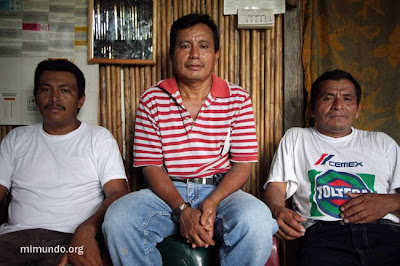
Story and photo essay by James Rodríguez, Barrio La Union, El Estor, Izabal, Guatemala
September 28, 2009 -- MiMundo.org -- (Unless indicated, all photographs were taken in June 2009.) As a result of a frustrated eviction attempt in the community of Las Nubes in El Estor, Izabal, Adolfo Ich Xaman (middle in photograph above) was brutally shot and killed by private security guards subcontracted by the Guatemalan Nickel Company (CGN), local subsidiary of HudBay Minerals Inc., a Canadian mining company.
Mr. Ich Xaman was chairperson of the Community Committee for Development (COCODE) of the nearby Barrio La Union community, a primary school teacher, and brother-in-law of Ramiro Choc, a high-profile imprisoned Indigenous and peasant leader. During the attack, the following men were also shot and injured: Samuel Coc, Ricardo Tec, Alfredo Xi, Haroldo Cucul (left in the photograph), Alejandro Acté, Luciano Choc, Hector Choc and Guzman Chub.


July 29, 2009 -- For Pacific islanders, climate change is not a threat looming somewhere in the future. Rising sea levels and unpredictable weather are having devastating effects right now. Climate change has already forced some communities to leave their traditional homes.Simon Butler spoke to two climate change activists from the Pacific about their campaign for immediate cuts to global greenhouse emissions.
Pelenise Alofa Pilitati is the chairperson of the Church Education Directors' Association in Kiribati. Reverend Tafue Lusama is the chairperson of the Tuvalu Climate Action Network. They are on an Australian speaking tour through July and August, which is co-sponsored by Greenpeace and Oxfam. For details of the tour go to http://www.greenpeace.org/australia/news-and-events/events/pacificvoicestour-300609.
* * *
Simon Butler: What are you hoping to achieve with your speaking tour?
Raúl Prada Alcoreza: Analysis of Bolivia's New Political Constitution of the State
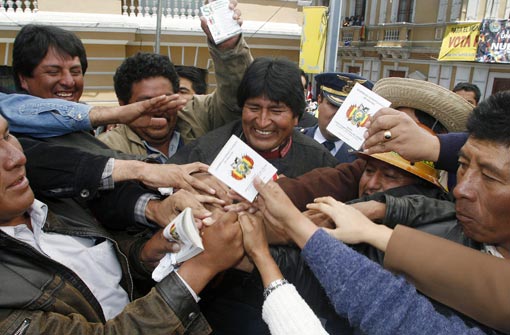
Bolivians celebrate their new constitution. President Evo Morales in centre.
The following article by Raúl Prada Alcoreza was originally published in the first issue (June 2008) of Crítica y Emancipación, a biannual Latin American journal of the social sciences. This translation from the Spanish, by Shana Yael Shubs and Ruth Felder, was published this year in a complete English-language version of the journal’s first issue. It was distributed at the recent congress of the Latin American Studies Association, held in Rio de Janeiro, Brazil, in June. A review of the first issue of Crítica y Emancipación was published at http://tinyurl.com/nuk4jp. This article also appeared at Bolivia Rising.
Latin America: Manifesto of the First Continental Summit of Indigenous Women
Puno, Peru – May 27-28, 2009 – We, indigenous women gathered in the sacred lands of Lake Titicaca, after two days of discussions and deliberation raise our voices in these times when Abya Yala’s[1] womb is once more with chi
Interview with Bolivia's foreign minister: `Communitarian socialism will refound Bolivia’
Interview with Bolivia’s foreign minister David Choquehuanca by Patricia Bravo and Cris González, translated from the original article in the March 20, 2009, edition of
Shell on trial: Landmark trial set to begin over Shell’s role in 1995 execution of Nigerian human rights activist Ken Saro-Wiwa
May 26, 2009 -- Democracy Now! -- A landmark trial against oil giant Royal Dutch Shell’s alleged involvement in human rights violations in the Niger Delta begins this Wednesday in a federal court in New York. Fourteen years after the widely condemned execution of the acclaimed Nigerian writer and environmental activist Ken Saro-Wiwa, the court will hear allegations that Shell was complicit in his torture and execution.
Guests:
Steve Kretzmann, executive director of Oil Change International. He was at Shell’s annual shareholder meeting in London earlier this month and has been following the case against Shell. He also worked closely with Ken Saro-Wiwa in the last two years before Saro-Wiwa’s death.
World Social Forum returns to Brazil, marks Latin America's `swing to the left'
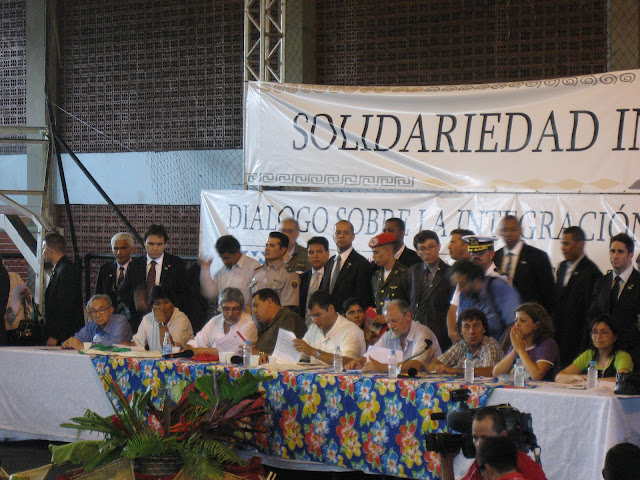
By Marc Becker
February 5, 2009 -- After an absence of four years, the World Social Forum (WSF) returned to Brazil during the last week of January 2009. More than 100,000 people descended on the city of Belem at the mouth of the mighty Amazon River to debate proposals and plan strategies for making a new and better world.
The forum first met in the southern Brazilian city of Porto Alegre in 2001 as a gathering of social movements dedicated to fighting neoliberalism and militarism. Nine years later, Latin America has shifted significantly to the left, and the forum has played an important role in that process.
The forum began on January 27, 2009, as all of the forums have, with a massive march through the streets of Belem. The theme of the march was from Africa, where the last unified forum was held in Nairobi, Kenya, in
2007, to the Amazon. A drenching tropical rain momentarily stalled the planned events. The march concluded with a massive rally featuring speeches and music.
Photo essay: Oaxaca, Mexico -- `Living Under the Trees'
A photo essay by David Bacon
Indigenous-majority Greenland wins self-government