Indigenous struggles
Bolivia's indigenous majority: Change the world by taking power
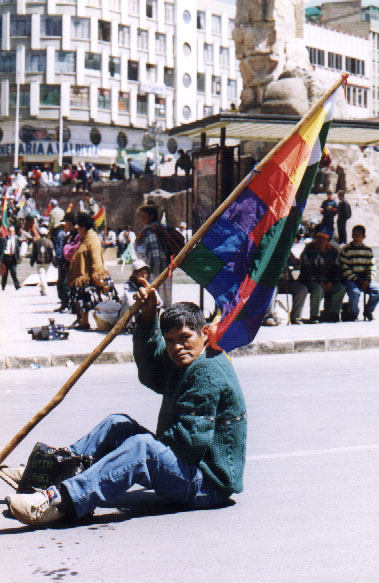
By Federico Fuentes
November 29, 2008 -- Having captured the imagination of progressives across the globe with scenes of indigenous uprisings confronting right-wing governments and multinationals, Bolivia has become a key focus point of discussion within the left regarding strategies for change.
However, starry-eyed notions and schemas rather than reality have often influenced the views of left commentators on the revolutionary process unfolding in South America’s poorest nation.
At the centre of this debate is the Movement Towards Socialism (MAS), led by indigenous President Evo Morales, and its strategy for refounding Bolivia.
After three years of the Morales government it is possible to draw some tentative conclusions about this social experiment.
Native blood: the truth behind the myth of `Thanksgiving Day' (now with video)
Video: Thanksgiving: A Native American View
By Mike Ely
It is a deep thing that people still celebrate the survival of the early colonists at Plymouth — by giving thanks to the Christian god who supposedly protected and championed the European invasion. The real meaning of all that, then and now, needs to be continually excavated. The myths and lies that surround the past are constantly draped over the horrors and tortures of our present.
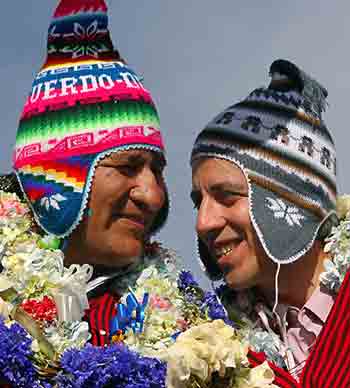
By Álvaro García Linera, introduced and translated by Richard Fidler
In the following interview, the vice-president of Bolivia, Álvaro García Linera, explains his interpretation of the changes that were made in the draft constitution, originally drafted in December 2007 by the country’s constituent assembly, as a result of the recent negotiations involving the parties represented in Bolivia’s National Congress. A popular referendum to adopt the new draft constitution is to be held on January 25, 2009. Álvaro García Linera also discusses his view of the role of constitutional change in the social transformation of Bolivia that is now under way.
Hugo Blanco: `No contradiction between my indigenous struggle and dialectical materialism'
Interview with veteran Peruvian Marxist Hugo Blanco, conducted by Yásser Gómez for
Racism, domination and revolution in Bolivia
By Adolfo Gilly
Canada: Saying `sorry' with a forked tongue
By Mike Krebs
“I want to get rid of the Indian problem. I do not think as a matter of fact, that the country ought to continuously protect a class of people who are able to stand alone… Our objective is to continue until there is not a single Indian in Canada that has not been absorbed into the body politic and there is no Indian question, and no Indian Department, that is the whole object of this Bill” — Duncan Campbell Scott, head of the Department of Indian Affairs and founder of the residential school system, 1920.
July 1, 2008 -- On June 11, 2008, Stephen Harper, prime minister of Canada and leader of the Conservative Party, issued an “apology” for the residential school system that more than 150,000 Indigenous children were forced through. The hype before and after the statement was enormous, with extensive coverage in all major media.
Peru: Miners, Moqueguanos win victory following violent government attacks

By Carlos Quiroz, peruanista.blogspot.com
June 19, 2008 (updated June 26) -- The videos you are about to see are a bit shocking. For 18 months the people of the Moquegua region (southeastern Peru) and the mining workers from that region have been seeking for peaceful negotiations with the Peruvian government in Lima.
Photo essay: Mexican indigenous front agitates for rights of migrants in the US
Text and photos by David Bacon
SANTIAGO DE JUXTLAHUACA, OAXACA, MEXICO
MAY 31, 2008 -- The assembly of the Indigenous Front of Binational Organisations in the Mixteca region of Oaxaca, one of the poorest areas in Mexico. A large percentage of the indigenous population of Oaxaca and other states has left to work in northern Mexico and in the United States. The FIOB is a political organisation of indigenous communities and migrants, with chapters in Mexico and the US. It advocates for the rights of migrants, and for the right not to migrate -- for economic development which would enable people to stay home.
Bolivia: When minorities deny the rights of the majorities
By Miguel Lora Fuentes, Bolpress (translation by David Montoute)
How true it is that nothing lasts forever. Bolivia’s exploited classes, of mainly indigenous origin, are now confronting more than five centuries of exclusion. This territory’s original inhabitants were subjugated by the cross and the sword during the colonial period, they were harassed and had their lands taken from them under the Republic, and their culture was ignored during the bourgeois-democratic revolution of 1952. Now, as they finally take state power by democratic means at the beginning of the 21st century, the dominant minority accuses them of wanting to install the ``first racist, fascist state in Latin America’’.
The current historical juncture is characterised by a profound crisis of the market economy, of liberal democracy and of the very foundations of the old republican colonial state, a monocultural, centralist and exclusionary state that has remained intact since the foundation of the Republic.
Video: Evo Morales on the Emergence of Bolivia's Indigenous Movement
Click here to watch Bolivia's President Evo Morales on the emergence of Bolivia's Indigenous movement.
Thanks to http://boliviarising.blogspot.com