Kohei Saito on degrowth, Marx and the future of the left
First published in Czech in Alarm. Translation from Notes of a Stubbornly Naive Leftist.
At a time when the world is grappling with deepening ecological and social crises, the search for alternatives has never been more urgent. In this context, the work of Kohei Saito, professor at the University of Tokyo and author of Marx in the Anthropocene and Slow Down: The Degrowth Manifesto, stands out. Saito focuses on the ecological and ecosocialist dimensions of Marx’s thought, arguing that Marx’s work contains ecological insights that have long been overlooked or misread. Although Marx did not explicitly advocate ecosocialism, Saito argues that his ecological thinking can inspire and support contemporary ecosocialist movements and policies aimed at addressing social and ecological injustice.
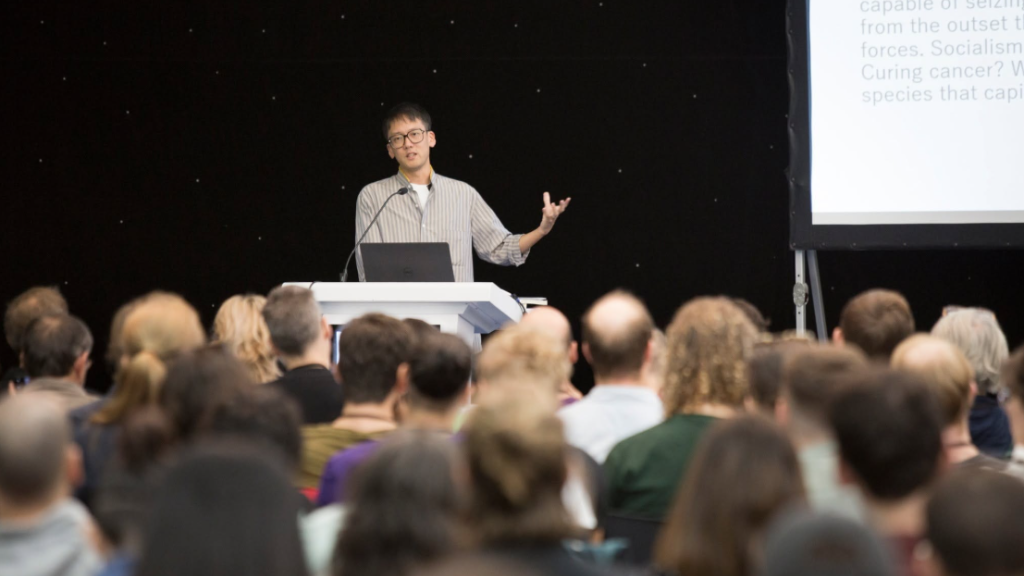
I met Kohei in Zagreb, where he was one of the keynote speakers at the 9th International Degrowth Conference, which brought together hundreds of participants from around the world, including scientists, academics, activists and politicians, to explore sustainable and just models of economy and society. His talk, titled “Marx and Degrowth: Is It Possible?,” set the tone for a wide-ranging discussion on the relationship between the degrowth movement and political approaches to the climate crisis. For me personally, this discussion was a key starting point in shaping a vision of post-growth democratic ecosocialism as a concrete direction for today’s left-wing politics, one rooted in the tradition of democratic socialism that has its origins in the Prague Spring.
How are you finding the international degrowth conference here in Zagreb, especially given its broad scope and the diverse audience it attracts?
It’s been great, especially due to the participation of many young people. That’s something very different from Japan, where discussion about Marx’s ideas often involve older people. I am very inspired by how this idea of degrowth is spreading among the younger generations and I’m very optimistic that we can build a new future together.
It also has a very broad background. Not just Marxists and activists, but also people from different disciplines: natural scientists, economists, philosophers. And it’s good that the degrowth concept is becoming so attractive to so many people. This is very important for mobilizing people. After all, it is a political idea, and this kind of attractiveness is something that we are actually looking for, right?
While it’s encouraging to see such a wide audience, don’t you feel that there’s a lack of clear direction on implementing the “degrowth” idea?
We are all learning from each other. Degrowth is a relatively new idea and often faces criticism for its inconsistency. I understand your concerns about the lack of direction. What should we do now? It is a very tough question. But we are not here to establish a single political party. The aim of this conference is to exchange new ideas, get to know each other, and build international relationships. I think the conference is successful in this regard. However, I understand that we also need to focus on building new strategies, changing politics and transforming the economic system. And that’s something we should work on right now.
And in relation to that, how do you see the role of ecosocialism and eco-Marxism in positively influencing this movement?
Marxism has been here for many years. If we can overcome the antagonism between ecosocialism and degrowth, I think that Marxism, with its political activism, can contribute in various ways. Addressing your point about the missing strategy, I believe Marxism can concretise the degrowth policies, especially concerning the working class, which currently is not very attracted to the degrowth idea. By integrating Marxist principles with degrowth, we can develop strategies that appeal to a broader alliance and a wider movement against the capitalist system and for climate justice.
During your lecture, you mentioned that some eco-socialists promote growth. Isn’t it contradictory for someone identifying as an eco-socialist to advocate for growth, perhaps in the form of green socialism? How should ecosocialism address this inconsistency?
Like degrowth, ecosocialism is also a very broad category. I recognize that some people are more optimistic about technological progress, and then they can have ecological socialism more associated with growth. But after reading various literature from the degrowth side, I came to realize that kind of eco-socialist growth is too optimistic. And so now I’m actively trying to convince my Marxist friends and colleagues to abandon that kind of technological optimism and try to look for another solution, which is degrowth communism. So, I think ecosocialism is a broader category where some people are more like growth-oriented ecosocialism, but I’m for degrowth communism, a vision of society without growth.
Do you know that in Eastern Europe, especially in Czechia, the terms socialism and communism have negative connotations? Some of my friends are trying to restore the original meaning of these terms. Do you think it’s worthwhile to do so, or should we seek alternative terminology?
Yes, I know. I come from Japan, where communism and socialism have different implications from those in Eastern Europe. When I talk to some people from Eastern Europe, like Czechs, they often criticize the use of the terms socialism and communism. It’s a complicated situation. People should find something that is attractive to them and also historically and politically meaningful. My primary audience is Japanese. However, when I came here to Croatia to share my ideas with people from different parts of the world, the reaction was rather positive. But I also understand that some people are like “no socialism, no communism, that’s like Stalin, it’s very authoritarian” and so on. So, if you think in that way, I respect it. The main thing is that we have to overcome capitalism, and then the post-capitalist society can be called whatever we want. I’m not dogmatic and I remain open to new ideas.
In the Czech Republic, we have some historical experience from the ‘60s, particularly from 1968 when the Russian army, along with other Warsaw Pact forces, intervened to suppress the attempt at “socialism with a human face”. One of the primary ideas was to democratise the economy to better serve the people. Do you think that it is still relevant today?
Of course, democratizing the economy is very important. When I talk about the necessity for more planning, we cannot leave everything to the market, competition and price mechanism. We are currently in a very difficult situation due to the climate crisis. And we must invest in what is necessary and avoid what is unnecessary. So, we need planning, but planning is also the term that reminds people of this old Soviet kind of dictatorship. However, when I say communism, socialism, and planning, it’s more about democratizing the economy. Today’s capitalist economy is not democratic either. We should really seek a new vision of democratising the economy and in doing so, we shouldn’t be afraid to criticise capitalism.
Based on this experience from the ‘60s and also with the new coming ideas, including yours, there is a group of people in the Czech Republic aiming to introduce the concept of democratic ecosocialism to the public as something that is really needed to change society. What’s your take on this?
I had a discussion with someone from the Czech Republic and he was quite critical of socialism. It was a very long debate and then when I talked about socialism, he criticized me for going back to the Soviet Union and that kind of thing. I believe that democratic ecosocialism aligns closely with my views. I want to make it clear that democratic ecosocialism will not aim for infinite growth but focuses on satisfying basic human needs and environmental protection. We don’t necessarily need to label it as “degrowth communism.” There can be various names, and I’m open to suggestions. The key is moving away from a capitalist system centered on constant expansion. When we have socialism, we should not pursue this constant expansion anymore. So, it is basically degrowth.
The focus on the word “democratic” is crucial in promoting systemic revolutionary change. Active public participation is essential for change to be sustainable. Degrowth economics or other alternative economic models, such as the doughnut economy, require institutional transformation. While movements can engage people and exert pressure on existing institutions, they cannot replace them. So, the real question is: how can we effectively bring about institutional change?
That sounds quite rigid. We mentioned democratic ecosocialism in the context of degrowth. Currently, what we primarily have is a movement. We certainly need to institutionalize our demands. But I still think the movement itself is too small. Given the environmental crisis and the pervasive character of neoliberalism, especially post-pandemic, people are realizing that our society prioritizes profit over human lives. I think we have a chance. This experience of the Soviet Union made our future grim for many years. But after the economic crisis of 2008, we’re now embracing new post-capitalist ideas without being burdened by memories of the Soviet era. As I mentioned earlier, a significant number of young people are unhesitant, if not eager, to support post-capitalist ideologies, marking a departure from past sentiments.
We often use GDP as the primary pro-growth indicator; it’s almost like a magic word that currently dominates everything. Do you believe there’s another way to evaluate societal progress?
There are already many indicators, such as the Human Development Index, Genuine Progress Indicator, and many others that actually take into account our happiness, education, equality, environmental impact, and so on. Maybe we can come up with a new one. I’m not an economist so I cannot make something by myself but it’s relatively easy to imagine making things like that. It’s just a political choice. If the government decides to put more importance on these new indicators than GDP, we have a different world. And I’m actually advocating for this in Japan because Japan has been stagnating in terms of GDP for more than 30 years so people are worried but actually, if you look at education, if you look at security, like safety, food, culture, these things are quite good in Japan. So why don’t we use these measures and then promote them outside Japan? And some people are attracted to this kind of idea. So, I mean, we will try.
Finally, I would like to focus on your work. How did you discover the relation between Marx and ecology? I know that it is mostly described in your two books, but can you summarise?
I went to Germany and I started to look at Marx’s notebooks. These notebooks, especially before and after Capital, contain a lot of material on natural sciences. And then I was wondering why Marx had read natural science in order to complete Capital? Capital is about capitalism and critical political economy. It has nothing to do with natural science. Of course, I thought in that way. But then, looking at these notebooks, I realized that he was actually pretty much interested in the issues of ecology, sustainability, and how capitalism actually undermines those conditions. And so, I realized, reading these notebooks, that Marx was quite interested in ecological issues and then especially that dimension we didn’t take into account in the 20th century. By integrating that kind of ecological insight into socialism, I think we can have a more democratic and sustainable type of post-capitalism. That’s something we should do now, and we can have more development and more interaction with the degrowth people, learn from each other, and then build a bigger movement and then institutionalize our demands for the future.
I would like to ask one last question. What will your next book be about?
My next book? So, I’m thinking about the issue of planning. Planning is very important because we cannot leave everything to the market. So, how do we plan? We want to avoid the Soviet kind of planning, right? We need democratic planning or what is it? That’s something that we should consider.
Is this meant as involving people directly in the planning process? The key is to leave some room for people’s initiative, to find the right balance so that we don’t repeat our negative experiences.
Yes, exactly.
Thank you very much.