Argentina
Land grabbing: A new colonialism

A nascent oil palm plantation in southeastern Sierra Leone owed by Socfin Agriculture Company, which in March 2011 signed a 50-year lease with the government of Serra Leone. Photo by Felicity Thompson/IRIN.
By Alan Broughton
November 6, 2012 – Links International Journal of Socialist Renewal -- Since the global financial crisis of 2008 and its associated food crisis that sent another 200 million people into malnutrition, there has been a massive grab for land by large corporations around the world. Worst hit has been Africa, where food security is already non-existent for many people. Governments, including the Australian government, welcome this “investment” in agriculture, some bizarrely claiming that food security will be increased.
`Foro Social Latinamericano', Green Left Weekly's Spanish-language supplement, May 2012 issue
The tide of rebellion and revolution now sweeping Latin America is posing a serious challenge to imperialism’s brutal global rule. For anyone who wants an end to war, exploitation and oppression, Latin America’s struggles to create alternatives are crucially important.
Australia's leading socialist newspaper Green Left Weekly is strongly committed to supporting the growing “people’s power” movement in Latin America. Through our weekly articles on developments in the region, GLW strives to counter the corporate media’s many lies about Latin America’s revolutions, and to give a voice in English to the people’s movements for change.
The continent-wide rebellion is weakening imperialism’s power. As a result, it is taking increasingly threatening steps to push back the power of the people. Our solidarity, to help the people of Latin America defend and extend their tremendous achievements, is vital.
Latin America’s new left in power: the governments of Hugo Chavez, Evo Morales and Rafael Correa
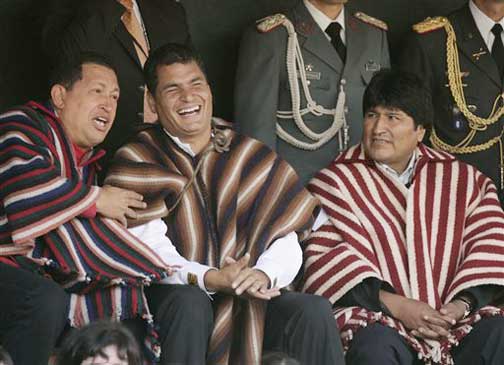
Presidents Hugo Chávez (Venezuela), Rafael Correa (Ecuador) and Evo Morales (Bolivia).


Claudio Katz.
Claudio Katz interviewed by Fernando Arellano Ortiz. Translated by John Mage for IIRE.
July 10, 2009 -- The exit from the systemic crisis of capitalism needs to be political and "a socialist project can mature in this turbulence". So says the Argentine economist, philosopher and sociologist Claudio Katz, who also warns that the "global economic situation is very serious and is going to have to hit bottom, and now we are but in the first moment of crisis".

[This is the eleventh in a series of regular articles. Click HERE for other articles in the series. Please return to Links regularly read the next articles in the series.]
By Marta Harnecker, translated by Federico Fuentes for Links International Journal of Socialist Renewal
1. I have previously argued the case for the need to create a large social bloc against neoliberalism that can unite all those affected by the system. To achieve this, it is fundamental that we create spaces that allow for the convergence of specific anti-neoliberal struggles where, safeguarding the specific characteristics of each political or social actor, common tasks can be taken up that aid in strengthening the struggle.
Luis Bilbao: The grand duel -- At the Fifth Summit of the Americas, a crucial battle is to be waged
By Luis Bilbao, translated by Gonzalo Villanueva for Links International Journal of Socialist Renewal.
Atilio Borón: From infinite war to infinite crisis

By Atilio Borón[*], translated by Machetera, Scott Campbell, Christine Lewis Carroll and Manuel Talens
March 25, 2009 -- Machetera/Tlaxcala -- Some thoughts on the current capitalist crisis, its probable “solutions” and the role that a socialist option might play in the present juncture.
Debemos aprender las lecciones del siglo XX para aplicarlas al comienzo del siglo XXI
Eric Toussaint
[Click HERE for the English translation]
By Eric Toussaint, translated by Federico Fuentes for Links International Journal of Socialist Renewal
Argentina: Winners and losers of the agricultural conflict
* * *
Latin America's struggle for integration and independence
Caracas, July 26, 2008 -- Commenting on how much the two had in common — same age, three children, similar music tastes — Ecuadorian President Rafael Correa said to Mexican President Felipe Calderon on April 11 that “perhaps we represent the new generation of leaders in Latin America”. He added, however, that one difference still remained: Calderon had still not become a socialist. “Being right wing is out of fashion in Latin America … Join us, you are always welcome.”
The election of Fernando Lugo as Paraguayan president seems to confirm the idea of a new fashion for presidents. The former priest joins the ranks of current Latin American presidents that includes two women (Cristina Fernandez de Kirchner in Argentina and Michelle Bachelet in Chile), an indigenous person (Evo Morales in Bolivia), a former militant trade unionist (Lula da Silva in Brazil), a radically minded economist (Rafael Correa in Ecuador), a doctor (Tabare Vasquez in Uruguay), a former guerrilla fighter (Daniel Ortega in Nicaragua) and a former rebel soldier (Hugo Chavez in Venezuela).