Colombia
PDF version of Marta Harnecker's: 'Instruments for doing politics'

September 8, 2013 – Links International Journal of Socialist Renewal – This is the PDF versi
New pamphlet by Marta Harnecker: 'Instruments for doing politics'
The above series of videos in Spanish by Marta Harnecker are what the pamphlet below is based o
`Foro Social Latinamericano', June 2013 issue: Green Left Weekly's Spanish-language supplement

[Haga clic aquí para más artículos en español.]
June 16, 2013 -- Links International Journal of Socialist Renewal -- Providing facts and analysis, and publicising and organising Latin America solidarity activities in Australia, Green Left Weekly and Links International Journal of Socialist Renewal has sought to promote greater understanding and solidarity between the people of Australia and Latin America.
We are therefore delighted to publish Latin America Social Forum (Foro Social Latinamericano), a Spanish-language supplement produced regularly by the Latin America Social Forum in Sydney.
`Foro Social Latinamericano', May 2013 issue: Green Left Weekly's Spanish-language supplement

Guatemalans remember the genocide conducted by the US-backed dictatorship. The issue is highlighted in the latest edition of Foro Social Latinamerico.
May 7, 2013 -- Links International Journal of Socialist Renewal -- Providing facts and analysis, and publicising and organising Latin America solidarity activities in Australia, Green Left Weekly and Links International Journal of Socialist Renewal has sought to promote greater understanding and solidarity between the people of Australia and Latin America.
We are therefore delighted to publish Latin America Social Forum (Foro Social Latinamericano), a Spanish-language supplement produced regularly by the Latin America Social Forum in Sydney.
We hope the supplement will help build stronger links and solidarity between the Spanish-speaking communities in Australia and all those involved in the urgent struggles for the people and the planet. In the words of Venezuela’s late president Hugo Chavez: “Time is short. If we don’t change the world now, there may be no 22nd century.”

Colombia peace talks: Interview with FARC leader Timoleon Jimenez (Timochenko)

Timoleon Jimenez (Timochenko).
Colombia: What prospects for the peace negotiations between FARC and government?

Revolutionary Armed Forces of Colombia (FARC) fighters walk in San Isidro, Colombia, May 30.
See also "Colombia: The end for guerrilla warfare?" For more coverage of Colombia, click HERE.
By Anthony Boynton, Bogota
September 12, 2012 – Links International Journal of Socialist Renewal -- The government of Colombia on September 4 announced that it had begun peace negotiations with the Fuerzas Armadas Revolucionarios de Colombia (FARC, Revolutionary Armed Forces of Colombia). The news was quickly confirmed by the FARC. Although FARC still leads thousands of armed fighters and has the financial resources to continue fighting, the decimation of its leadership combined with its political isolation has brought it to the point of no return. It has entered a new peace process with the government of Juan Manuel Santos with far less than it had to bargain with when it sat down at the negotiating table with the government of Andres Pastrana more than a decade ago.

Colombia: The end for guerrilla warfare?
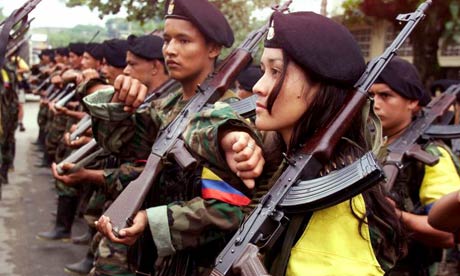
FARC guerillas.
[For more discussion on Colombia, click HERE.]
By Anthony Boynton, Bogotá, Colombia
March 25, 2012 – Links International Journal of Socialist Renewal -- As long as there are sleepy, oppressed, oppressive and isolated villages connected to a city somewhere over the hill by an unpaved road with bridges that might wash out in the next storm, guerrilla warfare will be possible. But those villages are fast disappearing into memory as the extension of electric grids and networks of paved roads extend into every corner of what used to be called the Third World.

The population of Bogotá, capital of Colombia, is about to pass 8 million.
By Anthony Boynton, Bogotá, Colombia
December 26, 2011 – Links International Journal of Socialist Renewal -- It may not be the mother of all bubbles, but it is a whopper. Colombia’s economy is rising as fast as a hot air balloon, but one that is almost certain to burst. Mining, petroleum, industrial agriculture and construction are all growing at record rates – fueled by a flood tide of investment, much of it foreign investment – directed by the World Bank and its local allies within the government of President Juan Manuel Santos, and made possible by the dispossession of millions of Colombians from the countryside through decades of violence combined with disastrous flooding caused by global warming.
Colombian cities have being growing as fast as any in the world. There are now more than 25 cities with populations of more than 200,000, at least five cities with more than 1 million people, three with more than 2 million; Bogotá the capital is about to pass 8 million.
Latin America: Summit in Venezuela opens 'new phase in history'

By Federico Fuentes
December 3, 2011 -- Green Left Weekly/Links International Journal of Socialist Renewal -- A summit of huge importance was held in Venezuela on December 2-3, 2011. Two hundred years after Latin America’s independence fighters first raised the battle cry for a united Latin America, 33 heads of state from across the region came together to form the Community of Latin American and Caribbean States (CELAC).
For Latin America, the summit represented a further step away from its traditional role as the United States’ backyard and its emergence as a player in its own right in international politics.
The importance of this new institution in world politics cannot be overstated. The combined gross domestic product of the countries within CELAC make it the third-largest economic powerhouse in the world. It is also home to the world’s largest oil reserves and the first and third largest global producers of food and energy, respectively.
Colombia: The mass movement re-emerges

By Anthony Boynton, Bogotá, Colombia