Germany
The role of the united-front tactic
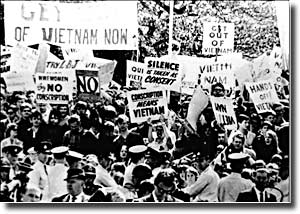
Australian protest against the US war on Vietnam.

Germany: Red Pepper interviews new Die Linke co-leader Katja Kipping

Emma Dowling speaks to Katja Kipping, new co-chair of Germany's Left Party (Die Linke)
November 2012 -- Red Pepper -- With 76 seats out of 622 in parliament, Die Linke is Germany’s fourth-largest party. It was founded in 2007 in a merger between the Party of Democratic Socialism (PDS) and the Electoral Alternative for Labour and Social Justice (WASG). Members of the PDS were predominantly East German and many had also been members of the Socialist Unity Party, the former ruling party of East Germany. WASG, meanwhile, was predominantly West German and made up of trade unionists and social movement activists, as well as social democrats who had left the German Social Democratic Party.

John Riddell: Lars Lih and Ben Lewis reveal Zinoviev at his best

Zinoviev and Martov: Head to Head in Halle
Edited by Ben Lewis and Lars T. Lih,
Tariq Ali: The rotten heart of Europe (video)
May 15, 2012 – Tariq Ali's keynote lecture on the state of Europe presented at the annual
Greece: 'For an anti-austerity government of the left'

By Socialist Resistance (Britain)

How revolutionaries of Lenin’s time resisted austerity

Towards the end of 1921, an attempt was made to shift the burden of debt to the working class through higher sales taxes. The German Communist Party opposed this, demanding instead an increase in the tax on wealth and the seizure of assets.
Introduction by John Riddell
April 26, 2012 -- Links International Journal of Socialist Renewal/johnriddell.wordpress.com -- Economic collapse drives workers into hunger and destitution. Foreign powers extort huge payments, forcing the national economy toward bankruptcy. The government forces workers to pay the costs of capitalist crisis.
This description of Greece in 2012 applies equally to Germany in 1921.
How should a workers’ party respond to such a breakdown? The proposals of the German Communist Party (KPD) included a simple approach to fiscal policy: tax those who own the country’s productive wealth.
The KPD was then a member of the Communist International, whose leadership included V.I. Lenin, Leon Trotsky and Gregory Zinoviev.
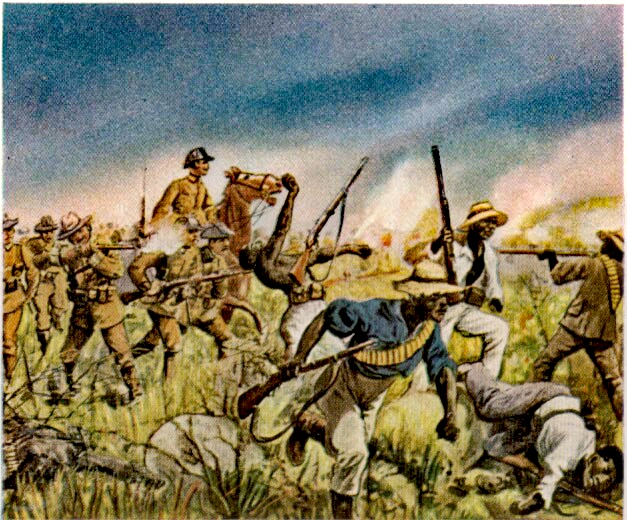
German troops kill the Herero, circa 1904. Painting by Richard Knötel (1857-1914).
Africa's Pambazuka News has devoted an entire issue to Germany's 1904-08 genocide of the Nama and Herero peoples (in Namibia). Below Links International Journal of Socialist Renewal posts the editorial and an article that details this shameful imperialist slaughter and modern Germany's refusal to adequately acknowledge and compensate Namibia for its crimes. Read the full issue HERE. Become a Friend of Pambazuka.]
* * *
By Eric Van Grasdorff, Nicolai Röschert and Firoze Manji
March 20, 2012 -- Pambazuka News -- On March 22, 2012, Germany's parliament will debate a motion to acknowledge its brutal 1904-08 genocide of the Nama and Herero peoples. Germany’s refusal thus far, and its less than even ‘diplomatic’ treatment in 2011 of the Namibian delegation at the first-ever return of the mortal remains of genocide victims, demands a reassessment of suppressed colonial histories and racism.
Un debate de actualidad: Gobierno de trabajadores y transición al socialismo
Por John Riddell
A ‘workers’ government’ as a step toward socialism

Soviet poster dedicated to the fifth anniversary of the October Revolution and Fourth Congress of the Co