Latin America
Cuba -- How the workers and peasants made the revolution

July 26, 2009, marks the 56th anniversary of the guerrilla attack on the Moncada military barracks by revolutionaries led by Fidel Castro in 1953, viewed by Cubans as the start of the revolution. 2009 is also the 50th anniversary year of the triumph of the Cuban Revolution.
Chris Slee, author of Cuba: How the Workers & Peasants Made the Revolution (Resistance Books, 2008), explains how the revolution was made and defended by Cuba’s working people.
[For more coverage of the 50th anniversary of the Cuban Revolution, click HERE.]
* * *
Workers, peasants and students played an active role before, during and after the insurrection that destroyed the brutal and corrupt US-backed Fulgencio Batista dictatorship in January 1959. Batista seized power in a coup in March 1952.
Honduras: Defying regime, Zelaya attempts return; Interview with President Manuel `Mel' Zelaya
By Felipe Stuart Cournoyer
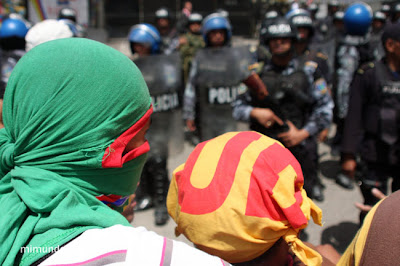
Update, July 24, 2009 -- Today, Honduras has been totally paralysed by a general strike, and Honduran resistance activists and protesters are chanting.
Zelaya - get used to it. The people are rising up
(it rhymes in Spanish).
Also common is the resistenCia, resistenCia, resistenCia, el pueblo unido jamas sera vencido (people united will never be overcome) and so on...
This afternoon Zelaya crossed over the frontier at Las Manos north of Esteli. He stood technically just inside Honduran territory, having crossed the chain separating the two countries in the "neutral" strip between them. Zelaya remained there for about two hours, hoping to meet up with members of his family and others who were trying to join him.
Raúl Prada Alcoreza: Analysis of Bolivia's New Political Constitution of the State
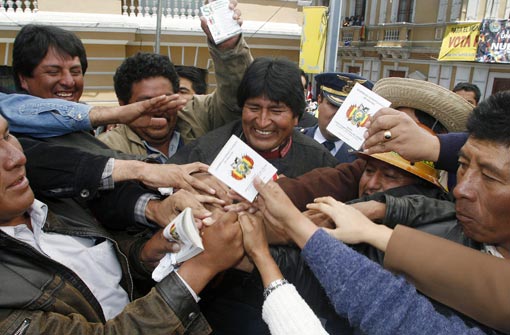
Bolivians celebrate their new constitution. President Evo Morales in centre.
The following article by Raúl Prada Alcoreza was originally published in the first issue (June 2008) of Crítica y Emancipación, a biannual Latin American journal of the social sciences. This translation from the Spanish, by Shana Yael Shubs and Ruth Felder, was published this year in a complete English-language version of the journal’s first issue. It was distributed at the recent congress of the Latin American Studies Association, held in Rio de Janeiro, Brazil, in June. A review of the first issue of Crítica y Emancipación was published at http://tinyurl.com/nuk4jp. This article also appeared at Bolivia Rising.
Melbourne, August 28-29: Latin America Solidarity Conference 2009
[Translators' note: The following editorials come from Marea Socialista (Socialist Tide), a magazine published by an organised tendency of the same name within Venezuela's United Socialist Party (PSUV), headed by Hugo Chávez.]
Marea
Socialista editorial, issue 20,
July 12, 2009. Translated by Sean
Seymour-Jones for Links International Journal of Socialist Renewal
December 1-9, 2009: Join the solidarity brigade to Venezuela and the see the revolution first hand
`Bishop of the slums' -- Dom Hélder Camara and Brazil's church of the poor

By Barry Healy
July 14, 2009 -- This year marks the centennial of the birth and the tenth anniversary of the death of one of the most significant religious figures of the 20th century, an instigator of the liberation theology trend in Latin American Catholicism and a campaigner against military dictatorship: Dom Hélder Camara.
Dom Hélder could have advanced himself to the position of cardinal and from there, who knows, possibly to the papacy itself. Instead, he stood for democracy in Brazil, despite threats to his life and certainly at the expense of his career. He represented the most extreme point that the Catholic hierarchy could go in standing with the poor in the tumultuous era following the Cuban Revolution and the Second Vatican Council (Vatican II).
Remembering Dom Hélder Camara is poignant in these times when the Vatican bureaucracy is headed by Benedict XVI, who, as Cardinal Ratzinger, oppressed the Latin American church precisely because of its identity with the poor.
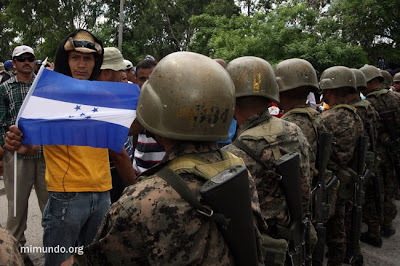
Mass people's resistance in Honduras -- In their own words
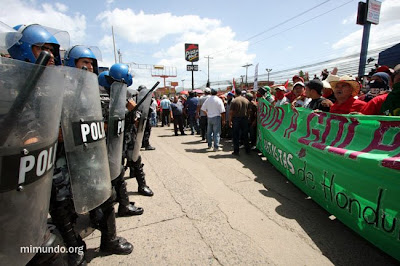
Compiled and introduced by Felipe Stuart Cournoyer
July 10, 2009 -- Most of the coverage of the military coup in Honduras from bourgeois and liberal circles, and from many Western foreign ministers, has focused on what various governments are doing to influence or force an outcome to this struggle.
Statements from Honduras' President Manuel Zelaya, his foreign minister Patricia Rodas, and from leaders of other ALBA countries (especially Venezuela's Hugo Chavez, Nicaragua's Daniel Ortega, Ecuador's Rafael Correa and Bolivia's Evo Morales) have emphasised the role of the mass movement in Honduras. So have the most astute analysts of the rapidly moving events unleashed by the coup.

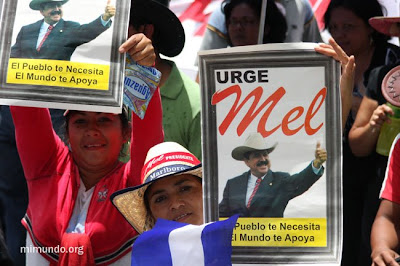
By Medea Benjamin
Tegucigalpa, July 5, 2009 -- The day started out full of joy, as thousands of Hondurans converged in front of the National Institute of Pedagogy, intent on marching about three miles to the airport to greet the plane that was supposed to bring deposed President Zelaya back to Honduras.
"Our president's coming home today, this is going to be a great day", said Jose Rodriguez, a campesino who came from Santa Barbara with his farmer's group to join the anti-coup movement. The military tried to stop them from getting to the capital, so they had to divide up and take local buses from town to town. "It took us two days to get here, and we slept outside in the forest last night, but we had to be here", said Rodriguez.