trade unions
Belgium: Class trade unionism seeks political expression

Daniel Piron, the Charleroi regional secretary of the FGTB.
Bolivia: Workers to take over closed or abandoned firms; The working class and the political process

By Richard Fidler, La Paz, Bolivia
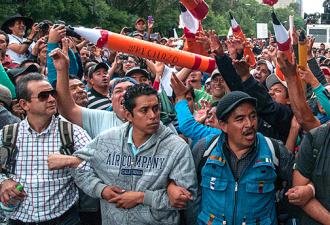
Egypt: Workers' hopes dashed after military coup

"The Egyptian Federation of Independent Trade Unions supports the demands of the people's revolution and ca
Russia: Moscow workers confront bosses over Metro safety
By activists of the Zashchita union, Moscow, translated by Renfrey Clarke
Lessons of the Australian Prices and Incomes Accord

Former ACTU heads Bill Kelty (left) and Simon Crean (right), and former Labor PM Bob Hawke attend the Prices and Income Accord 30-year anniversary. Photo by Renee Nowytarger. Source: The Australian.
June 1, 2013 -- Links International Journal of Socialist Renewal --The 30th anniversary of the Prices and Incomes Accord, signed by the Australian Labor Party federal government and the Australian Council of Trade Unions, has just been celebrated by the former employers, union officials and ALP politicians of the period. At the time, and again today, this class-collaborationist "social contract" was lauded as a tremendous step forward for workers and "the economy". The reality for Australian workers was the opposite and the lessons should never be forgotten.
Below is a talk presented to the political school of the South African Municipal Workers Union -- in Durban in 2001 -- by Norm Dixon, at the time editor of Green Left Weekly and a national executive member of the Democratic Socialist Perspective (since merged into the Socialist Alliance). It is excerpted from the SAMWU Political Education Book, 2002-03.
Europe's 'lefts' and the capitalist crisis

Front de Gauche (France) leader Jean-Luc Melenchon with SYRIZA (Greece) leader Alexis Tspiras.
For more on the developments on Europe's far left, click HERE (see also the pink tabs and the end of the article)
By Francois Sabado
May 20, 2013 -- International Viewpoint -- The situation of the "lefts" in Europe cannot be understood without starting from the crisis, its multiple dimensions and its effects on the social and political field. Hitting head-on all the organisations and parties linked to the history of the workers’ movement, precipitating ruptures, it obliges political forces to recompose around new axes.