Lula’s comeback: A popular victory that marks the start of a new chapter
First published in Portuguese at Esquerda en Movimento. Translation by Federico Fuentes for LINKS International Journal of Socialist Renewal.
The greatest comeback in electoral history. What seemed impossible became inevitable on October 25, a night that will go down in history. Lula da Silva defeated the miliciano (far-right militiaman) Flávio Bolsonaro by 51.79% to 48.21% of the valid votes. A record turnout and stunning comeback that involved securing 10 million new votes and reducing abstentions and invalid votes. A rising tide of popular and democratic sentiment defeated the concerted efforts of the far right, most of the Brazilian bourgeoisie, imperialism, Big Tech, and the “coalition of backwardness” that Flávio represents. Lula’s election expressed, in a particular way, a condensed and unique form of class struggle with international implications.
It was a hard-fought, unbelievable victory that overcame powerful enemies who, in desperation, resorted to boycotts and fraud, partially suspended public transport in capitals such as Salvador and São Paulo, and sought to create a climate of uncertainty and revolt.
This statement offers our preliminary assessment, with initial considerations, to stimulate debate among activists and set out clear tasks, especially regarding the need to position the Socialism and Liberty Party (PSOL) — which has gained the support of millions — for this new and acute stage of class struggle in Brazil.
This statement offers a preliminary assessment, with initial considerations, to stimulate debate among activists and to set out the tasks ahead – above all, the need to position the PSOL, which enjoys the support of millions, for this new and acute phase of the class struggle in Brazil.
Victory of a popular and democratic uprising
Lula’s victory was a victory for the entire Brazilian people, for the democratic forces, the working class, young people, women, the Black community and the people of the Northeast; it was an expression of the fact that those “at the bottom” no longer accept the living and political conditions that the Brazilian elite seek to impose. It was a democratic victory that thwarts US President Donald Trump’s neo-colonialist rampage and serves to halt the far right’s advance, which had been securing electoral victories in the region. It shifts the balance of forces, with Trump now on the defensive and threatened with defeat in the upcoming mid-term elections, amid the major social struggles unfolding across Europe.
It combined a genuine popular uprising — centred on the youth — with a broader democratic movement in support of Lula for the second round. It was the most polarised and politicised election campaign ever, surpassing even the epic 1989 campaign. A mass movement, of a political and electoral nature, featuring diverse mass actions across Brazil’s five regions, which stands on a par with the 1963–64 mobilisation for general reforms, the 1978–79 strike movement that shook the dictatorship, the 1983–84 “Diretas Já” (Direct Elections Now) democratic and civic uprising, the 1992 “Fora Collor” (Fernando Collor de Mello Out) protests, and the June 2013 protests.
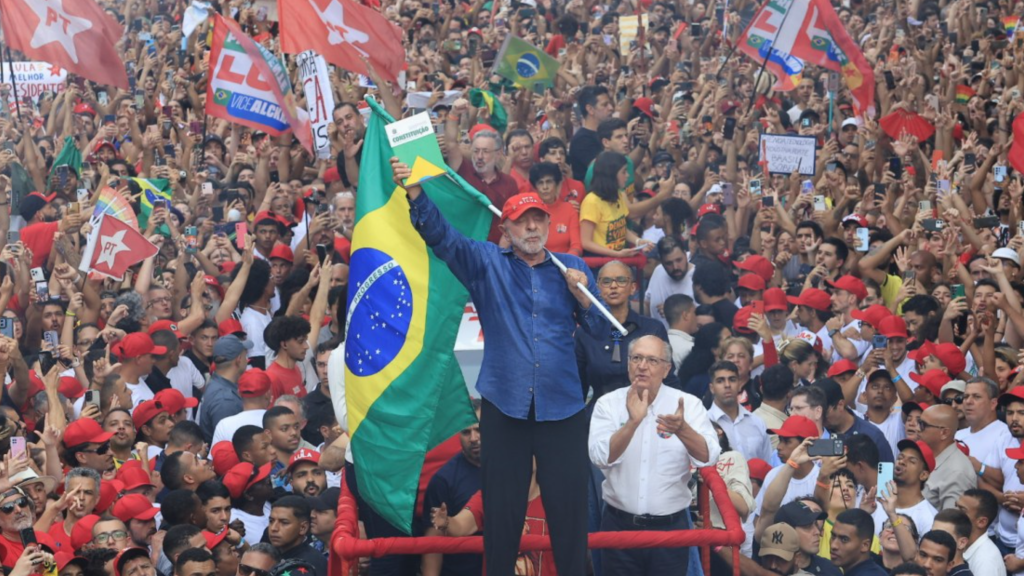
This combination was possible due to a series of factors, most notably a narrow window of opportunity that opened at the start of the second round when UFF (Fluminense Federal University) students provided the spark that ignited the mobilisation. This was further fuelled by the “whip” of Flávio’s reactionary statements, made amid the euphoria of his victory, suggesting that he could change the constitution, triggering an even greater response. From then on, the growing scale of mobilisation took an unprecedented turn, leading to the mobilisation of millions through street protests, online campaigns, activism and civic engagement. We witnessed the largest demonstrations in history, ranging from marches and election rallies to urban gatherings, culminating in the two demonstrations on Avenida Paulista that drew crowds numbering in the millions (some estimate between 1.2 and 1.5 million people). This was replicated in Brazil’s major capital cities, including Porto Alegre, Curitiba, Rio de Janeiro, Belo Horizonte, Vitória, Recife, Brasília, Belém, Teresina, Salvador, Fortaleza, Macapá, Natal and São Luís, among many others.
This mass movement expressed itself through practical demands, above all the call to end the 6x1 workweek schedule (six days on, one day off), with even Flávio Bolsonaro changing his vote in Congress. This major working class victory energised and instilled confidence in millions of people working in retail, telemarketing, fast-food restaurants and pharmacies across more than 5000 Brazilian municipalities.
The mass movement ran ahead of the leaders of the first round campaign — defeated due to erroneous forecasts and a moderate, bureaucratic line — and unleashed a new dynamic. Criticised for a lack of initiative, ineffective leadership and a shortage of resources, in practice the second round saw the start of a new campaign.
Lula, with his political acumen, was able to assess the situation and realign his strategy, stepping up his contestatory tone against Flávio, finding in young people and women his main base for mobilisation, and deepening effective measures to win over the majority of the people.
Lula's influence was central. Reflecting Brazil’s history and working class, and a key actor and statesman on the Brazilian stage, Lula reinvented himself at the age of 80 to capture the sentiment for change. He was aided by Andre Janones (Sustainability Network REDE federal deputy for Minas Gerais) with his “combat”-oriented focus, who understood the nature of the “war” being waged in the political and digital spheres, and operated as a true ‘“collective organiser” of this energy with his so-called “Exército de Lula” (Lula’s Army), fulfilling the role of a centralised digital party — the only one capable of countering the forces of Bolsonarism and Meta on social media and in public opinion.
It was the largest vote in Brazil’s history, with Lula receiving more than 64 million votes. To put this into perspective, Lula was elected in 2022 with about 60 million votes, while Jair Bolsonaro received more than 57 million in 2018. In his first successful presidential election in 2002, Lula secured almost 53 million votes, demonstrating the objective and absolute growth in the number of Brazilians voting for Lula.
Comeback possible due to mobilisation and a program
Lula’s strength and talent galvanised the political engagement of millions based on two key elements: mobilisation and championing a program to improve people’s lives.
The electoral and political struggle was tireless among young people and the elderly; the scenes of elderly people, with limited mobility, making their way to the polls were deeply moving. The result was flipped in 212 towns and cities. Notably were the distance covered and mobilisations undertaken in the Northeast; the spectacular turnaround in the Southeast where the tide turned the state of Minas Gerais and the capital, Rio de Janeiro; the incredible mobilisation in the state of São Paulo; and the comeback in swing regions such as the Porto Alegre metropolitan area (Alvorada, Esteio, Sapucaia), Osasco and the western region of São Paulo, Ribeirão das Neves, Nova Lima and others in Minas Gerais, and Ananindeua in the Belém metropolitan area. These are all testament to the scale of what took place.
Entire rural communities, quilombolas (Afro-Brazilian settlements), riverside communities and indigenous peoples turned out to vote, overcoming transport difficulties. Bus stations in the Northeast were packed from Saturday night to seal Lula’s victory.
The comeback was also made possible by the sudden realisation among millions of what it would mean if the Bolsonaro clan returned to power. Flávio embodies an anti-people elite, which attacked and slandered entire cities and regions during the televised debates, while Lula stood up and fearlessly exposed Flávio for what he is: an agent of the elite, a traitor to the nation, and a corrupt, violent figure with ties to paramilitaries. Against this “coalition of backwardness” — which involved Paulo Skaf (entrepreneur and right-wing politician), Ronaldo Caiado (landowner and right-wing politician) and other representatives of the regional oligarchies, baring the teeth of the same elite that inherited the violence of the slave-owning class — the majority of Brazilians rose up in the streets, on social media and at the ballot box.
The country’s two major political blocs came into visible confrontation. On one side stood Lula, expressing the democratic momentum of the streets, with broad support from the most politically aware sections of the working class and youth (in all their diversity); relying on minority sectors of the elites and business community, such as Geraldo Alckmin, the political representatives of the Centrão (Centre bloc) parties in the Northeast and Omar Aziz in Amazonas; as well as support from sections of the media and even non-Bolsonarist factions of the bourgeoisie, such as José Aníbal, José Sarney and others.
Flávio, on the other hand, primarily represented the core of the agribusiness sector with influence in the Central-West and North; the financial sector; the BBB bloc (Bullets, Beef and Bible or Bankers, Betting companies and Billionaires); part of the leadership of neo-Pentecostal churches; sections of the public security forces; as well as already established links with the paramilitaries in Rio de Janeiro and other states.
The program that Lula championed during this “spontaneous” campaign centred on reducing working hours, defending pay rises and pension increases, renegotiating the debts of households and small businesses, free public transport on weekends, support for investment in the SUS (Unified Health System), support for state education, the fight against gender violence, the fight against organised crime and state corruption, and, most forcefully, the issue of national sovereignty.
A turning point with international implications
The eyes of the world were on Brazil. A victory for Flávio would have bolstered Trump and Israeli Prime Minister Benjamin Netanyahu. It would have been a step towards strengthening Trump’s neo-colonialist Shield of the Americas project. The people, however, rejected Trump in an election that was also a referendum on Brazilian sovereignty. Peter Thiel, Palantir, Meta and other actors worked hard to tip the balance in favour of the far right.
The significance of Brazil’s natural resources — from its rare earths and critical minerals to its oil, water, environmental reserves, transport routes and waterways — will be central to the next round of global geopolitical contestation.
Lula’s victory puts a brake on neo-fascism and may usher in a new electoral cycle: all eyes are now on the US midterm elections, where a potential defeat for Trump could reverse the international balance of force. The efforts of Brazilian youth was a reflection of the Gen Z mobilisations across the globe, fighting for rights such as housing and education. All this against the backdrop of the largest demonstrations seen in many years in France, Albania, Portugal, Spain, Belgium and Italy, converging towards an alliance with workers in the form of potential general strikes in these countries.
The US elections point to global polarisation, with growing rejection of Trump as a despot and a sense of hope for political renewal among young people. The Democratic Socialists of America are playing a leading role in this process. The party of New York Mayor Zohran Mandami is part of the wave of “renewal” sweeping across the US, with 43% of young people declaring themselves sympathetic to “socialism”. In the face of this enormous challenge, we greatly value our relationship with the DSA, in particular with our comrades from Bread & Roses, who were present to observe the Brazilian electoral process.
Neo-fascism’s defeat in Brazil paves the way for the defence of national sovereignty and the necessary alliance between peoples, reviving the banner of Latin American unity. We must support the Argentine people in their struggle to defeat President Javier Milei, whom Flávio sought to imitate with his pathetic “austerity cuts” but who ended up demoralised by the result.
Lula’s electoral victory paves the way for new conditions in the international struggle.
The enemies of the people continue to act
This resounding popular victory paves the way for a more polarised, yet no less complex, new stage. Although the scale of the victory forced political parties and institutional authorities to promptly recognise the result — even the Bolsonarists’ arguments questioning the election outcome quickly lost credibility — pressure on the government will be considerable, whether this stems from genuine “market terrorism” — as evidenced by movements in the stock market and the dollar on the morning after the election victory — or the far right, which has entrenched itself within society and its institutions.
Even though the hard core of Bolsonarism, having been defeated, finds itself on the defensive, the role of the PL and the far right will be significant: their electoral showing in the first round was strong, achieving a record presence in both chambers of Congress, hegemony in most state governments, and a presence in the media and in shaping public opinion. We must not lose sight of the fact that the far right has mass appeal and support in Brazil, with almost half the electorate — including broad sections of the working class and middle classes — defending and voting for candidates who vocally champion a far-right agenda.
This will lead to fiercer contestation, both within society and in Congress — one that will be even more “hostile” and “anti-people” — with the Centrão playing the role of pragmatic negotiator. The PSOL parliamentary group will be in a position to push for and voice popular demands, ensuring the streets have the final say.
There will also be pressure on the government to implement fiscal austerity, precisely to cut back on the areas and demands that formed part of Lula’s central promises and commitments to change and improve people’s lives. Memory of the frustration experienced in 2015, when Dilma Rousseff implemented a plan that went contrary to what she had promised, must be kept in mind, lest it pave the way for further working class defeats.
New era, new challenges
This is still only the beginning of a new era. Lula’s mobilisation and speech at the public celebration on Avenida Paulista on the night of his victory point to a new stage in the political struggle. Lula stated that there will be more democratic channels for participation, suggesting he intends to “govern differently.” It is worth noting that Lula’s statements do not, in themselves, indicate structural changes, which we must continue to fight for from the streets. Lula will be under pressure, on the one hand, from the streets and, on the other hand, from commitments made to implement austerity, as he did during his third term when prioritising a budget surplus.
We will need to fight on multiple fronts.
First, we must defend the election result and ensure that the Bolsonaro clan criminals and their direct collaborators are held to account. We must prevent any attempt at a repeat of January 8, 2023 (when Bolsonaro’s supporters attacked Brazil's federal government buildings in the capital, Brasília) by reinforcing defence of the election result and meting out exemplary punishment for any coupmongering outbursts. We must drive Bolsonarism into proscription and illegality.
Second, we must remain mobilised around the people’s most pressing demands: defence of the “second-round program”, with an emphasis on securing substantial public investment for the SUS and for education throughout Brazil — whether university, higher education institutions, or basic education; extension of free travel to the entire public transport network; a real reduction in working hours and enshrining rights for the entire working class, whether through wage rises or adjustments to pensions and social benefits; the abolition of BETS (online betting houses) and increased taxes on billionaires; an effective debt relief program for millions of working people; investment to put an end to femicides; and an emergency plan to tackle climate disasters, among other measures. To this end, we must draw on the strength of the youth as the vanguard, while broadening our base to include the large section of the working class that voted for Flávio for a variety of reasons — a section we must engage with to reconnect them with class consciousness and a democratic, collective outlook.
Third, we must seize this window of opportunity to build a different model for Brazil — a sovereign country capable of achieving an energy and environmental transition, guaranteeing digital and technological sovereignty, and pursuing a different kind of industrialisation that breaks with the agro-export model, marking a genuine leap forward in the genuine sense of the Brazilian “nation”. We need a country that makes progress in international relations by tackling the bottlenecks of extreme inequality and dependence that characterise our current model.
Fourth, we have to build grassroots tools for action, participation and awareness that can overcome the pacts of the New Republic and class conciliation, of which the Centrão’ and Daniel Vorcaro (business owner involved in numerous frauds) are illegitimate heirs. We need to defend a new model of radicalising democracy, with radical political reform, an end to parliamentary amendments and the secret budget, changes to decision-making forums, attack the privileges of the elites in the three branches of government, and new parameters for the composition and oversight of courts. This is so that society, which organised itself during the second round of the election, can have effective channels for transparency, holding elected representatives to account, managing priorities and defending rights.
These are just a few initial measures, where society needs to be mobilised and organised to achieve its demands, given the failure of the strategy of inaction and the influence of the far right in Congress and regional governments.
PSOL as a collective force in the battle for the future
We need to position PSOL in this context. Our role must be to champion the people’s demands, affirming that only with the people on the streets will we be able to assert our rights. It is only on the streets that we can achieve victories and shift the balance of forces. We can draw on the example of the second round to remain mobilised. This is the central challenge.
Faced with this enormous battle, PSOL positioned itself at the forefront of the struggle. During the 21 intense days of the second round, our activists, leading members and parliamentarians worked tirelessly, acting in a united front manner with other movements and parties to support and organise the social energy sparked by the youth that took centre stage.
We received thousands of applications for membership from all over the country, with our leaders being warmly recognised for their fighting spirit and desire for political renewal — a sentiment already expressed by the electorate in the first round vote.
PSOL is fighting to remove the electoral threshold, an anti-democratic measure that seeks to restrict the activities of ideological parties and runs counter to the will of the people on the streets, who want to expand popular participation. There are millions who support us and bear witness to the fact that “PSOL is a necessary party”, because of its role in society, its program, its commitment to collective strength and its vision for the future. A party that affirms its core principles centred on: the centrality of the working class in all its many facets, defence of democratic and social rights, and an eco-socialist strategy.
PSOL’s difficulties are not limited to the draconian problem of the electoral threshold. The party needs to move beyond its federative and disorganised structure to forge syntheses and build a leadership capable of engaging with sectors of the mass movement.
We, as the Socialist Left Movement (MES), are aware of PSOL’s political, programmatic and leadership difficulties — difficulties which are also our own. One of the greatest difficulties, however, is reconnecting with and strengthening the organisational capacity of the mass movement, through a return to grassroots work, politicisation and the training of cadres. We will continue to emphasise the dialectic between the unity required to confront the far right and building a critical, anti-capitalist and radical pole to organise the most militant sectors of the mass movement in the face of the enormous struggles we face and those yet to come.
We stand for the defence of Socialism and Liberty, for the united front against neofascism, for the centrality of the streets and extra-parliamentary struggle independent of the bourgeoisie and the Centrão. We defend ecosocialism as a means of pulling the emergency brake in the face of the catastrophe into which the billionaires wish to plunge humanity. We want to organise thousands of new activists under these banners and in the struggle for a transitional program towards a fairer and more egalitarian Brazil.