Palestine
BDS: The global struggle for Palestinian rights (video)
July 21, 2011 – Wearemany.org – Omar Bargho
Western economic attacks against Arab democracy

By Patrick Bond
June 1, 2011-- Rosa Luxemburg Foundation Palestine office, posted at Links International Journal of Socialist Renewal with permission -- In their latest documents and meetings, the G8, the World Bank and the International Monetary Fund (IMF) reacted to the democratic movements in the Arab world: The recipe calls – as it did before the popular ousting of the Tunisian and Egyptian presidents – for privatisation, austerity measures and “market liberation”. Patrick Bond, economic advisor to the new South African government from 1994-2002, analyses the ramifications of the economic campaign on Tunisia, Egypt, Libya and Palestine.
Washington’s seeding of the Arab democratic revolution
Middle East: Can democracy activists undo US and IMF/World Bank damage?
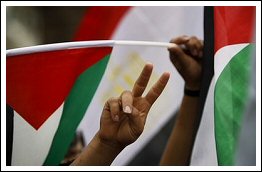
By Patrick Bond, Palestine
May 23, 2011 -- Links International Journal of Socialist Renewal -- Here in Palestine, disgust expressed by civil society reformers about US President Barack Obama’s May 19 policy speech on the Middle East and North Africa confirms that political reconciliation between Washington and fast-rising Arab democrats is impossible.
Amidst many examples, consider the longstanding US tradition of blind, self-destructive support for Israel, which Obama has just amplified. Recognisng a so-called “Jewish state” as a matter of US policy, he introduced a new twist that denies foundational democratic rights for 1.4 million Palestinians living within Israel. For a Harvard-trained constitutional lawyer to sink so low on behalf of Zionist discrimination is shocking.
For although Obama mentioned the “1967 lines” as the basis for two states and thereby appeared to annoy arch-Zionist leader Benjamin Netanyahu, this minimalist United Nations position was amended with a huge caveat: “with land swaps.”
Australia: Greens' BDS stance widens debate over boycott of Israel's apartheid
By Pip Hinman and Peter Boyle
May 18, 2011 -- Links International Journal of Socialist Renewal -- Samah Sabawi, from Australians for Palestine, addressed a May 13, 2011, community forum in Holy Trinity Church Hall, Dulwich Hill, a suburb in Sydney, which was called by local residents to discuss the controversy (incited by Rupert Murdoch's News Ltd media empire) around a December 2010 decision by Marrickville Council to support the global boycott, divestment and sanctions (BDS) campaign against Israel's apartheid. Samah is introduced by Father Dave Smith, the local Anglican parish priest.
Samah Sabawi, part 2
Former Greens parliamentarian Sylvia Hale dissected the NSW Greens' stand in support of BDS and the struggle around the Marrickville Council position.
Documentary: Al Nakba: The Palestinian Catastrophe 1948
Al Nakba: The Palestinian Catastrophe 1948 by Benny Brunner and Alexandra Jansse on Vimeo.
Al Nakba: The Palestinian Catastrophe 1948 (58 minutes, documentary, Israel-Germany-The Netherlands, 1997). Arguably the first film that seriously tackles the historic events that led to the creation of 750,000+ Palestinian refugees at the end of 1948. Based on historian Benny Morris' book, The birth of the Palestinian refugee problem, 1947-49.
Produced and directed for ARTE by Benny Brunner and Alexandra Jansse.
Israel: Histadrut unmoved by Arab winds of change
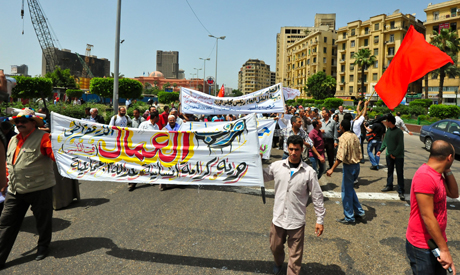
Members of the Workers Democratic Party march through Tahrir Square on May Day, 2011. Photo by Mohamed El Hebeishy/ahramonline.

South Africans march against Israeli apartheid (image from bdsmovement.net).
By Patrick Bond
A presentation to the Association of American Geographers Annual Meetings, Seattle, Washington, April 12, 2011. Posted at Links International Journal of Socialist Renewal with Patrick Bond’s permission.
This panel is not only devoted to considering arguments about implementing the call for boycott, divestment and sanctions (BDS) against Israel, but also about broader problems of progressive political positioning and backlash in the academy.

Australia: Murdoch press demonises Greens over support for Palestinian rights

Racist vandalism of Greens’ election campaign billboards, Sydney. Photo: Peter Boyle.
By Samah Sabawi
April 10, 2011 -- Green Left Weekly -- While Palestinian, Israeli and international non-violent protesters who march against Israel’s policies in the Occupied Territories are literally showered in sewage, beaten, arbitrarily arrested and sometimes killed by Israeli forces, the battle against non-violent resistance has taken its own ugly form in Australia.
Supporters of the non-violent global boycott, divestment and sanctions (BDS) movement — especially members of the Greens — have been subjected to abuse in a deliberate national campaign of misinformation and slurs orchestrated against them. It has questioned their values and integrity and falsely accused them of anti-Semitism.
The war on BDS is part of a concerted effort to sabotage Palestinian and Israeli non-violent resistance against Israel’s 43-year-old illegal occupation and its 63 years of discrimination against non-Jewish Israeli citizens.
South Africa: Victory for BDS campaign as university cuts Israel ties

University of Johannesburg terminates relationship with Israeli institution
By the Coalition for a free Palestine
March 24, 2011 -- The Congress of South African Trade Unions (COSATU) led Coalition for a free Palestine (CFP) welcomes the March 23 decision by the University of Johannesburg (UJ) to terminate its relationship with the Israeli institution, Ben Gurion University.
The termination translates into the first South African institutional boycott of an Israeli institution and is a watershed moment in the growing boycott, divestment and sanctions (BDS) of Israel campaign. This resonates with us in South Africa, as we are aware of the importance of international solidarity and realise the role that it played in dismantling South African apartheid.
Left debates Libya: `The Arab revolution must stay in Arab hands' -- a reply to Gilbert Achcar

French navy technicians load a Mica missile, destined for Libya, under the wing of a Rafale jet fighter on the deck of Charles de Gaulle aircraft carrier in the Mediterranean Sea.
[For more left views on Libya, click HERE.]
By Kevin Ovenden
March 28, 2011 -- Socialist Unity -- The Arab revolution has widened the left’s horizons. In the region itself there is now a historic possibility of a new radical politics: successful resistance to the hegemonic Western powers and to Israel fused with the movement of the young and propertyless masses against the corrupt and complicit elites.
The fall of Tunisia's Ben Ali and Egypt's Mubarak shattered decades of Western policy, rocking them onto the back foot. They are now moving onto the front foot, as the regional despots raid their political and military arsenals to cling on.